Accredited Investor Representation Letter
What is this form?
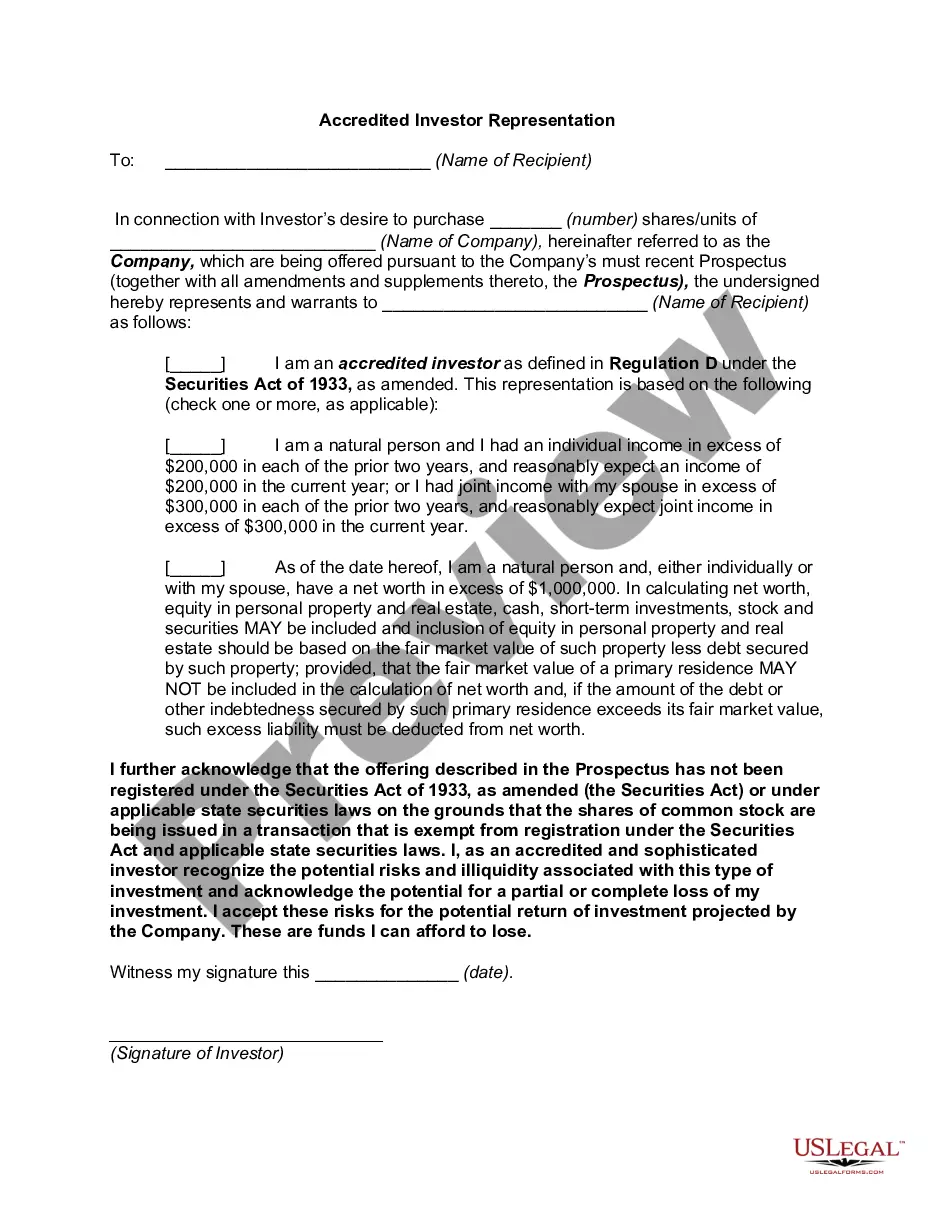
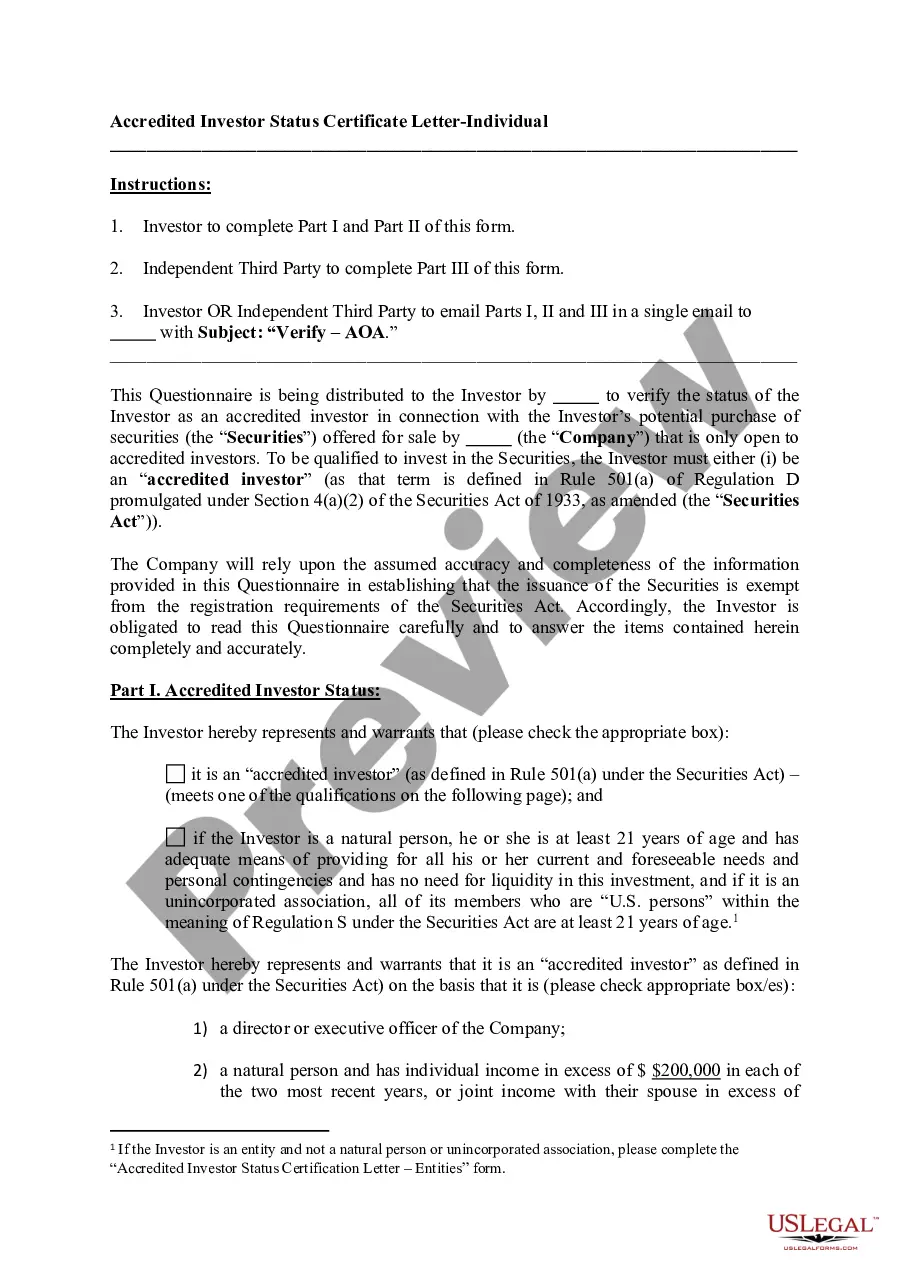
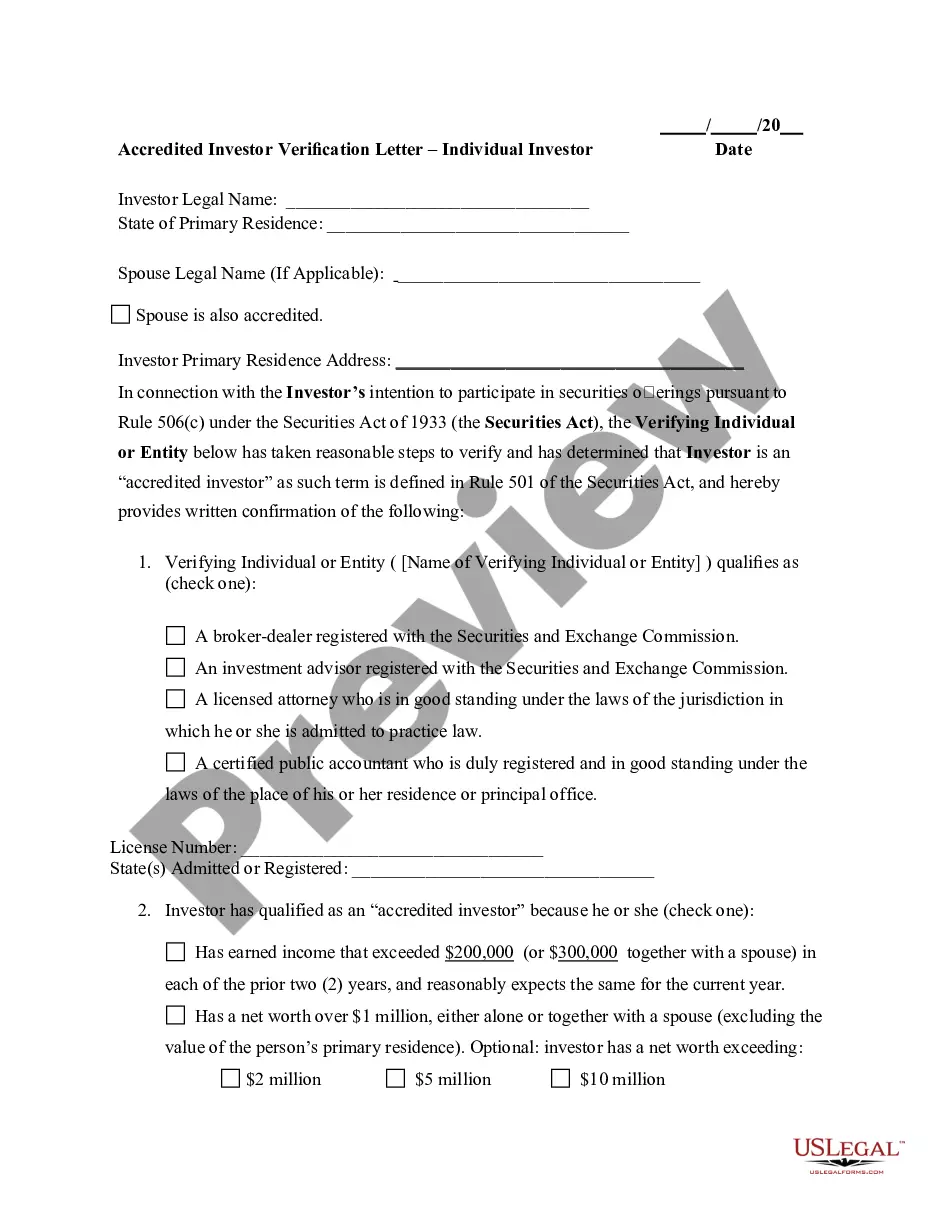
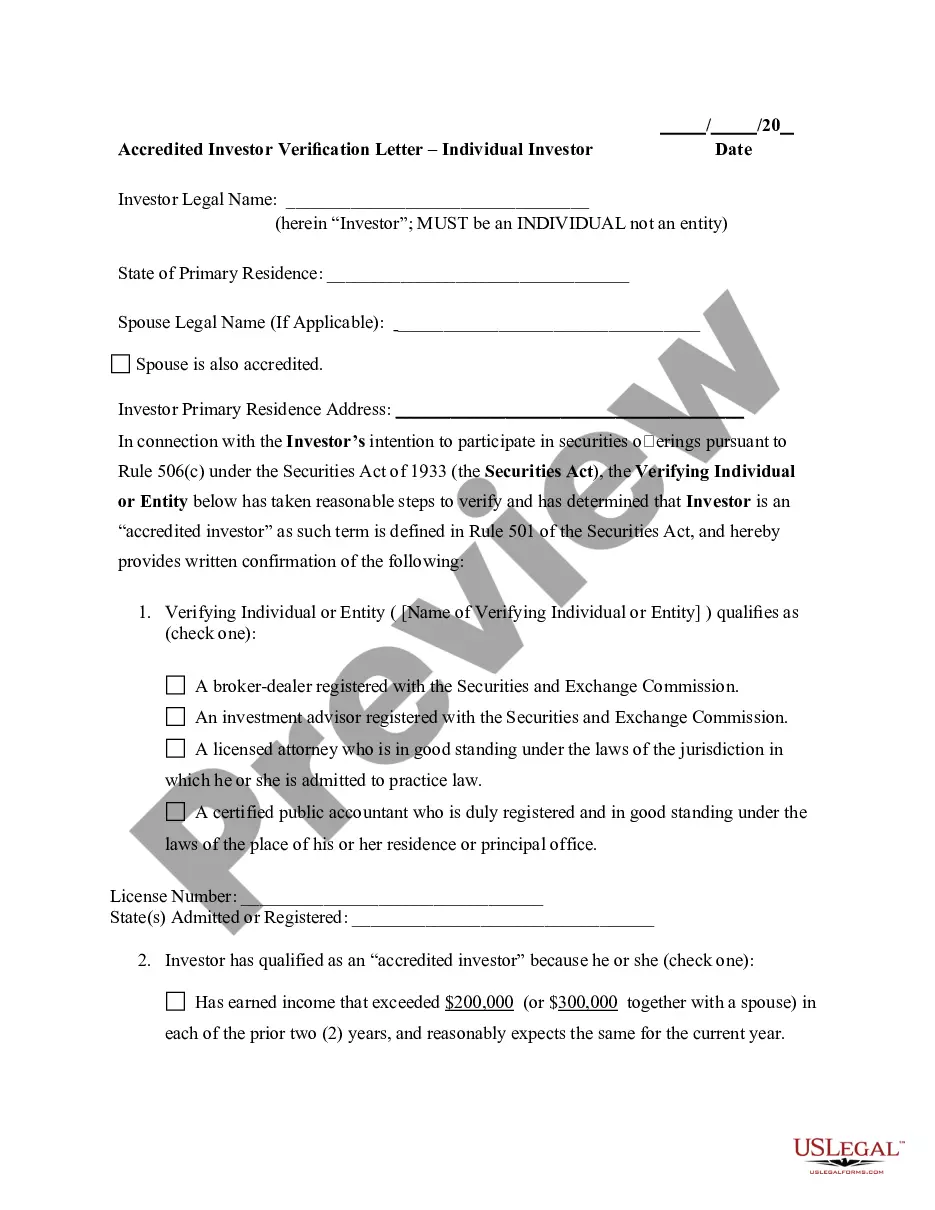
The accredited investor representation letter is a legal document used in connection with Rule 506(c) offerings. It helps issuers verify that each purchaser qualifies as an accredited investor. This form differs from other investor verification documents by specifically focusing on the criteria set forth in Regulation D under the Securities Act of 1933, ensuring compliance with federal securities laws.
Main sections of this form
- Recipient's name: A space to specify who receives the letter.
- Company details: Section to identify the company and the number of shares/units being purchased.
- Investor's accreditation status: Checkboxes for the investor's income or net worth qualification.
- Investment risk acknowledgment: A clause about the investor recognizing potential risks associated with the investment.
- Signature block: Includes spaces for investor's signature, printed name, address, and tax identification number.

When to use this form
This form is needed when an individual seeks to purchase shares or units in a company through a Rule 506(c) offering. It is particularly useful for documenting an investor's accreditation status, which is a requirement for certain private placements under securities law. Use this letter when preparing for an investment transaction to ensure compliance and protect both the investor and the issuer.
Who should use this form
- Individuals seeking to invest in private companies that issue securities under Rule 506(c).
- Investors who meet the definition of an accredited investor based on income or net worth.
- Legal and financial professionals assisting clients in investment transactions.
How to complete this form
- Identify the parties: Fill in the name of the recipient and the details of the company offering shares.
- Specify the purchase: Indicate the number of shares or units the investor intends to buy.
- Check accreditation status: Select the appropriate checkbox(es) that apply to the investor's financial status.
- Acknowledge risks: Review and accept the investment risks detailed in the form.
- Sign and print: Complete the signature block with the investorâs signature, printed name, address, and tax ID or SSN.
Does this document require notarization?
This form does not typically require notarization unless specified by local law. However, it is important to check local regulations to ensure compliance.
Get your form ready online
Our built-in tools help you complete, sign, share, and store your documents in one place.
Make edits, fill in missing information, and update formatting in US Legal Forms—just like you would in MS Word.
Download a copy, print it, send it by email, or mail it via USPS—whatever works best for your next step.
Sign and collect signatures with our SignNow integration. Send to multiple recipients, set reminders, and more. Go Premium to unlock E-Sign.
If this form requires notarization, complete it online through a secure video call—no need to meet a notary in person or wait for an appointment.
We protect your documents and personal data by following strict security and privacy standards.

Make edits, fill in missing information, and update formatting in US Legal Forms—just like you would in MS Word.

Download a copy, print it, send it by email, or mail it via USPS—whatever works best for your next step.

Sign and collect signatures with our SignNow integration. Send to multiple recipients, set reminders, and more. Go Premium to unlock E-Sign.

If this form requires notarization, complete it online through a secure video call—no need to meet a notary in person or wait for an appointment.

We protect your documents and personal data by following strict security and privacy standards.
Common mistakes to avoid
- Failing to accurately check the accreditation status, which may lead to invalid representation.
- Not providing a complete address or tax identification number, which can cause delays.
- Overlooking the acknowledgment of investment risks, potentially leading to misunderstandings.
Advantages of online completion
- Convenience: Easily download and fill out the form from anywhere, at any time.
- Editability: Customize the document to fit specific transactions and investments.
- Reliability: Assurance that the form is drafted based on current legal standards and compliance requirements.
Looking for another form?

Form popularity
FAQ
Pros of being an accredited investor include access to unique and restricted investments, high returns, and increased diversification. Cons of being an accredited investor include high risk, high minimum investment amounts, high fees, and illiquidity of the investments.
Have certain professional certifications or designations or other credentials. Have a net worth exceeding $1 million individually or combined with a spouse or spousal equivalent (excluding value of primary residence)
You can use a third party letter to obtain an InvestReady certificate as long as the letter is no older than 90 days and it was written by a licensed attorney, CPA, investment advisor, or Broker Dealer.
Do You Have to Prove You Are an Accredited Investor? The burden of proving that you are an accredited investor does not fall directly on you but rather the investment vehicle you would like to invest in. An investment vehicle, such as a fund, would have to determine that you qualify as an accredited investor.
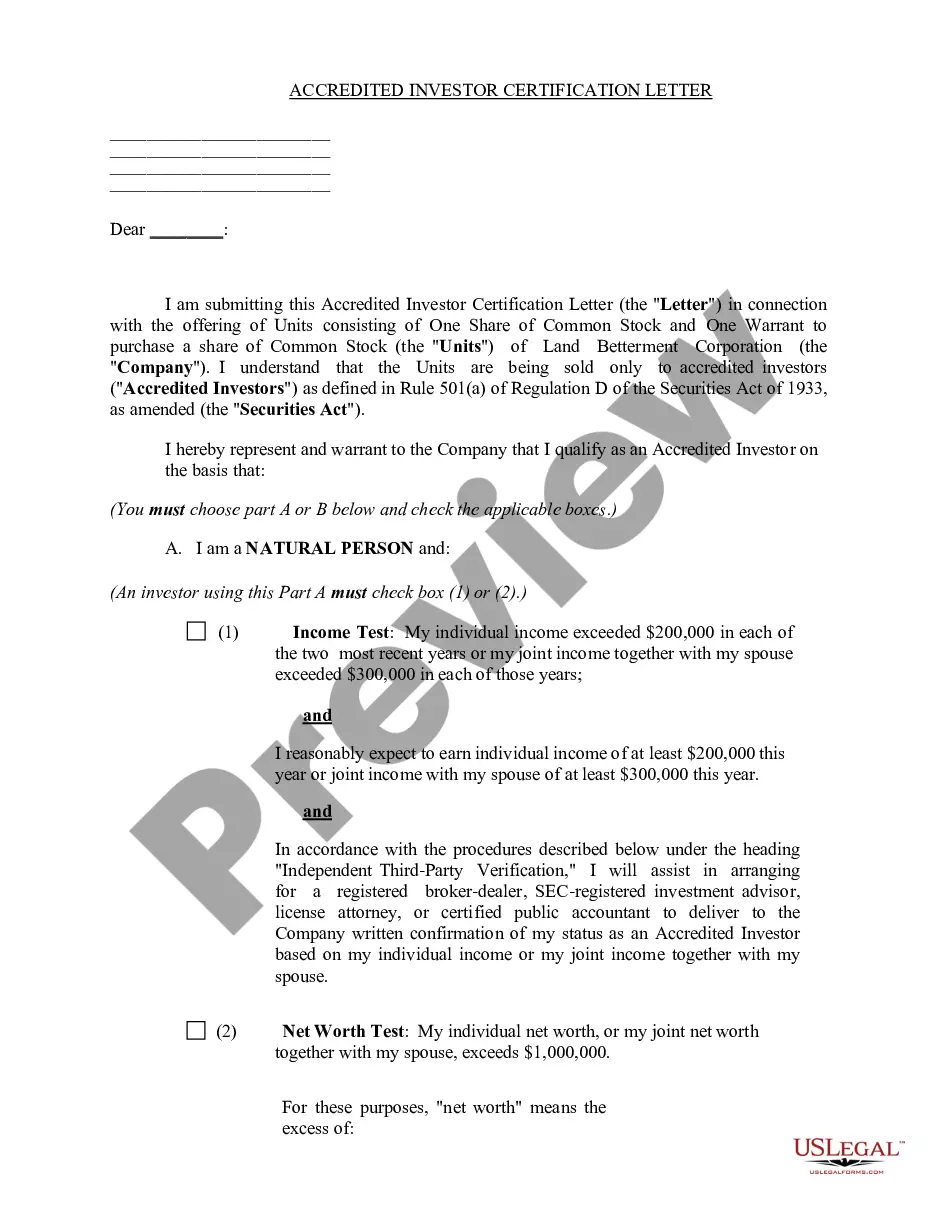
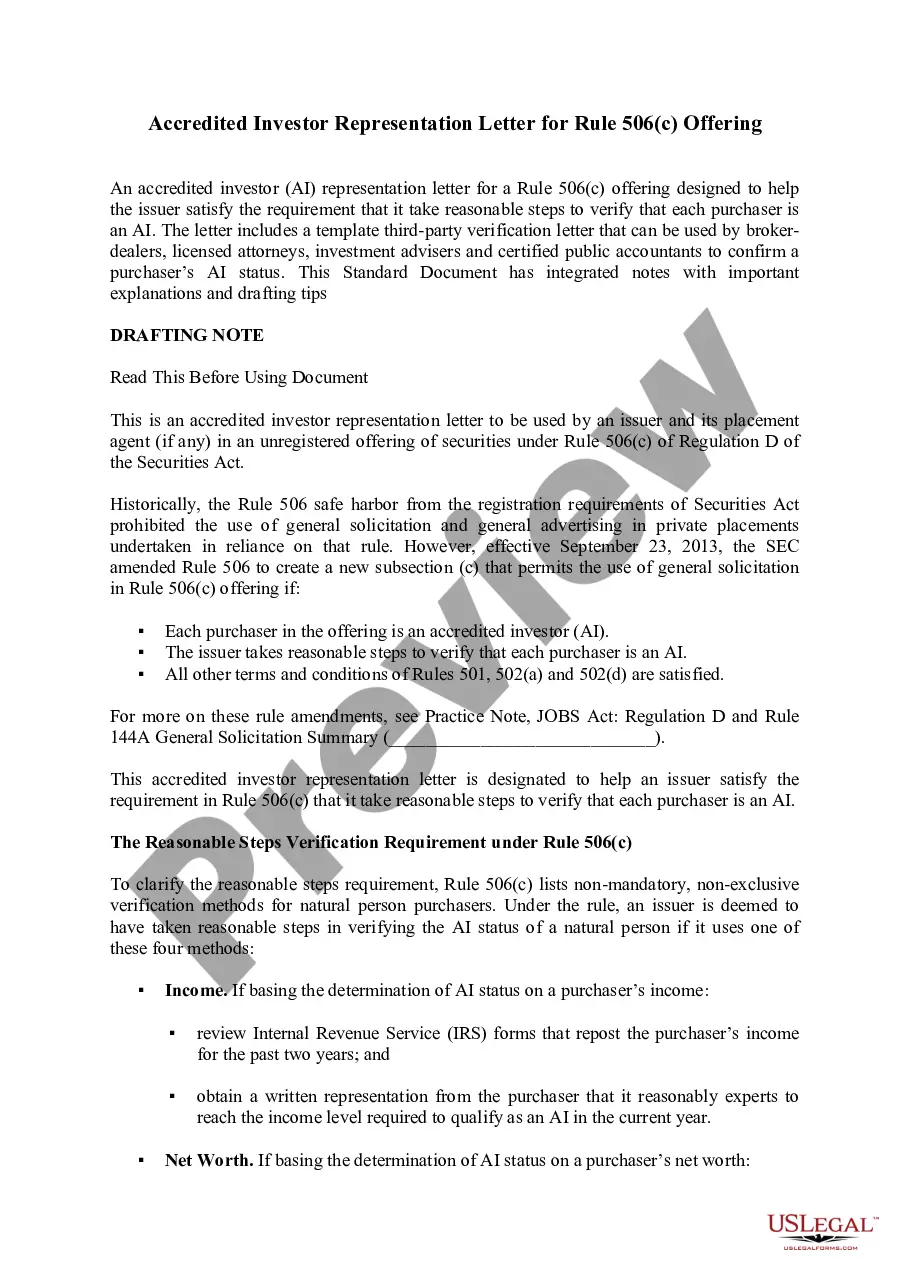
A letter to be delivered by a registered broker-dealer, registered investment adviser, licensed attorney, or certified public accountant to assist the issuer in a Rule 506(c) offering in taking the necessary "reasonable steps" to verify the accredited investor status of a prospective purchaser.
To be an accredited investor, a person must have an annual income exceeding $200,000 ($300,000 for joint income) for the last two years with the expectation of earning the same or a higher income in the current year.
If you qualify as an Accredited Investor based on net worth, you will need to provide recent account statements or third party appraisals that show the value of your assets. We will also pull your credit report and deduct any non-mortgage liabilities from the value of your assets.
With this method, a 3rd party verifies that the Investor is an Accredited Investor. The SEC specifically mentions broker dealers, registered investment advisors, attorneys, and certified public accountants. Safe harbor evidence is a letter written and signed by one of the above-mentioned professionals.