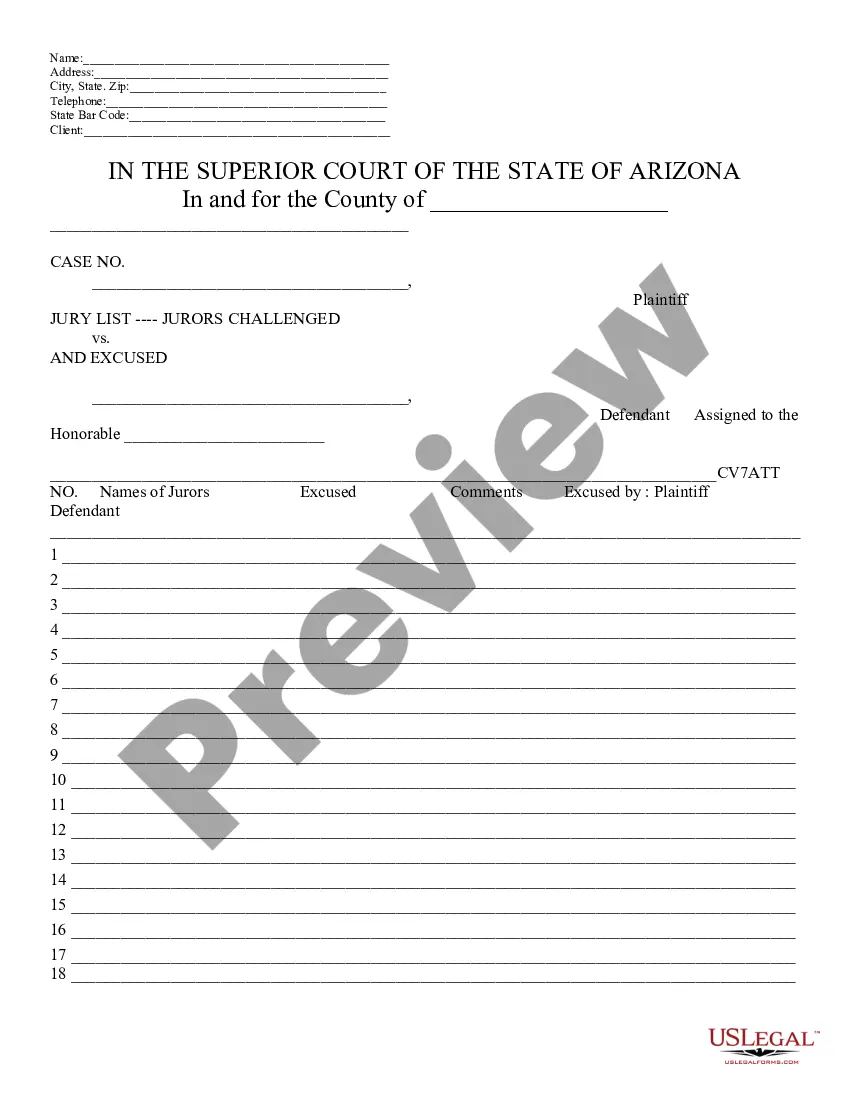
Arizona Jury List - Jurors challenged and Excused
Understanding this form
The Jury List: Jurors Challenged and Excused is a legal document used to record the names of prospective jurors during a court case. This form allows the Plaintiff or Defendant to indicate which jurors they wish to accept or excuse from serving on the jury. It is specifically important because it helps maintain the integrity of the jury selection process by ensuring that both parties have the opportunity to voice their preferences on jurors.
Form components explained
- Case information: Includes space to enter the case number and the names of both Plaintiff and Defendant.
- Juror names: A section dedicated to listing the names of prospective jurors.
- Excusal indication: Columns to note whether a juror is excused by the Plaintiff or Defendant.
- Comments: An area for additional notes about each juror's suitability or challenges raised.
- State Bar Code: Field for the attorney's state bar code, indicating legal representation.
When to use this form
This form is used during a trial when jurors are being selected. It is particularly important when either party wishes to challenge the qualification of specific jurors or acknowledges jurors they wish to keep. This situation often arises in civil or criminal cases where a jury is needed to make determinations on the matters at hand.
Who this form is for
- Attorneys representing a Plaintiff or Defendant in a trial.
- Individuals involved in legal proceedings who are participating in jury selection.
- Legal staff tasked with preparing documentation for court proceedings.
Completing this form step by step
- Enter the case information at the top of the form, including the case number and the names of the Plaintiff and Defendant.
- List the names of all prospective jurors in the designated space provided.
- Indicate whether each juror is excused by marking the appropriate column for the Plaintiff and Defendant.
- Add any comments relevant to each juror's challenge or suitability in the comments section.
- Fill in your State Bar Code and client information where indicated.
Notarization requirements for this form
Notarization is generally not required for this form. However, certain states or situations might demand it. You can complete notarization online through US Legal Forms, powered by Notarize, using a verified video call available anytime.
Get your form ready online
Our built-in tools help you complete, sign, share, and store your documents in one place.
Make edits, fill in missing information, and update formatting in US Legal Forms—just like you would in MS Word.
Download a copy, print it, send it by email, or mail it via USPS—whatever works best for your next step.
Sign and collect signatures with our SignNow integration. Send to multiple recipients, set reminders, and more. Go Premium to unlock E-Sign.
If this form requires notarization, complete it online through a secure video call—no need to meet a notary in person or wait for an appointment.
We protect your documents and personal data by following strict security and privacy standards.

Make edits, fill in missing information, and update formatting in US Legal Forms—just like you would in MS Word.

Download a copy, print it, send it by email, or mail it via USPS—whatever works best for your next step.

Sign and collect signatures with our SignNow integration. Send to multiple recipients, set reminders, and more. Go Premium to unlock E-Sign.

If this form requires notarization, complete it online through a secure video call—no need to meet a notary in person or wait for an appointment.

We protect your documents and personal data by following strict security and privacy standards.
Common mistakes to avoid
- Failing to list all prospective jurors.
- Not clearly indicating which juror is accepted or challenged.
- Leaving comments vague or unexplained.
- Missing signature or bar code from the attorney.
Advantages of online completion
- Convenience: Download and print the form at your convenience.
- Editability: Fill out the form digitally or by hand before printing.
- Reliability: Forms are created and vetted by licensed attorneys, ensuring legal compliance.
Looking for another form?
Form popularity
FAQ
You may be excused from jury duty for anxiety, or for any condition that may affect your ability to serve reliably as a juror. Receiving a doctor's note confirming your anxiety is likely the easiest way. You could also discuss your concerns with the judge privately during the juror selection process.
A judge generally should but need not consult with counsel before dismissing a juror. Jurors can be dismissed during deliberations. A judge may not hear requests and reasons for requests to be excused from members of the jury off the record and without the presence of the accused.
Economic Hardship. One of the more common reasons people are excused from jury duty is because serving on the jury presents that person with an economic hardship.Personal Opinions.Felony Conviction.Family Issues.Physical/Mental Disabilities.
If you're over 18 years old, you can be called for jury service. Some people aren't eligible for jury service or can get excused because of their job. There's no automatic exemption from jury service for being elderly. You can ask to be excluded when you're over 70.
Extreme Financial Hardship. Full-Time Student Status. Surgery/Medical Reasons. Being Elderly. Being Too Opinionated. Mental/Emotional Instability. Relation to the Case/Conflict of Interest. Line of Work.
Be an "expert" on the case at hand. Tell the judge you're not in a very good place in your life. Dig into your personal life for connections to the case. Mention your mental illness or other "sensitivities." Be a rebel. Have a crappy attitude.
Eligibility. In terms of the Jury Amendment Act 2010, you may have 'good cause' to be excused if: jury service would cause undue hardship or serious inconvenience to you or your family. you have a disability that makes you unsuitable or incapable of effectively serving as a juror, without reasonable accommodation.
Jurors must also be mentally aware enough to comprehend and apply the judge's legal instructions. Any person who doesn't meet these criteria will be dismissed for cause. Judges will also dismiss jurors who can't put aside their feelings and apply the law impartiallythat is, without actual or implied bias.
After removing a juror, the judge may grant a motion for mistrial. However, judges are generally loathe to declare a mistrial, which stops the trial without a verdict and may lead to the prosecutor to seek a new trial.