Arizona Transfer on Death Deed or TOD - Beneficiary Deed for Individual to Individual
Overview of this form
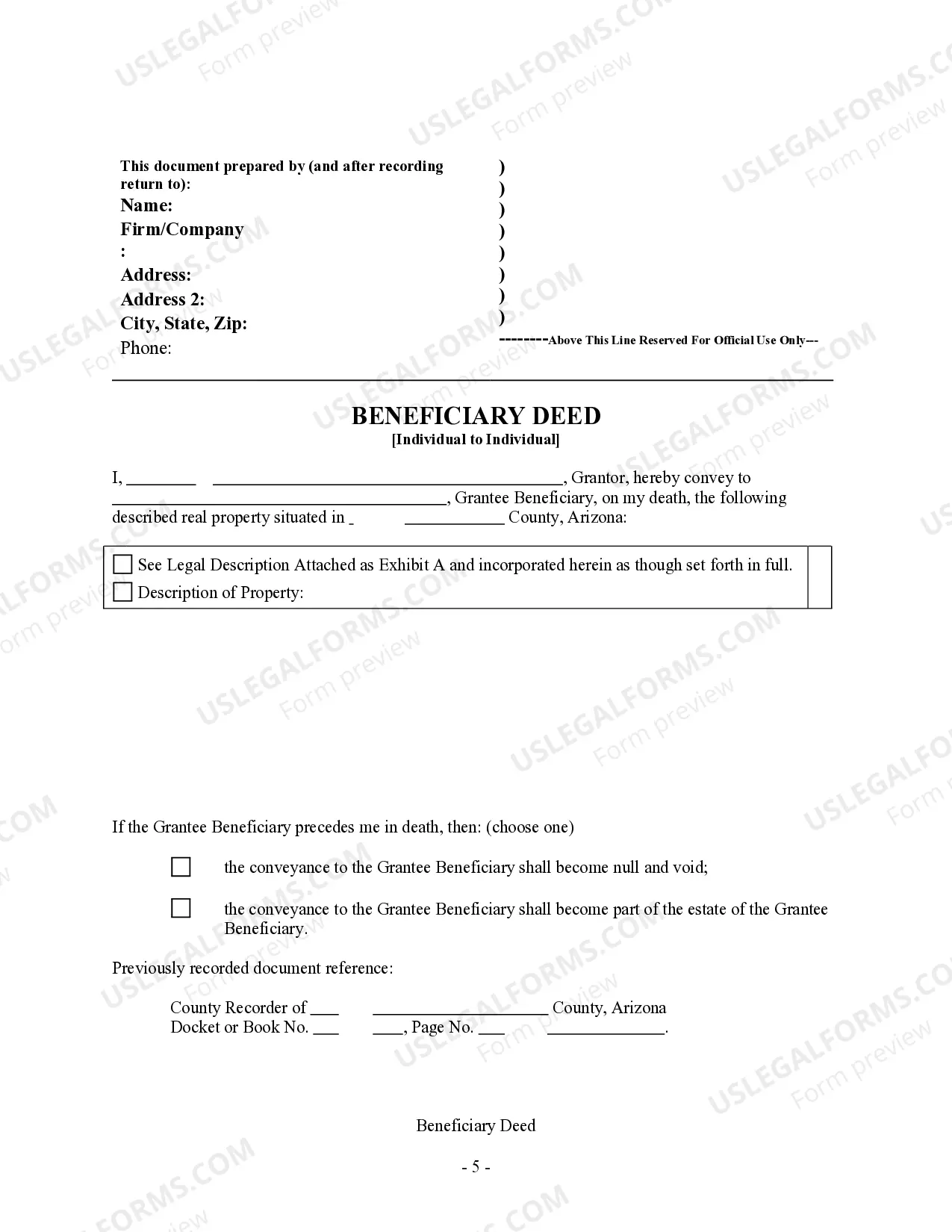
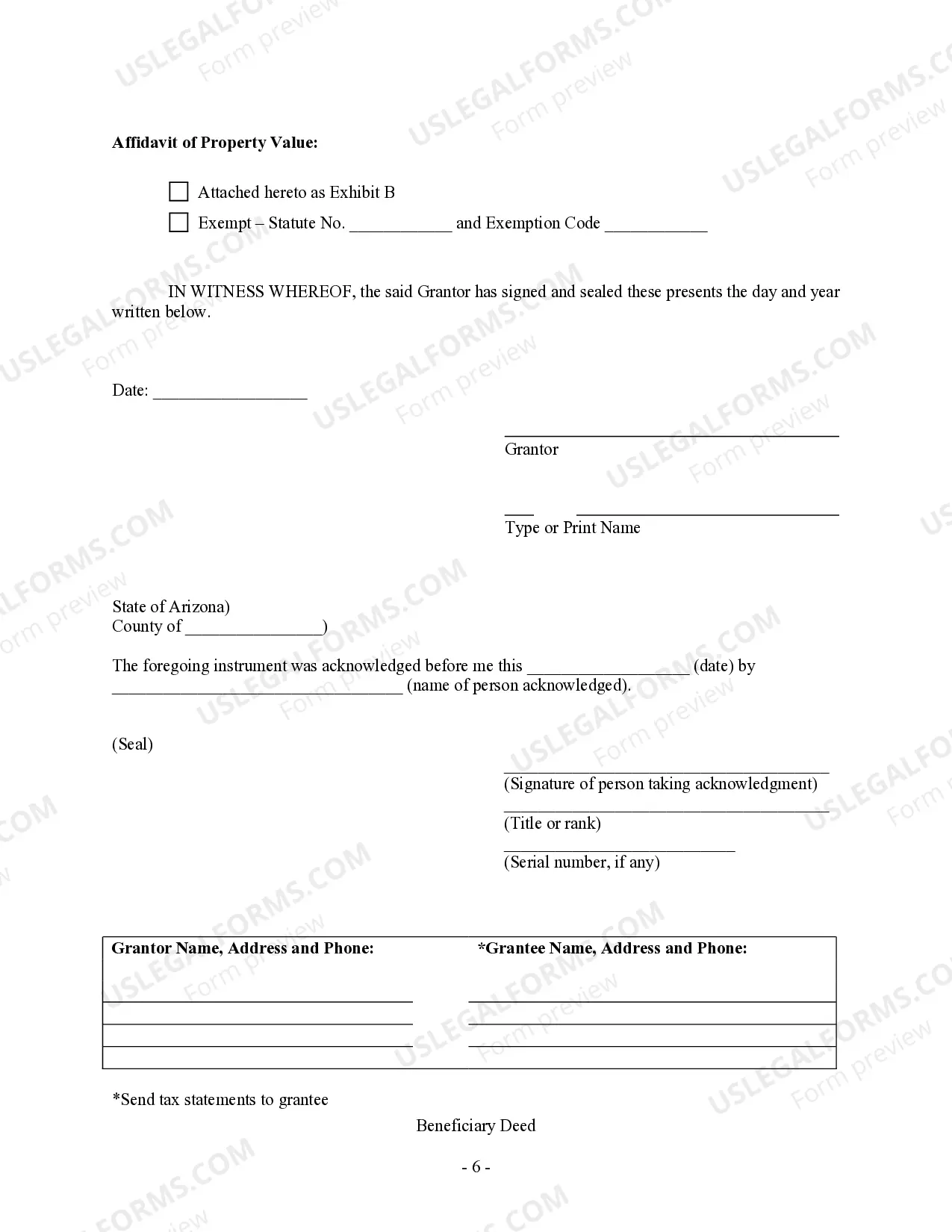
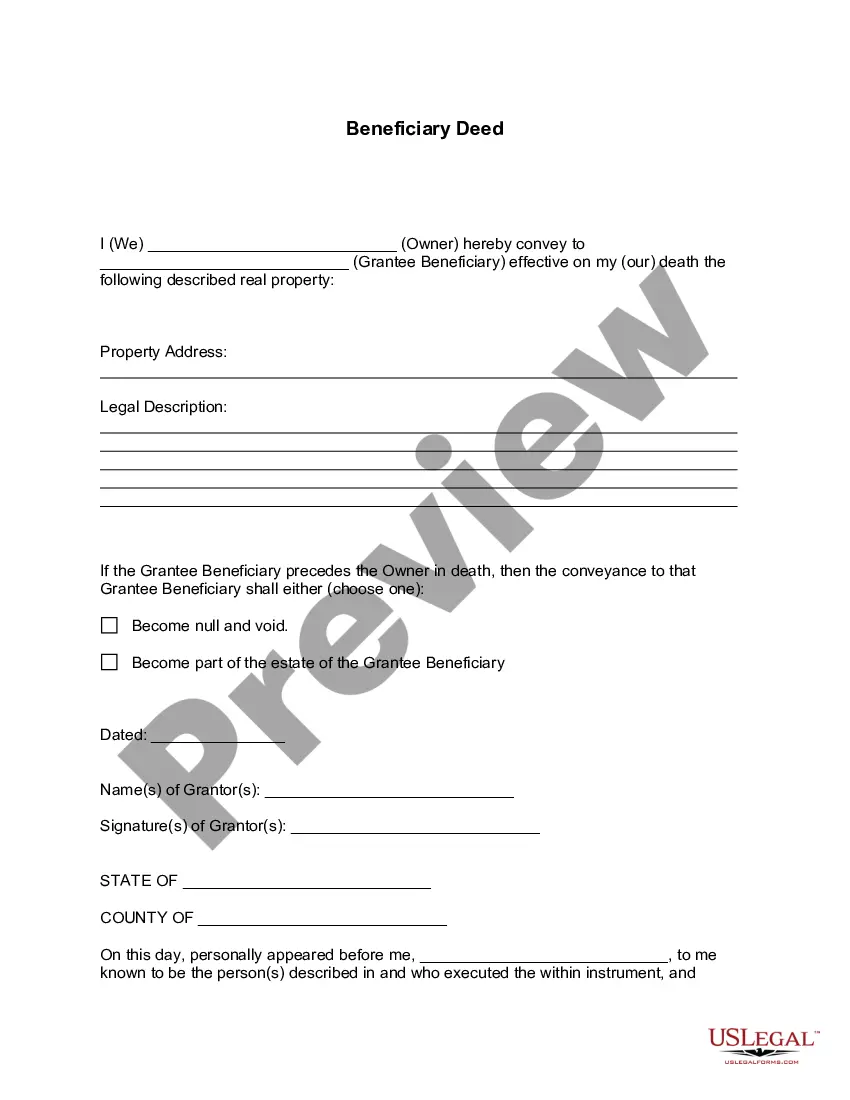
The Transfer on Death Deed (TOD) is a legal document allowing an individual (the grantor) to designate a beneficiary who will receive property upon the grantor's death. This deed is revocable during the grantor's lifetime and takes effect only after the grantor's passing. The form ensures that the transfer complies with applicable state laws, providing a streamlined way to pass on property without going through probate.
Main sections of this form
- Identification of the grantor and the beneficiary (grantee).
- Description of the property being transferred.
- Statement of revocability until the grantor's death.
- Signature sections for the grantor.
- Requirements for witnesses, if applicable.





Common use cases
This form is useful when an individual wishes to ensure their property is transferred directly to a chosen beneficiary upon their death, avoiding the lengthy and potentially costly probate process. It is typically used in estate planning when the grantor wants to maintain control over the property during their lifetime while clearly defining their wishes for after their death.
Who this form is for
This Transfer on Death Deed is suitable for:
- Individuals who own real property and want to designate a beneficiary.
- People looking to simplify the estate transfer process after death.
- Grantors who wish to retain control of their property while living.
Completing this form step by step
- Identify and enter the names of the grantor and beneficiary in the appropriate fields.
- Provide a complete description of the property being transferred.
- Specify that the transfer is revocable until the death of the grantor.
- Sign and date the form in the designated area.
- Complete any necessary witness signatures if required by state law.
Notarization requirements for this form
This form must be notarized to be legally valid. US Legal Forms provides secure online notarization powered by Notarize, allowing you to complete the process through a verified video call.
Get your form ready online
Our built-in tools help you complete, sign, share, and store your documents in one place.
Make edits, fill in missing information, and update formatting in US Legal Forms—just like you would in MS Word.
Download a copy, print it, send it by email, or mail it via USPS—whatever works best for your next step.
Sign and collect signatures with our SignNow integration. Send to multiple recipients, set reminders, and more. Go Premium to unlock E-Sign.
If this form requires notarization, complete it online through a secure video call—no need to meet a notary in person or wait for an appointment.
We protect your documents and personal data by following strict security and privacy standards.

Make edits, fill in missing information, and update formatting in US Legal Forms—just like you would in MS Word.

Download a copy, print it, send it by email, or mail it via USPS—whatever works best for your next step.

Sign and collect signatures with our SignNow integration. Send to multiple recipients, set reminders, and more. Go Premium to unlock E-Sign.

If this form requires notarization, complete it online through a secure video call—no need to meet a notary in person or wait for an appointment.

We protect your documents and personal data by following strict security and privacy standards.
Common mistakes to avoid
- Failing to sign and date the deed properly.
- Not including a complete and accurate description of the property.
- Overlooking the need for witnesses where required.
Advantages of online completion
- Convenient access to a legally sound form that can be completed at your own pace.
- Editability allows you to customize the form to meet your specific needs.
- Reliability due to the use of templates drafted by licensed attorneys.
Looking for another form?

Form popularity
FAQ
To transfer a property deed from a deceased relative in Arizona, you need to provide the original beneficiary deed, if applicable, along with the death certificate. This ensures a straightforward transfer without probate, as the property will automatically go to the named beneficiaries. For assistance with the process, consider using ulegalforms, which offers valuable resources and documents.
Yes, Arizona does allow a Transfer on Death Deed or TOD - Beneficiary Deed for Individual to Individual. This law enables residents to assign beneficiaries for their property, facilitating a swift transfer upon the owner's death. It simplifies estate planning and helps avoid probate.
A beneficiary deed in Arizona allows property owners to designate individuals who will inherit their property upon their death without going through probate. When the owner passes away, the named beneficiaries automatically gain ownership. This process requires careful completion of the deed to ensure clarity and legality.
Yes, a beneficiary deed can be contested in Arizona. Disputes may arise if there are claims of undue influence or if the document does not meet legal standards. However, establishing a clear and valid Transfer on Death Deed - Beneficiary Deed for Individual to Individual reduces the likelihood of challenges.
Utilizing a beneficiary deed, or a Transfer on Death Deed, offers several advantages in Arizona. It allows for a seamless transfer of property upon death, avoiding the lengthy probate process. Additionally, it helps maintain privacy since the property does not enter the public record until the owner's passing.
In Arizona, beneficiaries who are named in a Transfer on Death Deed, or TOD - Beneficiary Deed for Individual to Individual, gain certain rights without needing to go through probate. These beneficiaries can receive the property directly upon the owner's death. However, they have no rights to the property while the owner is alive, ensuring the owner's control until that time.
A life estate deed is not commonly used in Arizona compared to other types of deeds, such as the Arizona Transfer on Death Deed or TOD - Beneficiary Deed for Individual to Individual. Although life estate deeds provide benefits, they can complicate the property ownership upon the death of the life tenant. Many residents prefer the straightforward transfer mechanisms of beneficiary deeds for their simplicity and effectiveness. It's wise to choose the deed type that best meets your needs.
Yes, Arizona is a deed state, which means that property ownership is conveyed through deeds. The Arizona Transfer on Death Deed or TOD - Beneficiary Deed for Individual to Individual plays a significant role in this process as it allows individuals to transfer property upon death without probate. Understanding the different types of deeds is vital to navigate property transfers. Utilizing the right deed streamlines the ownership transition.
An unrecorded deed may not be valid in Arizona when it comes to the Arizona Transfer on Death Deed or TOD - Beneficiary Deed for Individual to Individual. In general, to protect your interest, it's vital to record the deed with the county recorder's office. Unrecorded deeds can lead to disputes and complications, making your ownership harder to prove. Always ensure your deed is recorded to establish clear title.
To transfer property in Arizona after your parent passes away, you can use the Arizona Transfer on Death Deed or TOD - Beneficiary Deed for Individual to Individual. First, ensure that the deed is properly executed and recorded before your parent's death. If your parent included you as a beneficiary, you can claim the property directly. This process simplifies the transfer, avoiding probate expenses and delays.