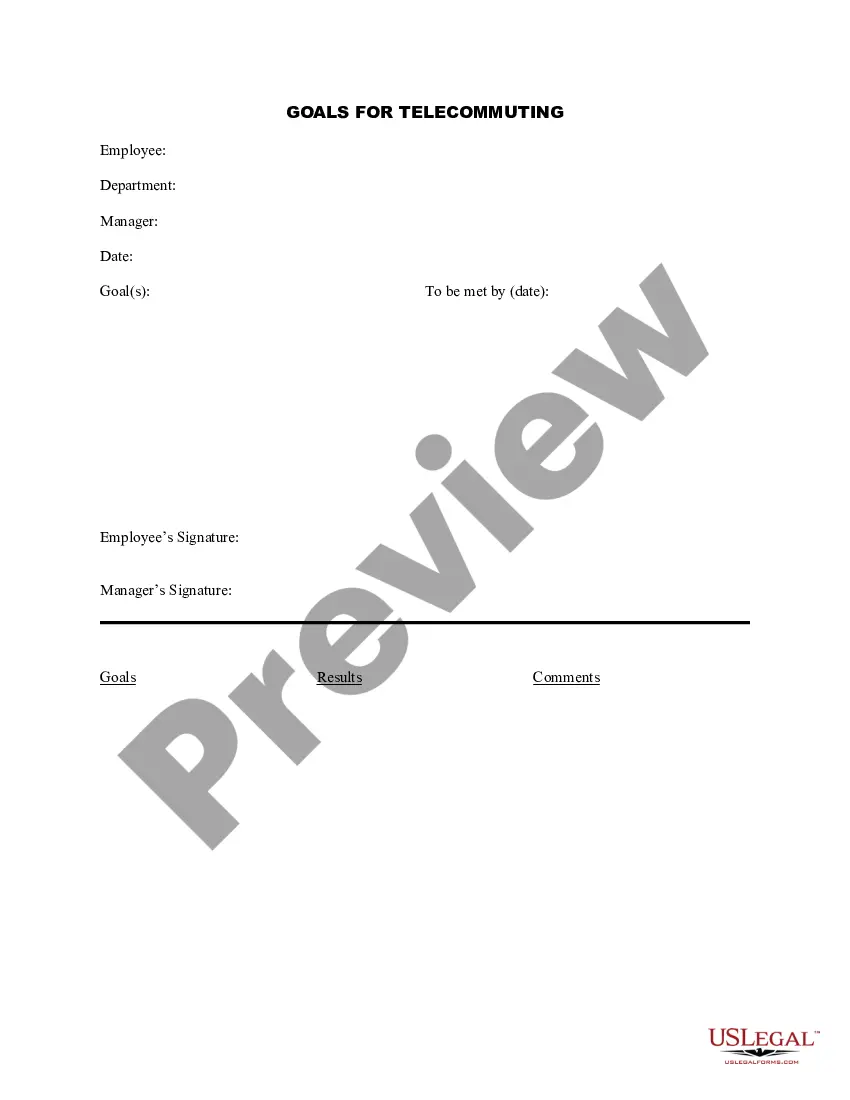
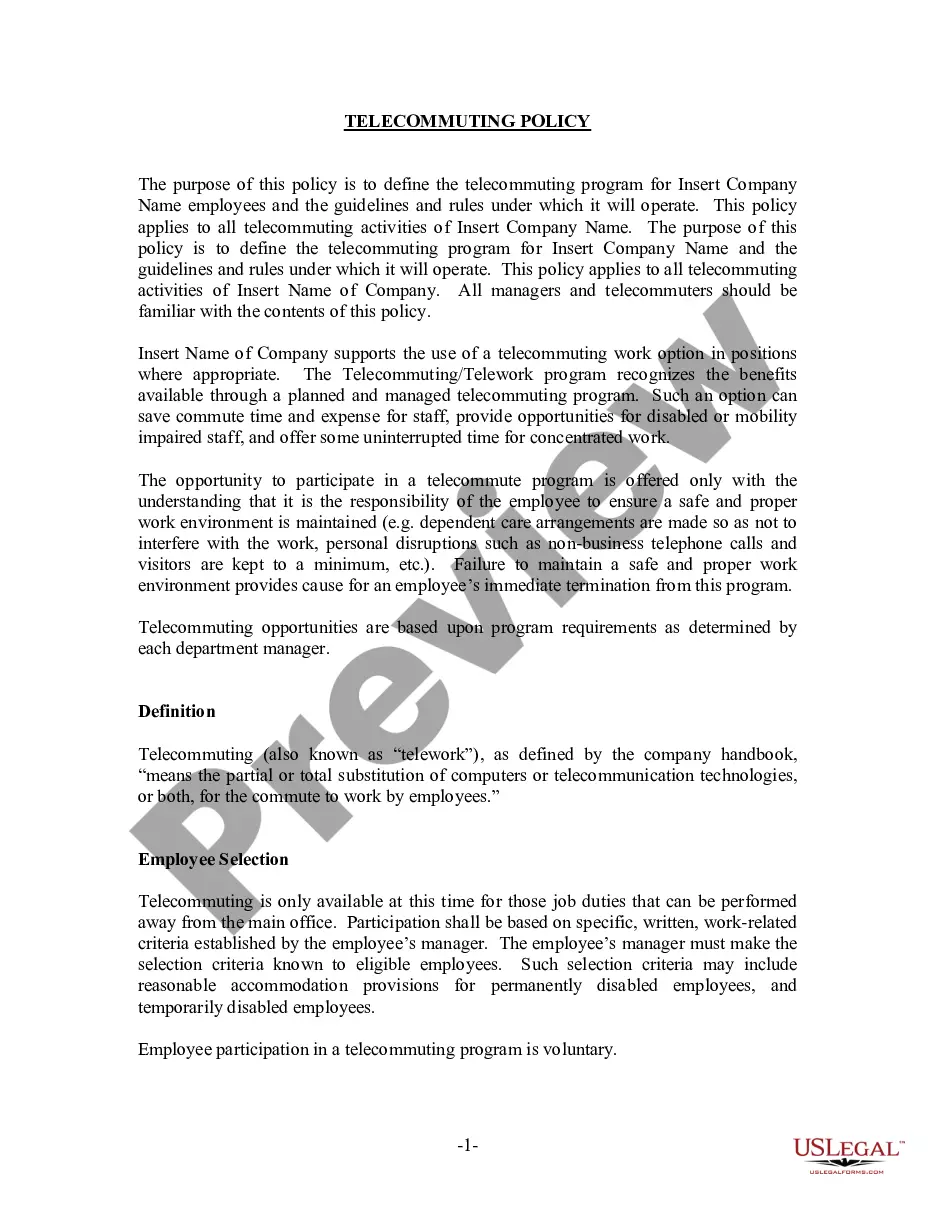
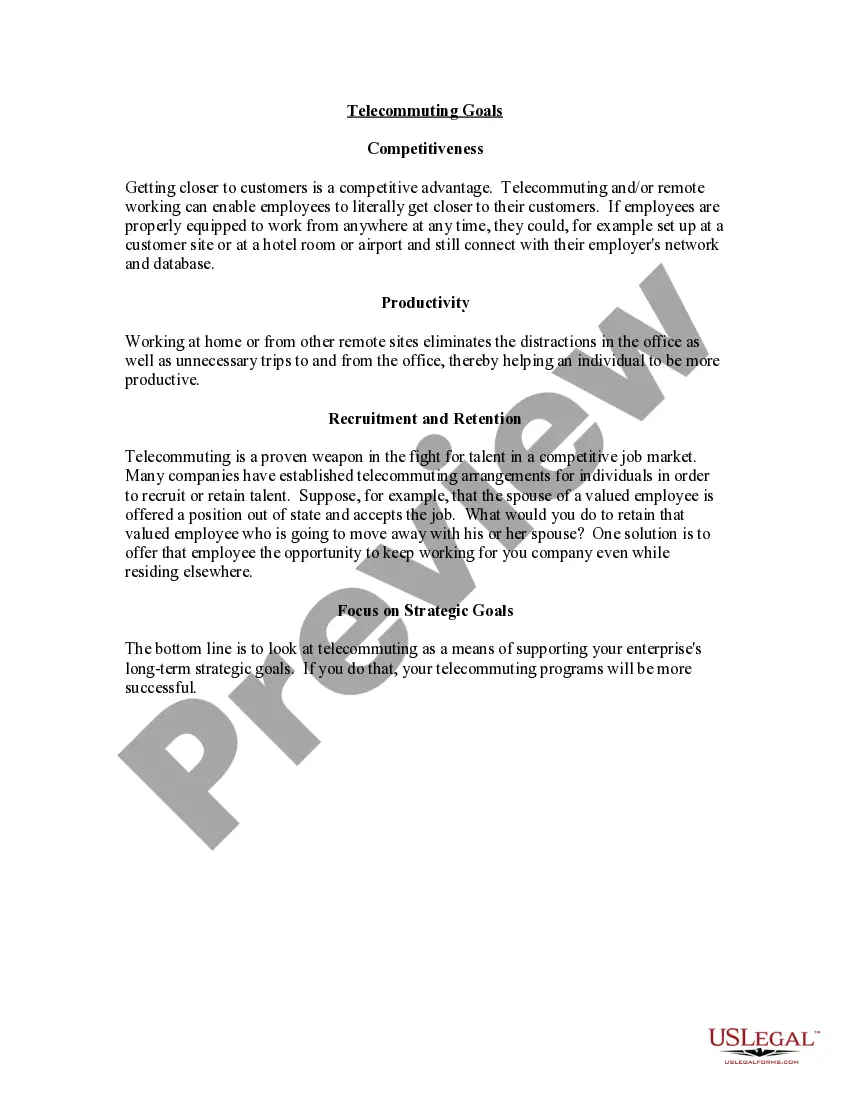
Arkansas Goals for Telecommuting
Description
Get your form ready online
Our built-in tools help you complete, sign, share, and store your documents in one place.
Make edits, fill in missing information, and update formatting in US Legal Forms—just like you would in MS Word.
Download a copy, print it, send it by email, or mail it via USPS—whatever works best for your next step.
Sign and collect signatures with our SignNow integration. Send to multiple recipients, set reminders, and more. Go Premium to unlock E-Sign.
If this form requires notarization, complete it online through a secure video call—no need to meet a notary in person or wait for an appointment.
We protect your documents and personal data by following strict security and privacy standards.

Make edits, fill in missing information, and update formatting in US Legal Forms—just like you would in MS Word.

Download a copy, print it, send it by email, or mail it via USPS—whatever works best for your next step.

Sign and collect signatures with our SignNow integration. Send to multiple recipients, set reminders, and more. Go Premium to unlock E-Sign.

If this form requires notarization, complete it online through a secure video call—no need to meet a notary in person or wait for an appointment.

We protect your documents and personal data by following strict security and privacy standards.
Looking for another form?




How to fill out Goals For Telecommuting?
You can spend hours online searching for the legal document template that meets the federal and state requirements you need.
US Legal Forms offers an extensive collection of legal forms that can be reviewed by experts.
You can conveniently download or print the Arkansas Goals for Telecommuting from our service.
If available, make use of the Preview option to review the document template as well.
- If you have an account with US Legal Forms, you can Log In and select the Obtain option.
- After that, you can complete, edit, print, or sign the Arkansas Goals for Telecommuting.
- Each legal document template you acquire is yours indefinitely.
- To get another copy of any purchased form, go to the My documents tab and click on the relevant option.
- If it's your first time using the US Legal Forms website, follow the simple instructions below.
- First, ensure you have selected the correct document template for the state/city you choose.
- Review the form description to make sure you have chosen the right form.
Form popularity
FAQ
Telecommuting allows employees to manage their personal and professional lives more effectively. By introducing this initiative, organizations actively support the Arkansas Goals for Telecommuting, which aim to create a healthier work environment. This flexibility leads to increased job satisfaction and better overall employee well-being.
7 advantages of telecommuting1) Higher employee satisfaction.2) Better work-life balance.3) Increased flexibility.4) Reduced operational costs.5) Reduced expenses for employees.6) Easier to focus.7) There's zero commuting necessary.1) You need the right technology to be effective.More items...?16-Apr-2020
Having a well-designed telecommuting policy is essential for clarifying obligations and responsibilities, as well as ensuring that employees stay productive and efficient.
Objective. Telecommuting allows employees to work at home, on the road or in a satellite location for all or part of their workweek. Company Name considers telecommuting to be a viable, flexible work option when both the employee and the job are suited to such an arrangement.
Telework can give employees more control over their schedules and flexibility in meeting personal and professional responsibilities. It can offer freedom from office distractions, reduce work-life stress, and provide an alternative workplace arrangement in case of emergencies.
To work from home successfully, you'll need to plan out and structure your days so the hours don't get away from you. Create to-do lists, set goals, and come up with a daily schedule, complete with breaks and times when you'll be able to focus on deep work.
Teleworking staff must adhere to all departmental and institutional policies including, but not limited to policies regarding confidentiality of information, work schedules, work hours, use of equipment, ethics, performance, leave use and tracking of work hours.
The purpose of the Telecommuting Policy is to provide employees with the guidelines and controls for working remotely. Teleworking, or telecommuting, is the concept of working from home or another location on a full- or part-time basis. Teleworking is not a formal, universal employee benefit.
Strong Written and Verbal Communication Skills This is a non-negotiable and critical skill. A remote worker must be able comprehend and communicate with everyone on the team. They need to be clear and concise without leaving room for miscommunications is vital.
Teleworking staff must adhere to all departmental and institutional policies including, but not limited to policies regarding confidentiality of information, work schedules, work hours, use of equipment, ethics, performance, leave use and tracking of work hours.