Arkansas New Resident Guide
About this form
The New Resident Guide is an essential resource for individuals relocating to a new state. It outlines the necessary steps and requirements for establishing residency, registering to vote, obtaining identification cards, and securing a driver's license and vehicle registration. This form serves to simplify the process for new residents, ensuring they are informed about their legal obligations. Unlike other residency forms, this guide specifically caters to various state requirements, making it a comprehensive tool for anyone moving to a new state.
Key parts of this document
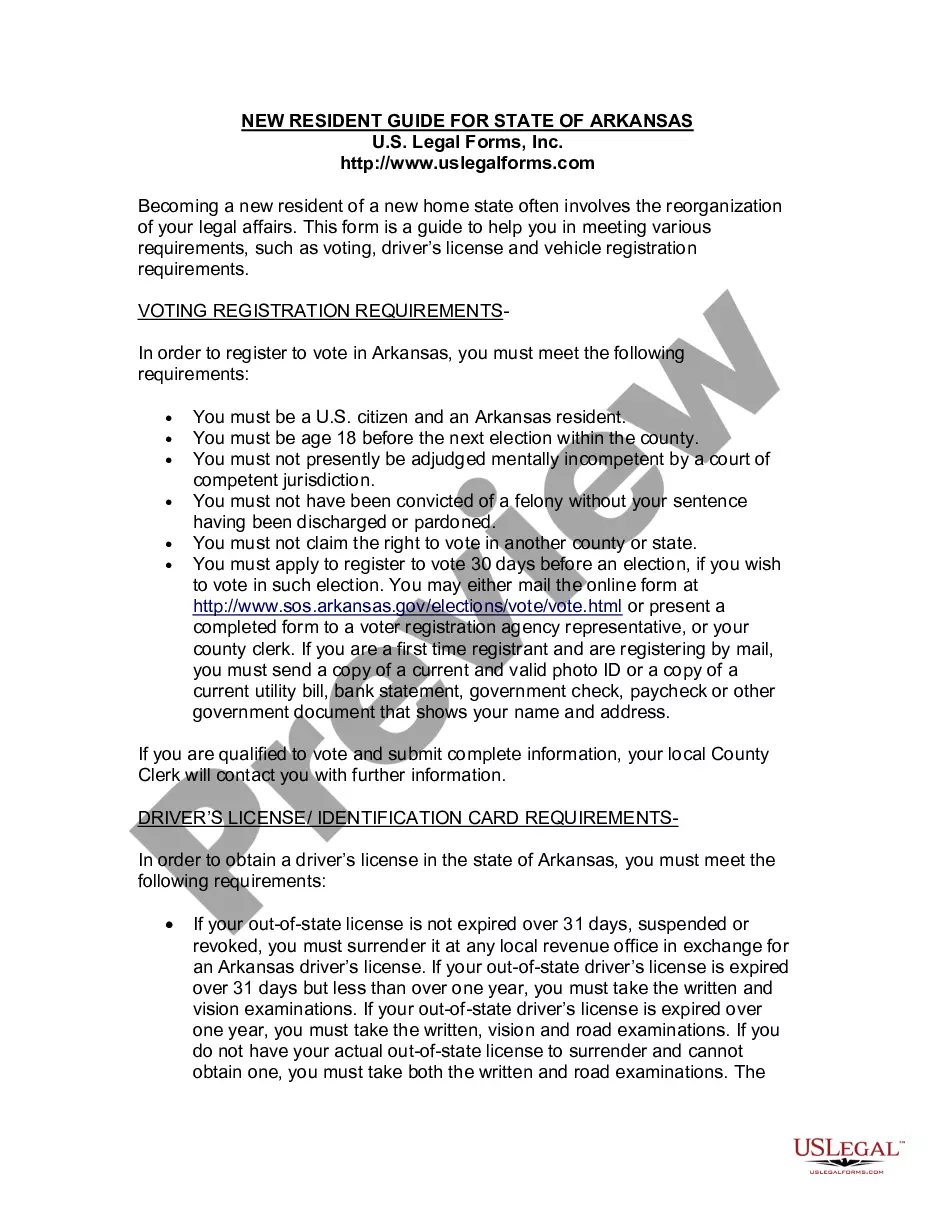
- Voting registration requirements, including eligibility criteria and application process.
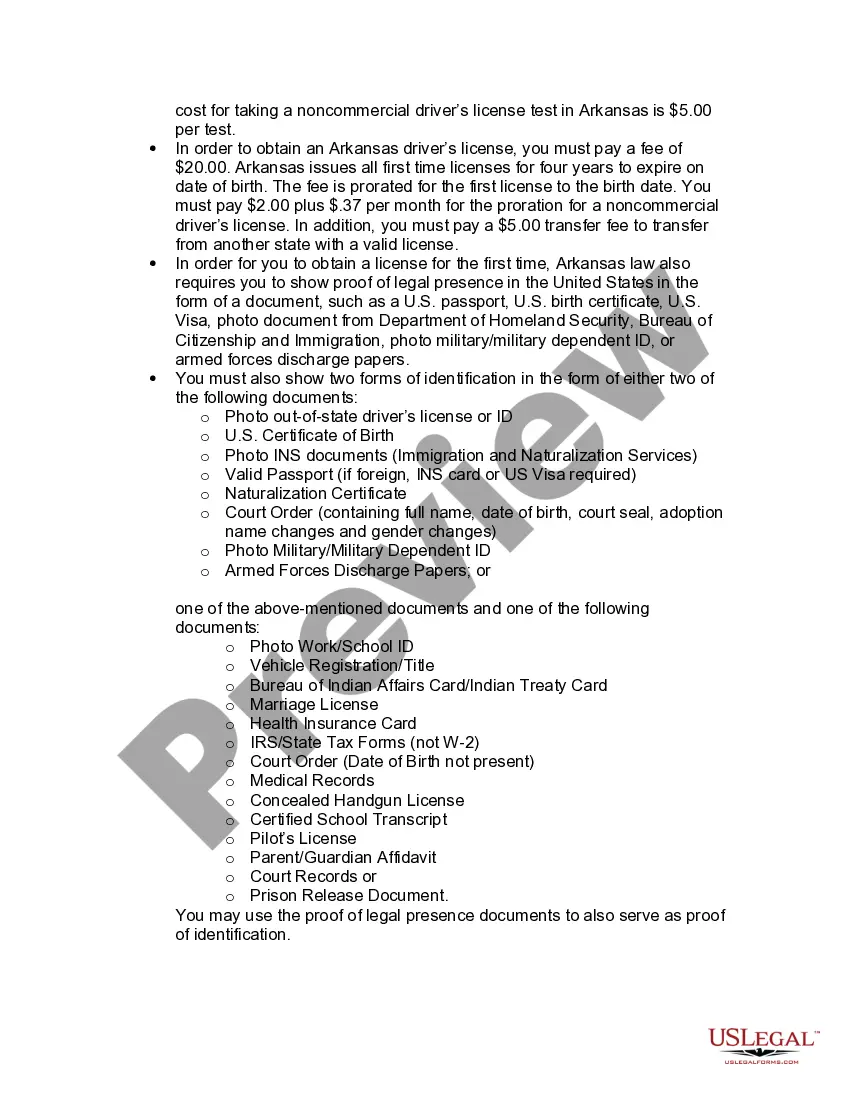
- Driver's license and identification card requirements, detailing what is needed for issuance.
- Vehicle registration requirements, outlining the necessary documents and timelines.
- Links to state-specific resources for further assistance.

Common use cases
This guide is useful when you move to a new state and need to familiarize yourself with local laws and regulations regarding residency. It is particularly important to reference this form when registering to vote, obtaining a driver's license, or registering your vehicle to ensure compliance with state-specific requirements.
Who should use this form
- New residents relocating to a different state in the U.S.
- Individuals seeking to register to vote in their new state.
- Those needing to apply for a driver's license or identification card.
- People looking to register their vehicle after moving.
Completing this form step by step
- Determine your voter registration eligibility and gather necessary documentation.
- Prepare identification proofs required for obtaining a driver's license.
- Complete the vehicle registration application and collect relevant documents.
- Visit your local revenue office or appropriate agency for processing your application.
- Submit applications and required fees as instructed for voting, licensing, and vehicle registration.
Notarization guidance
This form does not typically require notarization unless specified by local law. Always check state requirements to confirm if notarization is needed for specific applications related to residency and voting.
Get your form ready online
Our built-in tools help you complete, sign, share, and store your documents in one place.
Make edits, fill in missing information, and update formatting in US Legal Forms—just like you would in MS Word.
Download a copy, print it, send it by email, or mail it via USPS—whatever works best for your next step.
Sign and collect signatures with our SignNow integration. Send to multiple recipients, set reminders, and more. Go Premium to unlock E-Sign.
If this form requires notarization, complete it online through a secure video call—no need to meet a notary in person or wait for an appointment.
We protect your documents and personal data by following strict security and privacy standards.

Make edits, fill in missing information, and update formatting in US Legal Forms—just like you would in MS Word.

Download a copy, print it, send it by email, or mail it via USPS—whatever works best for your next step.

Sign and collect signatures with our SignNow integration. Send to multiple recipients, set reminders, and more. Go Premium to unlock E-Sign.

If this form requires notarization, complete it online through a secure video call—no need to meet a notary in person or wait for an appointment.

We protect your documents and personal data by following strict security and privacy standards.
Common mistakes
- Failing to register to vote within the designated timeframe.
- Not having the required identification documents when applying for a driver's license.
- Missing important deadlines for vehicle registration after moving.
- Assuming all states have the same requirements without consulting state-specific guidance.
Benefits of completing this form online
- Convenient access to important residency information from anywhere.
- Editable templates that can be easily customized to fit your needs.
- Reliable legal guidance drafted by licensed attorneys.
Legal use & context
- The New Resident Guide provides a comprehensive overview of state regulations that ensure compliance for individuals moving to Arkansas.
- Failure to follow the outlined procedures may lead to legal repercussions, such as fines or penalties for delayed registrations.
Quick recap
- The New Resident Guide is vital for understanding what is required after relocating.
- Be proactive in meeting registration deadlines for voting, driving, and vehicle ownership.
- Having the correct identification and documentation is crucial to avoid delays.
Looking for another form?
Form popularity
FAQ
Becoming an Arkansas resident involves several steps outlined in the Arkansas New Resident Guide. You need to establish physical presence in the state, which usually requires living there for at least six months. Additionally, you should register to vote and update your driver's license to reflect your Arkansas address. Following these steps will make your relocation process smooth and straightforward.
To qualify for in-state tuition in Arkansas, you must establish residency in the state. This includes living in Arkansas for at least 12 months prior to enrollment and demonstrating your intent to remain, such as obtaining a local driver’s license. The Arkansas New Resident Guide offers comprehensive information on residency requirements and necessary documentation. Ensuring you meet the criteria will simplify your transition to a new academic journey.
To become a fishing guide in Arkansas, you must obtain a valid fishing guide license. This involves passing a background check and providing proof of fishing experience. In addition, staying informed about the regulations in the Arkansas New Resident Guide will help you comply with local laws. Many guides also invest in liability insurance for added protection.
While each state has its own requirements, many people find Arkansas manageable due to its straightforward processes for establishing residency. Providing essential documents like a lease agreement or utility bill can suffice. For simplified guidelines, refer to the Arkansas New Resident Guide as a source to navigate the residency proof requirements effectively.
To obtain a new driver's license in Arkansas, you must provide proof of identity, residency, and legal presence in the U.S. This may include documents like your birth certificate and utility bills. The Arkansas New Resident Guide lists all the necessary documents and guidelines to smooth your application process.
To declare residency in Arkansas, you typically need to gather documentation that shows your permanent address, such as a utility bill or lease agreement. Additionally, applying for an Arkansas driver's license and registering your vehicle can strengthen your residency claim. The Arkansas New Resident Guide details what documentation you will need to support your residency declaration.
To establish residency in Arkansas, you need to move to the state with the intention of making it your permanent home. This may involve obtaining a driver's license, registering your vehicle, and updating your voter registration. The Arkansas New Resident Guide provides detailed instructions on the necessary steps to ensure your residency is recognized.
Yes, Arkansas is a domicile state. This means that once you establish residency here, it is your permanent home. Your domicile is critical for tax purposes and can affect various legal matters. The Arkansas New Resident Guide offers resources to help you comprehend the requirements for establishing domicile.
To declare residency in Arkansas, you must take specific steps that include establishing a physical address in the state and obtaining an Arkansas driver's license or state ID. Additionally, you should register your vehicle in Arkansas and consider changing your voter registration. The Arkansas New Resident Guide offers straightforward instructions to help you transition smoothly into your new life in Arkansas. For personalized assistance, US Legal Forms provides forms and helpful resources for declaring your residency.
Proving residency in Arkansas is essential for various applications, including voting and obtaining a driver's license. You can show residency by providing documents such as a lease agreement, utility bill, or bank statement that displays your name and Arkansas address. The Arkansas New Resident Guide outlines acceptable proof, ensuring that you have the information you need. Consider using US Legal Forms to access templates for documents needed to establish residency.