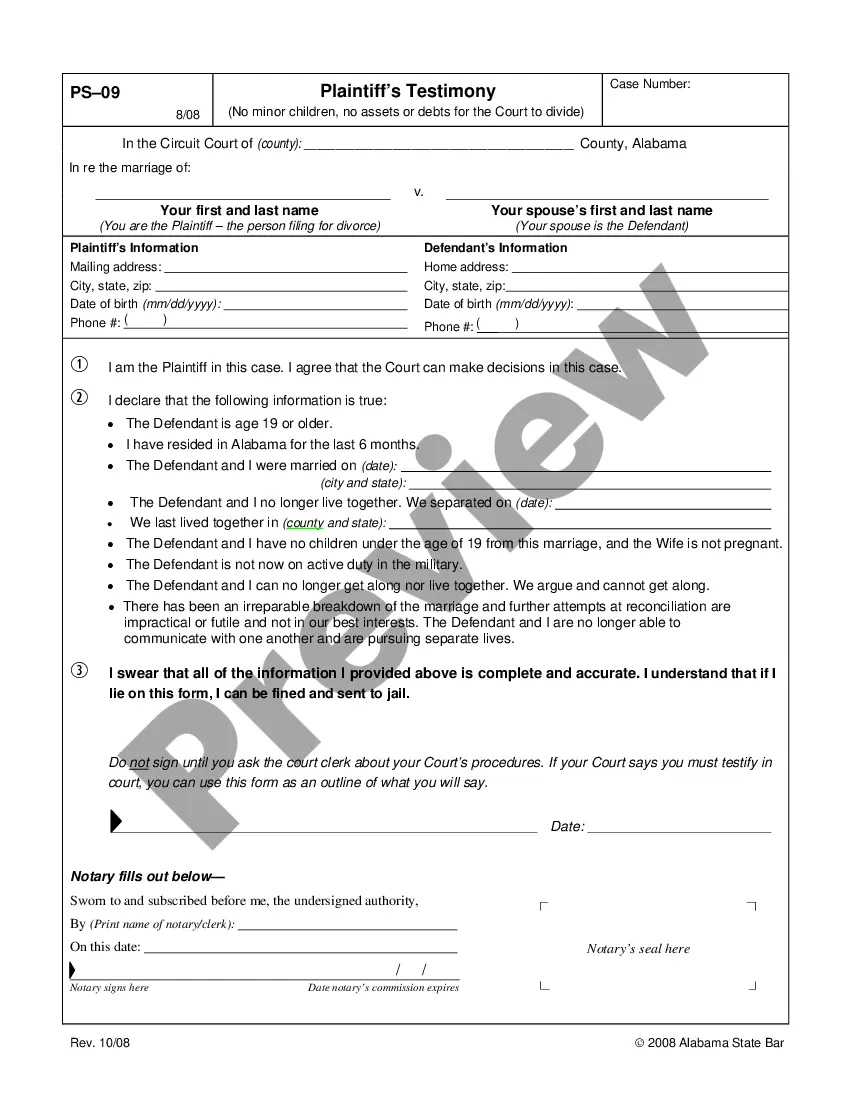
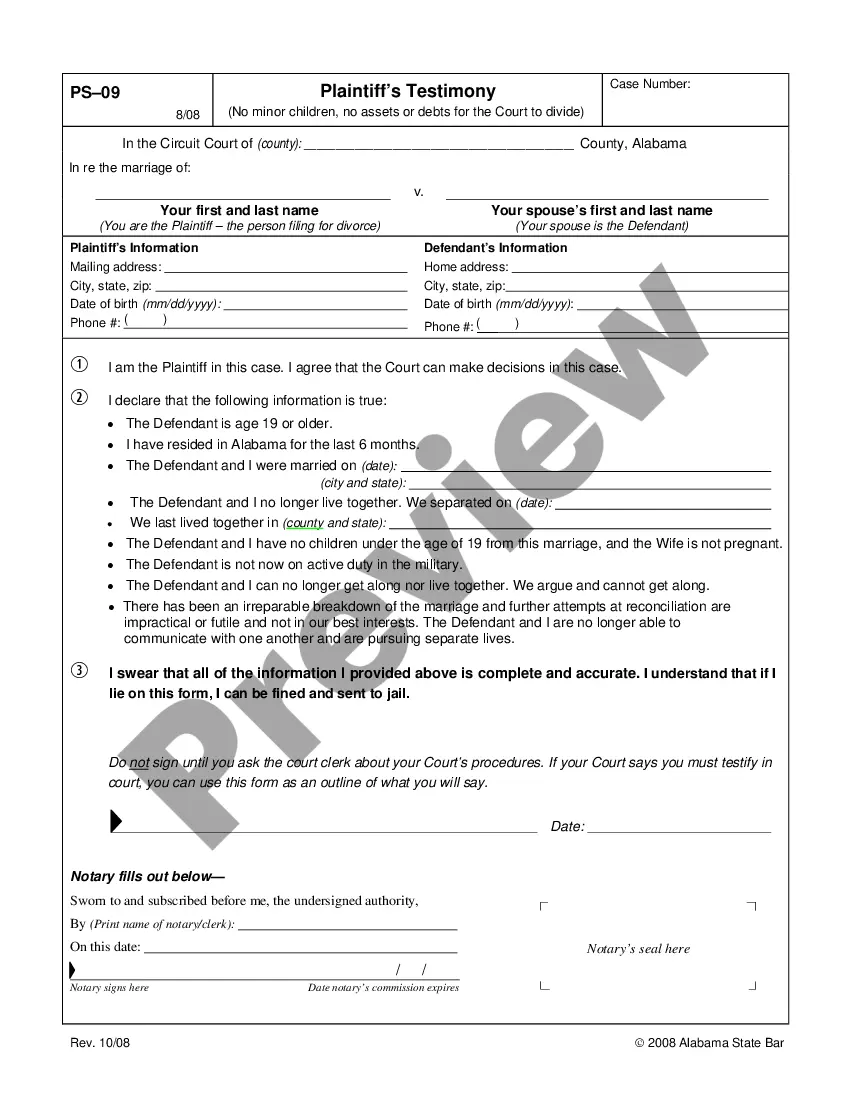
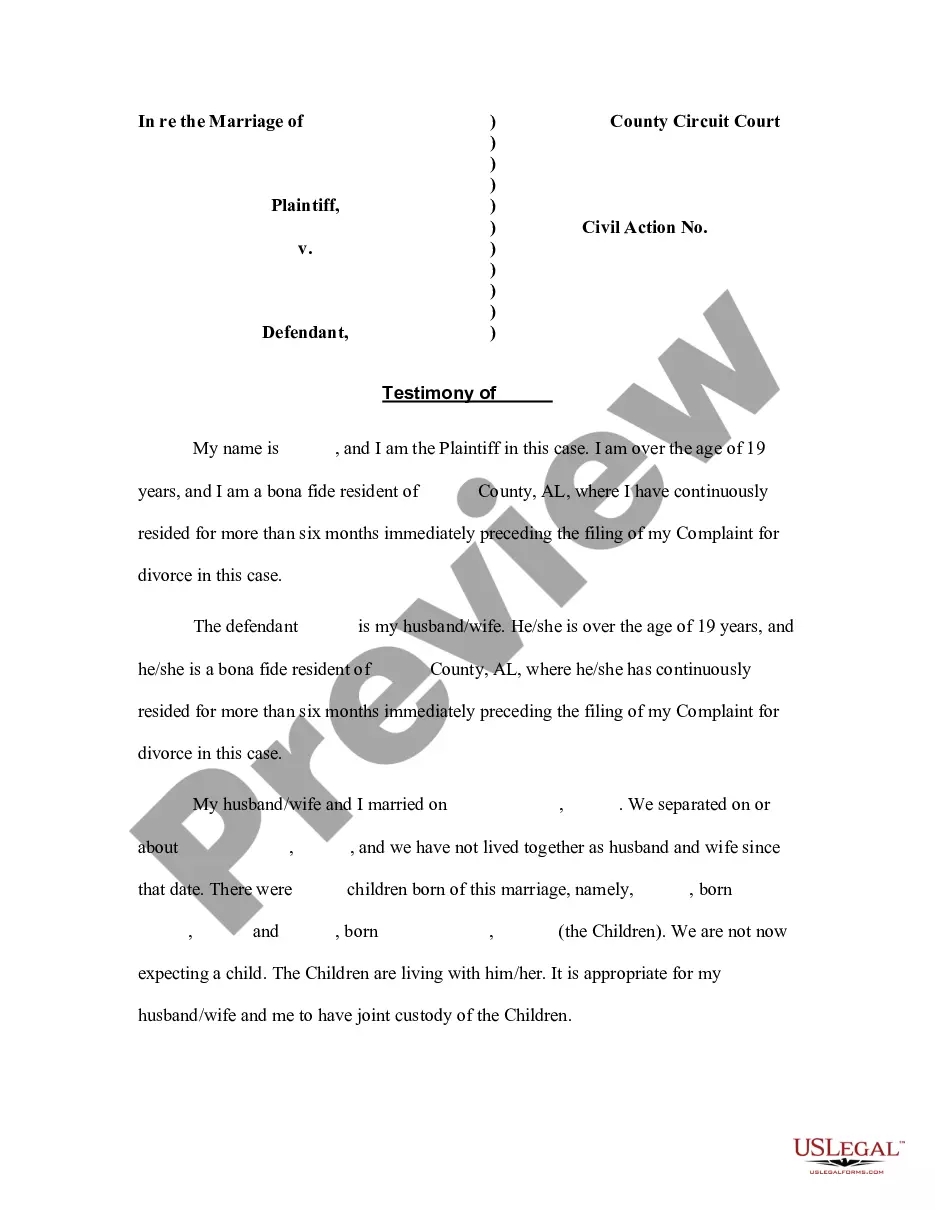
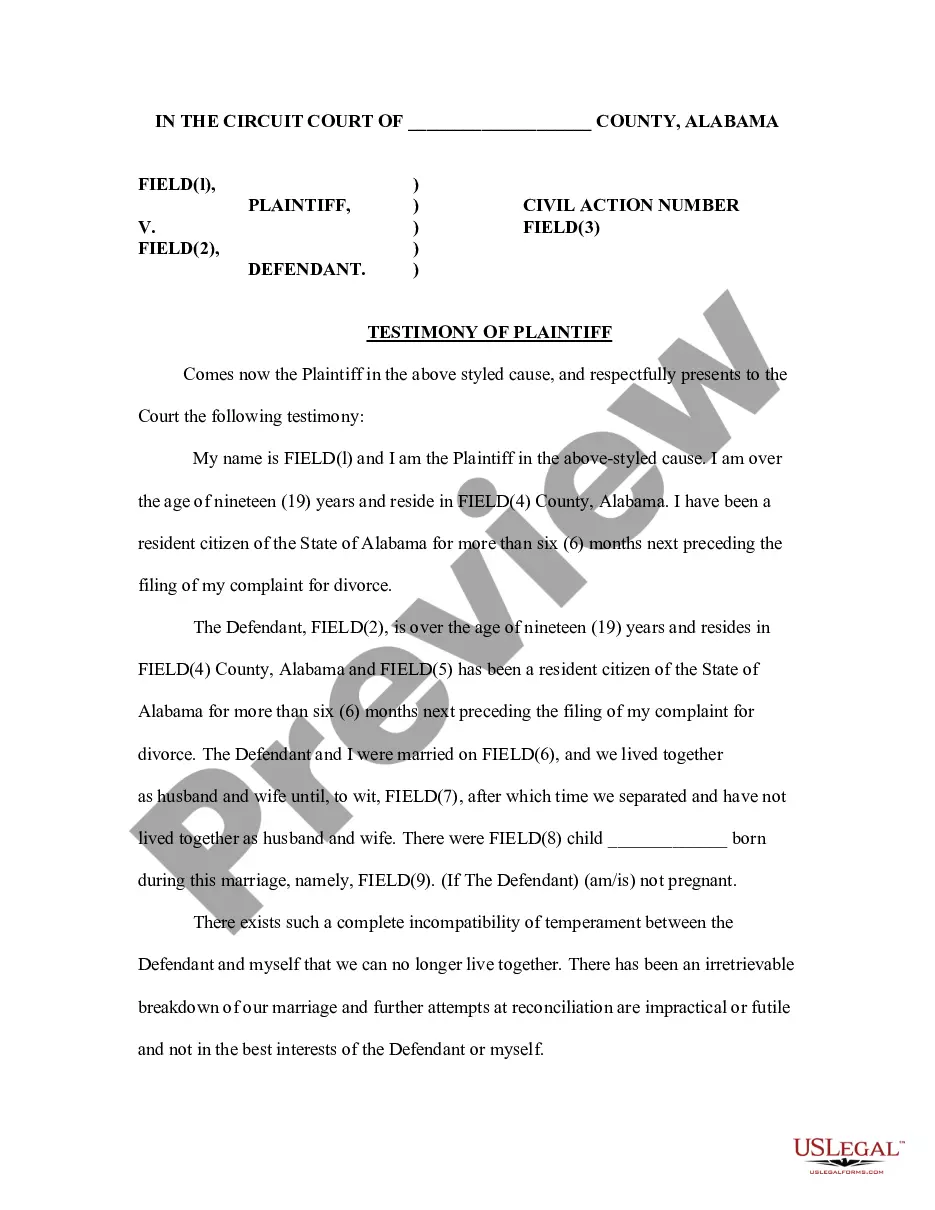
Affidavit in Testimony Support of Decree (Plaintiff): In this form, you aver that you meet the requirements to be divorced in Alabama and agree to the divorce in accordance with the Separation Agreement.
Alabama Plaintiff's Affidavit of Testimony in Support of Decree - No Minor Children
Instant download
This website is not affiliated with any governmental entity
Public form
Description
Get your form ready online
Our built-in tools help you complete, sign, share, and store your documents in one place.
Built-in online Word editor
Make edits, fill in missing information, and update formatting in US Legal Forms—just like you would in MS Word.
Export easily
Download a copy, print it, send it by email, or mail it via USPS—whatever works best for your next step.
E-sign your document
Sign and collect signatures with our SignNow integration. Send to multiple recipients, set reminders, and more. Go Premium to unlock E-Sign.
Notarize online 24/7
If this form requires notarization, complete it online through a secure video call—no need to meet a notary in person or wait for an appointment.
Store your document securely
We protect your documents and personal data by following strict security and privacy standards.

Make edits, fill in missing information, and update formatting in US Legal Forms—just like you would in MS Word.

Download a copy, print it, send it by email, or mail it via USPS—whatever works best for your next step.

Sign and collect signatures with our SignNow integration. Send to multiple recipients, set reminders, and more. Go Premium to unlock E-Sign.

If this form requires notarization, complete it online through a secure video call—no need to meet a notary in person or wait for an appointment.

We protect your documents and personal data by following strict security and privacy standards.
Looking for another form?
How to fill out Alabama Plaintiff's Affidavit Of Testimony In Support Of Decree - No Minor Children?
Employing the Alabama Plaintiff's Affidavit of Testimony in Favor of Decree with Adult Children templates created by experienced attorneys helps you steer clear of complications while completing forms.
Simply download the example from our site, complete it, and ask a legal expert to review it.
Doing so can save you significantly more time and money than finding a legal expert to draft a document from scratch for you.
- If you already hold a US Legal Forms subscription, just Log In to your account and revisit the sample page.
- Locate the Download button near the templates you are exploring.
- After you download a document, your saved samples will be available in the My documents tab.
- If you don’t possess a subscription, don't worry.
- Simply follow the instructions below to register for an online account, obtain, and complete your Alabama Plaintiff's Affidavit of Testimony in Favor of Decree with Adult Children template.
- Verify and ensure that you are downloading the correct state-specific form.
Form popularity
FAQ
According to the Alabama Schedule of Basic Child-Support Obligations, the total child support obligation is $1,192. The total child support obligation must be divided between the parents in proportion to their adjusted gross incomes. The percentage of the gross income is used to figure the dollar amount.
In Alabama, parents can't lower their existing child support obligations by having new children.
Under Alabama law, child support payments usually end when the child reaches the age of 19 or when he or she graduates from high school, or becomes emancipated, whichever happens later. However, if the child attends college and is not working, the noncustodial parent still has an obligation pay support.
In determining a parent's income for child support purposes, courts typically look at the parent's gross income from all sources. They then subtract certain obligatory deductions, like income taxes, Social Security, health care, and mandatory union dues.
Alabama bases child support payments on what is referred to as the income shares model. This is based on the concept that a child should receive the same ratio of support from each parent that they would have been given had the parent's relationship remained intact.
According to the Alabama Schedule of Basic Child-Support Obligations, the total child support obligation is $1,192. The total child support obligation must be divided between the parents in proportion to their adjusted gross incomes. The percentage of the gross income is used to figure the dollar amount.
Generally speaking, child support obligations in Alabama will be owed until the child reaches the age of 19. That is considered the age of majority in this state.
Once you've obtained an order for child support from your child's other parent, that parent must continue to pay child support on time and in full until the child support obligation ends, which in Alabama is usually when the child reaches age 19.
Under Alabama law, child support payments usually end when the child reaches the age of 19 or when he or she graduates from high school, or becomes emancipated, whichever happens later. However, if the child attends college and is not working, the noncustodial parent still has an obligation pay support.