District of Columbia Letter from Tenant to Landlord about Landlord using Unlawful Self-Help to Gain Possession
What is this form?
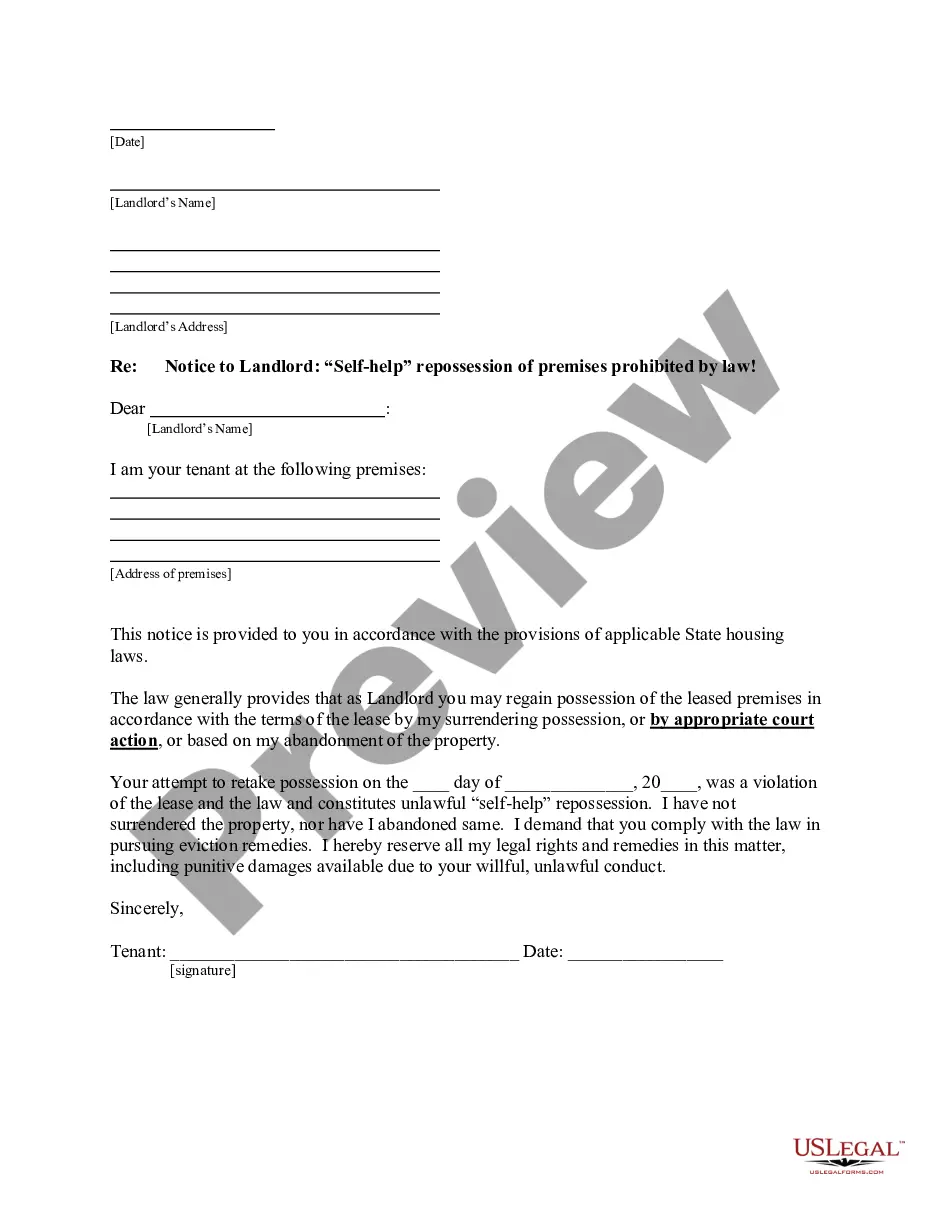
This form is a written notice from a tenant to a landlord regarding unlawful self-help eviction measures. It serves to inform the landlord that their actions to regain possession of the property must comply with legal requirements, which typically include court action or surrender by the tenant. This form differs from general eviction notices as it specifically addresses illegal attempts by the landlord to reclaim the leased premises without proper legal procedures.
Form components explained
- Identification of the landlord and tenant
- Date of the attempted self-help eviction
- Statement of non-surrender and non-abandonment of the property
- Demand for compliance with legal eviction procedures
- Reservation of legal rights, including the potential for punitive damages
- Signature and date of the tenant
When to use this form
This form should be used when a tenant believes their landlord is attempting to unlawfully regain possession of the rental property. Common scenarios include situations where the landlord changes locks, enters the property without permission, or removes the tenant's belongings without following proper legal procedures. It serves as a formal notice to remind the landlord that such actions are illegal and reinforces the tenant's legal standing.
Who this form is for
- Tenants who are currently renting a residential property
- Tenants who have experienced or are at risk of unlawful eviction measures
- Individuals seeking to assert their rights under landlord-tenant laws
Completing this form step by step
- Identify the tenant's name and address at the top of the letter.
- Specify the landlord's name and address clearly.
- Fill in the date of the landlord's unlawful actions.
- Clearly state that you have not surrendered the property or abandoned it.
- Sign and date the letter, ensuring it reflects your intent.
Is notarization required?
This form does not typically require notarization unless specified by local law. It is advisable to check state-specific regulations regarding notarization requirements for such communications.
Get your form ready online
Our built-in tools help you complete, sign, share, and store your documents in one place.
Make edits, fill in missing information, and update formatting in US Legal Forms—just like you would in MS Word.
Download a copy, print it, send it by email, or mail it via USPS—whatever works best for your next step.
Sign and collect signatures with our SignNow integration. Send to multiple recipients, set reminders, and more. Go Premium to unlock E-Sign.
If this form requires notarization, complete it online through a secure video call—no need to meet a notary in person or wait for an appointment.
We protect your documents and personal data by following strict security and privacy standards.

Make edits, fill in missing information, and update formatting in US Legal Forms—just like you would in MS Word.

Download a copy, print it, send it by email, or mail it via USPS—whatever works best for your next step.

Sign and collect signatures with our SignNow integration. Send to multiple recipients, set reminders, and more. Go Premium to unlock E-Sign.

If this form requires notarization, complete it online through a secure video call—no need to meet a notary in person or wait for an appointment.

We protect your documents and personal data by following strict security and privacy standards.
Common mistakes to avoid
- Failing to include the date of the unlawful self-help eviction.
- Not providing sufficient details regarding the property.
- Neglecting to sign the letter before delivery.
- Using ambiguous language that may weaken the notice's impact.
Advantages of online completion
- Convenience of immediate access and downloading the form.
- Editability to customize the form according to specific needs.
- Reliability of a document drafted by licensed attorneys.
Legal use & context
- This form establishes the tenant's notification of unlawful eviction attempts.
- It protects the tenant's rights under state landlord-tenant law.
- Using this form can help tenants avoid illegal eviction actions and seek legal recourse if needed.
Looking for another form?
Form popularity
FAQ
A powerful complaint letter should start with a clear description of the problem you are facing. Use assertive, straightforward language to outline your complaint, and state the resolution you seek. To enhance your letter's impact, consider framing it as a District of Columbia Letter from Tenant to Landlord about Landlord using Unlawful Self-Help to Gain Possession, which not only communicates your concerns but also signals your understanding of legal options available to you.
To write a letter to a landlord about harassment, begin by detailing the behavior you have experienced which you qualify as harassment. Be factual and avoid emotional language; instead, focus on the specific actions that have made you uncomfortable. Including an element that suggests a District of Columbia Letter from Tenant to Landlord about Landlord using Unlawful Self-Help to Gain Possession may highlight the seriousness of your claim and your knowledge of your rights.
When writing a harassment complaint letter, clearly identify the incidents that you consider to be harassment, including dates and descriptions of events. It is important to communicate your feelings about how these actions have affected you and why they are unacceptable. A well-structured District of Columbia Letter from Tenant to Landlord about Landlord using Unlawful Self-Help to Gain Possession can serve as a formal notice of your concerns and request for resolution.
Fighting a writ of possession typically involves filing an objection or counterclaim within the court system. It is essential to gather any evidence that supports your case and be prepared to demonstrate why the writ should not be enforced. Seeking legal assistance can be beneficial, and drafting a District of Columbia Letter from Tenant to Landlord about Landlord using Unlawful Self-Help to Gain Possession could be a strong component of your defense.
To write a strongly worded letter of complaint, start by clearly stating your issue and what led to your dissatisfaction. Use direct language to outline your concerns and specify the action you expect from the landlord. Including a request for a timely response can emphasize the importance of your complaint and may support your case, particularly if you reference a District of Columbia Letter from Tenant to Landlord about Landlord using Unlawful Self-Help to Gain Possession.
Harassment by a tenant towards a landlord can include actions that disrupt the landlord's ability to carry out their responsibilities. This might involve repeated unwanted communication, destruction of property, or interference with the landlord's access to the rental unit. If you believe your landlord is using unlawful self-help to gain possession, you may want to draft a District of Columbia Letter from Tenant to Landlord about Landlord using Unlawful Self-Help to Gain Possession.
To file a complaint against a landlord in the District of Columbia, you should start by gathering all relevant documents and evidence. This includes leases, payments, and communication records. Next, contact the Department of Consumer and Regulatory Affairs (DCRA) to file a formal complaint. Additionally, you may want to draft a District of Columbia Letter from Tenant to Landlord about Landlord using Unlawful Self-Help to Gain Possession, if you believe the landlord's actions are unlawful, as this may strengthen your case.
Landlord negligence occurs when a landlord fails to meet their legal duties, resulting in harm or unsafe living conditions for tenants. This can include ignoring repairs, failing to maintain common areas, or improperly handling lease agreements. The District of Columbia Letter from Tenant to Landlord about Landlord using Unlawful Self-Help to Gain Possession can be an important document to address serious concerns. Being aware of these factors can empower you as a tenant to take appropriate action.
Taking legal action against a landlord often starts with collecting evidence of their actions, such as neglect or misuse of self-help measures. After gathering the necessary documentation, you may consider filing a complaint in small claims court or seeking mediation. The District of Columbia Letter from Tenant to Landlord about Landlord using Unlawful Self-Help to Gain Possession can serve as a formal step before pursuing legal interactions. Consulting a legal professional can also provide guidance on the best approach.
Writing a letter to remove a tenant requires clarity and adherence to local laws. Begin by stating the reason for eviction, referencing relevant rules in the lease agreement, and including a proper format. You can utilize a District of Columbia Letter from Tenant to Landlord about Landlord using Unlawful Self-Help to Gain Possession as a guideline. It's beneficial to remain professional and provide a clear timeline for the tenant's departure.