Alabama Motion For Preliminary Hearing
Overview of this form
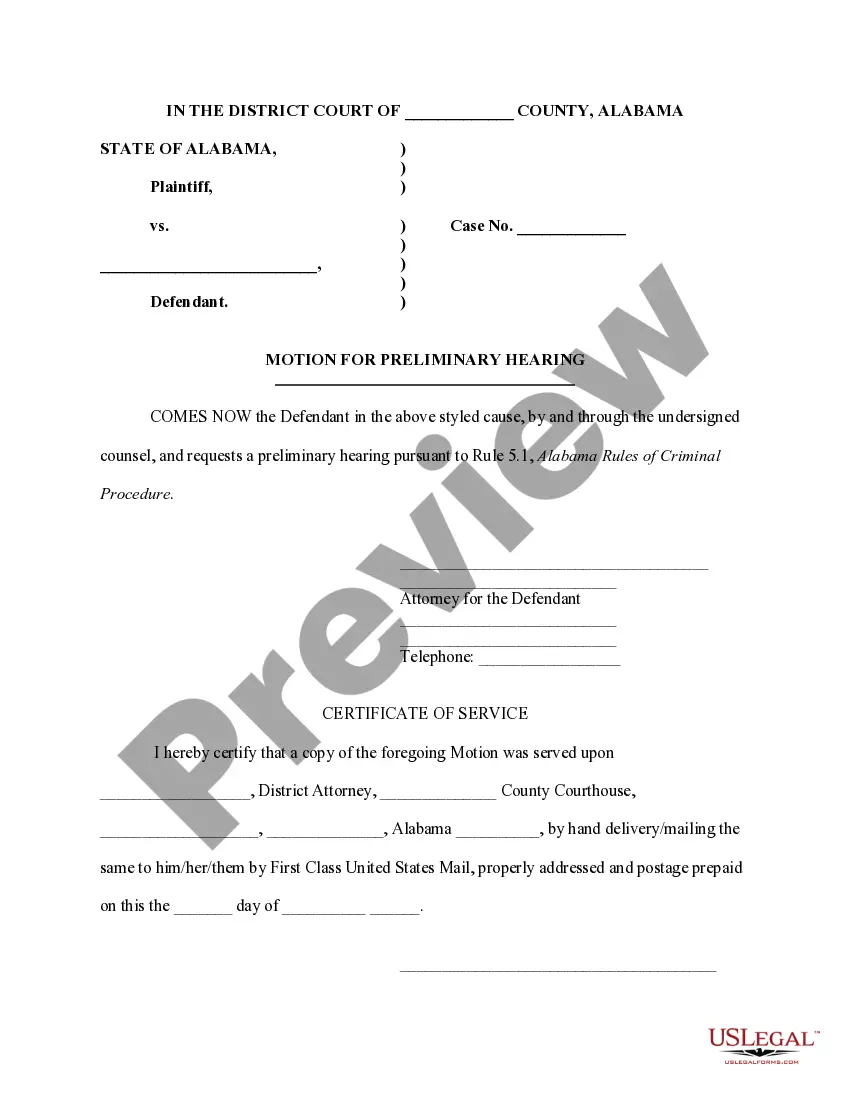
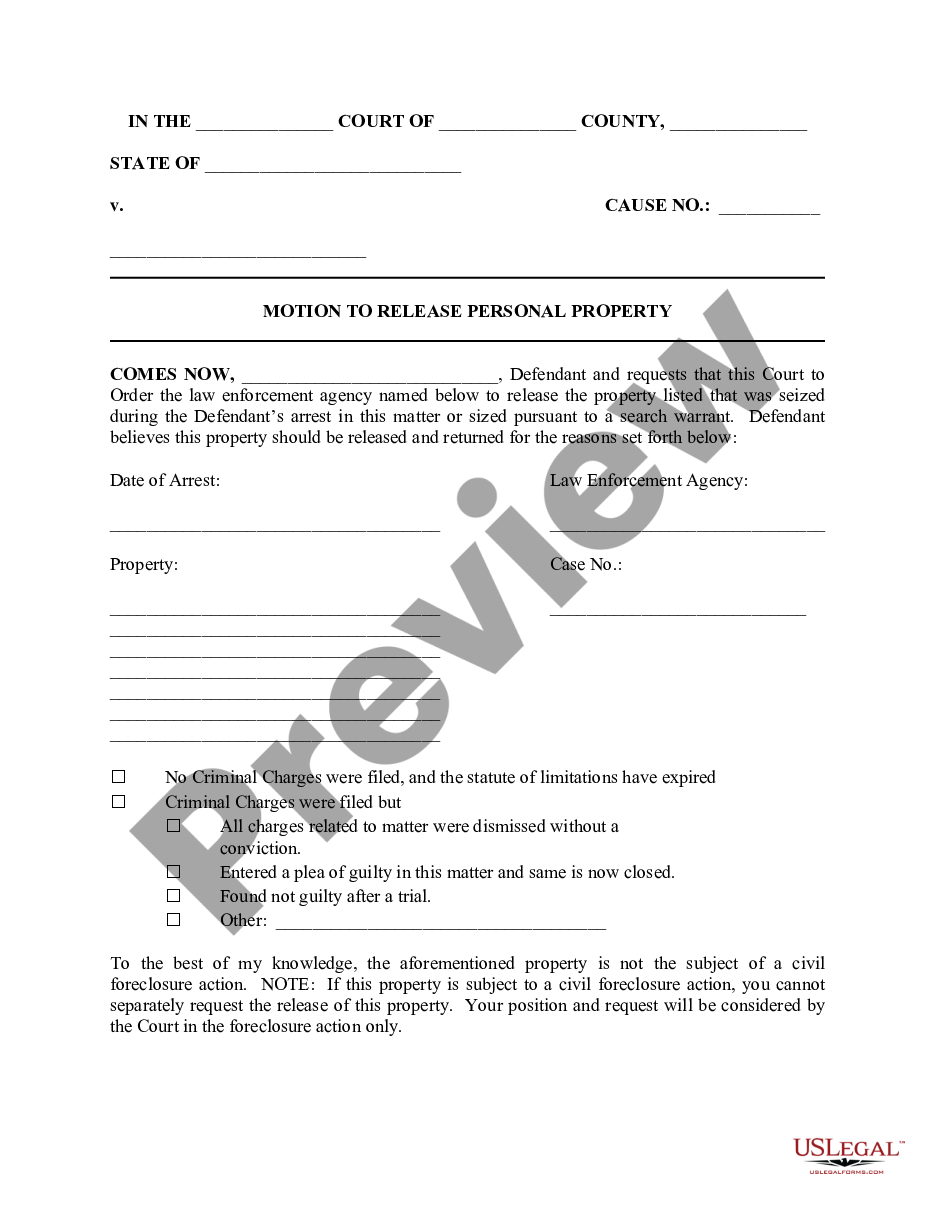
The Motion For Preliminary Hearing is a legal document filed by a defendant to request a preliminary hearing in a criminal case. This motion allows the defendant to contest the evidence presented by the prosecution before the trial begins. It's essential to understand that this form is distinct from other motions, as it specifically pertains to the request for a hearing to decide if there is enough evidence to proceed with the charges against the defendant.
Main sections of this form
- Case caption: Identifies the court, parties involved, and case number.
- Motion title: Clearly states that it is a âMotion For Preliminary Hearing.â
- Legal basis: References the applicable rule under the Alabama Rules of Criminal Procedure.
- Signature block: Includes a space for the defendant's attorney to sign and provide contact information.
- Certificate of service: Confirms that a copy of the motion has been provided to the district attorney.
Situations where this form applies
This form is used when a defendant in a criminal case wishes to contest the sufficiency of the evidence presented by the prosecution at a preliminary hearing. A preliminary hearing is crucial for the defendant's strategy as it can lead to the dismissal of charges if the evidence is deemed insufficient. Utilize this motion if you feel that the prosecution does not have enough evidence to warrant a full trial.
Who can use this document
This form is intended for:
- Defendants facing criminal charges in Alabama.
- Attorneys representing defendants seeking to contest evidence before a trial.
- Individuals who wish to understand and assert their rights during the preliminary hearing process.
How to complete this form
- Fill in the case caption with the court's name, parties involved, and case number.
- Clearly write the title "Motion For Preliminary Hearing" on the document.
- State the legal basis for your request by referencing the relevant Alabama law.
- Sign the motion in the designated area, and provide your attorney's contact information.
- Complete the certificate of service, ensuring you detail how and to whom the motion was delivered.
Notarization requirements for this form
This form does not typically require notarization unless specified by local law.
Get your form ready online
Our built-in tools help you complete, sign, share, and store your documents in one place.
Make edits, fill in missing information, and update formatting in US Legal Forms—just like you would in MS Word.
Download a copy, print it, send it by email, or mail it via USPS—whatever works best for your next step.
Sign and collect signatures with our SignNow integration. Send to multiple recipients, set reminders, and more. Go Premium to unlock E-Sign.
If this form requires notarization, complete it online through a secure video call—no need to meet a notary in person or wait for an appointment.
We protect your documents and personal data by following strict security and privacy standards.

Make edits, fill in missing information, and update formatting in US Legal Forms—just like you would in MS Word.

Download a copy, print it, send it by email, or mail it via USPS—whatever works best for your next step.

Sign and collect signatures with our SignNow integration. Send to multiple recipients, set reminders, and more. Go Premium to unlock E-Sign.

If this form requires notarization, complete it online through a secure video call—no need to meet a notary in person or wait for an appointment.

We protect your documents and personal data by following strict security and privacy standards.
Typical mistakes to avoid
- Failing to include the case number or proper court information.
- Not referencing the correct legal rule under which the motion is filed.
- Omitting signatures or contact information in the signature block.
- Neglecting to complete the certificate of service, which can invalidate the motion.
Benefits of completing this form online
- Convenience of downloading the form in your preferred format (Word or WordPerfect).
- Immediate access to legal templates drafted by experienced attorneys.
- Easy customization options to tailor the form to your specific case.
- Secure storage and easy retrieval of completed documents.
Legal use & context
- Utilized within the framework of Alabama criminal law for preliminary hearings.
- Supports the legal right of a defendant to contest the grounds of charges before trial.
Summary of main points
- The Motion for Preliminary Hearing is essential for defendants wishing to challenge evidence pre-trial.
- Proper completion and timely filing are crucial for the motion to be effective.
- This form should reflect specific legal standards applicable in Alabama.
Looking for another form?
Form popularity
FAQ
At the pre-preliminary hearing conference, the defense and prosecution meet to discuss a possible plea bargain on the case.After hearing all the witnesses and viewing all the evidence presented, the judge decides whether the prosecutor has established probable cause to support the charges.
Is there probable cause to believe the alleged crime occurred and did it occur within the court's jurisdiction? Is there probable cause to believe that the defendant committed the crime?
An arraignment is a pre-trial proceeding, sometimes called an initial appearance. The criminal defendant is brought in front of a judge at a lower court.
Investigation. Charging. Initial Hearing/Arraignment. Discovery. Plea Bargaining. Preliminary Hearing. Pre-Trial Motions. Trial.
In a preliminary hearing in Los Angeles and in all other counties, an accused is entitled to be present, to have a lawyer present and, with certain exceptions to cross examine the witnesses who testify against him or her at the preliminary hearing.
Preliminary hearings are heard by the District Court Judge in the Alabama County in which you were arrested.On occasion, usually in more serious cases with an incarcerated defendant, the State will call additional fact witnesses to establish the identity of the defendant or to ensure the Court finds probable cause.
Some of the rights afforded defendants during a preliminary hearing include:Defendants can successfully have their charges dismissed if they prove a prosecutor's case lack sufficient evidence to prove that a crime occurred.
The preliminary hearing is like a mini-trial. The prosecution will call witnesses and introduce evidence, and the defense can cross-examine witnesses.If the judge concludes there is probable cause to believe the crime was committed by the defendant, a trial will soon be scheduled.
If you are held for court, the next step in the process is arraignment.