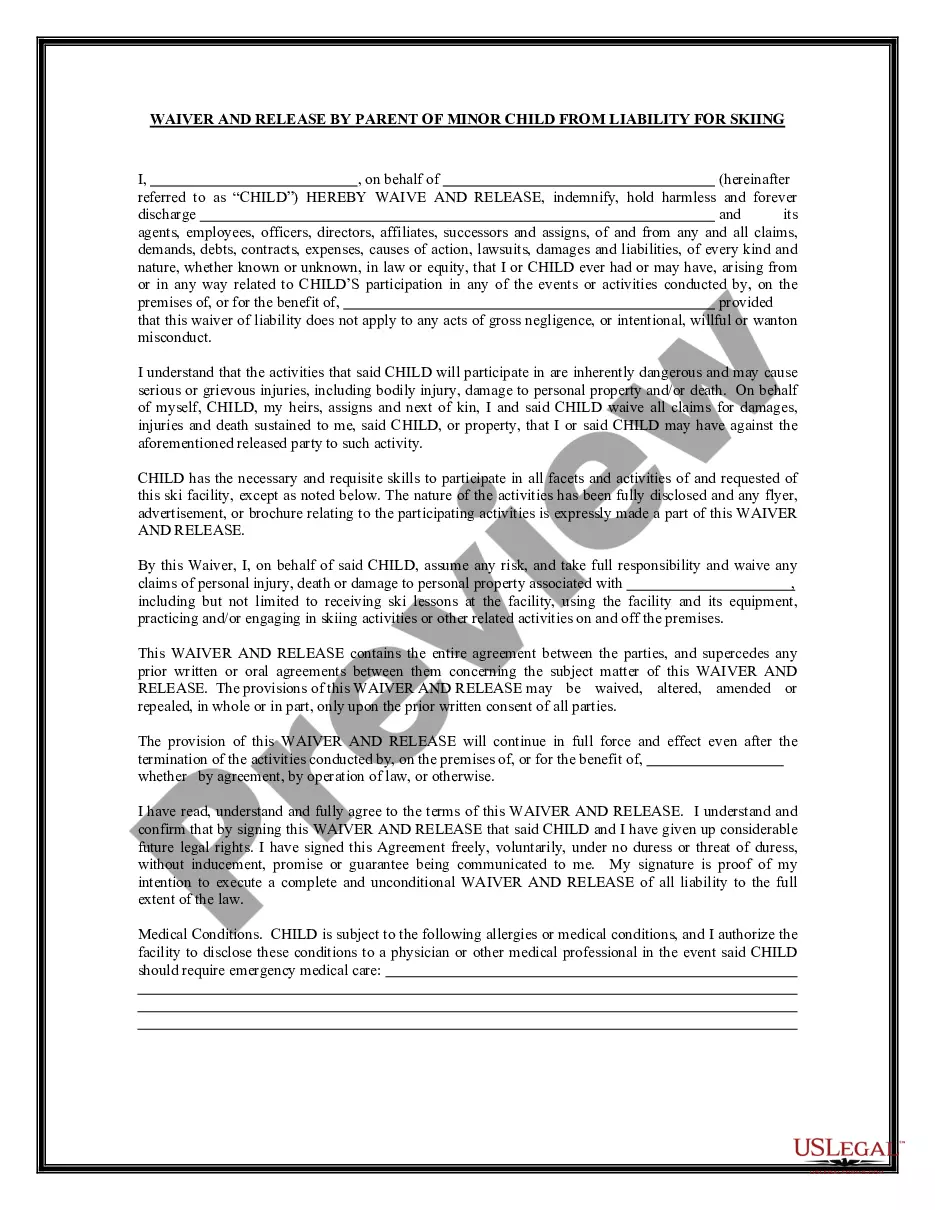
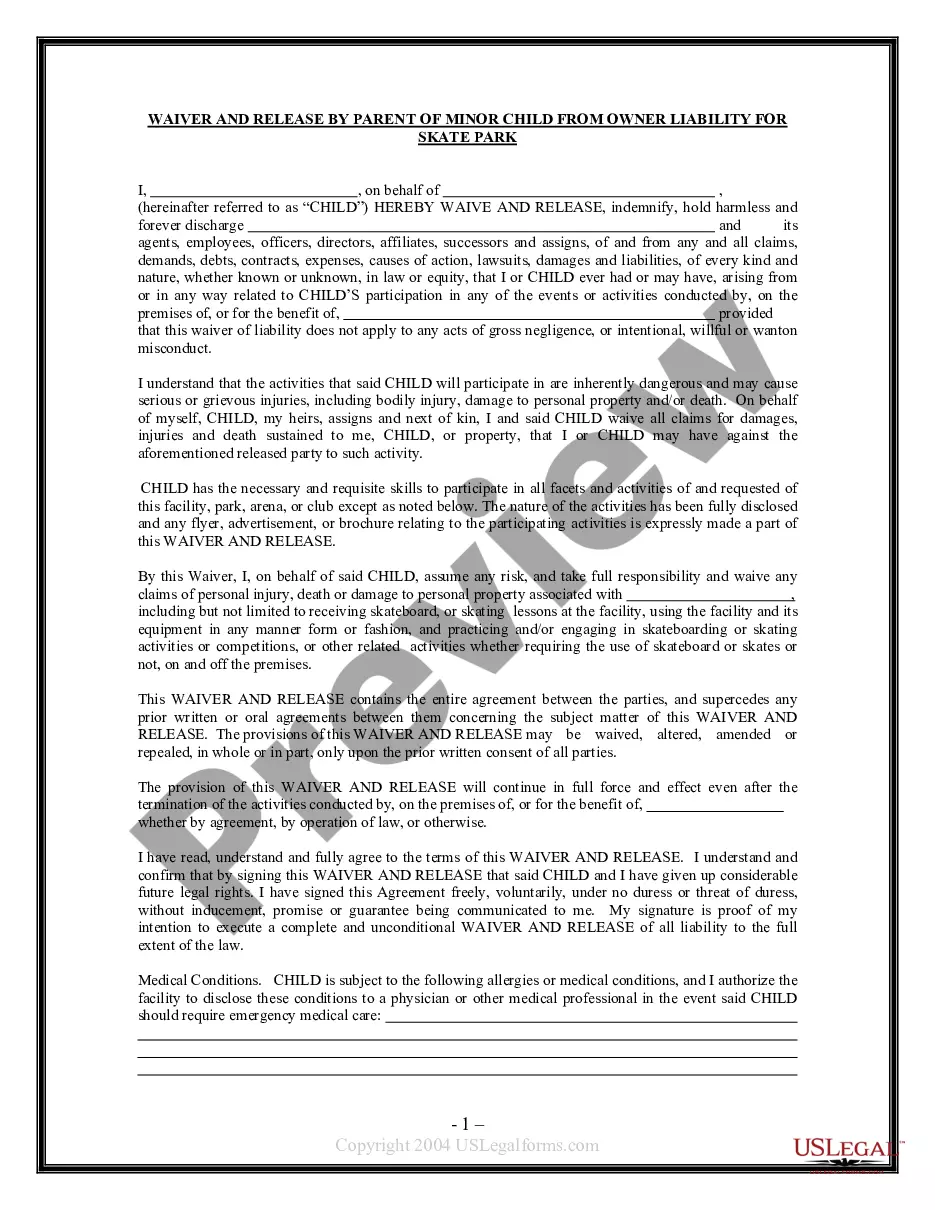
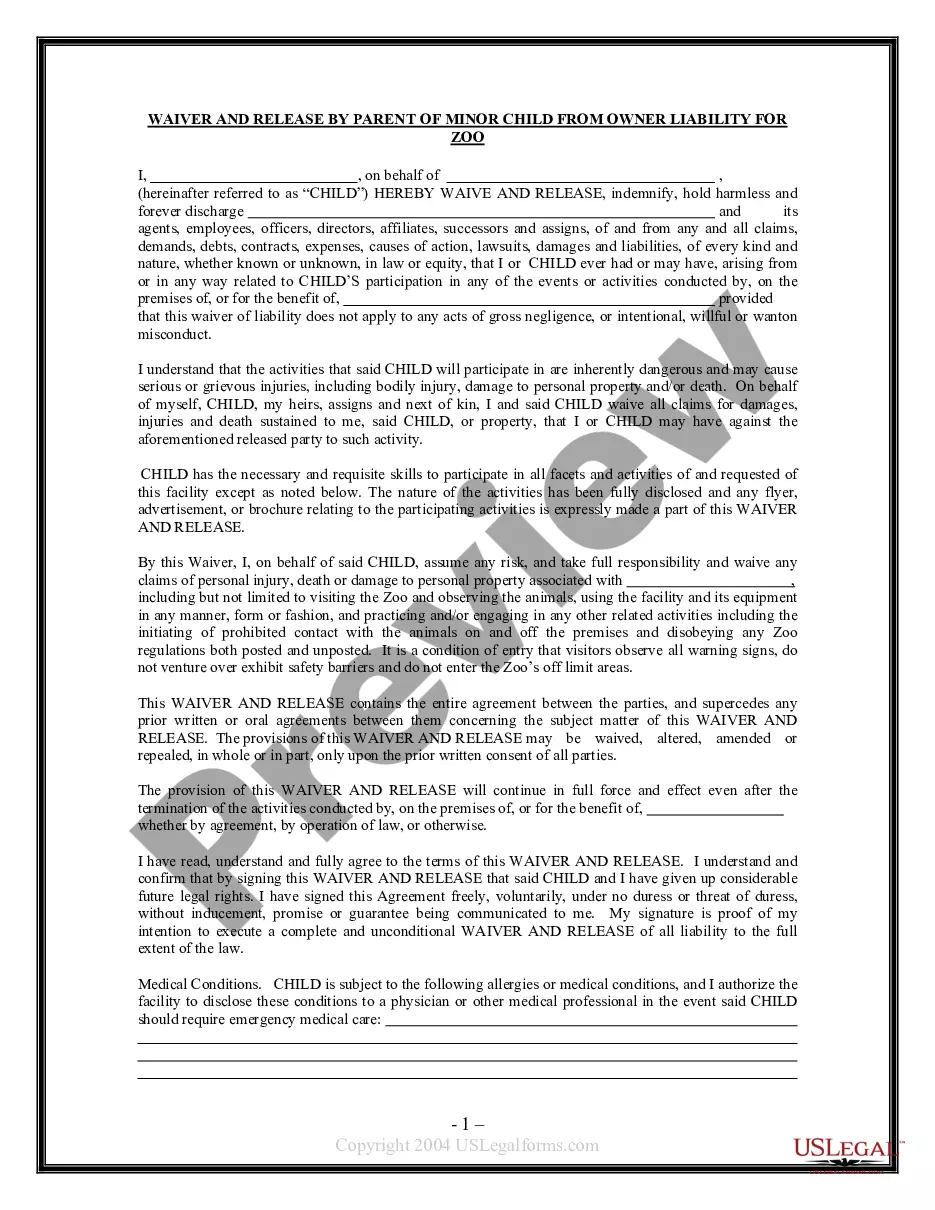
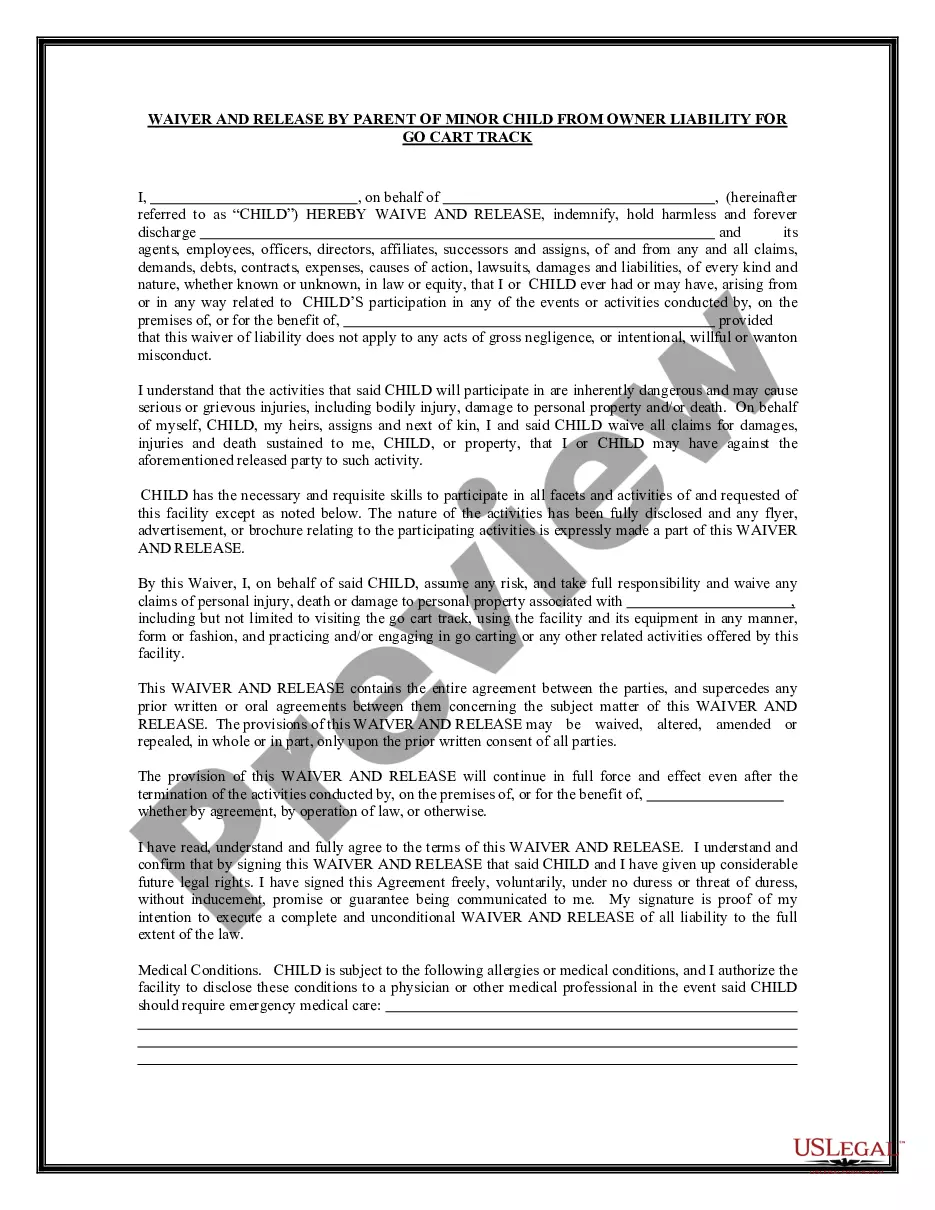
This form allows a parent or guardian to release an amusement park from liability for injuries which may be incurred by a minor child while on the premises, taking part in activities, etc.
Alaska Waiver and Release From Liability For Minor Child for Amusement Park
Category:
State:
Multi-State
Control #:
US-WAV-35M
Format:
Word;
Rich Text
Instant download
Description
Free preview
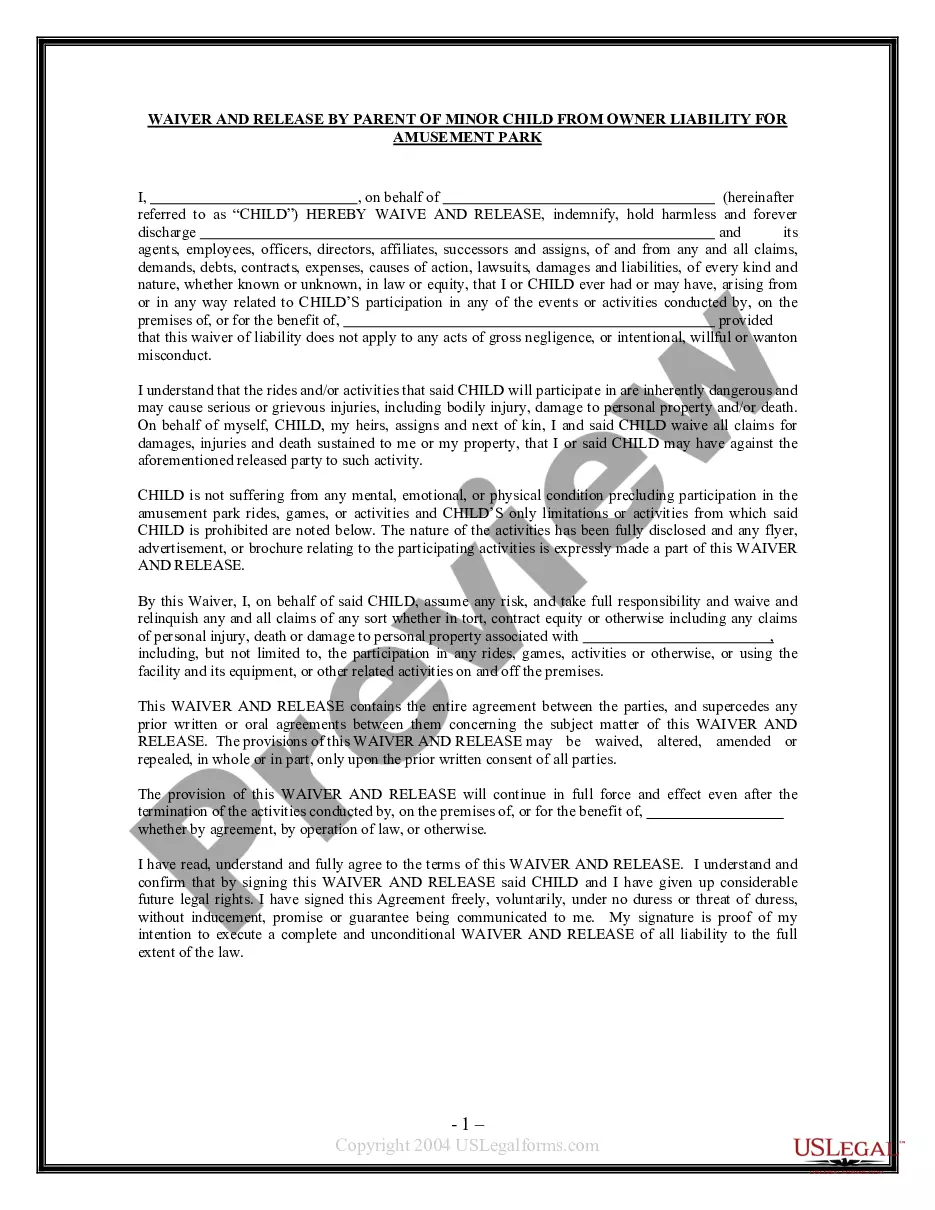
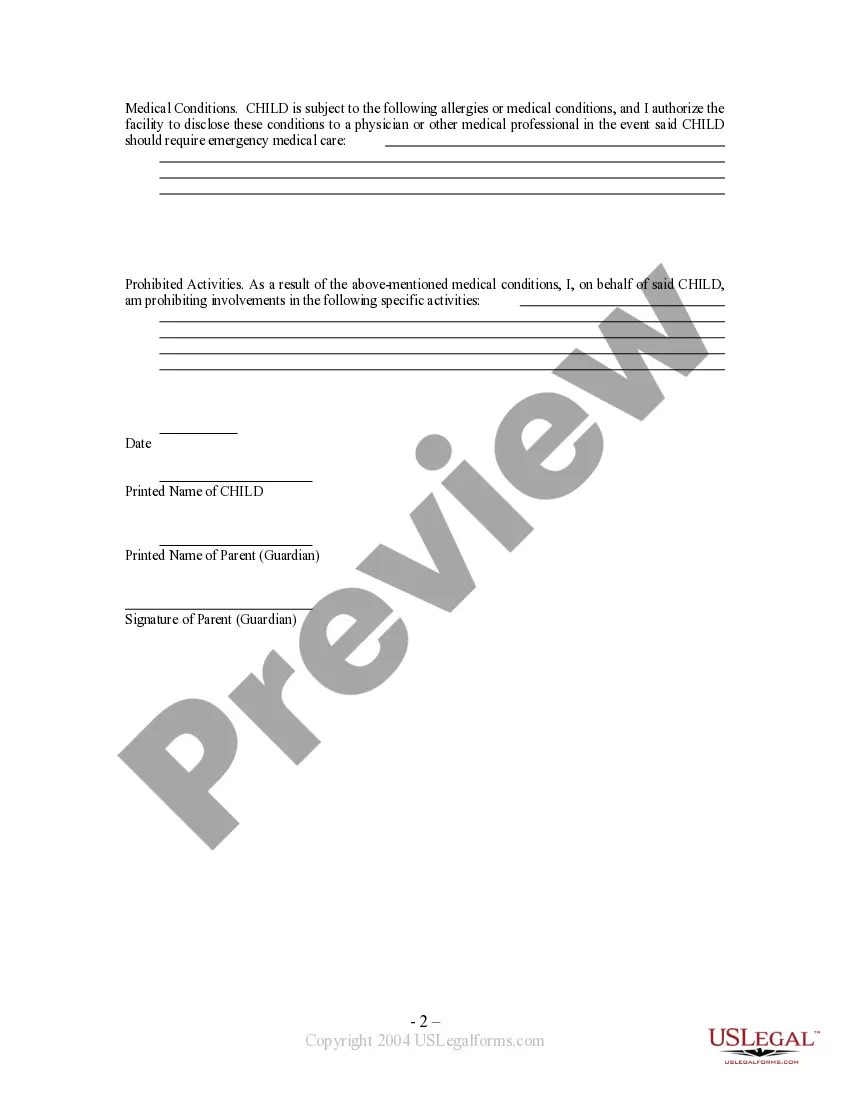
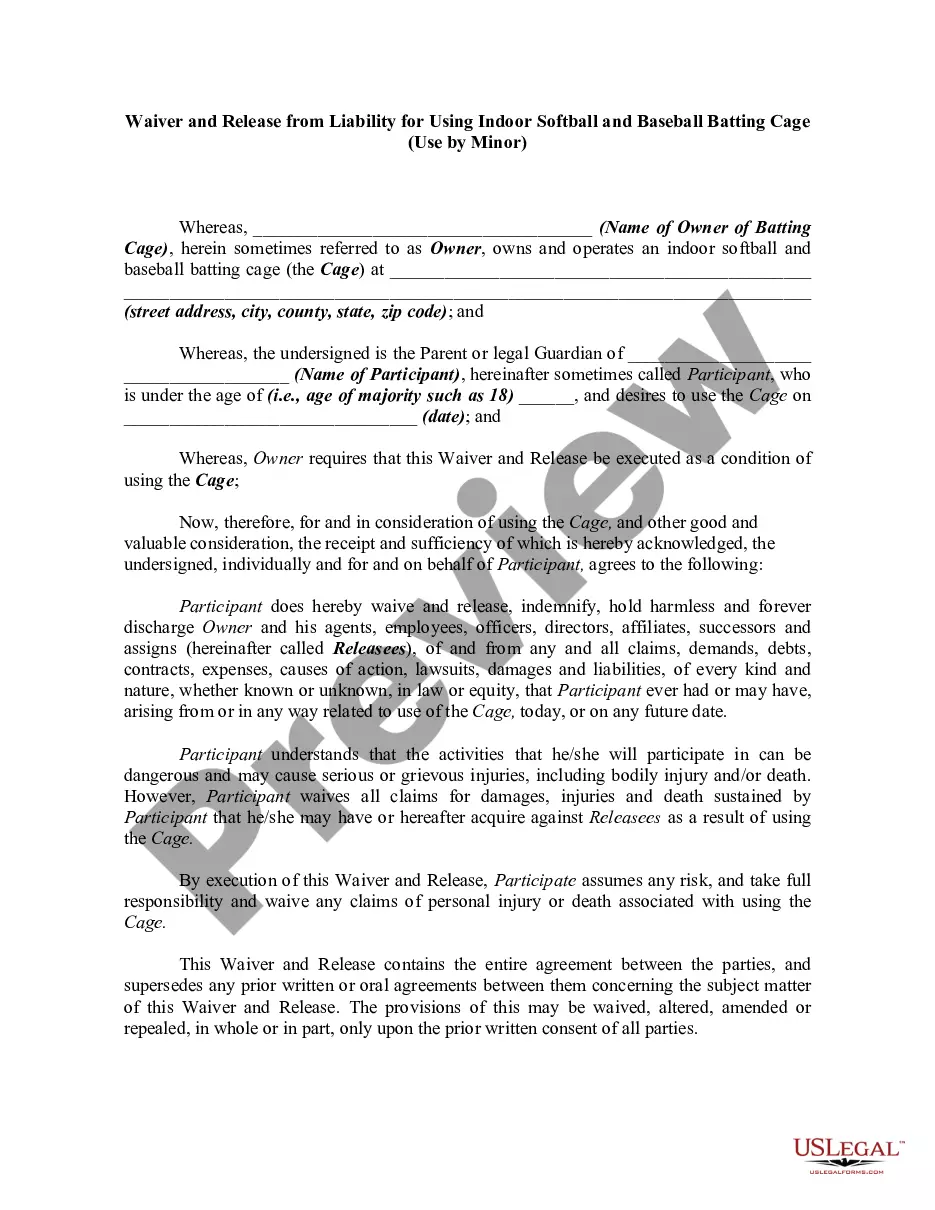
How to fill out Waiver And Release From Liability For Minor Child For Amusement Park?
Are you presently in a scenario that you will require documents for occasional organizational or personal purposes nearly every workday.
There are numerous authentic document templates available online, but locating ones you can rely on is not simple.
US Legal Forms offers thousands of form templates, such as the Alaska Waiver and Release From Liability For Minor Child for Amusement Park, designed to comply with state and federal requirements.
If you find the appropriate form, click on Get now.
Select the pricing plan you prefer, complete the necessary information to create your account, and pay for the transaction using your PayPal or credit card.
- If you are currently familiar with the US Legal Forms website and possess an account, simply Log In.
- Then, you can download the Alaska Waiver and Release From Liability For Minor Child for Amusement Park template.
- If you don’t have an account and wish to start using US Legal Forms, follow these instructions.
- Locate the form you need and ensure it corresponds to the correct city/county.
- Use the Review button to examine the form.
- Check the details to confirm you have selected the right form.
- If the form is not what you are searching for, utilize the Search field to find the form that meets your needs.
Form popularity
FAQ
Yes, most amusement parks require guests to sign a waiver. This waiver, often referred to as an Alaska Waiver and Release From Liability For Minor Child for Amusement Park, helps protect the park from legal claims arising from accidents or injuries. It is important for parents to read these waivers carefully, as they outline the risks involved. If you need a template or further information about these waivers, US Legal Forms offers resources to help you navigate this process.
To relinquish parental rights in Alaska, a parent must petition the court for termination of these rights. This process often involves proving that the termination serves the best interest of the child. Additionally, it is essential to understand the implications of this decision fully. If you require assistance, consider using US Legal Forms to access the necessary documents and guidance for completing the Alaska Waiver and Release From Liability For Minor Child for Amusement Park.
Ambiguous language or missing information can invalidate a waiver. The waiver contains errors that make it invalid. The language of the waiver must obey relevant state laws. An improperly worded or drafted waiver, as well as one that violates the law or public policy, may not hold up in court.
You might think that since you signed a waiver acknowledging the risks of the activity, you have no legal leg to stand on to file a personal injury lawsuit. Waivers can make personal injury lawsuits more complex, but you can still seek damages for injuries that could have and should have been prevented.
So, if an accident happens and injury occurs, is a Waiver effective in protecting the institution from liability and preventing a lawsuit from the injured party? The answer is that, if properly worded and signed, the Waiver is likely valid and will preclude legal claims for injuries.
Liability waivers are enforceable in California solely to the extent they shift to the customer the risk of ordinary negligence. Under California law, a liability waiver cannot excuse an injury caused by a defendant's gross negligence, recklessness or intentionally wrongful act.
Signing a waiver does not mean you automatically do not have the right to file a lawsuit after suffering a serious injury in California. Liability laws are complex and often require an attorney's assistance. If you signed a waiver before an activity that gave you an injury, speak to a lawyer about your rights.
To sum it up, customers can still sue business owners even when they've signed a waiver to use the business.
So, do liability waivers hold up in court? if you are injured as a result of ordinary negligence, the liability waiver may fully protect the defendant and leave you without legal recourse. If you are injured as a result of gross negligence, then you may have a case.
A liability waiver, or release of liability, is a legal document that a company or organization has you sign in order to protect them from being sued in the event that you are injured.