Texas Warning of Default on Residential Lease
Understanding this form
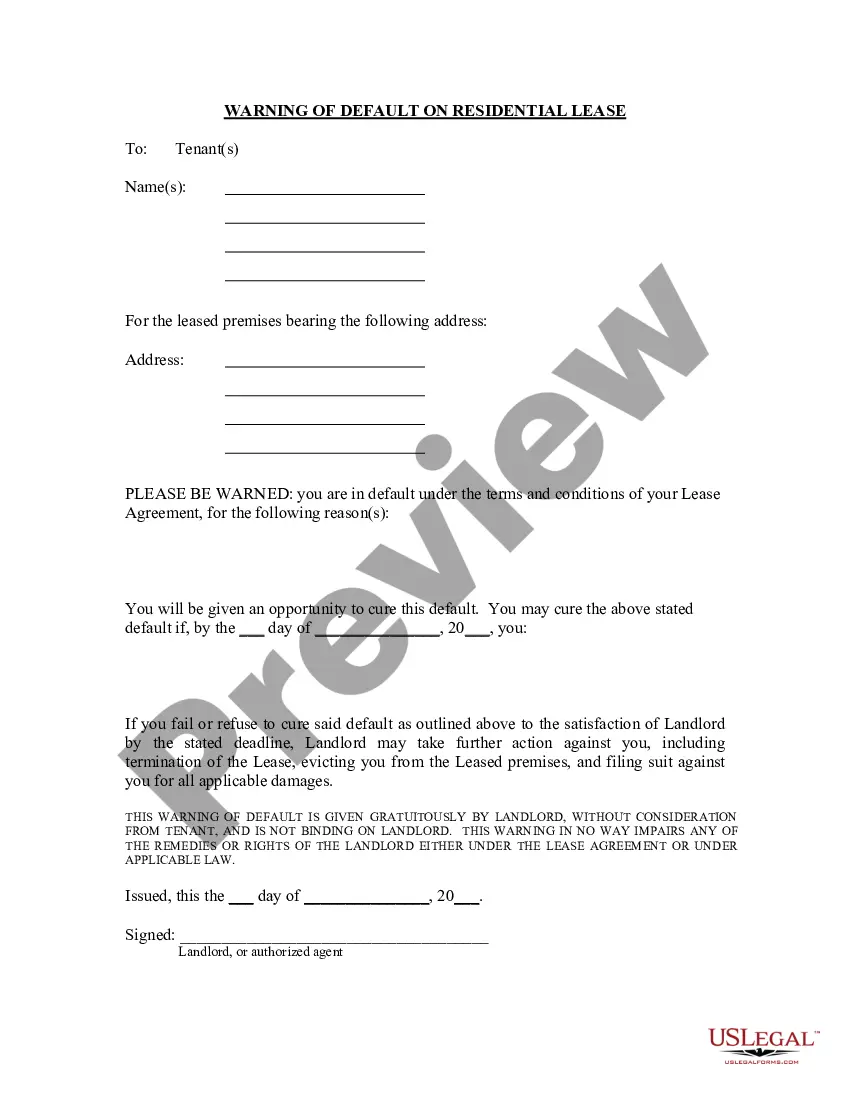
The Warning of Default on Residential Lease is a legal notice issued by a landlord to a tenant, alerting them that they may be in violation of their lease agreement. This form expresses the landlord's concern that if certain conditions are not addressed, the tenant could be considered in default. Unlike other notices or forms, this warning serves primarily as a preliminary step before further legal action, providing the tenant an opportunity to remedy the situation before any penalties are imposed.
What’s included in this form
- Condition of default: Specifies the reasons for the warning.
- Date of issuance: Indicates when the notice was given.
- Landlord's details: Includes the name and signature of the landlord or their authorized agent.
- Statements of rights: Clarifies that the warning does not limit the landlord's legal remedies.



When to use this document
This form is typically used when a tenant is suspected of breaching the lease agreement, such as failing to pay rent or violating property rules. It serves as a formal notice to the tenant, giving them a chance to correct the issue before the landlord takes further action, such as pursuing eviction or legal claims.
Who needs this form
This form is intended for use by:
- Landlords who wish to formally notify tenants of a lease violation.
- Property managers acting on behalf of landlords.
- Legal professionals representing landlords in tenant disputes.
Instructions for completing this form
- Identify the parties: Fill in the names of the landlord and tenant involved.
- Specify the property: Provide the address of the rental property.
- Enter the default conditions: Clearly describe the reasons for the warning.
- Fill in the date of issuance: Write the date when the warning is being issued.
- Sign the form: The landlord or their authorized agent should sign the document.
Does this document require notarization?
This form does not typically require notarization unless specified by local law. However, it is important to verify any state-specific requirements that may necessitate notarization for legal standing.
Get your form ready online
Our built-in tools help you complete, sign, share, and store your documents in one place.
Make edits, fill in missing information, and update formatting in US Legal Forms—just like you would in MS Word.
Download a copy, print it, send it by email, or mail it via USPS—whatever works best for your next step.
Sign and collect signatures with our SignNow integration. Send to multiple recipients, set reminders, and more. Go Premium to unlock E-Sign.
If this form requires notarization, complete it online through a secure video call—no need to meet a notary in person or wait for an appointment.
We protect your documents and personal data by following strict security and privacy standards.

Make edits, fill in missing information, and update formatting in US Legal Forms—just like you would in MS Word.

Download a copy, print it, send it by email, or mail it via USPS—whatever works best for your next step.

Sign and collect signatures with our SignNow integration. Send to multiple recipients, set reminders, and more. Go Premium to unlock E-Sign.

If this form requires notarization, complete it online through a secure video call—no need to meet a notary in person or wait for an appointment.

We protect your documents and personal data by following strict security and privacy standards.
Common mistakes to avoid
- Failing to specify the conditions of default clearly.
- Not including the date of issuance, which can delay the process.
- Neglecting to have the landlord's signature on the form.
Why complete this form online
- Convenience of instant download and access at any time.
- Editability allows for tailored modifications to meet specific needs.
- Reliability of forms drafted by licensed attorneys, ensuring legal validity.
Legal use & context
This warning is part of the legal process for managing tenant defaults. Providing this notice can help establish the landlord's efforts to resolve the issue amicably before proceeding with eviction or other legal action. However, it does not guarantee protection from legal remedies if the tenant fails to comply.
Summary of main points
- The Warning of Default on Residential Lease serves as a notice for lease violations.
- It gives tenants a chance to address issues before facing legal consequences.
- Correctly completing this form aids in maintaining legal standing in lease disputes.
Looking for another form?
Form popularity
FAQ
Negotiating a Month to Month Contract into a Lease Agreement When a potential tenant and a landlord are looking at rental forms together, they often go over most of what's on the lease, as a formality and to get on the same page regarding policy. This is the time to request a month to month lease situation.
In Texas, landlords must give tenants 30 days' notice before terminating the lease.Often, month-to-month leases are verbal, so the terms can seem murky. But Texas law is clearboth landlords and tenants can end their agreement at any time, as long as they give the other person 30 days' advance notice.
In a residential context, a landlord must issue proceedings at court to forfeit the lease. Before he does so, the leaseholder must either admit the breach or there must be a court or tribunal determination that the leaseholder is indeed in breach.
Your lease agreement will state what constitutes a default of the lease as well as if there is any grace period in making lease payments. Not making a contractually required monthly payment will normally be a breach of the lease and the lessor can then repossess the vehicle from you.
A landlord can simply give you a written notice to move, allowing you one month as required by Texas law and specifying the date on which your tenancy will end. However, the landlord and tenant may agree in writing to different notice periods, or none at all.
STEPS TO TAKE BEFORE FORFEITING A LEASE Conventionally, it will apply to any breach of covenant by the tenant, except that, where rent is concerned, the right to forfeit will usually only arise 14 or 21 days after the rent falls due.
In landlord-tenant law, default refers to the failure of a tenant to timely pay rent due.In general, the landlord is required to give the tenant notice of the default before bringing eviction proceedings or applying security deposit proceeds to the payment in default.
When a lease ends, a tenant may choose to move, continue to pay rent as a month-to-month tenant, or sign a new lease. If a tenant continues to pay rent after a lease ends, in most states the terms of the expired lease carry over into a month-to-month tenancy.
In a residential context, a landlord must issue proceedings at court to forfeit the lease. Before he does so, the leaseholder must either admit the breach or there must be a court or tribunal determination that the leaseholder is indeed in breach.