Texas Gift Deed for Individual to Individual
About this form
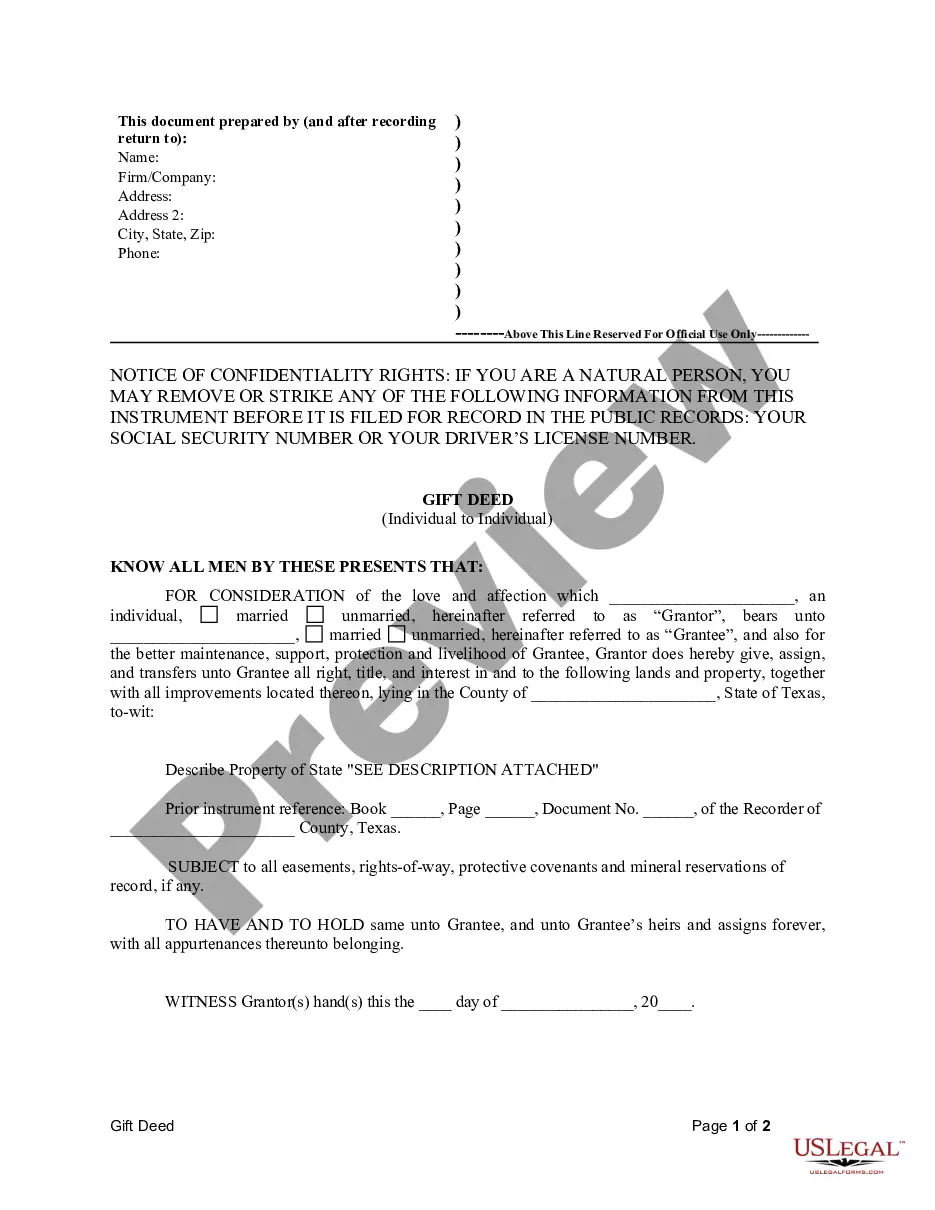
The Texas Gift Deed for Individual to Individual is a legal document that allows one individual (the Grantor) to transfer ownership of property to another individual (the Grantee) without any financial exchange. This form is specifically drafted to comply with Texas law and is distinct from other property transfer documents, as it emphasizes the gift aspect and the personal relationship between the parties involved.
What’s included in this form
- Grantor and Grantee information: Names and marital status of both parties.
- Property description: Specific details about the property being transferred.
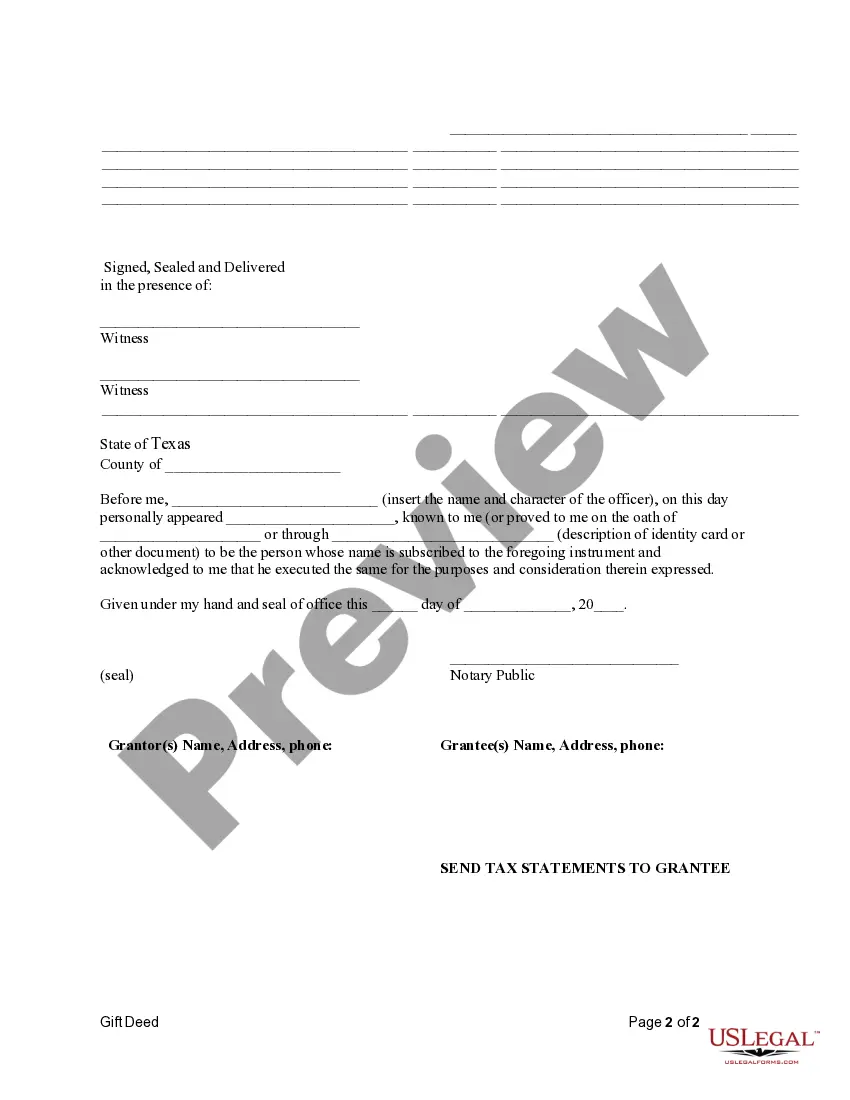
- Acknowledgment by a notary: A section for notarization to validate the deed.
- Consideration: Statement of love and affection for the gift.
- Legal references: Information about prior instruments and county recording.



When this form is needed
Use this form when you wish to formally gift property to an individual without receiving payment in return. Common scenarios include transferring property to a family member or friend as a gesture of goodwill, or when parents wish to transfer ownership of a family home to their children. It is essential to use this deed in situations where a legal acknowledgment of the gift is needed to avoid any future disputes.
Who can use this document
- Individuals looking to transfer property ownership as a gift
- Family members wishing to pass down property without financial compensation
- Friends who want to gift real estate or other significant assets
- Anyone needing a compliant legal document for property transfer in Texas
Steps to complete this form
- Identify the Grantor and Grantee: Provide the full names and marital status of both parties involved.
- Specify the property: Include a detailed description of the property being gifted, referencing its legal location.
- Enter the date: Fill in the date on which the deed is executed.
- Sign the document: The Grantor must sign the deed to authenticate the transfer.
- Obtain notarization: Have the document notarized to ensure legal validity.
Notarization guidance
This document requires notarization to meet legal standards. US Legal Forms provides secure online notarization powered by Notarize, allowing you to complete the process through a verified video call, available 24/7.
Get your form ready online
Our built-in tools help you complete, sign, share, and store your documents in one place.
Make edits, fill in missing information, and update formatting in US Legal Forms—just like you would in MS Word.
Download a copy, print it, send it by email, or mail it via USPS—whatever works best for your next step.
Sign and collect signatures with our SignNow integration. Send to multiple recipients, set reminders, and more. Go Premium to unlock E-Sign.
If this form requires notarization, complete it online through a secure video call—no need to meet a notary in person or wait for an appointment.
We protect your documents and personal data by following strict security and privacy standards.

Make edits, fill in missing information, and update formatting in US Legal Forms—just like you would in MS Word.

Download a copy, print it, send it by email, or mail it via USPS—whatever works best for your next step.

Sign and collect signatures with our SignNow integration. Send to multiple recipients, set reminders, and more. Go Premium to unlock E-Sign.

If this form requires notarization, complete it online through a secure video call—no need to meet a notary in person or wait for an appointment.

We protect your documents and personal data by following strict security and privacy standards.
Typical mistakes to avoid
- Failing to provide a complete property description.
- Not including the necessary details for notarization.
- Forgetting to sign the document before a notary.
- Leaving out the acknowledgment of the Grantor's love and affection.
Advantages of online completion
- Convenience: Download the form instantly from any location.
- Editability: Customize the form to reflect your specific situation.
- Reliability: Professionally drafted by licensed attorneys to ensure accuracy.
Looking for another form?
Form popularity
FAQ
Gift made by way of movable property is required to be made in stamp paper and stamped by the notary or court. Registration of gift deed is not required in case of transfer of moveable property.Gift of immovable property which is not registered is not a valid as per law and cannot pass any title to the donee.
Gift deeds transfer title to real property from one party to another with no exchange of consideration, monetary or otherwise. Often used to transfer property between family members or to transfer property as a charitable act or donation, these transfers occur during the grantor's lifetime.
Find the most recent deed to the property. It is best to begin with a copy of the most recent deed to the property (the deed that transferred the property to the current grantor). Create a new deed. Sign and notarize the deed. File the documents in the county land records.
A gift deed, or deed of gift, is a legal document voluntarily transferring title to real property from one party (the grantor or donor) to another (the grantee or donee), typically between family members or close friends. Gift deeds are also used to donate to a non-profit organization or charity.
Section 122 of the Transfer of Property Act defines a gift deed as a legal document that describes the voluntary transfer of gift from a donor (owner of the property) to donee (receiver of gift) without any exchange of money. The donor must be solvent and should not use this tool for tax evasion and illegal gains.
To be valid, gift deeds in Texas further require the document set forth (1) the intent of the grantor, (2) the delivery of the property to the grantee, and (3) the gift to be accepted by the grantee. The one claiming the gift bears the burden to establish each of the elements.
The gift cannot ever be revoked nor can you later ask for financial compensation. Disadvantages of a Gift Deed? Usually a Gift Deed is used to transfer property between family members. As a result, the transaction may be subject to coercion or fraud.