Texas Warranty Deed from Husband and Wife to a Trust
What this document covers
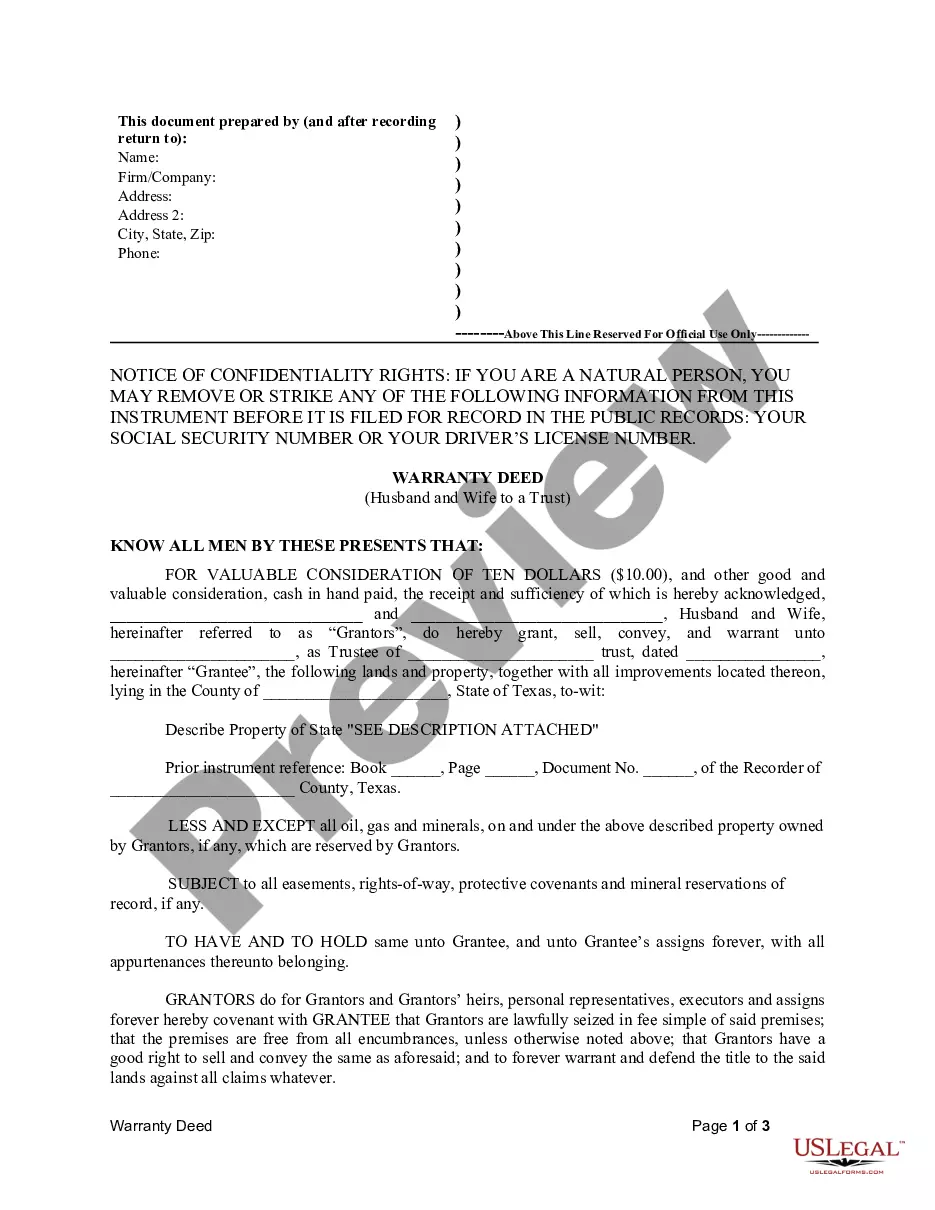
The Warranty Deed from Husband and Wife to a Trust is a legal document that allows a couple to transfer ownership of their property into a trust. This deed ensures that the property is conveyed to a trustee, providing specific warranties about the title. Unlike other deeds, this form distinctly outlines the reservation of certain rights related to oil, gas, and minerals beneath the property. It complies with state statutory laws and is essential for estate planning and asset protection strategies.
What’s included in this form
- Identification of Grantors (Husband and Wife) and Grantee (Trustee of the Trust).
- Legal description of the property being transferred.
- Reservation clause for oil, gas, and mineral rights.
- Warranties regarding title and the absence of encumbrances.
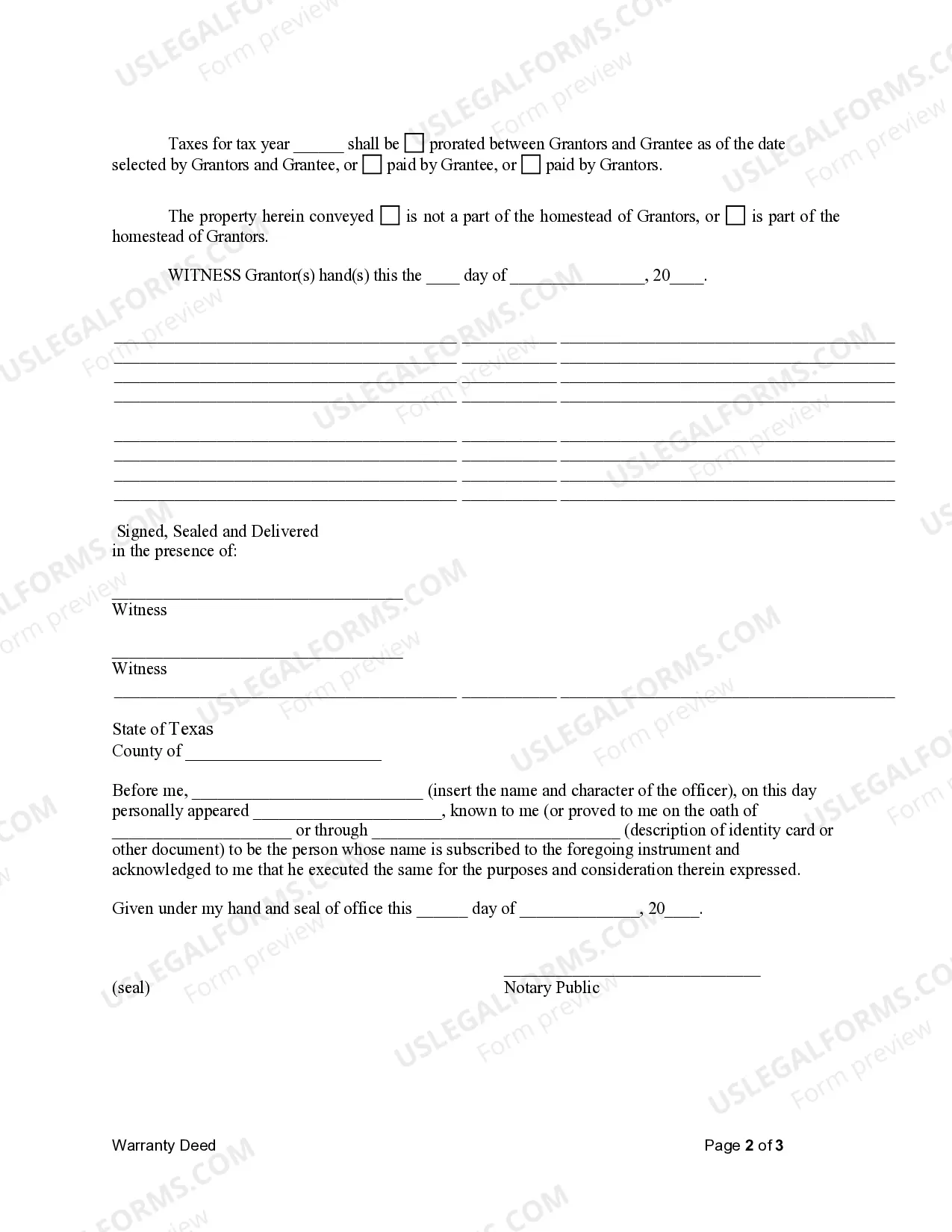
- Provisions for proration of property taxes between the Grantors and Grantee.
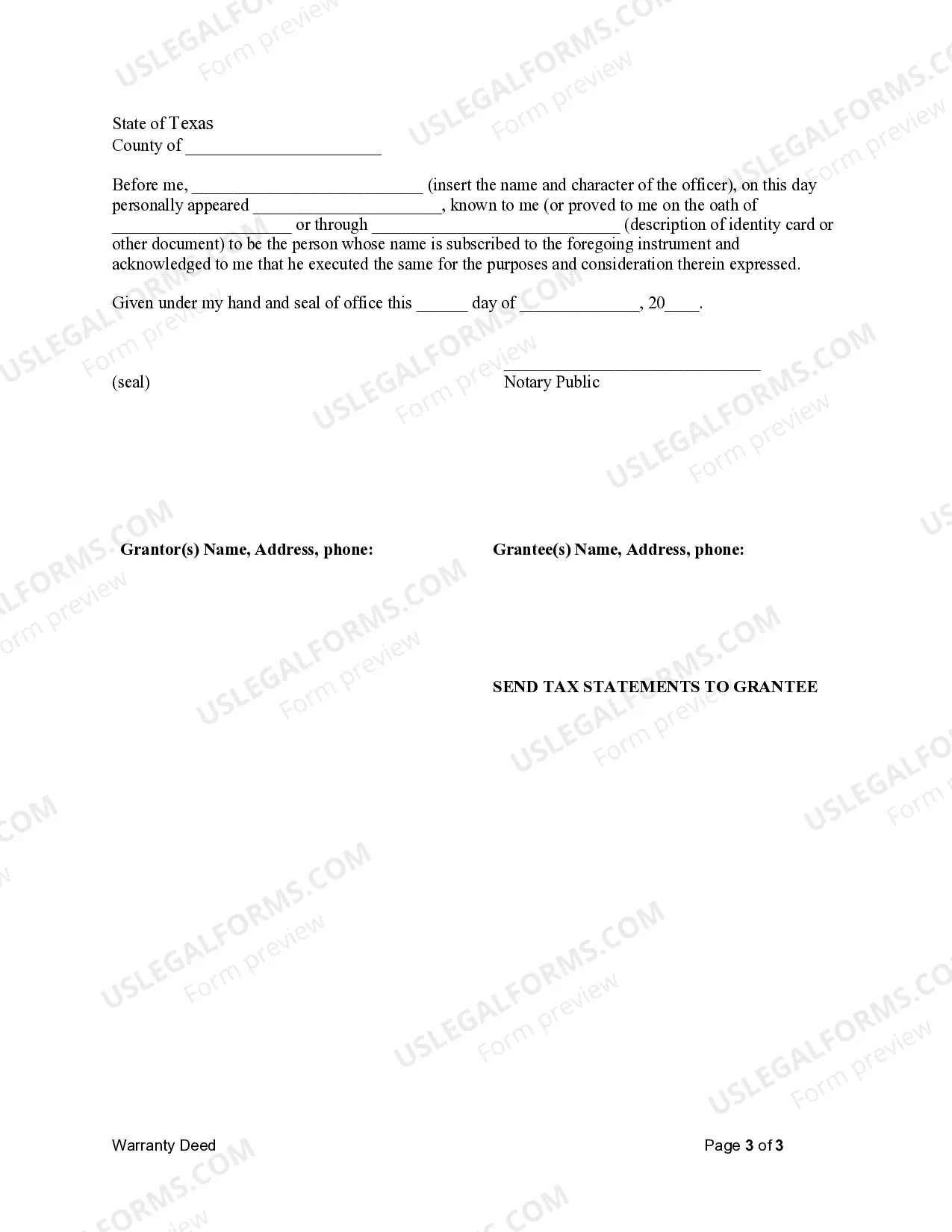
- Signature block for both Grantors and acknowledgment by a Notary Public.




When to use this document
This form is commonly used when a married couple wants to place their property into a trust for estate planning purposes. It is particularly useful when the couple wishes to manage the property through a trustee for their beneficiaries. Additionally, it may be used during the separation of assets in a divorce or in cases where the couple seeks to protect their property from creditors.
Who can use this document
- Married couples wishing to transfer property into a trust.
- Individuals involved in estate planning or asset protection strategies.
- Couples looking to manage property through a trust for the benefit of their heirs.
- Those wanting to ensure clarity regarding ownership and rights over property.
How to complete this form
- Identify and fill in the names of the Grantors (Husband and Wife).
- Enter the name of the Grantee (Trustee) and the specific Trust name.
- Provide a detailed legal description of the property being transferred.
- Specify the reservation of oil, gas, and minerals if applicable.
- Both Grantors must sign the document in the designated areas.
- Have the signatures acknowledged by a Notary Public.
Notarization requirements for this form
To make this form legally binding, it must be notarized. Our online notarization service, powered by Notarize, lets you verify and sign documents remotely through an encrypted video session.
Get your form ready online
Our built-in tools help you complete, sign, share, and store your documents in one place.
Make edits, fill in missing information, and update formatting in US Legal Forms—just like you would in MS Word.
Download a copy, print it, send it by email, or mail it via USPS—whatever works best for your next step.
Sign and collect signatures with our SignNow integration. Send to multiple recipients, set reminders, and more. Go Premium to unlock E-Sign.
If this form requires notarization, complete it online through a secure video call—no need to meet a notary in person or wait for an appointment.
We protect your documents and personal data by following strict security and privacy standards.

Make edits, fill in missing information, and update formatting in US Legal Forms—just like you would in MS Word.

Download a copy, print it, send it by email, or mail it via USPS—whatever works best for your next step.

Sign and collect signatures with our SignNow integration. Send to multiple recipients, set reminders, and more. Go Premium to unlock E-Sign.

If this form requires notarization, complete it online through a secure video call—no need to meet a notary in person or wait for an appointment.

We protect your documents and personal data by following strict security and privacy standards.
Common mistakes to avoid
- Failing to provide a complete and accurate legal description of the property.
- Not reserving mineral rights if applicable, which could affect ownership in the future.
- Ignoring the requirement for notarization, which could render the deed invalid.
- Omitting the proration of taxes, leading to disputes later.
Why complete this form online
- Convenience of downloading and filling the form at any time.
- Editability allows users to customize the document as needed.
- Reliable templates drafted by licensed attorneys ensure legal compliance.
- Immediate access to updates reflecting changes in state laws.
Legal use & context
- This form provides legal evidence of the transfer of property from the grantors to the trust.
- Ensures that the grantors are protected from future claims to the property as long as the transfer is properly executed.
- Facilitates estate planning by allowing property to be managed in accordance with the terms of the trust.
Quick recap
- This Warranty Deed is essential for transferring property from a husband and wife to a trust.
- Accurate completion and notarization of the form are critical for legal validity.
- Understanding the rights retained and conveyed is crucial for proper asset management.
Looking for another form?
Form popularity
FAQ
State of Texas (and perhaps other community-property states), gives that right to the non-owner spouse that other spouse (separate-property owner) cannot sell properties without her consent and approval, regardless if she is entitled to the property or not.
In the context of a California mortgage transaction, a trust deed also transfer ownership. Only this time, the title is being placed in the hands of a third-party trustee, who holds the property on behalf of the lender and the homeowner-borrower until the mortgage is paid.
In Texas, the trustee is specifically appointed within the deed of trust document. Usually, the beneficiary of a deed of trust chooses the trustee. Technically, a trustee can be any individual or entity that is willing to serve in that capacity.
A property deed, or house deed, is a legal document that transfers ownership of real estate from the grantor (seller) to the grantee (buyer). Property deeds are the legal tool of defining ownership. When a property or house is sold, the buyer and seller sign the deed to transfer ownership.
It's important to note that a warranty deed does not actually prove the grantor has ownership (a title search is the best way to prove that), but it is a promise by the grantor that they are transferring ownership and if it turns out they don't actually own the property, the grantor will be responsible for compensating
In every sale transaction a title company is required to determine if the seller of the property is married. If they are married, their spouse is typically required to sign a document at closing and the document changes depending on the classification of the property as homestead or investment.
If you are married and your name is not on the title deed, you may have relinquished your ownership right.
Because the Deed of Trust basically "shares" ownership between the borrower and the lender's trustee, and because Texas is a community property state, both the borrower and the spouse (even if they are not on the mortgage note) must be on the Deed of Trust.
It is also crucial that a spouse know about the loan, even if he or she is not on the mortgage. In general, the spouse must sign a deed of trust, the Truth in Lending and Right to Cancel documents. By signing these documents, they are simply acknowledging the existence of the mortgage.