Texas Renunciation And Disclaimer of Property from Will by Testate
Overview of this form
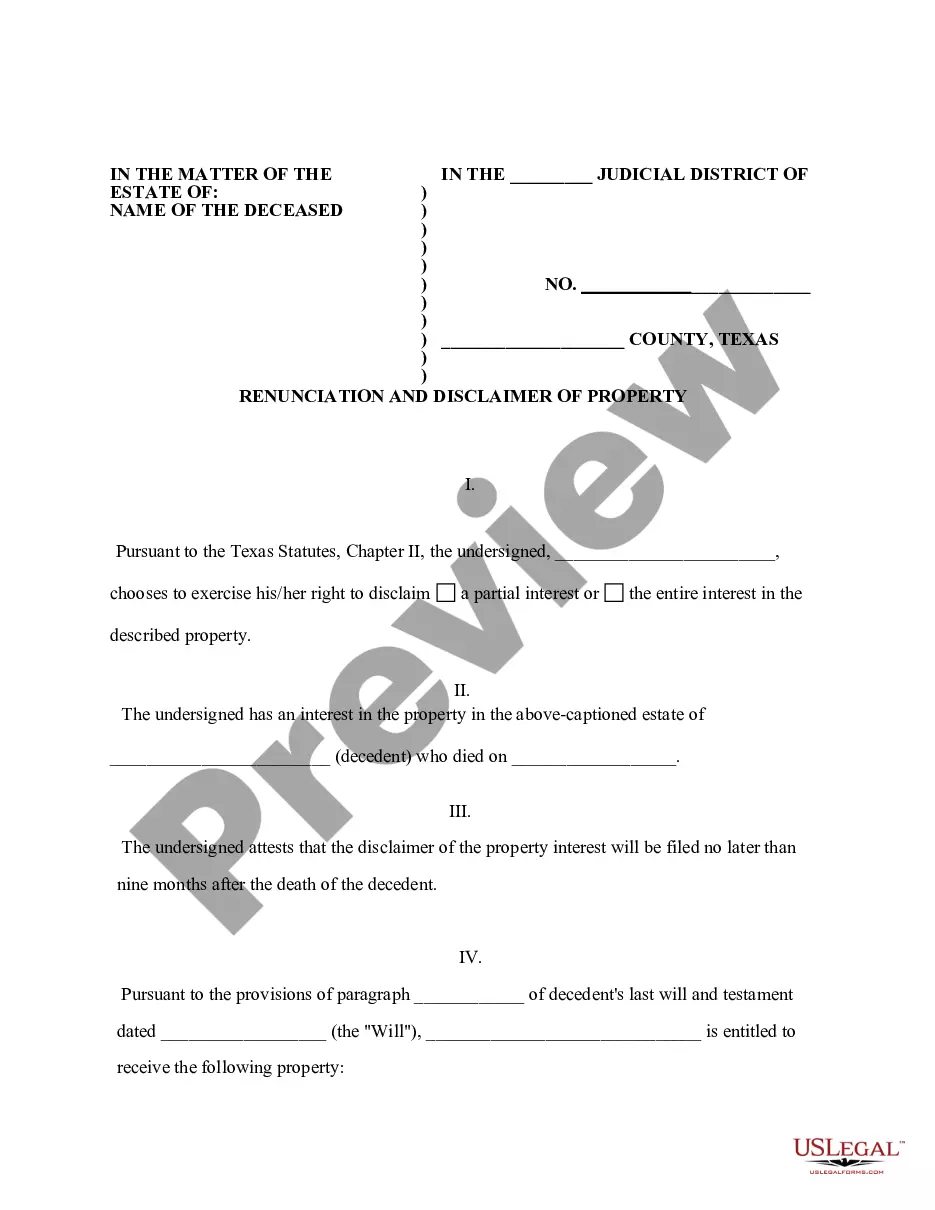
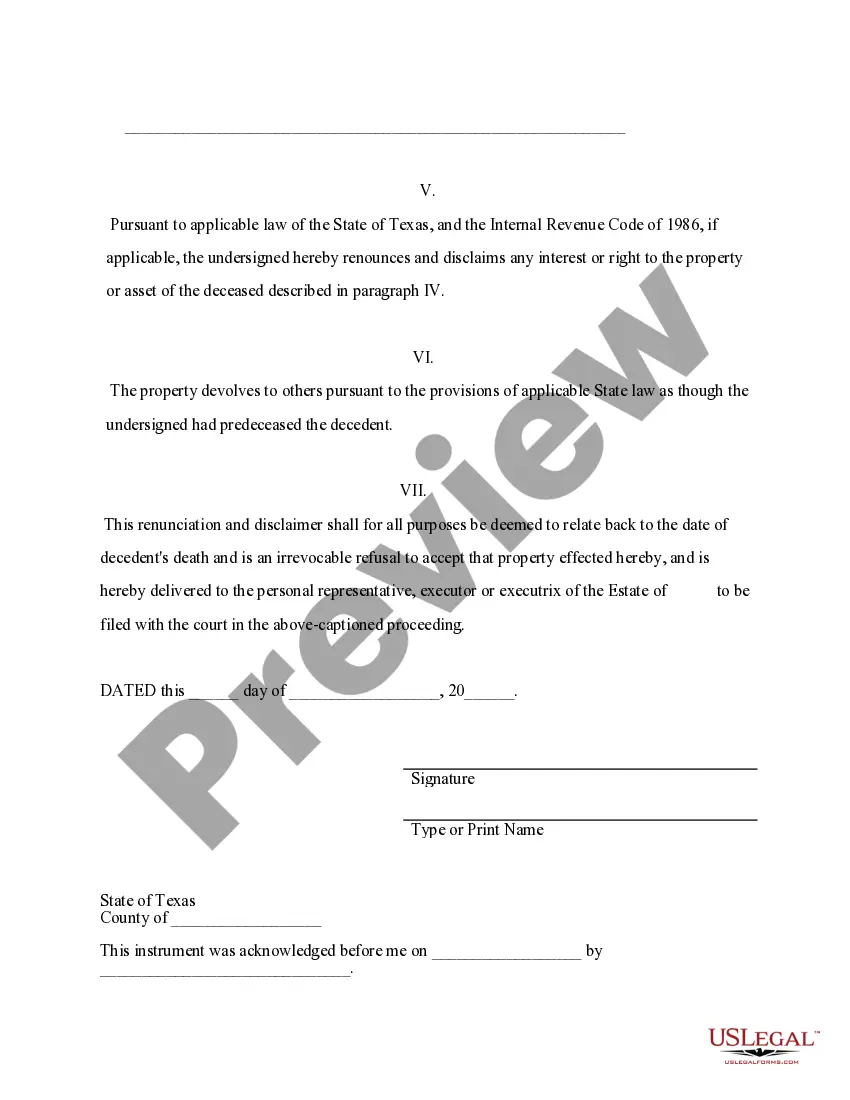
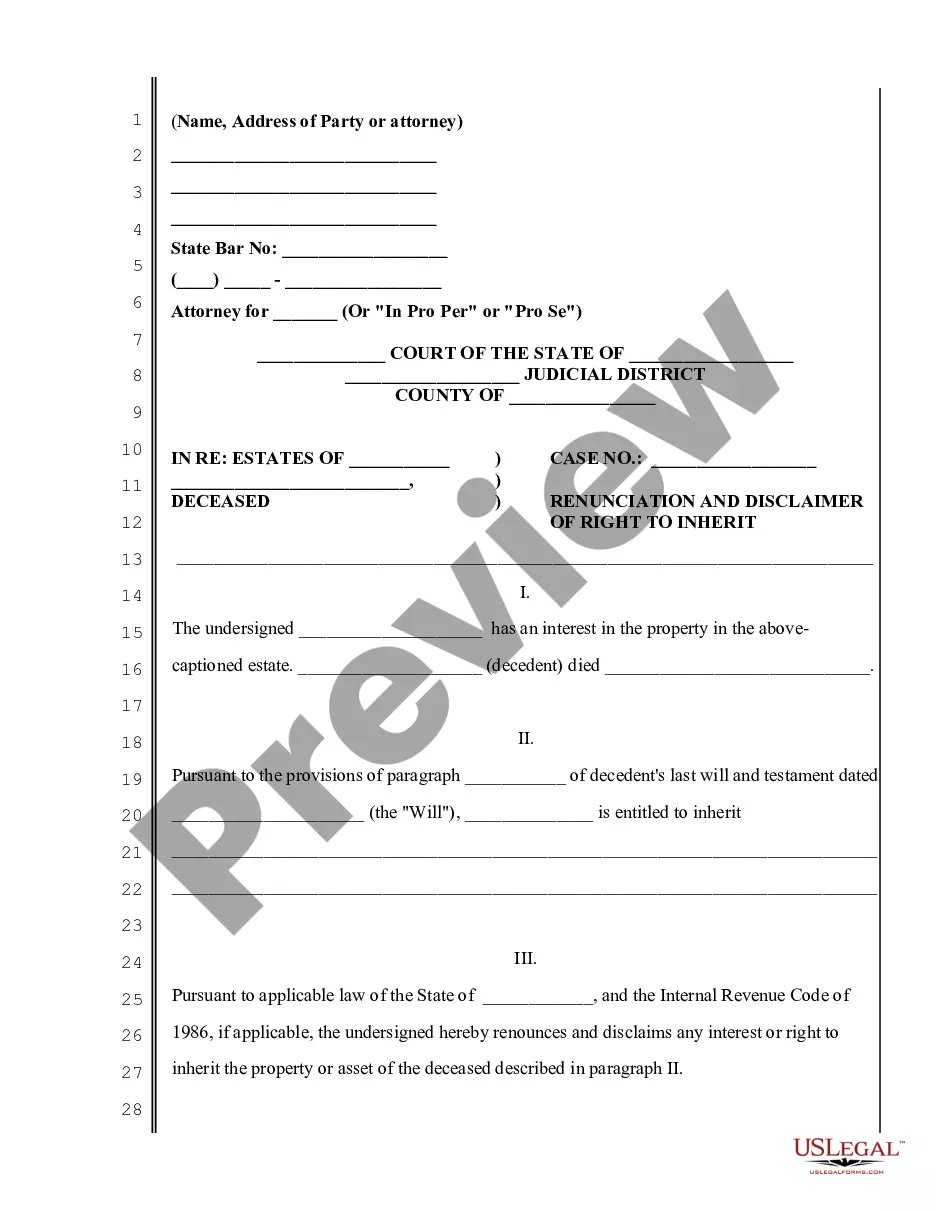
The Renunciation and Disclaimer of Property from Will by Testate is a legal document that allows a beneficiary to formally reject all or part of their interest in property inherited through a decedent's will. This form ensures that the beneficiary can waive their rights to the property, which will then pass to other heirs as if the beneficiary had predeceased the decedent. It is essential for beneficiaries who may not wish to accept inherited property for personal, financial, or estate planning reasons.
Key parts of this document
- Declaration of the beneficiary's intent to renounce interest in the property.
- Identification of the deceased and the date of death.
- Confirmation that the disclaimer will be filed within nine months of the decedent's death.
- Specification of the property inherited per the decedent's will.
- Legal acknowledgment that renouncing will affect property distribution under state law.

When this form is needed
This form should be used when a beneficiary of a will decides not to accept property or assets that have been bequeathed to them. Common scenarios include situations where inheriting property could lead to tax burdens, or conflicts with other beneficiaries, or when personal circumstances have changed, making acceptance of the inheritance undesirable.
Who needs this form
- Beneficiaries named in a will who want to renounce their interest in a property.
- Individuals looking to navigate complex family or financial situations concerning inherited property.
- Anyone seeking to ensure a clear and legally recognized disclaimer of interest to prevent future disputes.
How to complete this form
- Identify the beneficiary and provide their name in the declaration section.
- Fill in the decedent's name and the date of death accurately.
- Clearly state the portion of the interest in the property that is being disclaimed.
- List the specific property or assets in question as stated in the decedent's will.
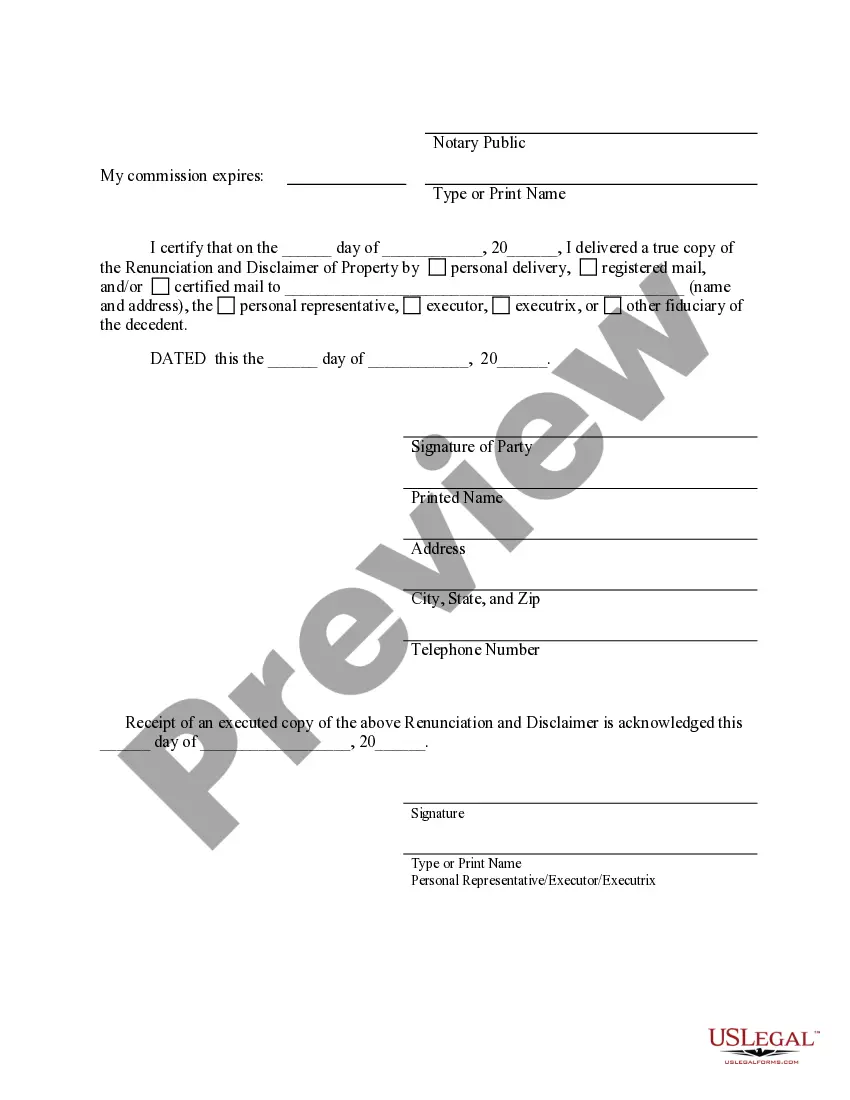
- Ensure all relevant signatures are obtained and the disclaimer is filed within the specified time frame.
Does this form need to be notarized?
This form does not typically require notarization unless specified by local law. However, it is advisable to consult with an attorney to ensure that all legal requirements are met properly.
Get your form ready online
Our built-in tools help you complete, sign, share, and store your documents in one place.
Make edits, fill in missing information, and update formatting in US Legal Forms—just like you would in MS Word.
Download a copy, print it, send it by email, or mail it via USPS—whatever works best for your next step.
Sign and collect signatures with our SignNow integration. Send to multiple recipients, set reminders, and more. Go Premium to unlock E-Sign.
If this form requires notarization, complete it online through a secure video call—no need to meet a notary in person or wait for an appointment.
We protect your documents and personal data by following strict security and privacy standards.

Make edits, fill in missing information, and update formatting in US Legal Forms—just like you would in MS Word.

Download a copy, print it, send it by email, or mail it via USPS—whatever works best for your next step.

Sign and collect signatures with our SignNow integration. Send to multiple recipients, set reminders, and more. Go Premium to unlock E-Sign.

If this form requires notarization, complete it online through a secure video call—no need to meet a notary in person or wait for an appointment.

We protect your documents and personal data by following strict security and privacy standards.
Common mistakes
- Failing to file the disclaimer within the nine-month deadline.
- Not clearly specifying the exact property being disclaimed.
- Overlooking the requirement for signatures or acknowledgments.
Advantages of online completion
- Convenient access to legal documents that can be downloaded and completed at your own pace.
- Editable templates that allow customization to meet specific needs.
- Authored by licensed attorneys to ensure compliance with legal standards.
Key takeaways
- The Renunciation and Disclaimer of Property allows beneficiaries to withdraw from accepting an inheritance.
- Timeliness is crucial: disclaimers must be filed within nine months of the decedentâs death.
- Proper completion of the form safeguards against future legal disputes regarding the property.
Looking for another form?
Form popularity
FAQ
The answer is yes. The technical term is "disclaiming" it. If you are considering disclaiming an inheritance, you need to understand the effect of your refusalknown as the "disclaimer"and the procedure you must follow to ensure that it is considered qualified under federal and state law.
If you refuse to accept an inheritance, you will not be responsible for inheritance taxes, but you'll have no say in who receives the assets in your place. The bequest passes either to the contingent beneficiary listed in the will or, if that person died without a will, according to your state's laws of intestacy.
Be in writing; Declare the refusal to accept an interest in or power over the property; Describe the interest or power disclaimed; Be signed by the person making a disclaimer;
Put the disclaimer in writing. Deliver the disclaimer to the person in control of the estate usually the executor or trustee. Complete the disclaimer within nine months of the death of the person leaving the property.
Disclaim, in a legal sense, refers to the renunciation of an interest in, or an acceptance of, inherited assets, such as property, by way of a legal instrument. A person disclaiming an interest, right, or obligation is known as a disclaimant.
The disclaimer must be in writing: A signed letter by the person doing the disclaiming, identifying the decedent, describing the asset to be disclaimed, and the extent and amount, percentage or dollar amount, to be disclaimed, must be delivered to the person in control of the estate or asset, such as an executor,
Put the disclaimer in writing. Deliver the disclaimer to the person in control of the estate usually the executor or trustee. Complete the disclaimer within nine months of the death of the person leaving the property. Do not accept any benefit from the property you're disclaiming.
Disclaim Inheritance, DefinitionDisclaiming means that you give up your rights to receive the inheritance. If you choose to do so, whatever assets you were meant to receive would be passed along to the next beneficiary in line.
Yes, a fiduciary can disclaim an interest in property if the will, trust or power of attorney gives the fiduciary that authority or if the appropriate probate court authorizes the disclaimer.The primary reason an executor or trustee might disclaim property passing to an estate or trust is to save death taxes.