South Dakota Employment or Job Termination Package
Understanding this form package
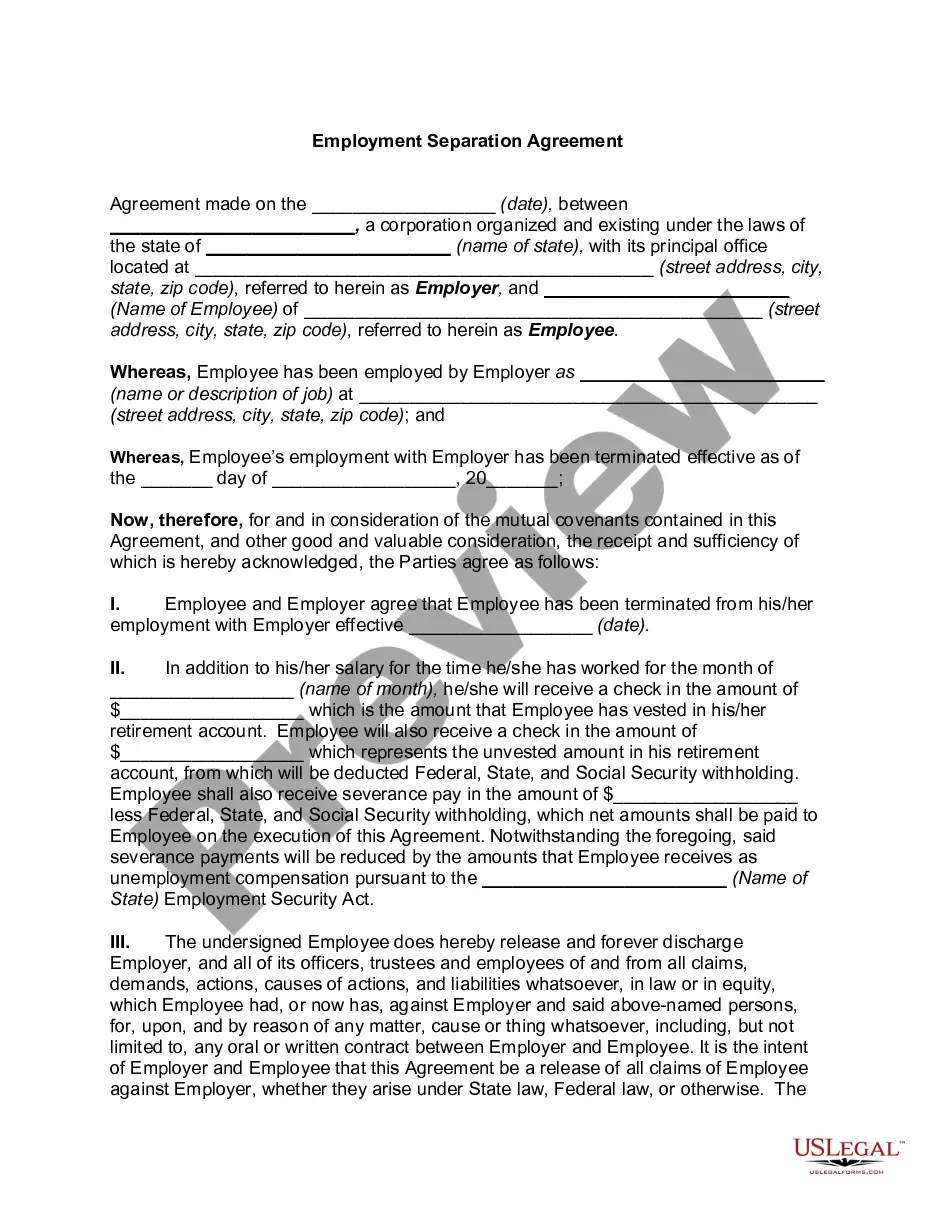
The South Dakota Employment or Job Termination Package is a collection of essential legal forms designed to assist employers in managing employee terminations. This package not only helps streamline the process but also aims to limit the risk of employment-related litigation and improve workplace practices. Unlike other packages, this one is specifically tailored to meet the legal requirements and nuances in South Dakota, ensuring compliance and clarity for employers navigating this sensitive area.
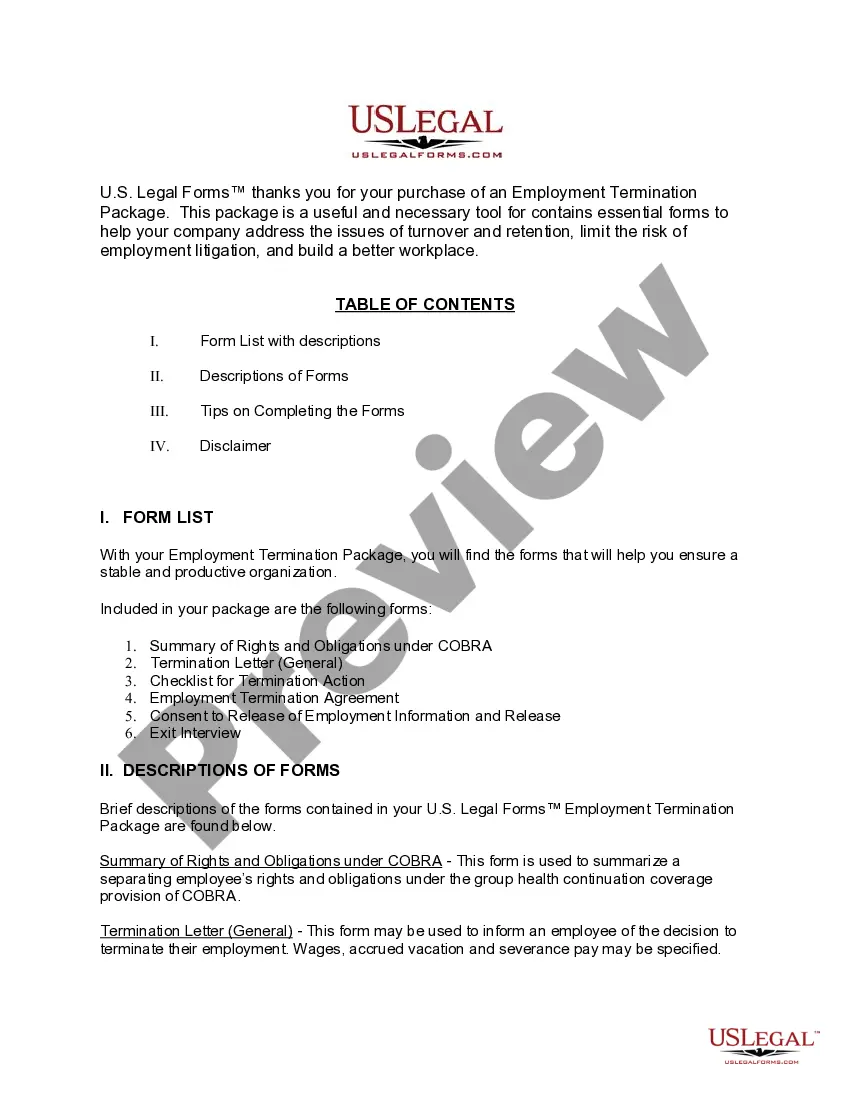
What’s included in this form package

When to use this document
This form package is particularly valuable in scenarios such as:
- When an employer decides to terminate an employee for performance-related issues.
- When restructuring or downsizing causes layoffs.
- To formalize the separation process during employee exits.
- When an employee resigns, and the employer needs to document the termination properly.
Who can use this document
- Business owners in South Dakota looking to manage employee terminations effectively.
- Human resource professionals seeking to ensure compliance with state labor laws.
- Managers involved in the process of employee exits, ensuring proper documentation.
- Employers wanting to create a respectful and legally compliant termination process.
How to complete these forms
- Review the included forms to understand their purposes and requirements.
- Gather necessary information about the employee, including employment history and performance details.
- Complete the Termination Letter and Employment Termination Agreement with relevant details.
- Use the Checklist for Termination Action to ensure all steps are followed correctly before the termination meeting.
- Conduct the Exit Interview to collect feedback from the departing employee, providing valuable insights for the organization.
Notarization guidance for this package
Forms in this package typically do not require notarization unless required by local law. However, it is crucial to double-check each form's specifications to confirm if notarization is necessary for your situation.
Get your form ready online
Our built-in tools help you complete, sign, share, and store your documents in one place.
Make edits, fill in missing information, and update formatting in US Legal Forms—just like you would in MS Word.
Download a copy, print it, send it by email, or mail it via USPS—whatever works best for your next step.
Sign and collect signatures with our SignNow integration. Send to multiple recipients, set reminders, and more. Go Premium to unlock E-Sign.
If this form requires notarization, complete it online through a secure video call—no need to meet a notary in person or wait for an appointment.
We protect your documents and personal data by following strict security and privacy standards.

Make edits, fill in missing information, and update formatting in US Legal Forms—just like you would in MS Word.

Download a copy, print it, send it by email, or mail it via USPS—whatever works best for your next step.

Sign and collect signatures with our SignNow integration. Send to multiple recipients, set reminders, and more. Go Premium to unlock E-Sign.

If this form requires notarization, complete it online through a secure video call—no need to meet a notary in person or wait for an appointment.

We protect your documents and personal data by following strict security and privacy standards.
Common mistakes
- Failing to complete the Checklist for Termination Action, which can lead to omitted steps and potential legal issues.
- Not specifying terms clearly in the Employment Termination Agreement, which could result in misunderstandings with the employee.
- Skipping the Exit Interview, missing an opportunity to gain valuable feedback.
- Neglecting to document the decision-making process leading to termination, which could impact legal defensibility.
Advantages of online completion
- Convenience of downloading and completing forms at any time without the need for physical paperwork.
- Edit and customize forms easily to fit specific termination circumstances.
- Access to forms drafted by licensed attorneys, ensuring reliability and adherence to South Dakota laws.
- Immediate access to essential documents helps streamline the termination process efficiently.
Key takeaways
- The South Dakota Employment or Job Termination Package provides essential forms to streamline the termination process.
- Proper documentation can limit the risk of employment litigation and promote a respectful workplace.
- It is crucial to complete the included forms accurately to ensure compliance with state laws.
- The package offers convenience, ease of customization, and reliability through attorney-drafted content.
Looking for another form?

Form popularity
FAQ
There is no standard process to terminate an employee in India. An employee may be terminated according to the individual labor contract signed between the employee and the employer, if the contract defines a process for termination.
Does Getting Fired Go On Your Record? Asking yourself will my being fired showed up on a background check? The good news for you is that the answer is generally no. While getting fired does not go on your criminal background check, there are other ways a prospective employer can learn of a termination.
Being fired means that the company ended your employment for reasons specific to you. This may also be referred to as terminated by some companies. Getting laid off is different, and means that the company eliminated your position for strategic or financial reasons and not through any fault of yours.
If employee is fired: immediately upon demand by employee. If employee quits: next payday. If payday is less than five days after last day of work, employer may pay on the following payday or 20 days after last day of work, whichever is earlier.
When you lose or leave your job in California, you are entitled to receive your final paycheck in short order. California law gives employers only a short time to give employees their final paychecks after they quit or are fired.
Employment relationships in South Dakota may be 'terminated at will,' which means an employer does not need a specific reason to fire an employee. This is the same concept as an employee not needing a specific reason to quit a job. Generally, the only exceptions to this rule are when: A contract for employment exists.
Termination of employment refers to the end of an employee's work with a company. Termination may be voluntary, as when a worker leaves of their own accord, or involuntary, in the case of a company downsize or layoff, or if an employee is fired.
Employees terminated by an employer have certain rights. An employee has the right to receive a final paycheck and the option of continuing health insurance coverage, and may even be eligible for severance pay and unemployment compensation benefits.
Termination is analogous with the common term of being fired. One may be fired or terminated for a variety of reasons but is traditionally used to mean letting an employee with performance issues go.