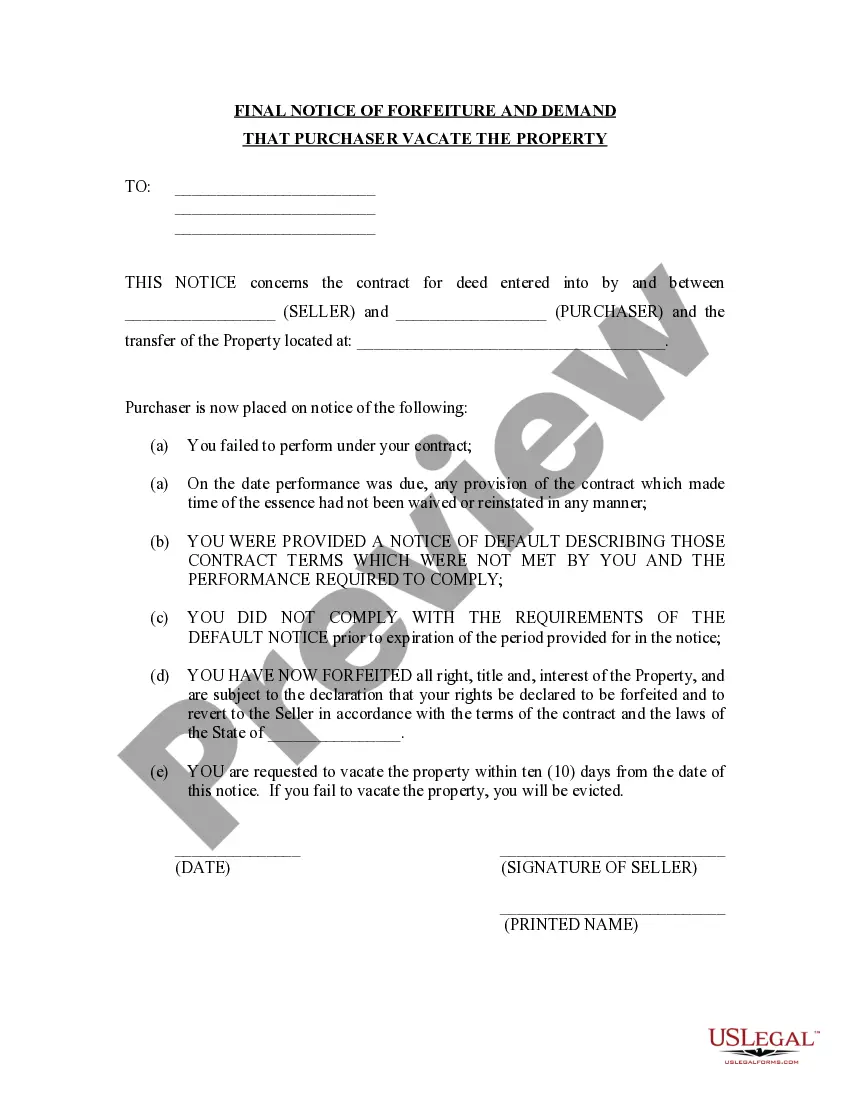
Pennsylvania Final Notice of Forfeiture and Request to Vacate Property under Contract for Deed
The Final Notice of Forfeiture and Request to Vacate Property under Contract for Deed serves as a formal notification to a Purchaser that the Seller has chosen to cancel the contract for deed. This form is issued after all prior notices regarding breaches have expired and informs the Purchaser that all prior payments are forfeited. It outlines that any future occupancy may lead to court action, differentiating it from preliminary notices of default or breach that may not carry such immediate consequences.
- Identification of the Seller and Purchaser involved in the contract.
- Details of the property subject to the contract for deed.
- Reference to previous notices of default and the Purchaserâs failure to comply.
- Statement indicating the cancellation of the contract and forfeiture of past payments.
- Instructions on vacating the property and potential legal actions for future occupancy.
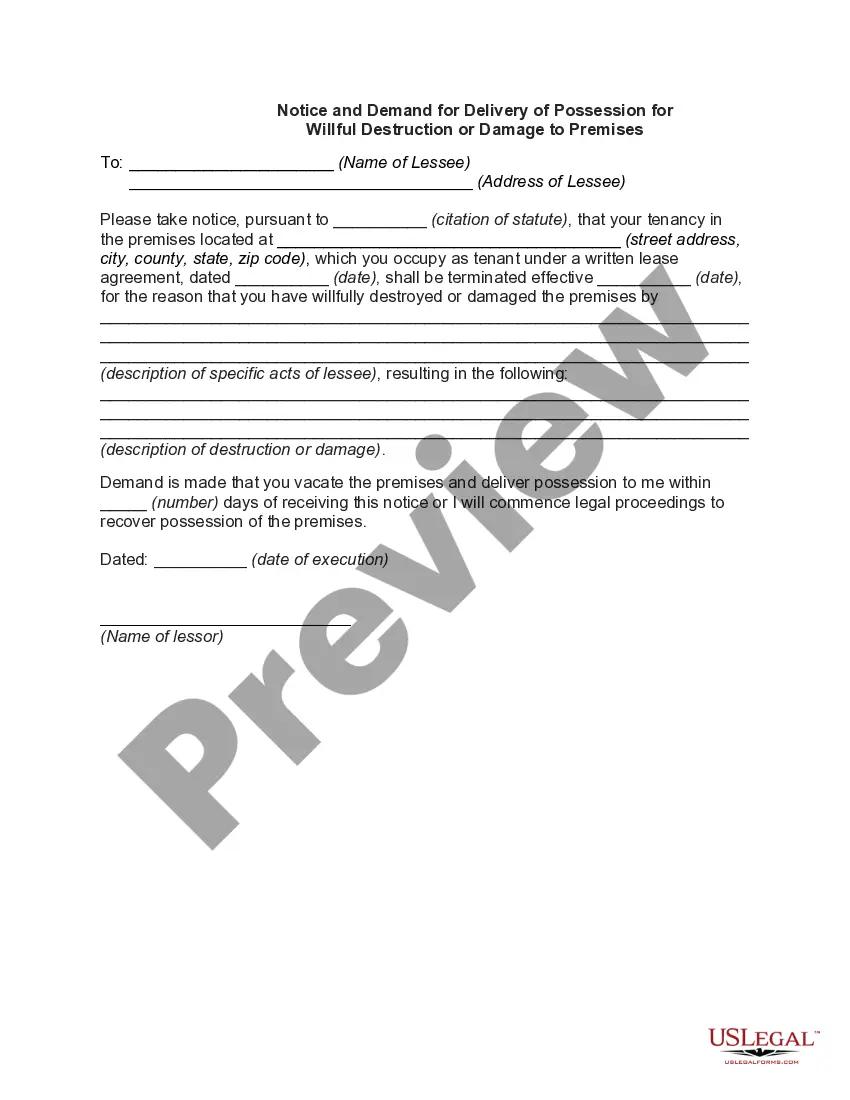
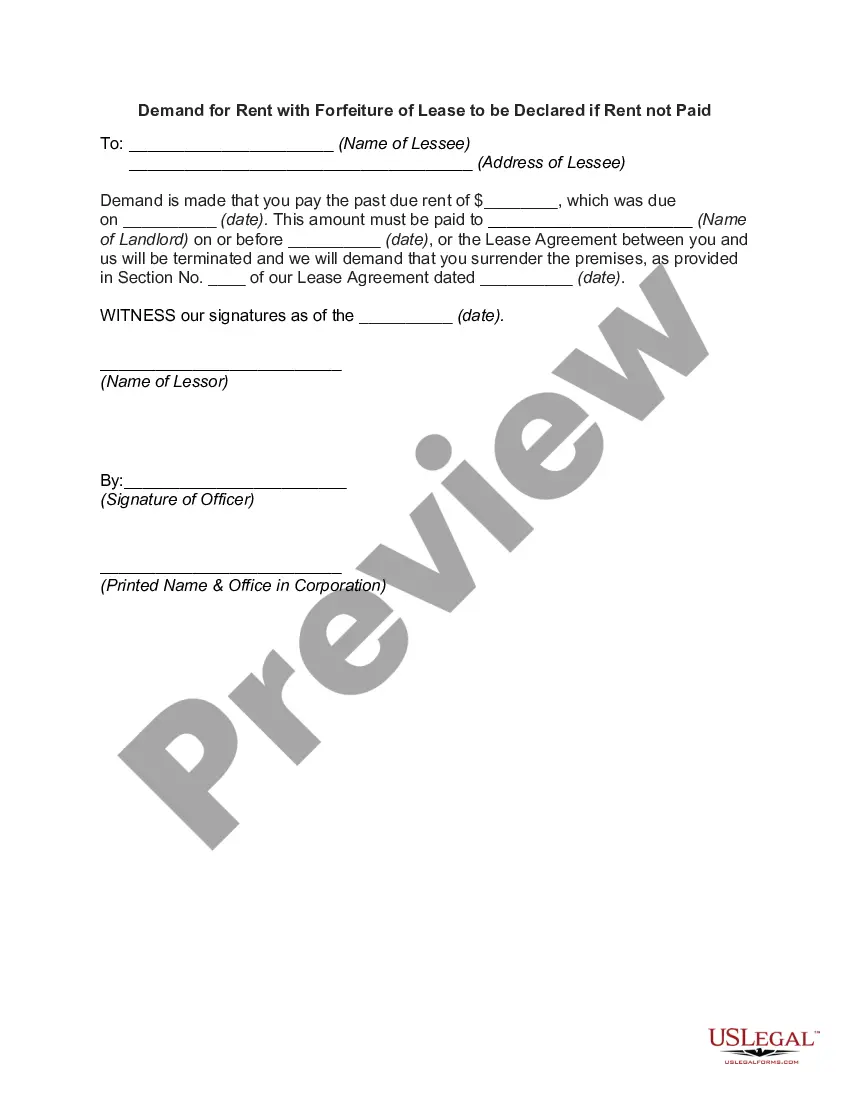
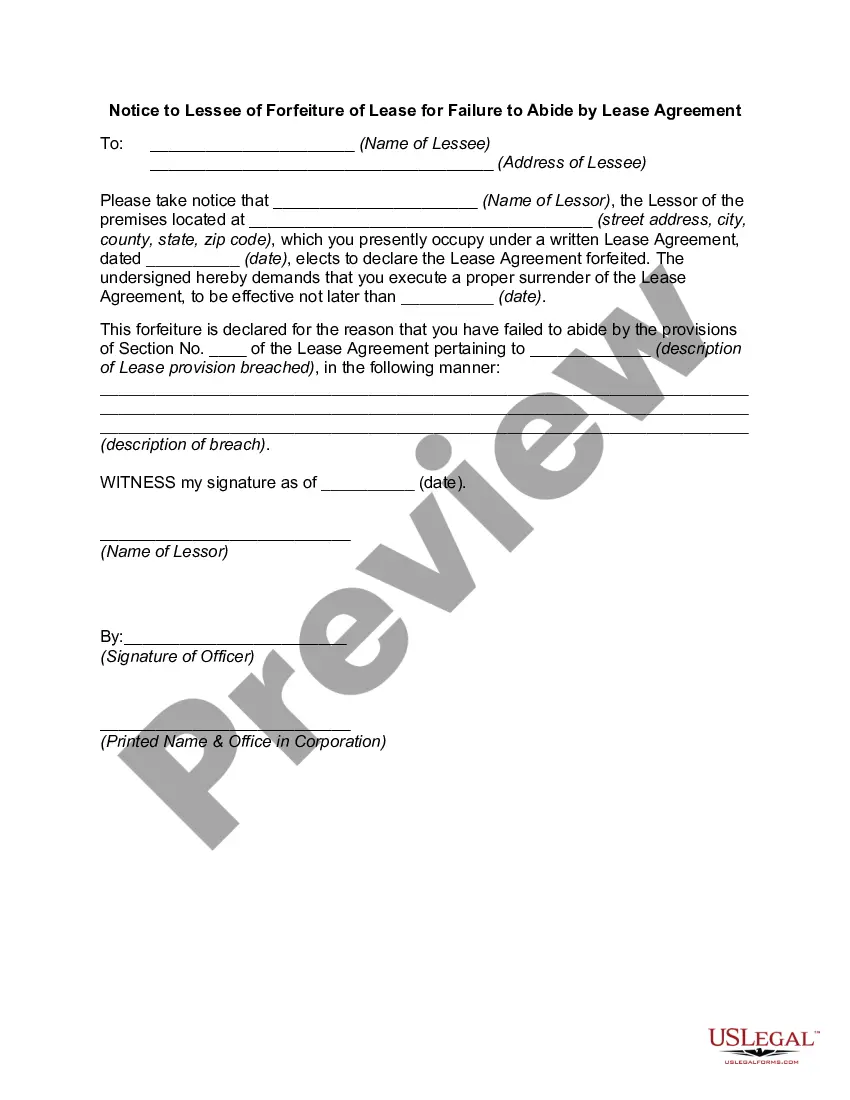
This form is needed when a Seller has issued previous notices regarding default or breach of contract and the Purchaser has not fulfilled the requirements outlined in those notices. It is the final step prior to legal action for possession of the property, making it crucial in situations where the Seller intends to regain control of the property due to the Purchaser's non-compliance.
Intended Audience:
- Sellers who have entered into a contract for deed with a Purchaser.
- Buyers who have been notified of a breach but remain in the property without compliance.
- Real estate professionals involved in transactions that include contracts for deed.
Steps to Complete the Form:
- Identify and enter the names of the Seller and Purchaser.
- Specify the address of the property involved in the contract for deed.
- Reference previous notices of default that were provided to the Purchaser.
- Clearly state that the contract has been canceled and that past payments are forfeited.
- Include instructions on vacating the property and note the potential for legal action if the Purchaser does not comply.
This form does not typically require notarization unless specified by local law. Ensure to verify local regulations for any specific requirements regarding notarization of property-related documents.
Get your form ready online
Our built-in tools help you complete, sign, share, and store your documents in one place.
Make edits, fill in missing information, and update formatting in US Legal Forms—just like you would in MS Word.
Download a copy, print it, send it by email, or mail it via USPS—whatever works best for your next step.
Sign and collect signatures with our SignNow integration. Send to multiple recipients, set reminders, and more. Go Premium to unlock E-Sign.
If this form requires notarization, complete it online through a secure video call—no need to meet a notary in person or wait for an appointment.
We protect your documents and personal data by following strict security and privacy standards.

Make edits, fill in missing information, and update formatting in US Legal Forms—just like you would in MS Word.

Download a copy, print it, send it by email, or mail it via USPS—whatever works best for your next step.

Sign and collect signatures with our SignNow integration. Send to multiple recipients, set reminders, and more. Go Premium to unlock E-Sign.

If this form requires notarization, complete it online through a secure video call—no need to meet a notary in person or wait for an appointment.

We protect your documents and personal data by following strict security and privacy standards.
- Failing to provide all required previous notices before issuing the final notice.
- Not accurately identifying the parties involved in the contract.
- Overlooking the specific language that must be included regarding forfeiture of payments.
- Neglecting to include the timeframe for vacating the property.
- Ease of access: Download the form immediately for use.
- Editable templates allow customization to meet your specific circumstances.
- Drafted by licensed attorneys, ensuring legal validity and compliance.
- Convenient to use from home, allowing for a quicker process than traditional legal consultations.
Legal use & context
- This form serves to formally document the seller's intention to cancel the contract and reclaim the property.
- It provides legal grounds for potential eviction proceedings if the purchaser does not vacate.
- Understanding the legal implications of this notice is essential for both sellers and purchasers in property transactions.
Summary of main points
- The Final Notice of Forfeiture is crucial for sellers wanting to reclaim their property legally.
- It is important to follow all legal requirements and ensure proper notifications have been served.
- Completing the form accurately is essential to avoid complications in the forfeiture process.
Looking for another form?

Form popularity
FAQ
Failure to record a deed effectively makes it impossible for the public to know about the transfer of a property. That means the legal owner of the property appears to be someone other than the buyer, a situation that can generate serious ramifications.
If a seller is actually breaching a contract and you can prove you have been financially damaged, you could sue. However, the amount you can sue for depends on the law in your individual state.With that said, if you can show the seller acted in bad faith, your state may allow you to seek additional damages.
Backing out of a home sale can have costly consequences A home seller who backs out of a purchase contract can be sued for breach of contract. A judge could order the seller to sign over a deed and complete the sale anyway. The buyer could sue for damages, but usually, they sue for the property, Schorr says.
Monetary Damages If the Seller decides to breach the contract and keep their home, they may do so, but the court may order the Buyer receive money for the resulting breach. Generally, the money owed to Buyer may include reimbursing the Buyer with: The buyer's temporary housing costs.
In the first instance, if your deed is not recorded, there is nothing in the public record to stop the seller from conveying the property to another person.The second situation could happen if your seller fails to pay his or her debts and the seller's creditors file liens or judgments against your property.
You can terminate the agreement by giving a notice to the buyer stating that you are no more interested to sell the property since he has not paid any advance amount towards the consideration of sale so far. Consult a local lawyer and take decision as per his further advise after seeing the agreement paper. 1.
If a seller defaults, he must return all deposits, plus added reasonable expenses, to the buyer. The other party may also seek to compel the erring party to complete the deal under specific performance. From a buyer's point of view, it is advisable to get the sale agreement registered.
It is not necessary for the seller to go to court to cancel the contract. In order to cancel a contract for deed, a seller needs to complete a form called a notice of cancellation of contract for deed, and have the notice personally served on the buyer.
But unlike buyers, sellers can't back out and forfeit their earnest deposit money (usually 1-3 percent of the offer price). If you decide to cancel a deal when the home is already under contract, you can be either legally forced to close anyway or sued for financial damages.