Oregon General Power of Attorney for Care and Custody of Child or Children
Understanding this form
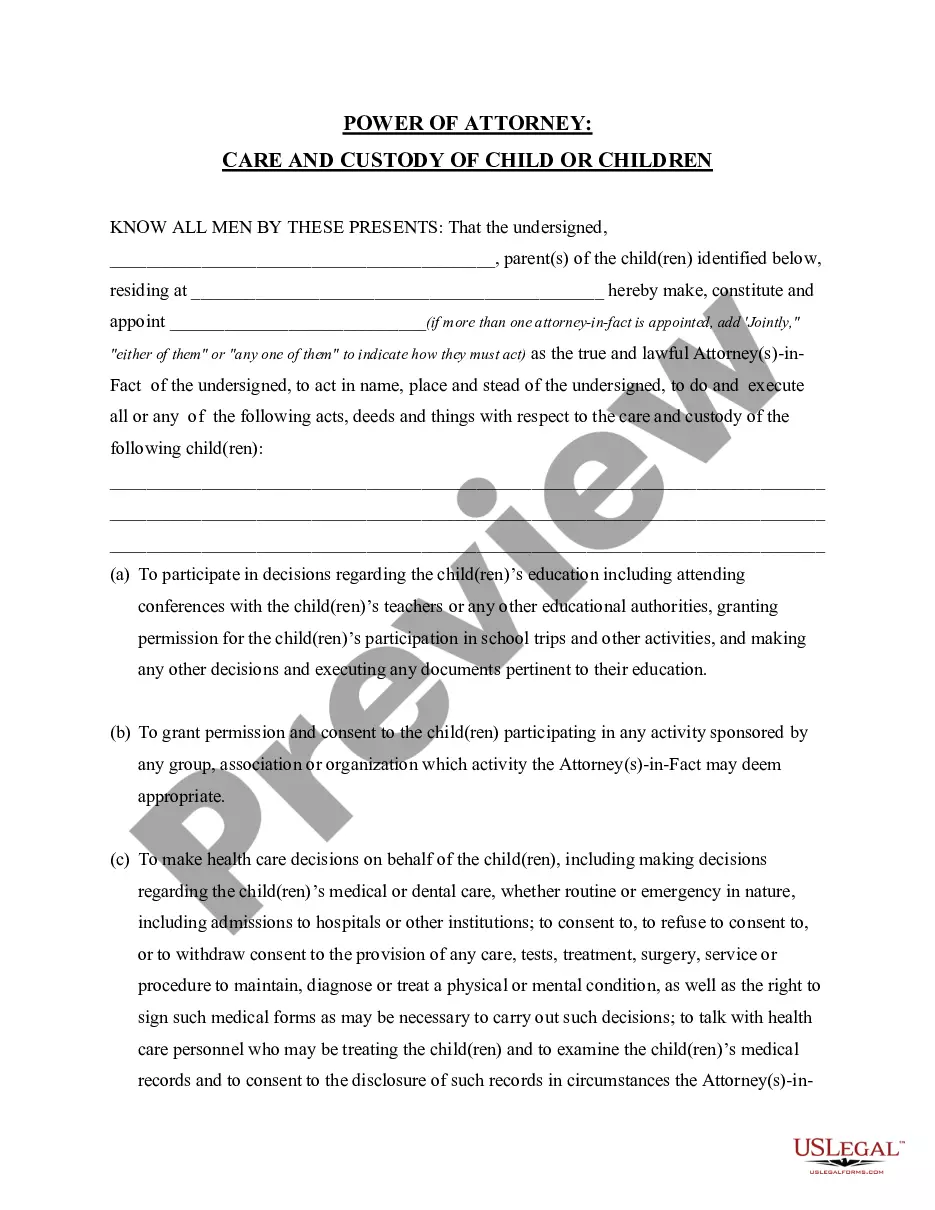
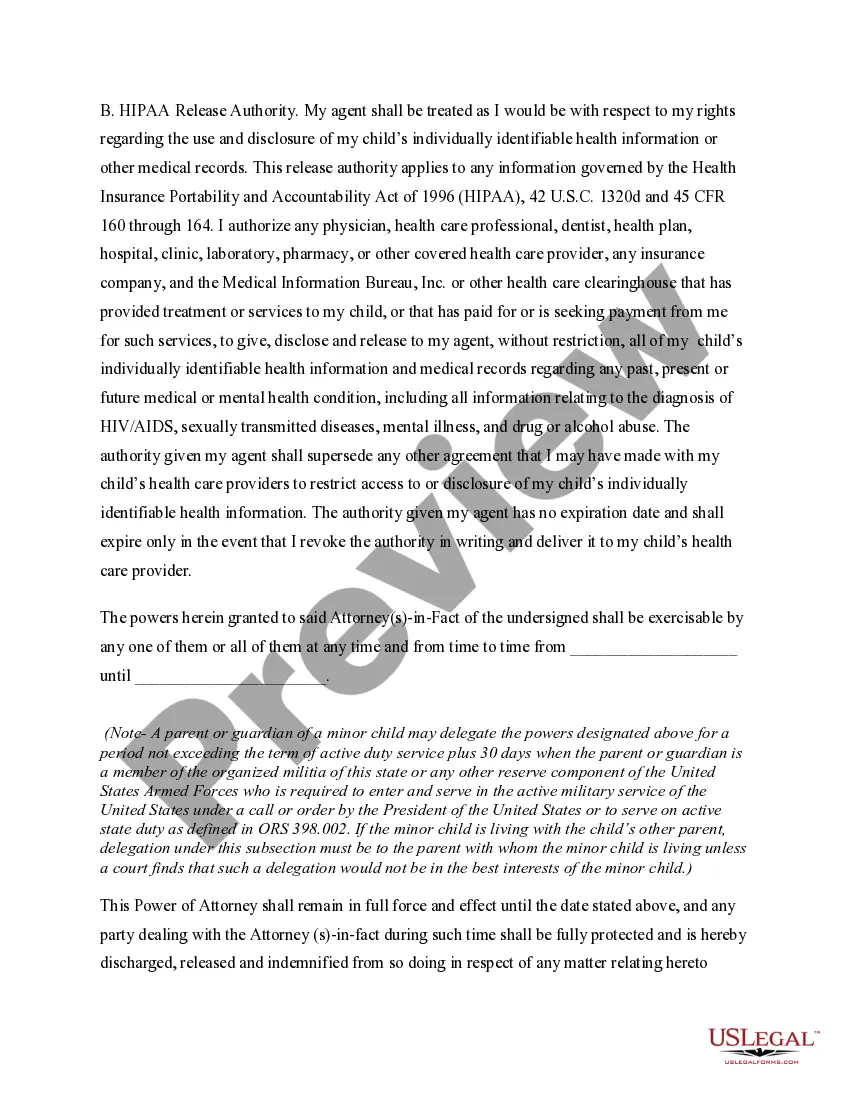
The General Power of Attorney for Care and Custody of Child or Children allows a parent to legally appoint an attorney-in-fact to manage the care and custody of their child or children. This form enables designated individuals to make critical decisions regarding the child's education and health care, ensuring that a trusted representative can act on behalf of the parent when necessary. Unlike other power of attorney forms, this one is specifically tailored for situations involving the care of minors.
Main sections of this form
- Appointment of attorney-in-fact for the care of child or children.
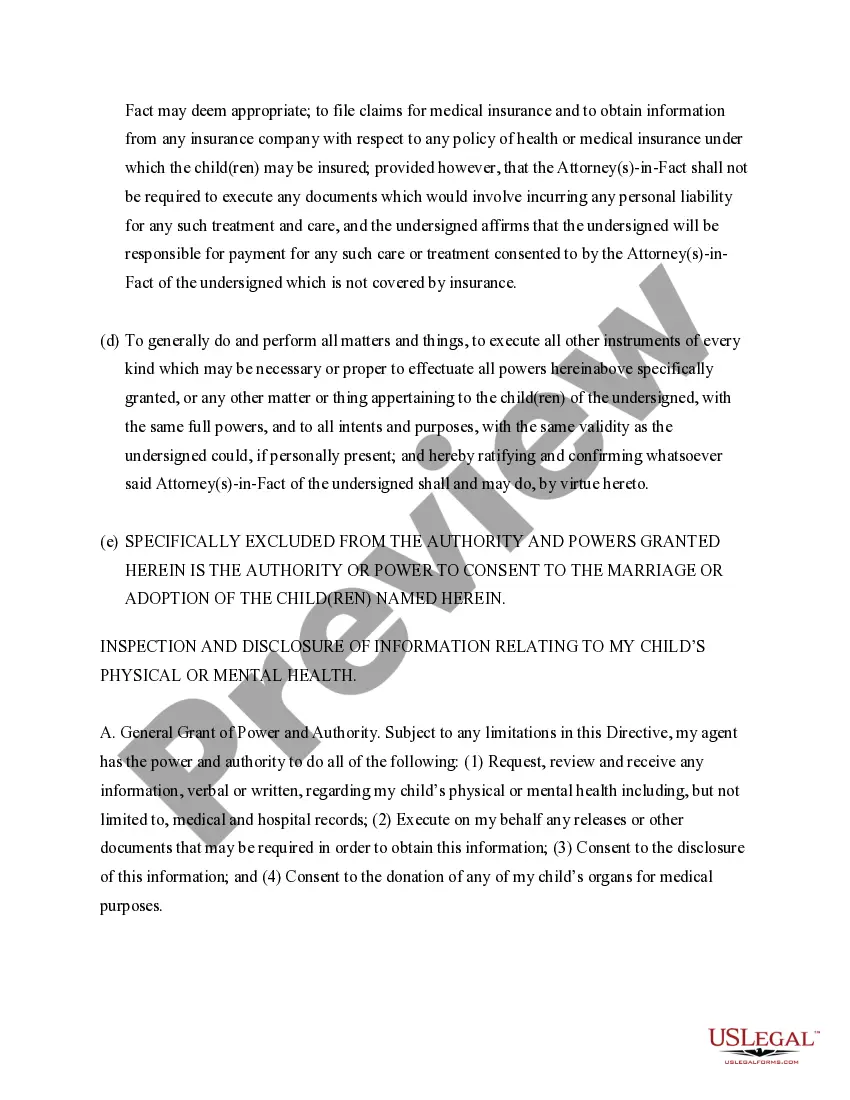
- Authority to make decisions regarding education, health care, and general welfare.
- Exclusions of powers, particularly regarding marriage or adoption.
- HIPAA release authority for disclosing health information.
- Notarization requirement for legal validity.
- Duration of authority specified by the principal.




When to use this form
This form is useful in situations where a parent is temporarily unable to care for their child or children due to various circumstances such as military deployment, illness, or travel. It is also appropriate when a parent wishes to delegate authority for child care decisions to another trusted individual for specific periods or situations.
Who this form is for
- Parents or guardians seeking to appoint someone to make care decisions for their children.
- Individuals who need a temporary solution for child custody and care matters.
- Parents deploying for military service or facing medical treatment requiring absence.
Completing this form step by step
- Identify and provide the names and addresses of all parties involved, including the parent and attorney-in-fact.
- Specify the full names of the children for whom care decisions will be delegated.
- Outline the scope of authority granted to the attorney-in-fact, detailing specific powers related to education and health care.
- Include the effective dates for this power of attorney, indicating when it starts and when it will expire.
- Sign the form in the presence of a notary public to validate the document legally.
Notarization guidance
Notarization is required for this form to take effect. Our online notarization service, powered by Notarize, lets you verify and sign documents remotely through an encrypted video session, available 24/7.
Get your form ready online
Our built-in tools help you complete, sign, share, and store your documents in one place.
Make edits, fill in missing information, and update formatting in US Legal Forms—just like you would in MS Word.
Download a copy, print it, send it by email, or mail it via USPS—whatever works best for your next step.
Sign and collect signatures with our SignNow integration. Send to multiple recipients, set reminders, and more. Go Premium to unlock E-Sign.
If this form requires notarization, complete it online through a secure video call—no need to meet a notary in person or wait for an appointment.
We protect your documents and personal data by following strict security and privacy standards.

Make edits, fill in missing information, and update formatting in US Legal Forms—just like you would in MS Word.
Download a copy, print it, send it by email, or mail it via USPS—whatever works best for your next step.
Sign and collect signatures with our SignNow integration. Send to multiple recipients, set reminders, and more. Go Premium to unlock E-Sign.

If this form requires notarization, complete it online through a secure video call—no need to meet a notary in person or wait for an appointment.

We protect your documents and personal data by following strict security and privacy standards.
Mistakes to watch out for
- Failing to specify the names of all children involved.
- Not notarizing the document, which is necessary for it to be legally binding.
- Leaving out important details about the authority granted to the attorney-in-fact.
- Not being clear about the time frame for which the power of attorney is effective.
Why use this form online
- Convenient access to professional legal templates without the need for in-person consultations.
- Edit and customize the form to fit your specific needs before downloading.
- Reliable guidance in completing the form accurately, ensuring all necessary components are included.
Quick recap
- The General Power of Attorney for Care and Custody of Child or Children is essential for temporary delegation of parental authority.
- Notarization is required for legal validity.
- Clearly outline decision-making powers to avoid misunderstandings.
Looking for another form?





Form popularity
FAQ
One parent gets legal custody of the children. Both parents have joint custody. In families with more than one child, one or more children live with one parent and one or more children live with the other parent.
Oregon Custody Law Does Not Favor Either Parent Fathers' rights in Oregon are viewed as equal to mothers' rights. Instead, according to Oregon custody law, courts largely base their decisions on what is in the best interests of the child.
Some people think joint custody means the child lives with each parent 50% of the time.A court cannot award joint custody in Oregon unless both parents agree to it. Sole custody in Oregon means that the parent who has custody makes all major decisions regarding the child.
Oregon Custody Law Does Not Favor Either Parent Fathers' rights in Oregon are viewed as equal to mothers' rights. Instead, according to Oregon custody law, courts largely base their decisions on what is in the best interests of the child.
The legal definition of an unfit parent is when the parent through their conduct fails to provide proper guidance, care, or support. Also, if there is abuse, neglect, or substance abuse issues, that parent will be deemed unfit.
If the parents are unmarried but have paternity established, both will generally have equal custody rights. In fact, Oregon courts almost always favor arrangements where the child can have both parents playing active roles in their life, but will always put the child's best interests first.