Ohio Revised Uniform Anatomical Gift Act Donation with Donor Registry Enrollment Form
Understanding this form
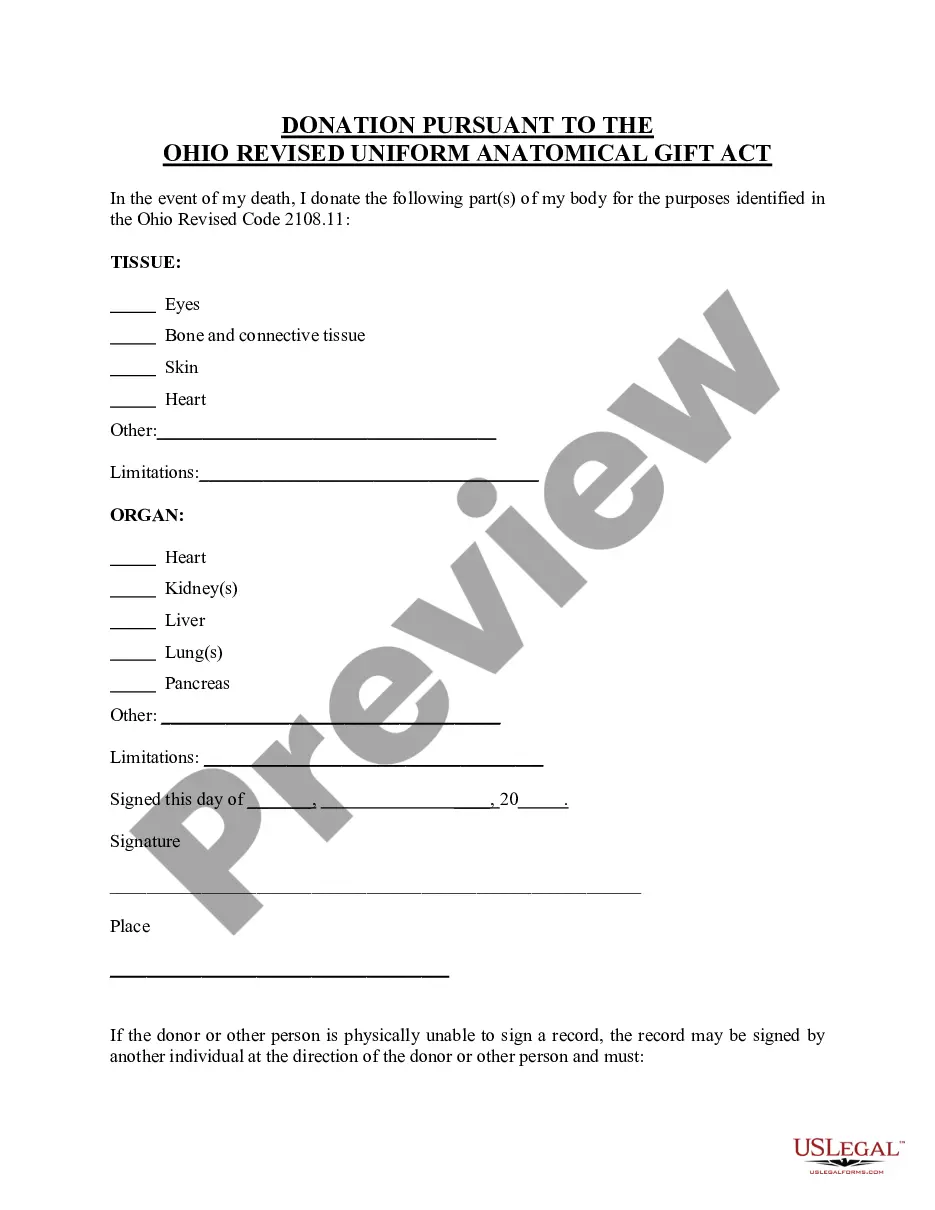
The Revised Uniform Anatomical Gift Act Donation with Donor Registry Enrollment Form is a legal document that allows individuals to specify the body parts and organs they wish to donate upon their death. This form is essential for clearly communicating one's intentions regarding anatomical gifts, making it a vital step for anyone considering donation. Unlike other legal documents, this form not only allows for the designation of gifts but also includes a provision for enrollment in the donor registry.
Key components of this form
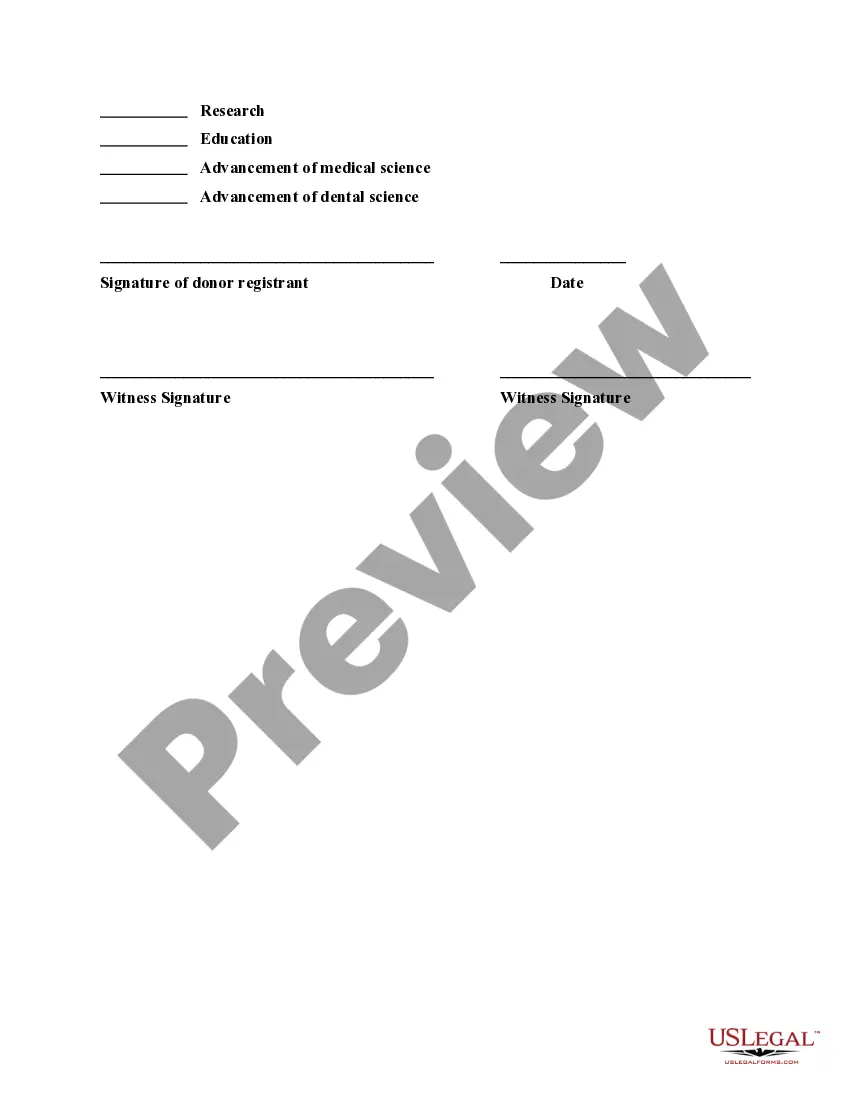
- Donor's declaration of anatomical gifts and preferences for use (e.g., transplantation, research).
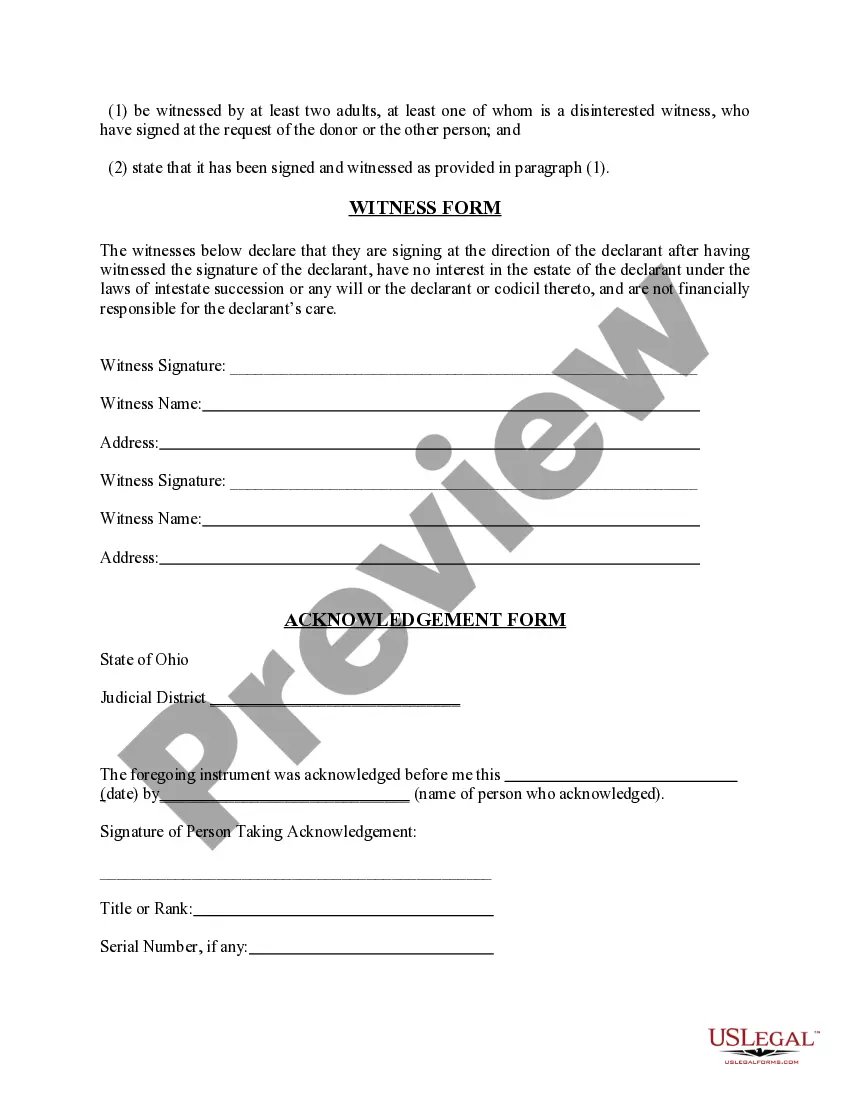
- Witness requirements, including signatures of at least two adults, with one being disinterested.
- Notarization section to validate the donor's signature and intentions.
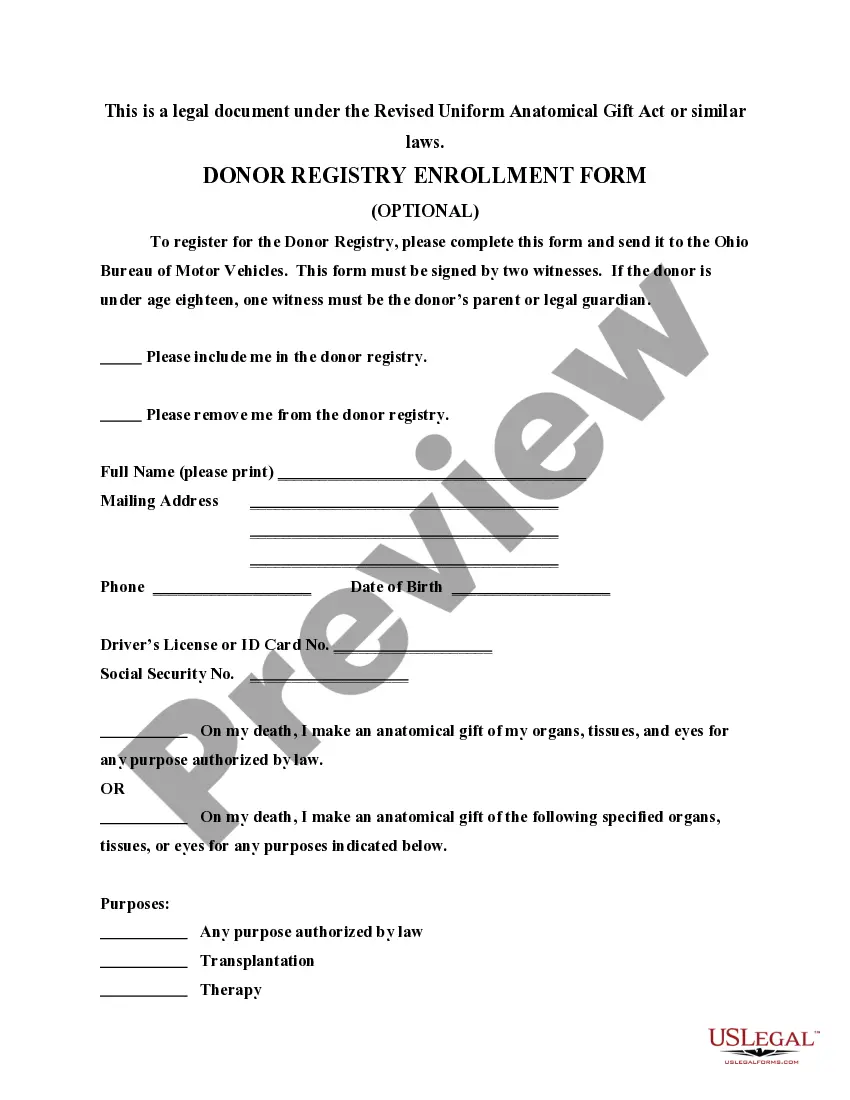
- Donor registry enrollment details for organizational purposes.
- Personal information fields for the donor, including mailing address, date of birth, and identification numbers.
Common use cases
This form should be used by individuals who wish to make an anatomical gift after their death. It is applicable in situations where someone wants to specify which organs or tissues they wish to donate, whether for transplantation, education, or research. The form is crucial for ensuring that the donor's wishes are legally recognized and respected.
Who can use this document
The following individuals should consider using this form:
- Adults aged eighteen years or older wishing to authorize anatomical gifts.
- Individuals of sound mind who want to express their wishes about organ donation.
- Minors wishing to make an anatomical gift, with parental or guardian consent through witnessed signatures.
Completing this form step by step
- Enter your personal information, including your mailing address, date of birth, and identification numbers.
- Clearly state your wishes regarding which organs and tissues you wish to donate.
- Specify the purposes for which the donations are authorized, such as transplantation or research.
- Sign the form in the presence of at least two adult witnesses.
- Have the form notarized to validate your signatures, if required for local laws.
Does this document require notarization?
This form must be notarized to be legally valid. US Legal Forms provides secure online notarization powered by Notarize, allowing you to complete the process through a verified video call.
Get your form ready online
Our built-in tools help you complete, sign, share, and store your documents in one place.
Make edits, fill in missing information, and update formatting in US Legal Forms—just like you would in MS Word.
Download a copy, print it, send it by email, or mail it via USPS—whatever works best for your next step.
Sign and collect signatures with our SignNow integration. Send to multiple recipients, set reminders, and more. Go Premium to unlock E-Sign.
If this form requires notarization, complete it online through a secure video call—no need to meet a notary in person or wait for an appointment.
We protect your documents and personal data by following strict security and privacy standards.
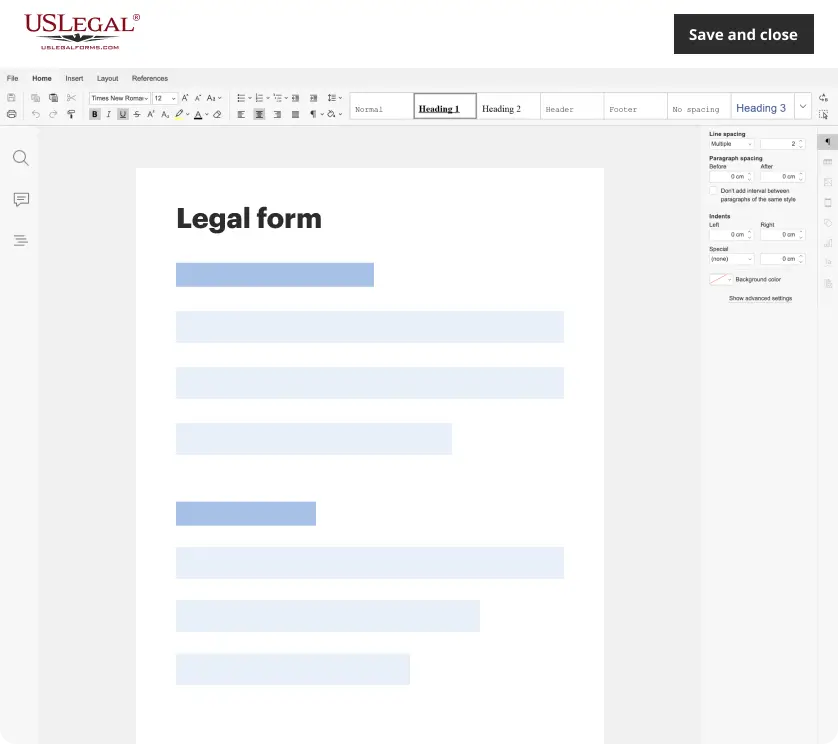
Make edits, fill in missing information, and update formatting in US Legal Forms—just like you would in MS Word.
Download a copy, print it, send it by email, or mail it via USPS—whatever works best for your next step.
Sign and collect signatures with our SignNow integration. Send to multiple recipients, set reminders, and more. Go Premium to unlock E-Sign.

If this form requires notarization, complete it online through a secure video call—no need to meet a notary in person or wait for an appointment.
We protect your documents and personal data by following strict security and privacy standards.
Common mistakes
- Failing to have the correct number of witnesses sign the document.
- Not including specific details about which organs or tissues are to be donated.
- Neglecting to complete the donor registry enrollment section if intending to register.
Why use this form online
- Convenience of accessing and filling out the form from home.
- Editability allows you to revise until you are satisfied with your declarations.
- Reliability of having a complete and legally compliant document.
Key takeaways
- The form designates your wishes regarding anatomical gifts upon your death.
- Witness and notarization requirements are critical for legal validity.
- Enrollment in the donor registry is an optional but recommended step.
Looking for another form?
Form popularity
FAQ
A: You do not have to wait until your license expires to update your organ and tissue donor status. Simply visit www.DMV.ca.gov and click the Donate Life California link. From there you can become a registered donor and read answers to frequently asked questions and real-life organ donor and recipient stories.
Can I remove myself from the registered donors list? Yes, you can change your donor status at any time. Look for an option such as "updating your status" on your state's site. If you have a donor designation on your driver's license, removing yourself from the registry will not change that.
Can I remove myself from the registered donors list? Yes, you can change your donor status at any time. Look for an option such as "updating your status" on your state's site. If you have a donor designation on your driver's license, removing yourself from the registry will not change that.
(3) "Anatomical gift" means a donation of all or part of a human body to take effect after the donor's death for the purpose of transplantation, therapy, research, or education.
That was a major first step. The Uniform Anatomical Gift Act was subsequently adopted by all 50 states and the District of Columbia.
To modify your gift or withdraw from the registry: Complete, sign and mail the Change and Specification Form or Removal Form to the address on the form or email to NYS Donate Life Registry at: registry@donatelife.ny.gov.
Any individual who is 15 1/2 years old or older and holds a valid Ohio driver's license, learner's permit or state ID card can authorize the donation of their organs, corneas and tissues by joining the Ohio Donor Registry at their local Bureau of Motor Vehicles office, by filling out and mailing in a registration form
The Act sets a regulatory framework for the donation of organs, tissues, and other human body parts in the US. The UAGA helps regulate body donations to science, medicine, and education. The Act has been consulted in discussions about abortion, fetal tissue transplants, and Body Worlds, an anatomy exhibition.
Important Revisions. The UAGA of 2006 allows for individuals to consent to organ donation by expressing their wish when obtaining a driver's license, through verbal expression, by writing it in a will or other advance directive, or in any other manner, simplifying the consent process.