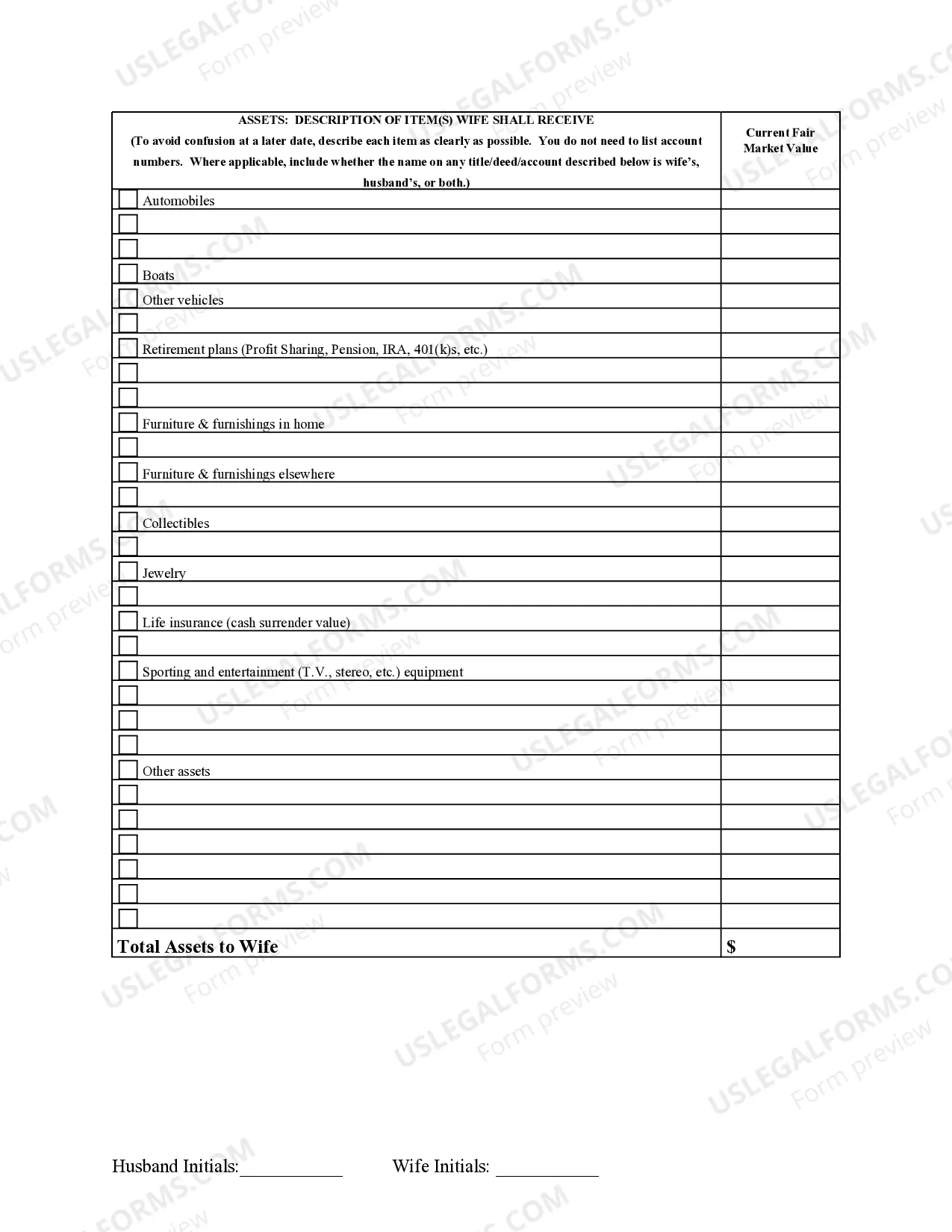
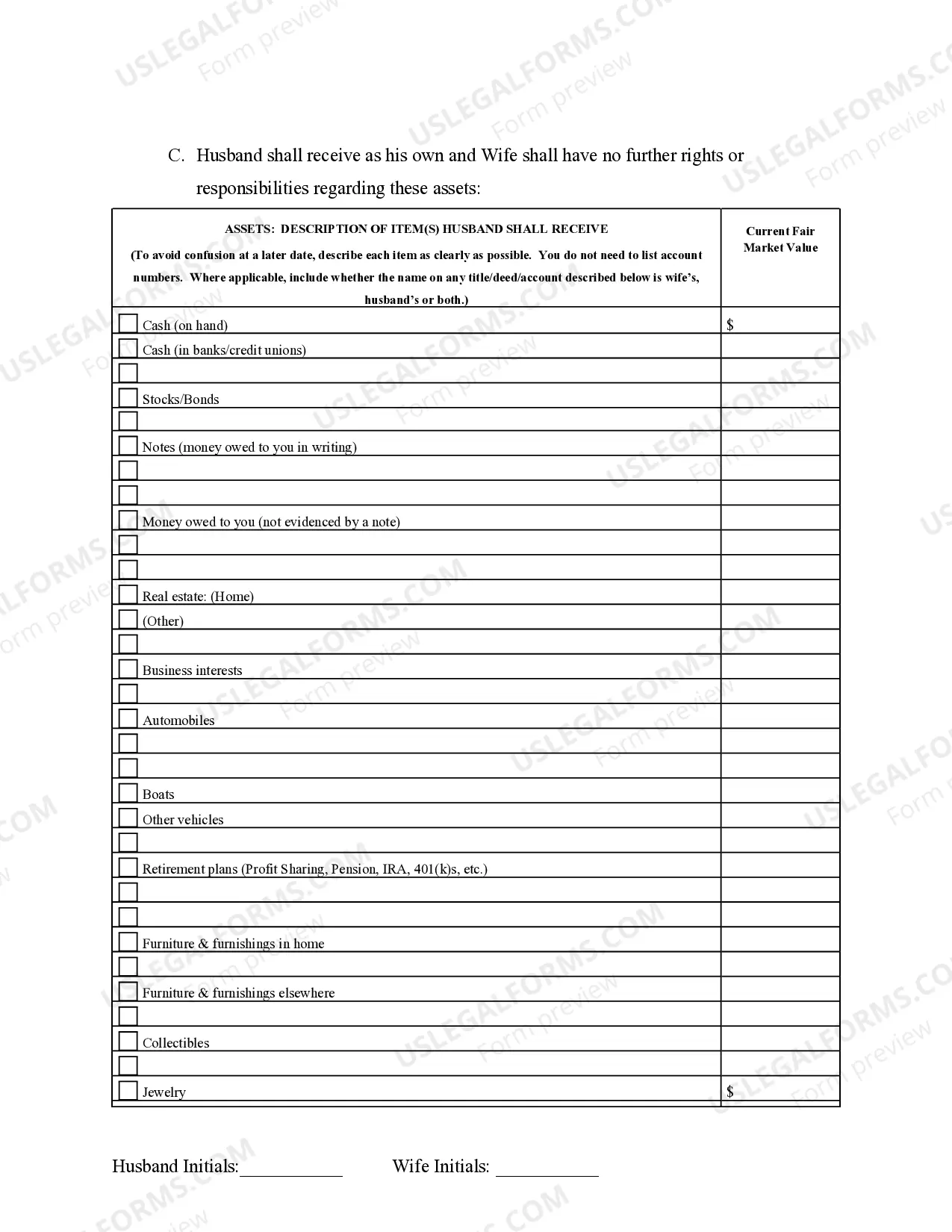
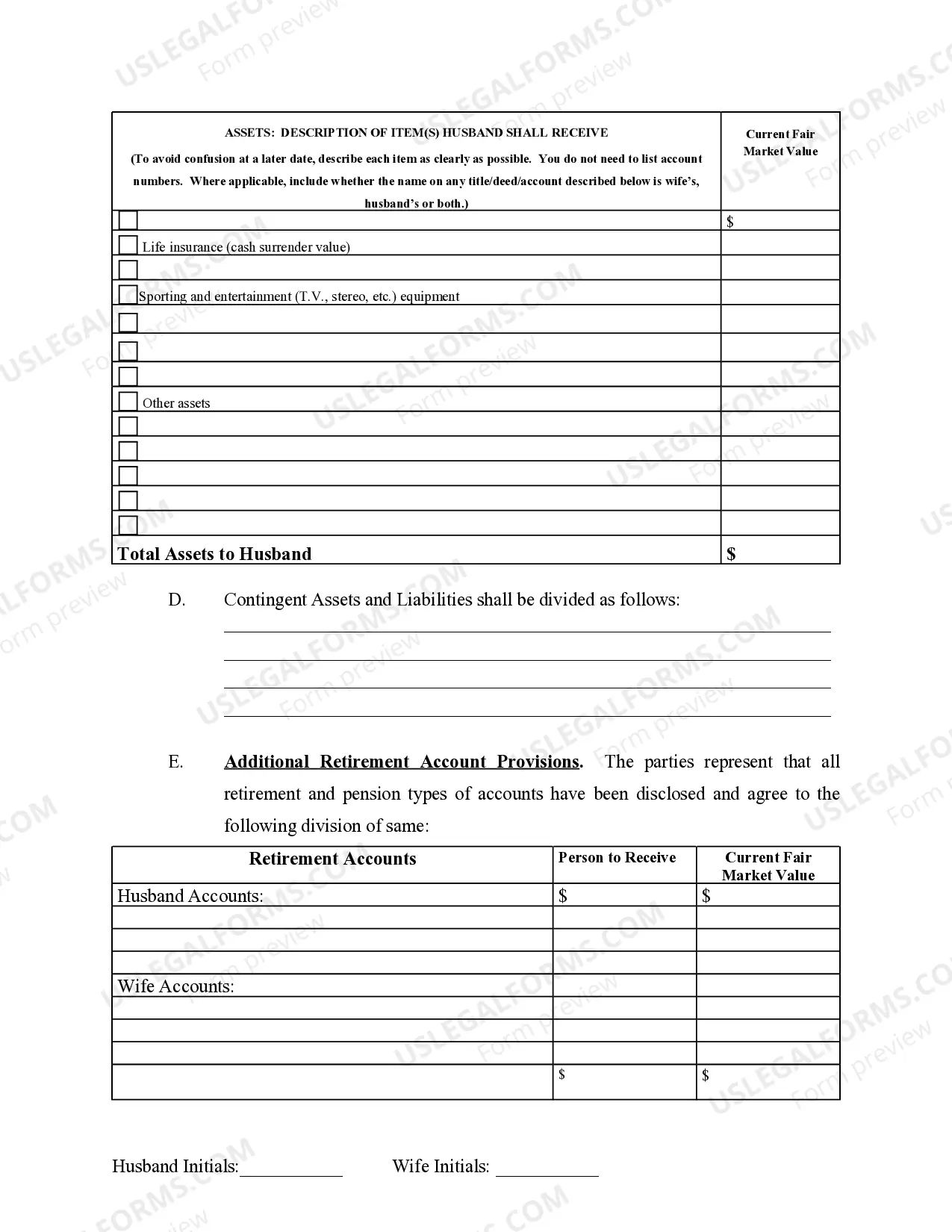
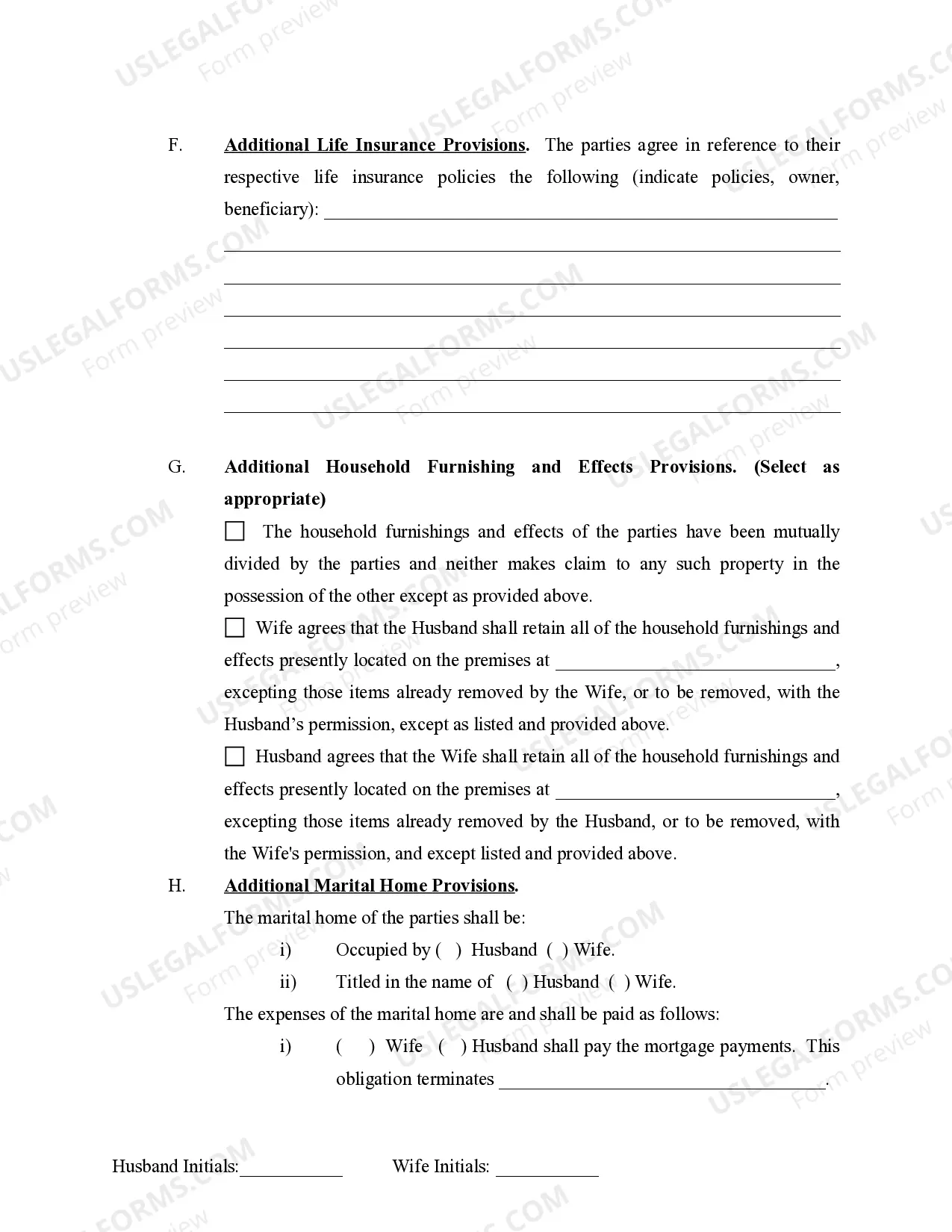
Marital Domestic Separation and Property Settlement Agreement no Children parties may have Joint Property or Debts where Divorce Action Filed
Note: This summary is not intended to be an all
inclusive discussion of the law of separation agreements in Ohio, but does
include basic and other provisions.
General Summary:
Through a valid separation agreement the parties to a divorce may make provisions for the division of property
and obligations of the marriage. Absent such an agreement, the court
will make a property division based upon the statutory guidelines.
A Petition for Dissolution of Marriage must have an attached and
incorporated separation agreement signed by both parties satisfying the
requirements of Title 31 of the Revised Code of Ohio.
The separation agreement incorporated into the petition for dissolution
of marriage must provide for a division of all property; spousal support;
all the issues relative to minor children of the marriage, if any; and,
if the parties so desire, an authorization for the court to modify the
amount or terms of spousal support provided in the separation agreement.
An amended separation agreement may be offered up to or during the hearing
on the petition for dissolution. If, at the time of the hearing on
the petition for dissolution, either party expresses dissatisfaction with
the property settlement agreement, the court must dismiss the petition
for dissolution of marriage and refuse to validate the proposed property
settlement agreement.
Statutes:
Ohio Revised Code
Title XXXI Domestic Relations -- Children
Chapter 3105: Divorce, Alimony, Annulment, Dissolution
of Marriage
Equitable division of marital and separate property; distributive
award:
(A) As used in this section:
(1) "Distributive award" means any payment or payments,
in real or personal property, that are payable in a lump sum or over time,
in fixed amounts, that are made from separate property or income, and that
are not made from marital property and do not constitute payments of spousal
support, as defined in section 3105.18 of the Revised Code.
(b) If the court determines that the use of either or both of the
dates specified in division (A)(2)(a) of this section would be inequitable,
the court may select dates that it considers equitable in determining marital
property. If the court selects dates that it considers equitable in determining
marital property, "during the marriage" means the period of time between
those dates selected and specified by the court.
(3) (a) "Marital property" means, subject to division (A)(3)(b) of this
section, all of the following:
(i) All real and personal property that currently is owned
by either or both of the spouses, including, but not limited to, the retirement
benefits of the spouses, and that was acquired by either or both of the
spouses during the marriage;
(ii) All interest that either or both of the spouses currently
has in any real or personal property, including, but not limited to, the
retirement benefits of the spouses, and that was acquired by either or
both of the spouses during the marriage;
(iii) Except as otherwise provided in this section, all income
and appreciation on separate property, due to the labor, monetary, or in-kind
contribution of either or both of the spouses that occurred during the
marriage;
(iv) A participant account, as defined in section 148.01 of the
Revised Code, of either of the spouses, to the extent of the following:
the moneys that have been deferred by a continuing member or participating
employee, as defined in that section, and that have been transmitted to
the Ohio public employees deferred compensation board during the marriage
and any income that is derived from the investment of those moneys during
the marriage; the moneys that have been deferred by an officer or employee
of a municipal corporation and that have been transmitted to the governing
board, administrator, depository, or trustee of the deferred compensation
program of the municipal corporation during the marriage and any income
that is derived from the investment of those moneys during the marriage;
or the moneys that have been deferred by an officer or employee of a government
unit, as defined in section 148.06 of the Revised Code, and that have been transmitted to the governing board, as defined in that section,
during the marriage and any income that is derived from the investment
of those moneys during the marriage.
(4) "Passive income" means income acquired other than as a result of
the labor, monetary, or in-kind contribution of either spouse.
(6) (a) "Separate property" means all real and personal property
and any interest in real or personal property that is found by the court
to be any of the following:
(B) In divorce proceedings, the court shall, and in legal separation
proceedings upon the request of either spouse, the court may, determine
what constitutes marital property and what constitutes separate property.
In either case, upon making such a determination, the court shall divide
the marital and separate property equitably between the spouses, in accordance
with this section. For purposes of this section, the court has jurisdiction
over all property in which one or both spouses have an interest.
(C) (1) Except as provided in this division or division (E) of this
section, the division of marital property shall be equal. If an equal division
of marital property would be inequitable, the court shall not divide the
marital property equally but instead shall divide it between the spouses
in the manner the court determines equitable. In making a division of marital
property, the court shall consider all relevant factors, including those
set forth in division (F) of this section.
(2) Each spouse shall be considered to have contributed
equally to the production and acquisition of marital property.
(3) The court shall provide for an equitable division of marital
property under this section prior to making any award of spousal support
to either spouse under section 3105.18 of the Revised Code and without
regard to any spousal support so awarded.
(4) If the marital property includes a participant account, as
defined in section 148.01 of the Revised Code, the court shall not order
the division or disbursement of the moneys and income described in division
(A)(3)(a)(iv) of this section to occur in a manner that is inconsistent
with the law, rules, or plan governing the deferred compensation program
involved or prior to the time that the spouse in whose name the participant
account is maintained commences receipt of the moneys and income credited
to the account in accordance with that law, rules, and plan.
(D) Except as otherwise provided in division (E) of this section or
by another provision of this section, the court shall disburse a spouse's
separate property to that spouse. If a court does not disburse a spouse's
separate property to that spouse, the court shall make written findings
of fact that explain the factors that it considered in making its determination
that the spouse's separate property should not be disbursed to that spouse.
(E) (1) The court may make a distributive award to facilitate, effectuate,
or supplement a division of marital property. The court may require any
distributive award to be secured by a lien on the payor's specific marital
property or separate property.
(2) The court may make a distributive award in lieu of
a division of marital property in order to achieve equity between the spouses,
if the court determines that a division of the marital property in kind
or in money would be impractical or burdensome.
(3) If a spouse has engaged in financial misconduct, including,
but not limited to, the dissipation, destruction, concealment, or fraudulent
disposition of assets, the court may compensate the offended spouse with
a distributive award or with a greater award of marital property.
(F) In making a division of marital property and in determining whether
to make and the amount of any distributive award under this section, the
court shall consider all of the following factors:
(3) The desirability of awarding the family home, or the right
to reside in the family home for reasonable periods of time, to the spouse
with custody of the children of the marriage;
(6) The tax consequences of the property division upon the respective
awards to be made to each spouse;
(7) The costs of sale, if it is necessary that an asset be sold
to effectuate an equitable distribution of property;
(8) Any division or disbursement of property made in a separation
agreement that was voluntarily entered into by the spouses;
(G) In any order for the division or disbursement of property or a
distributive award made pursuant to this section, the court shall make
written findings of fact that support the determination that the marital
property has been equitably divided and shall specify the dates it used
in determining the meaning of "during the marriage."
(H) Except as otherwise provided in this section, the holding of
title to property by one spouse individually or by both spouses in a form
of co-ownership does not determine whether the property is marital property
or separate property.
(I) A division or disbursement of property or a distributive award
made under this section is not subject to future modification by the court.
(J) The court may issue any orders under this section that it determines
equitable, including, but not limited to, either of the following types
of orders:
(1) An order granting a spouse the right to use the marital
dwelling or any other marital property or separate property for any reasonable
period of time;
(2) An order requiring the sale or encumbrancing of any real or
personal property, with the proceeds from the sale and the funds from any
loan secured by the encumbrance to be applied as determined by the court.
§ 3105.171
Separation agreement provisions:
(A) (1) A petition for dissolution of marriage shall be
signed by both spouses and shall have attached and incorporated a
separation agreement agreed to by both spouses. The separation agreement
shall provide for a division of all property; spousal support; if there
are minor children of the marriage, the allocation of parental rights and
responsibilities for the care of the minor children, the designation of
a residential parent and legal custodian of the minor children, child support,
and visitation rights; and, if the spouses so desire, an authorization
for the court to modify the amount or terms of spousal support provided
in the separation agreement. If there are minor children of the marriage,
the spouses may address the allocation of the parental rights and responsibilities
for the care of the minor children by including in the separation agreement
a plan under which both parents will have shared rights and responsibilities
for the care of the minor children. The spouses shall file the plan with
the petition for dissolution of marriage and shall include in the plan
the provisions described in division (G) of section 3109.04 of the Revised
Code.
(2) The division of property in the separation agreement
shall include any participant account, as defined in section 148.01 of
the Revised Code, of either of the spouses, to the extent of the following:
(a) The moneys that have been deferred by a continuing
member or participating employee, as defined in that section, and that
have been transmitted to the Ohio public employees deferred compensation
board during the marriage and any income that is derived from the investment
of those moneys during the marriage;
(b) The moneys that have been deferred by an officer or employee
of a municipal corporation and that have been transmitted to the governing
board, administrator, depository, or trustee of the deferred compensation
program of the municipal corporation during the marriage and any income
that is derived from the investment of those moneys during the marriage;
(c) The moneys that have been deferred by an officer or employee
of a government unit, as defined in section 148.06 of the Revised Code,
and that have been transmitted to the governing board, as defined in that
section, during the marriage and any income that is derived from the investment
of those moneys during the marriage.
(3) The separation agreement shall not require or permit the division
or disbursement of the moneys and income described in division (A)(2) of
this section to occur in a manner that is inconsistent with the law, rules,
or plan governing the deferred compensation program involved or prior to
the time that the spouse in whose name the participant account is maintained
commences receipt of the moneys and income credited to the account in accordance
with that law, rules, and plan.
(B) An amended separation agreement may be filed at any time prior
to or during the hearing on the petition for dissolution of marriage. Upon
receipt of a petition for dissolution of marriage, the court may cause
an investigation to be made pursuant to the Rules of Civil Procedure.
(C) If a petition for dissolution of marriage contains an authorization
for the court to modify the amount or terms of spousal support provided
in the separation agreement, the modification shall be in accordance with
section 3105.18 of the Revised Code. Title 31, §3105.63
Power of court:
(A) If, at the time of the hearing, either spouse is not
satisfied with the separation agreement or does not wish a dissolution
of the marriage and if neither spouse files a motion pursuant to division
(C) of this section to convert the action to an action for divorce, the
court shall dismiss the petition and refuse to validate the proposed separation
agreement.
(B) If, upon review of the testimony of both spouses and of the
report of the investigator pursuant to the Rules of Civil Procedure, the
court approves the separation agreement and any amendments to it agreed
upon by the parties, it shall grant a decree of dissolution of marriage
that incorporates the separation agreement. If the separation agreement
contains a plan for the exercise of shared parenting by the spouses, the
court shall review the plan in accordance with the provisions of division
(D)(1) of section 3109.04 of the Revised Code that govern the review of
a pleading or motion requesting shared parenting jointly submitted by both
spouses to a marriage. A decree of dissolution of marriage has the same
effect upon the property rights of the parties, including rights of dower
and inheritance, as a decree of divorce. The court has full power to enforce
its decree and retains jurisdiction to modify all matters pertaining to
the allocation of parental rights and responsibilities for the care of
the children, to the designation of a residential parent and legal custodian
of the children, to child support, and to visitation. The court, only in
accordance with division (E)(2) of section 3105.18 of the Revised Code,
may modify the amount or terms of spousal support.
(C) At any time before a decree of dissolution of marriage has
been granted under division (B) of this section, either spouse may convert
the action for dissolution of marriage into a divorce action by filing
a motion with the court in which the action for dissolution of marriage
is pending for conversion of the action for dissolution of marriage. The
motion shall contain a complaint for divorce that contains grounds for
a divorce and that otherwise complies with the Rules of Civil Procedure
and this chapter. The divorce action then shall proceed in accordance with
the Rules of Civil Procedure in the same manner as if the motion had been
the original complaint in the action, including, but not limited to, the
issuance and service of summons pursuant to Civil Rules 4 to 4.6, except
that no court fees shall be charged upon conversion of the action for dissolution
of marriage into a divorce action under this division. Title 31,
§ 3105.65
CASE LAW:
In Ohio, dissolution is a creature of statute that is based upon
the parties' consent. It is this mutuality component of a dissolution that
distinguishes it from termination of a marriage by divorce. In re Whitman(1998),
___ Ohio St.3d ___
Indeed, "mutual consent is the cornerstone of our dissolution law."
Knapp v. Knapp (1986), 24 Ohio St.3d 141, 144, 24 OBR 362, 364, 493 N.E.2d
1353, 1356. An integral part of the dissolution proceeding is the separation
agreement agreed to by both spouses. R.C. 3105.63(A)(1). The separation
agreement must provide for a division of all property. Id. The separation
agreement is a binding contract between the parties. In re Adams (1989),
45 Ohio St.3d 219, 220, 543 N.E.2d 797, 798.
If the court is satisfied that both parties agree to the dissolution
and to the terms of the separation agreement, then a judgment or decree
of dissolution is granted whereby the marriage is legally terminated. R.C.
3105.65(B). The statute provides for relief from the final judgment in
strictly limited circumstances because both parties agreed and consented
to the terms of the separation agreement and dissolution of the marriage.
In re Whitman (1998), ___ Ohio St.3d ___
Courts retain only limited jurisdiction in dissolution proceedings.
A court retains continuing jurisdiction to enforce the decree and to modify
issues "pertaining to the allocation of parental rights and responsibilities
for the care of the children, to the designation of a residential parent
and legal custodian of the children, to child support, and to visitation."
[R.C. 3105.65(B)] In re Whitman (1998), ___ Ohio St.3d ___
But if consent or mutuality did not exist when the parties entered
into the separation agreement because of fraud or material mistake or misrepresentation,
then there was no agreement upon which the dissolution decree could have
been based. This lack of mutuality undermines the integrity of the dissolution
proceeding and may constitute sufficient grounds to set aside the
decree under Civ.R. 60(B). In Re Murphy (1983), 10 Ohio App.3d 134,
10 OBR 184, 461 N.E.2d 910.