New York Warranty Deed from Individual to LLC
Understanding this form
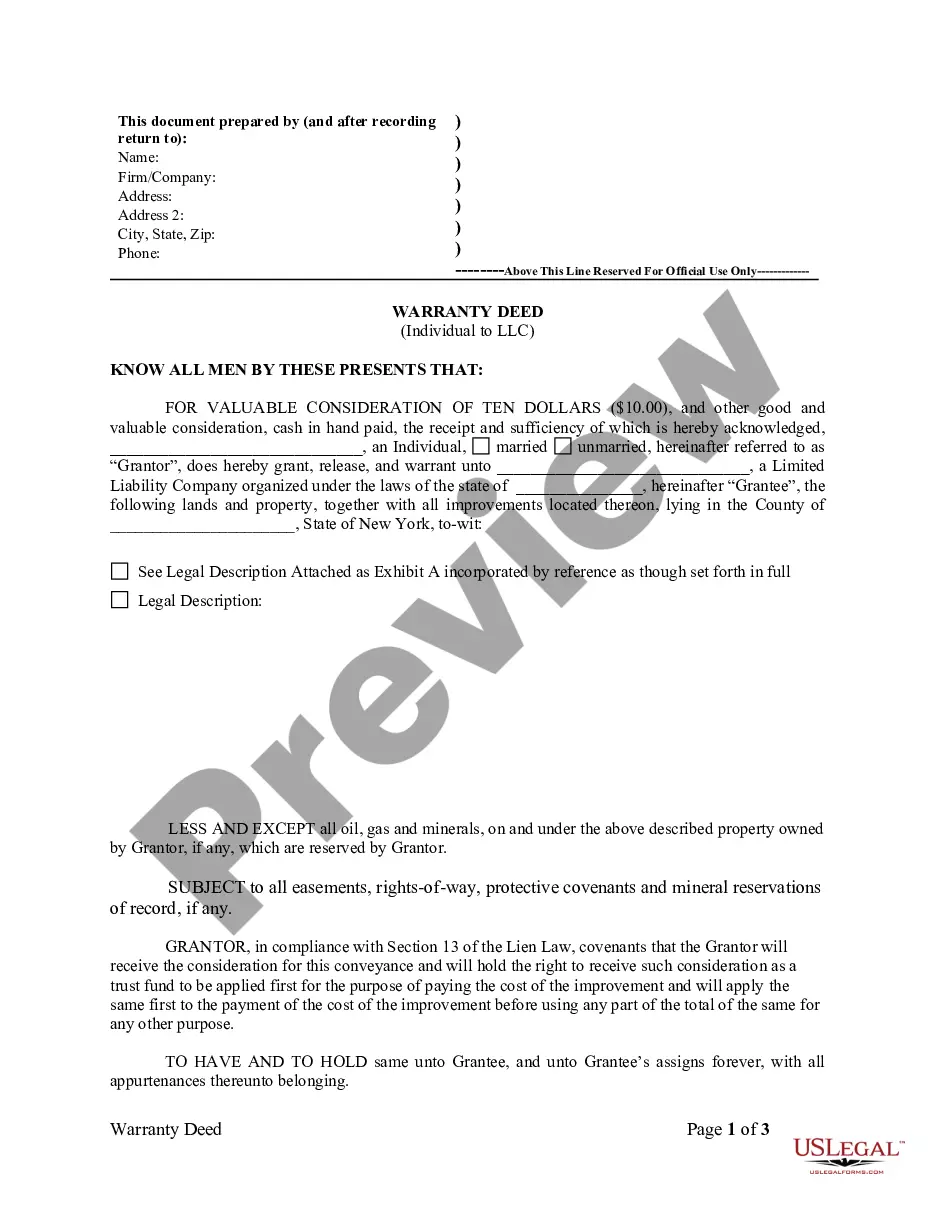
The Warranty Deed from Individual to LLC is a legal document that allows an individual (the grantor) to transfer ownership of property to a limited liability company (the grantee). This type of warranty deed ensures that the property is free from any encumbrances, with the previous owner guaranteeing clear title to the property. Unlike other deeds, this document specifically indicates the exclusion of oil, gas, and minerals from the conveyed property, providing clear instructions on what is being transferred.
Key parts of this document
- Identification of the grantor (individual) and grantee (LLC).
- Legal description of the property being conveyed.
- Covenant stating the property is free from encumbrances, unless noted.
- Specifies the exclusion of oil, gas, and minerals when applicable.
- Affirmation of the grantor's right to sell the property.
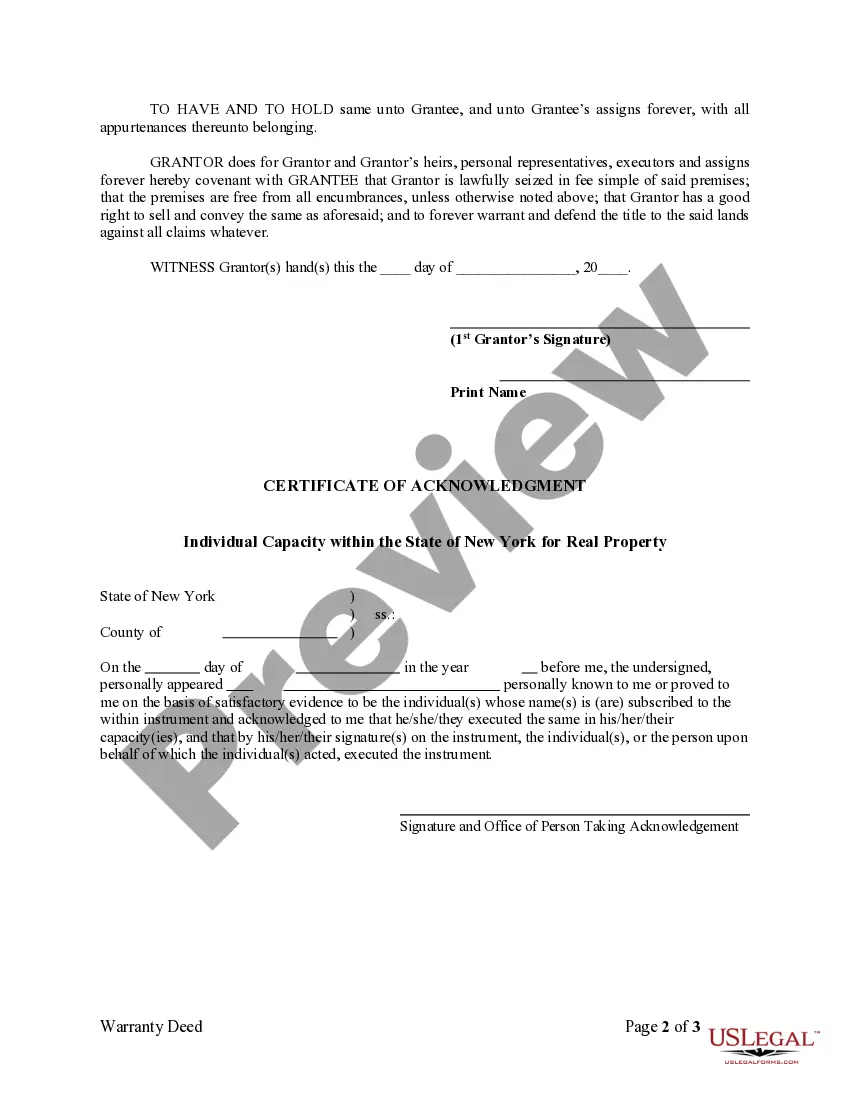
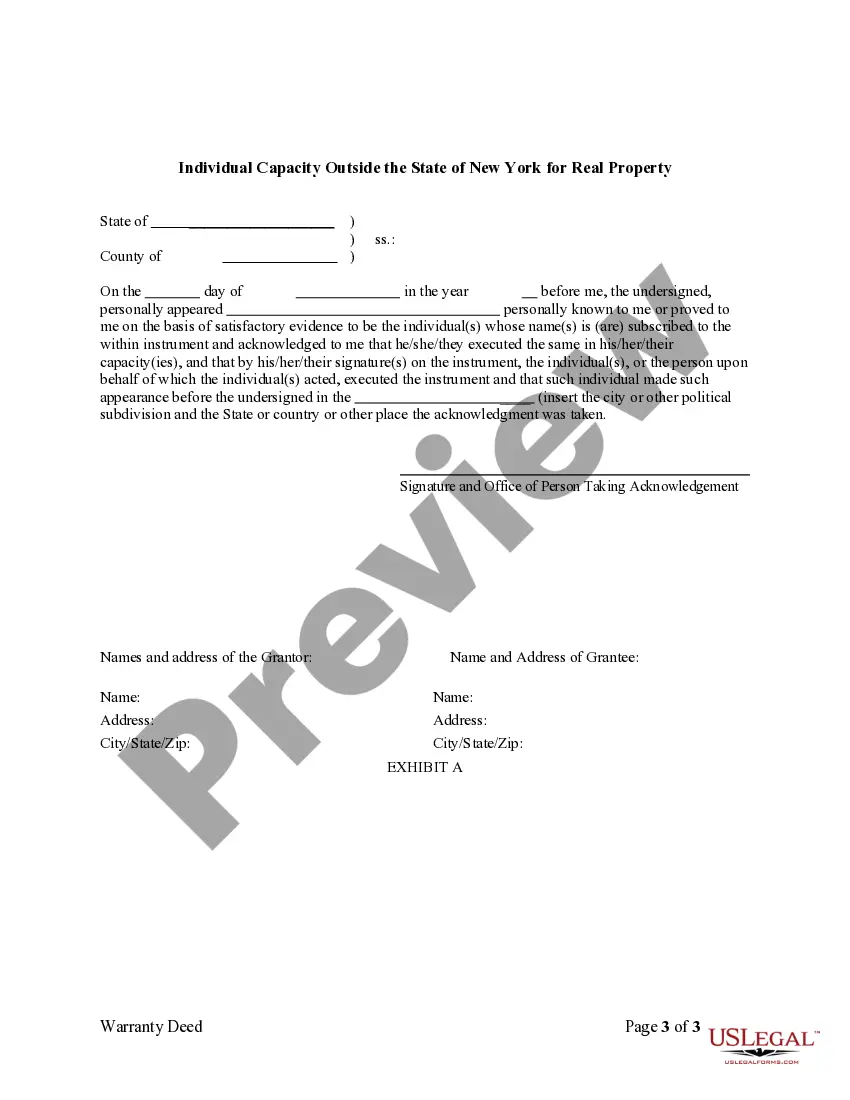
- Signatures of the grantor and any witnesses or notary as required.



When this form is needed
This warranty deed is commonly used when an individual wishes to transfer property ownership to their limited liability company. It is particularly applicable in real estate transactions involving business assets and provides legal protection for the LLC by confirming clear title and ownership without liens or claims from outside parties.
Who can use this document
- Business owners who have personal property they want to transfer to their LLC.
- Real estate investors transferring ownership between personal and business entities.
- Individuals seeking to formalize their property transfer to limit personal liability.
How to complete this form
- Identify the parties involvedâinclude the full legal names of the grantor and grantee.
- Specify the propertyâprovide a detailed legal description of the property as required.
- Include any necessary exemptions, such as the exclusion of oil, gas, and minerals.
- Sign the document in the presence of a notary or witnesses as required by state law.
- File the completed deed with the appropriate local government office to finalize the transfer.
Notarization requirements for this form
Yes, this form must be notarized to be legally valid. US Legal Forms offers integrated online notarization services, allowing you to complete the process securely via video call, providing legal equivalence without the need for in-person meetings.
Get your form ready online
Our built-in tools help you complete, sign, share, and store your documents in one place.
Make edits, fill in missing information, and update formatting in US Legal Forms—just like you would in MS Word.
Download a copy, print it, send it by email, or mail it via USPS—whatever works best for your next step.
Sign and collect signatures with our SignNow integration. Send to multiple recipients, set reminders, and more. Go Premium to unlock E-Sign.
If this form requires notarization, complete it online through a secure video call—no need to meet a notary in person or wait for an appointment.
We protect your documents and personal data by following strict security and privacy standards.

Make edits, fill in missing information, and update formatting in US Legal Forms—just like you would in MS Word.

Download a copy, print it, send it by email, or mail it via USPS—whatever works best for your next step.

Sign and collect signatures with our SignNow integration. Send to multiple recipients, set reminders, and more. Go Premium to unlock E-Sign.

If this form requires notarization, complete it online through a secure video call—no need to meet a notary in person or wait for an appointment.

We protect your documents and personal data by following strict security and privacy standards.
Common mistakes to avoid
- Failing to provide a complete legal description of the property.
- Not including necessary acknowledgments from a notary or witnesses.
- Omitting the exclusion language for oil, gas, and minerals if applicable.
- Incorrectly identifying the grantor or grantee, which may lead to disputes.
Advantages of online completion
- Immediate access to professionally drafted legal documents.
- Customizable fields ensure the form fits specific circumstances.
- Convenience of downloading and completing the form at your own pace.
- Includes guidance on legal requirements and execution procedures.
Legal use & context
- The Warranty Deed conveys ownership and is legally binding once signed and dated.
- It is important to ensure that the grantor has legal authority to convey the property.
- Failure to follow proper procedures can lead to disputes over ownership.
What to keep in mind
- The Warranty Deed from Individual to LLC is used to transfer property ownership effectively and legally.
- Understanding the formâs components and proper completion is critical to avoid legal issues.
- Utilizing online resources can simplify the process and ensure compliance with legal standards.
Looking for another form?
Form popularity
FAQ
Creating an LLC for your rental property is a smart choice as a property owner. It reduces your liability risk, effectively separates your assets, and has the tax benefit of pass-through taxation.You can add unique bank accounts for each rental property.
The fees to file a New York quitclaim deed vary from county to county, but some of the fees are similar. As of 2018, the basic fee for filing a quitclaim deed of residential or farm property is $125, while the fee for all other property is $250. These fees are for the RP-5217 form.
Retrieve your original deed. Get the appropriate deed form. Draft the deed. Sign the deed before a notary. Record the deed with the county recorder. Obtain the new original deed.
However, there are substantial downsides associated with transferring your primary home into an LLC.If you are using your personal residence for estate planning purposes, a qualified personal residence trust (QPRT) may be more effective than transferring your property to a limited liability company.
Does LLC ownership count as time used as a primary residence? For a single-member LLC, the answer is typically yes. For example, if the house is owned by an LLC. The Treasury Regulations allow for the capital gains exclusion when title is held by a single-member disregarded entity.
A warranty deed guarantees that: The grantor is the rightful owner of the property and has the legal right to transfer the title.The title would withstand third-party claims to ownership of the property. The grantor will do anything to ensure the grantee's title to the property.
The only way to forcibly change the ownership status is through a legal action and the resultant court order. However, if an owner chooses to be removed from the deed, it is simply a matter of preparing a new deed transferring that owner's interest in the property.
To change the deed in New York City, as we discussed, we will need a deed signed and notorized by the grantor. Additionally, the deed must also be filed and recorded with the Office of the City Register along with transfer documents which identify if any taxes are due.
To change the deed in New York City, as we discussed, we will need a deed signed and notorized by the grantor. Additionally, the deed must also be filed and recorded with the Office of the City Register along with transfer documents which identify if any taxes are due.