New York Quitclaim Deed from Individual to Individual
About this form
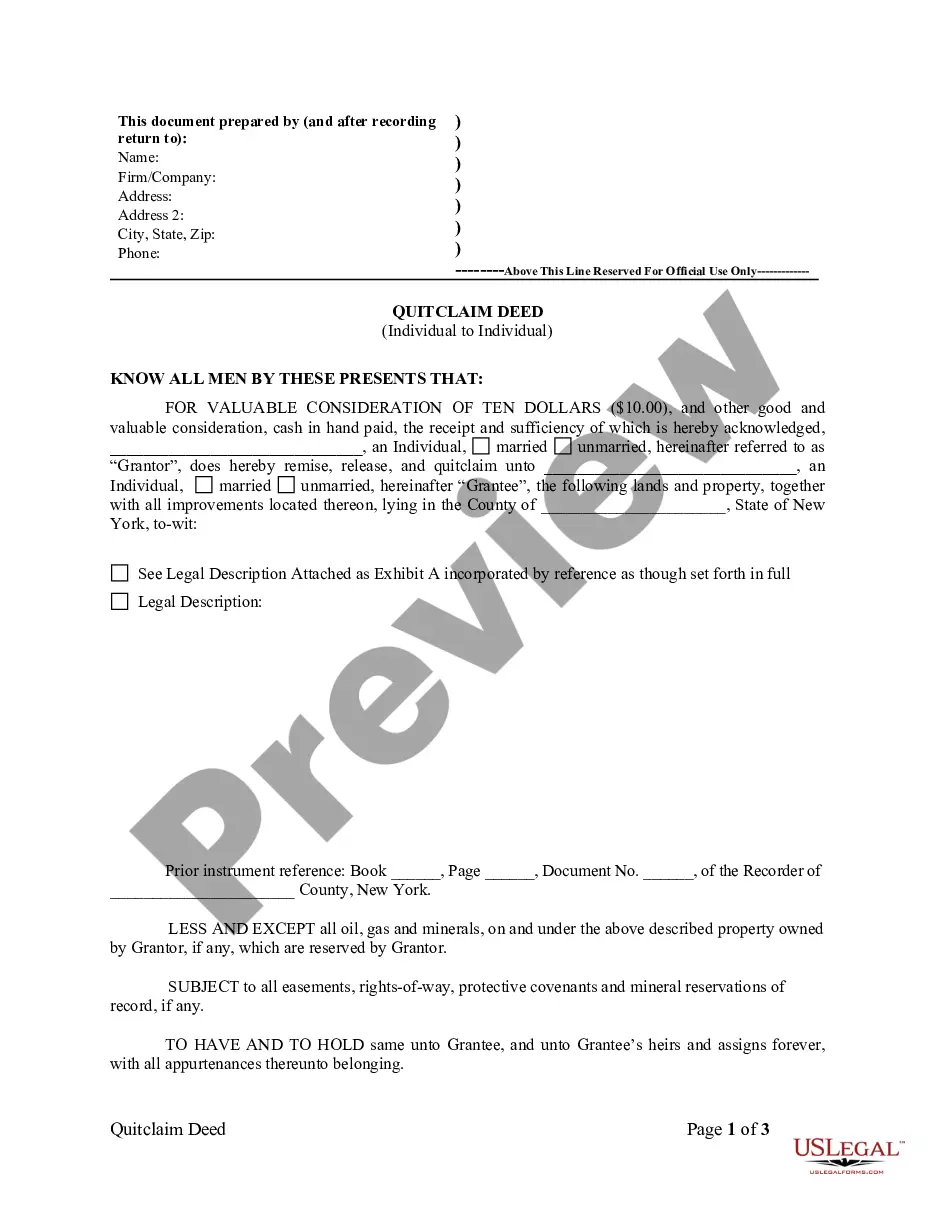
The Quitclaim Deed from Individual to Individual is a legal document that allows one individual (the Grantor) to transfer their ownership interest in a specific property to another individual (the Grantee) without making any warranties about the title. This form is suitable for a straightforward transfer of property rights between individuals, differing from other deeds, such as warranty deeds, which guarantee clear title. This Quitclaim Deed complies with state statutory laws, ensuring legal validity.
Key components of this form
- Identification of the Grantor and Grantee
- Legal description of the property being transferred
- Statement of the interest being conveyed
- Reservation of oil, gas, and minerals by the Grantor, if applicable
- Signatures of the parties involved
- Acknowledgment by a notary public, if required







Situations where this form applies
This Quitclaim Deed is used when an individual wishes to transfer property rights to another individual without providing any guarantees about the title. Common scenarios include transferring property between family members, resolving disputes over property ownership, or when clearing title to a property where clear ownership is uncertain. It is a suitable choice when the parties are familiar with the property or when the transfer is part of a divorce settlement or similar arrangement.
Who needs this form
- Individuals transferring property ownership to another individual
- Family members or relatives involved in property transactions
- Parties seeking to clarify or resolve ownership issues
- Individuals involved in legal agreements, such as divorce settlements
- People looking to transfer property as a gift or donation
Instructions for completing this form
- Identify the Grantor and Grantee by providing their full names and addresses.
- Specify the property by inserting the legal description in the designated section.
- Clearly state the interest being conveyed, including any reservations of rights.
- Have the Grantor sign the document and date it in the appropriate space.
- Complete any necessary acknowledgment sections for notarization, if required.
Notarization requirements for this form
This form does not typically require notarization unless specified by local law. However, it is advisable to have the signature acknowledged by a notary public to ensure the validity of the deed.
Get your form ready online
Our built-in tools help you complete, sign, share, and store your documents in one place.
Make edits, fill in missing information, and update formatting in US Legal Forms—just like you would in MS Word.
Download a copy, print it, send it by email, or mail it via USPS—whatever works best for your next step.
Sign and collect signatures with our SignNow integration. Send to multiple recipients, set reminders, and more. Go Premium to unlock E-Sign.
If this form requires notarization, complete it online through a secure video call—no need to meet a notary in person or wait for an appointment.
We protect your documents and personal data by following strict security and privacy standards.

Make edits, fill in missing information, and update formatting in US Legal Forms—just like you would in MS Word.

Download a copy, print it, send it by email, or mail it via USPS—whatever works best for your next step.

Sign and collect signatures with our SignNow integration. Send to multiple recipients, set reminders, and more. Go Premium to unlock E-Sign.

If this form requires notarization, complete it online through a secure video call—no need to meet a notary in person or wait for an appointment.

We protect your documents and personal data by following strict security and privacy standards.
Common mistakes
- Failing to provide a complete legal description of the property.
- Not including all necessary signatures from the Grantor.
- Overlooking the necessity of notarization if required by state law.
- Using the form without confirming the Granteeâs acceptance of the property transfer.
Advantages of online completion
- Convenient access to the form from anywhere, at any time.
- Editability to ensure accurate information before printing.
- Reliability, as the form is drafted by licensed professionals to meet legal standards.
- Quick download for immediate use, streamlining the process.
Looking for another form?
Form popularity
FAQ
Transferring ownership from one person to another without title warranties. It is used for straightforward transfers between individuals, such as family transfers, gifts, or divorce settlements where the parties know the property well. The form requires identifying the grantor and grantee, a legal property description, the interest conveyed, any mineral reservations, signatures, and an optional notary acknowledgment if required.
Yes. In New York, you can execute a New York Quitclaim Deed from Individual to Individual to transfer an ownership interest without title warranties. Use this standard form to identify the grantor and grantee, include the property description, specify the interest conveyed, note any reservations, and obtain signatures with a notary if required.
The form requires identification of the grantor and grantee, a legal description of the property, a statement of the interest conveyed, and, if applicable, a reservation of oil, gas, and minerals by the grantor. It also needs signatures of both parties and a notary acknowledgment if required.
Common mistakes include incorrect or missing grantor/grantee names, omitting the property's legal description, failing to specify the exact interest conveyed, missing signatures from one party, or skipping the notary acknowledgment or recording when required. These errors can delay or invalidate the transfer.
Not required by New York law to hire a lawyer to execute a quitclaim deed, but consulting a licensed attorney is advisable if there are title questions, complex ownership, or potential disputes, especially in transfers within families or during divorce settlements.
The New York Quitclaim Deed from Individual to Individual conveys only the grantor's interest and does not provide title warranties or defenses against claims. A warranty deed, by contrast, promises clear title and protections, making it a different form for transfers where title assurance is desired.