New Jersey Warranty Deed to Separate Property of One Spouse to Both Spouses as Joint Tenants
About this form
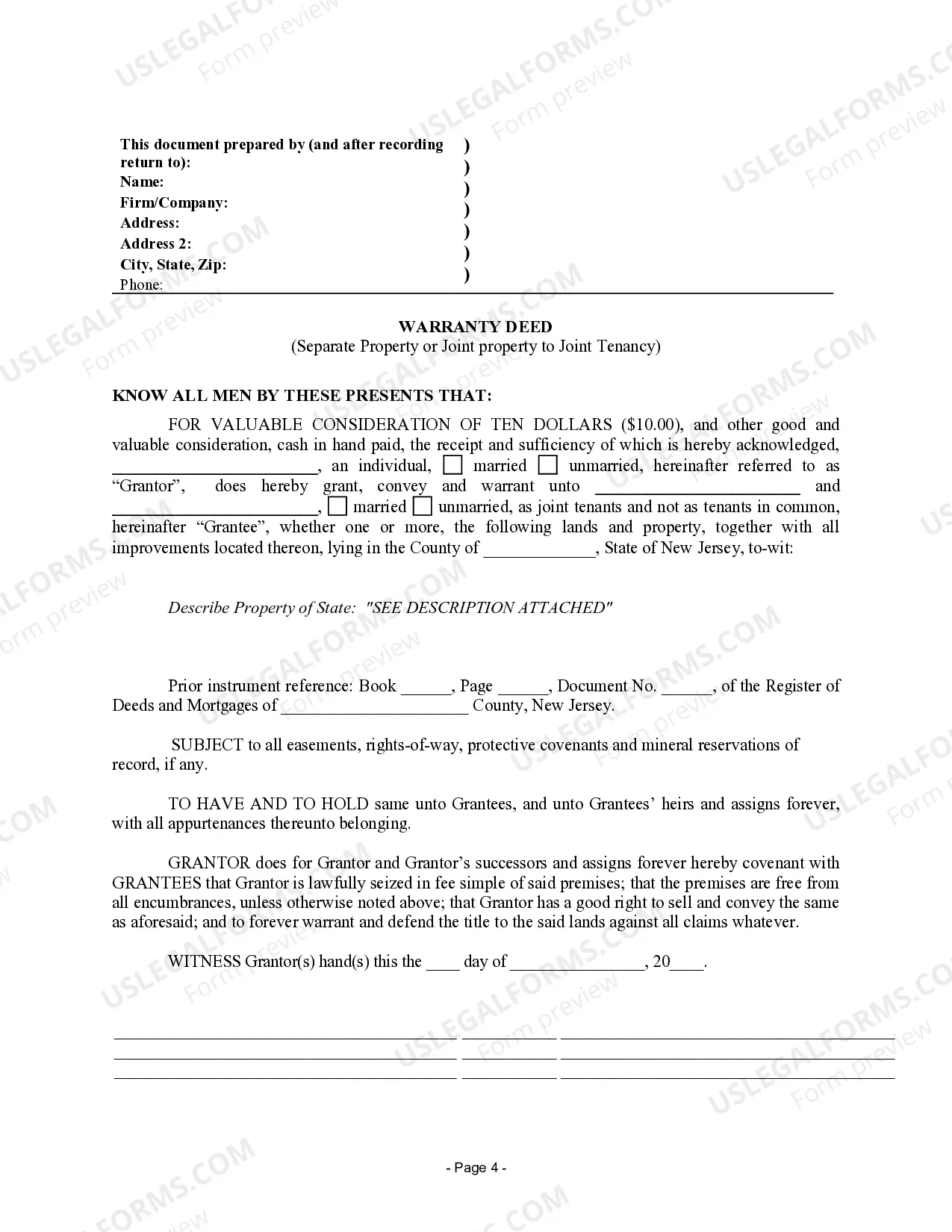
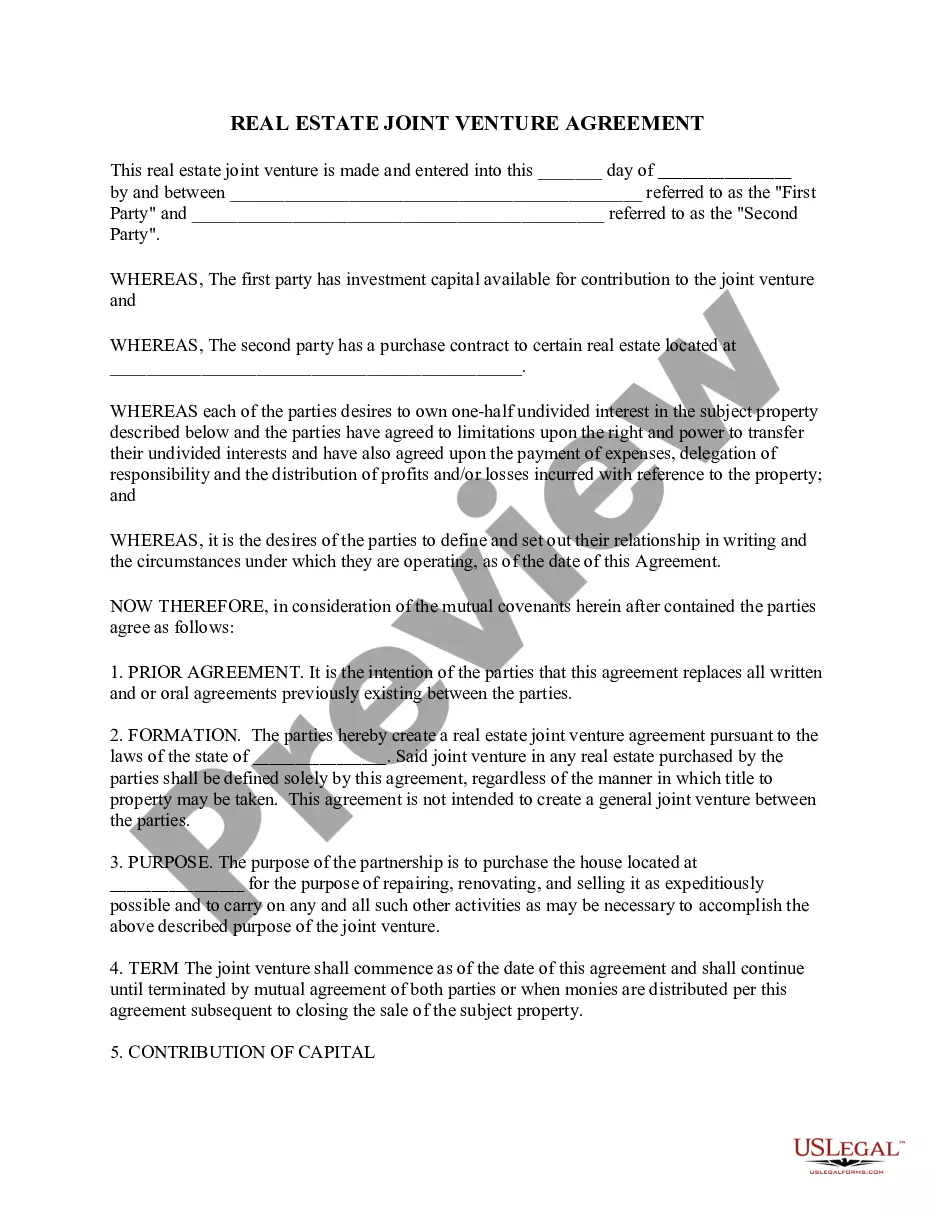
This Warranty Deed allows a wife to transfer her separate property to both herself and her husband, making them joint tenants. Unlike other forms of property transfer, this deed specifically creates joint ownership, which can affect inheritance and property rights. It is essential for ensuring that both spouses have equal rights to the property in question.
Key components of this form
- The names of the Grantor (the wife) and Grantees (the couple as joint tenants)
- A legal description of the property being transferred
- Identification of any outstanding encumbrances and easements
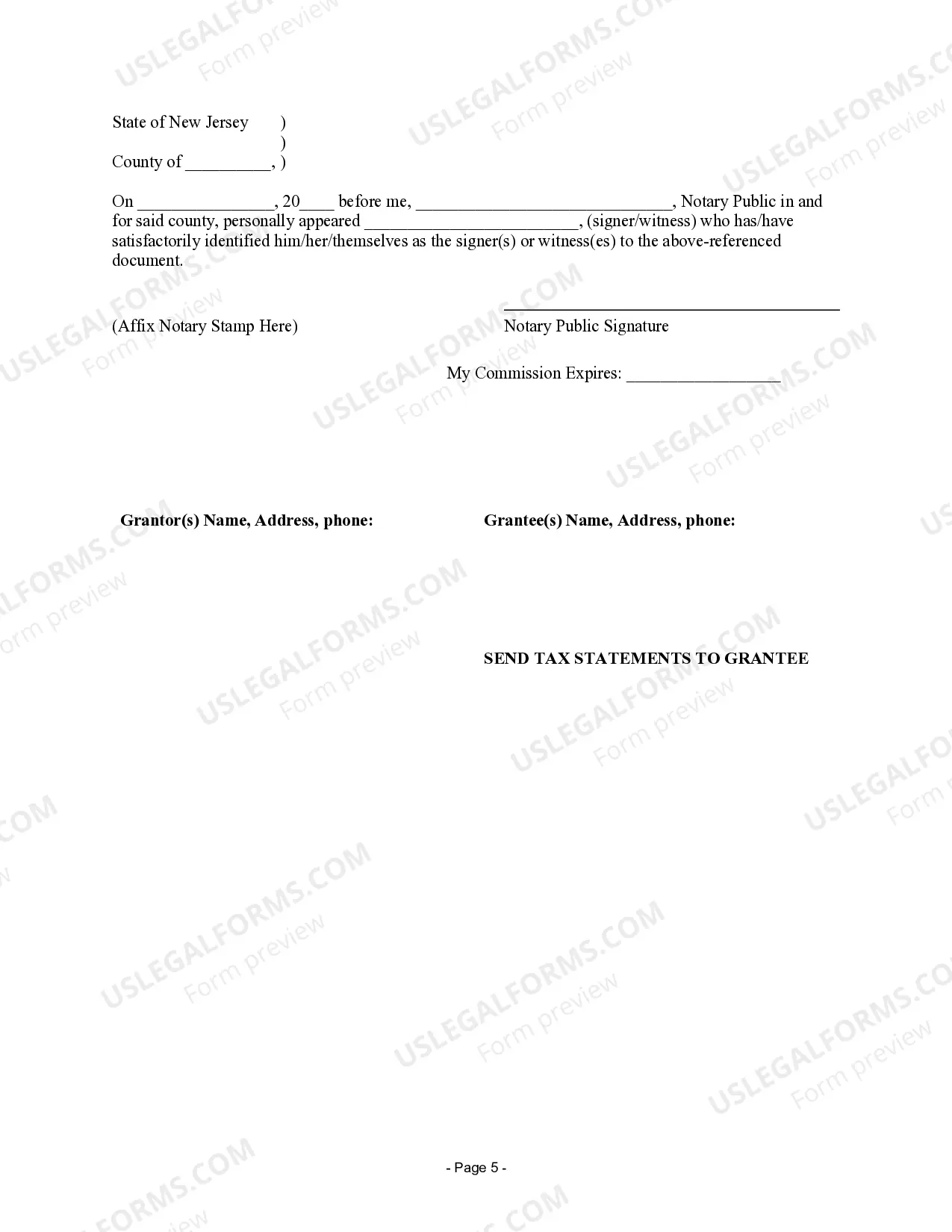
- Signatures of the Grantor and acknowledgment by a notary public
- Statements regarding the ownership and warranties of the property title


When to use this form
This form is typically used when a married couple wishes to consolidate property ownership or convert a separately owned property into joint tenancy. You may need this deed when one spouse seeks to ensure that their property passes directly to their spouse without going through probate upon death, or when planning to facilitate shared ownership for both parties.
Who should use this form
This Warranty Deed is suitable for:
- Married couples who own property separately and wish to transfer it to joint ownership
- Individuals who want to ensure rights of survivorship for their spouse
- Spouses looking to simplify the process of property transfer in estate planning
How to complete this form
- Identify the Grantor and Grantees by entering their full legal names.
- Provide a detailed description of the property being transferred, including its location.
- Indicate if there are any existing encumbrances on the property.
- Have the Grantor sign the document in the presence of a notary.
- Complete the notary acknowledgment section, ensuring all required information is included.
Notarization guidance
Notarization is required for this form to take effect. Our online notarization service, powered by Notarize, lets you verify and sign documents remotely through an encrypted video session, available 24/7.
Get your form ready online
Our built-in tools help you complete, sign, share, and store your documents in one place.
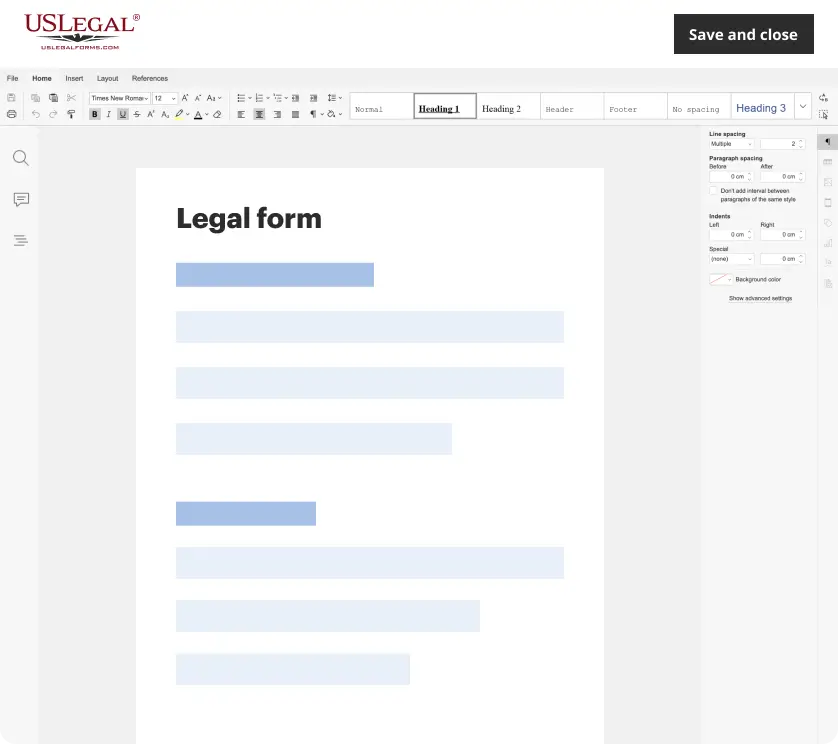
Make edits, fill in missing information, and update formatting in US Legal Forms—just like you would in MS Word.
Download a copy, print it, send it by email, or mail it via USPS—whatever works best for your next step.
Sign and collect signatures with our SignNow integration. Send to multiple recipients, set reminders, and more. Go Premium to unlock E-Sign.
If this form requires notarization, complete it online through a secure video call—no need to meet a notary in person or wait for an appointment.
We protect your documents and personal data by following strict security and privacy standards.
Make edits, fill in missing information, and update formatting in US Legal Forms—just like you would in MS Word.
Download a copy, print it, send it by email, or mail it via USPS—whatever works best for your next step.
Sign and collect signatures with our SignNow integration. Send to multiple recipients, set reminders, and more. Go Premium to unlock E-Sign.

If this form requires notarization, complete it online through a secure video call—no need to meet a notary in person or wait for an appointment.
We protect your documents and personal data by following strict security and privacy standards.
Avoid these common issues
- Failing to provide a clear legal description of the property.
- Not having the document notarized, which may invalidate the deed.
- Omitting necessary information about existing encumbrances.
- Incorrectly filling out the names of Grantors and Grantees.
Why use this form online
- Convenient access to legal forms anytime, from anywhere.
- Editable fields allow for easy customization of the document.
- Reliability of forms created by licensed attorneys ensures legal compliance.
Looking for another form?
Form popularity
FAQ
In cases where a couple shares a home but only one spouse's name is on it, the home will not automatically pass to the surviving pass, if his or her name is not on the title.
California married couples generally have three options to take title to their community (vs separate) property real estate: community property, joint tenancy or Community Property with Right of Survivorship. The latter coming into play in California July of 2001.
When one joint owner (called a joint tenant, though it has nothing to do with renting) dies, the surviving owners automatically get the deceased owner's share of the joint tenancy property.The surviving joint tenant will automatically own the property after your death.
In a common-law state, you can apply for a mortgage without your spouse. Your lender won't be able to consider your spouse's financial circumstances or credit while determining your eligibility.If you and your partner were to split up, the home would be yours alone; you wouldn't have to split it with your spouse.
When a property is owned by joint tenants with survivorship, the interest of a deceased owner automatically gets transferred to the remaining surviving owners. For example, if four joint tenants own a house and one of them dies, each of the three remaining joint tenants ends up with a one-third share of the property.
In California, all property bought during the marriage with income that was earned during the marriage is deemed "community property." The law implies that both spouses own this property equally, regardless of which name is on the title deed.
Property owned in joint tenancy automatically passes, without probate, to the surviving owner(s) when one owner dies. Joint tenancy often works well when couples (married or not) acquire real estate, vehicles, bank accounts, securities, or other valuable property together.
It's often easier to qualify for a joint mortgage, because both spouses can contribute income and assets to the application. However, if one spouse can qualify for a mortgage based on his own income and credit, the mortgage does not need to be in both spouses' names unless you live in a community property state.
In California, most married couples hold real property (such as land and buildings) as joint tenants with right of survivorship.For instance, many married couples share real property as joint tenants. This way, upon the death of a spouse, the surviving spouse will own 100% share of the property.