North Carolina Warranty Deed for Husband and Wife Converting Property from Tenants in Common to Joint Tenancy
About this form
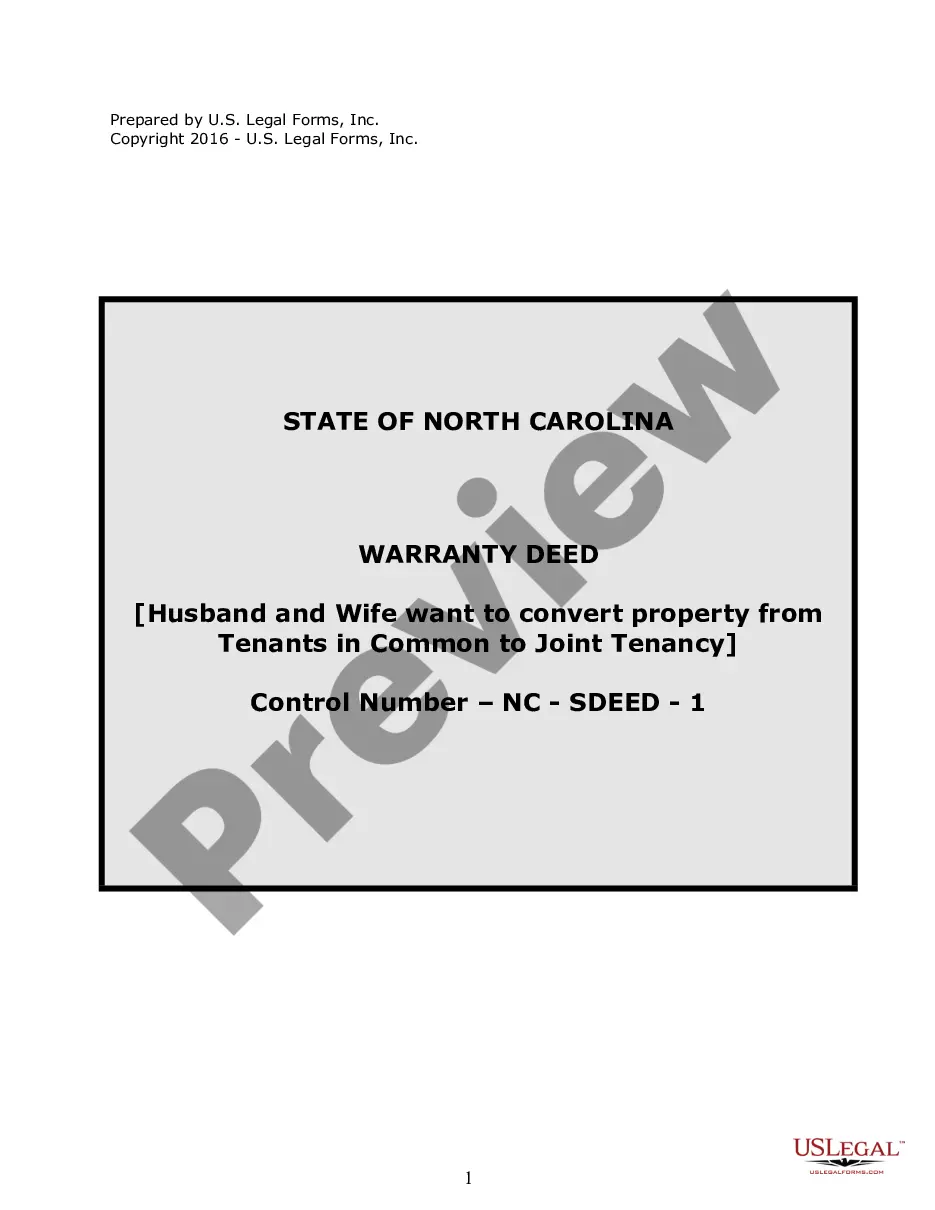
A Warranty Deed for Husband and Wife converting property from Tenants in Common to Joint Tenancy is a legal document used to transfer ownership of real property from a married couple who currently hold the title as tenants in common to joint tenants. This form ensures that both spouses retain equal rights to the property, which can simplify the transfer of property rights in case of one spouse's passing.
Key components of this form
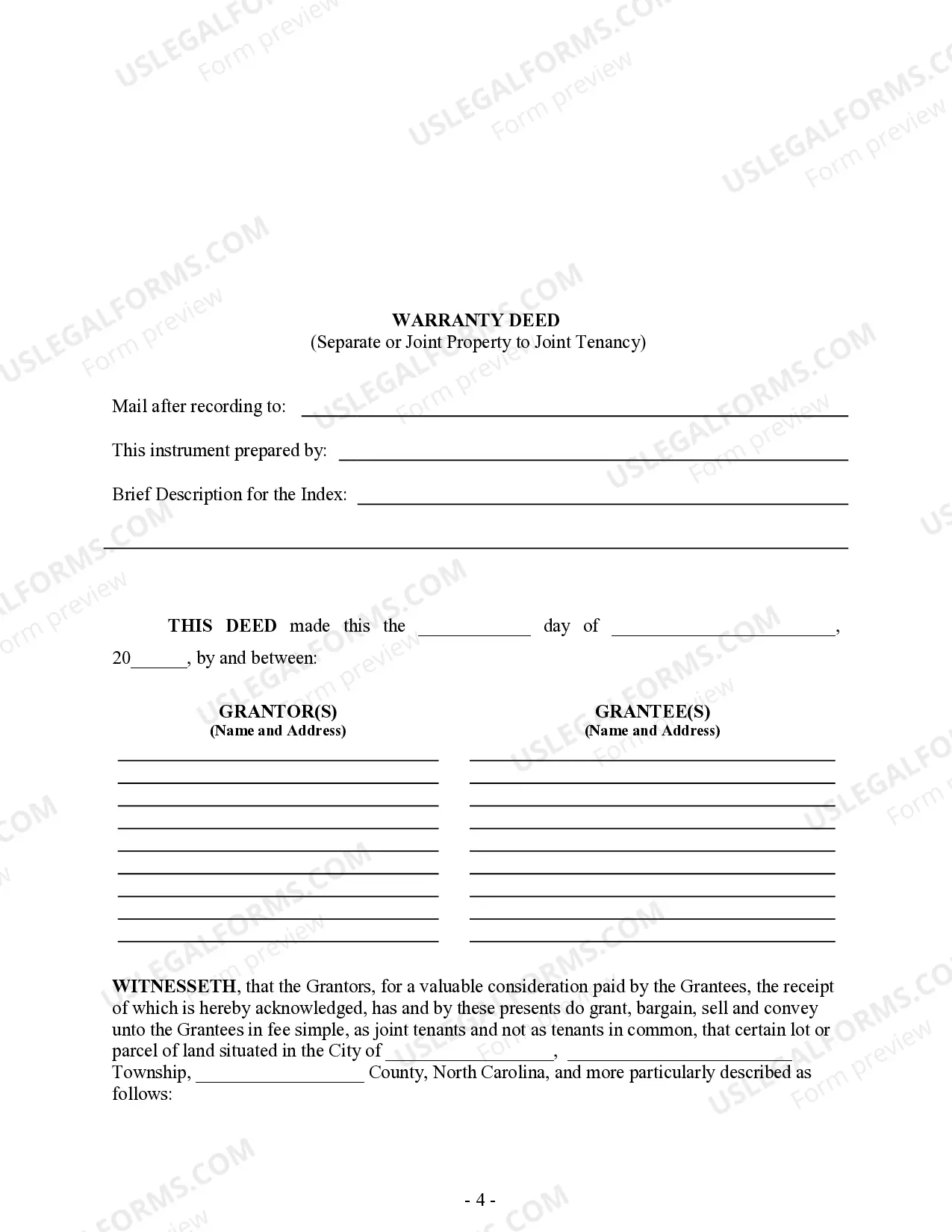
- Grantor and Grantee Details: Names and addresses of the couple transferring the property and the individuals receiving it.
- Property Description: Detailed information about the real property being conveyed, including its location and reference to previous deeds.
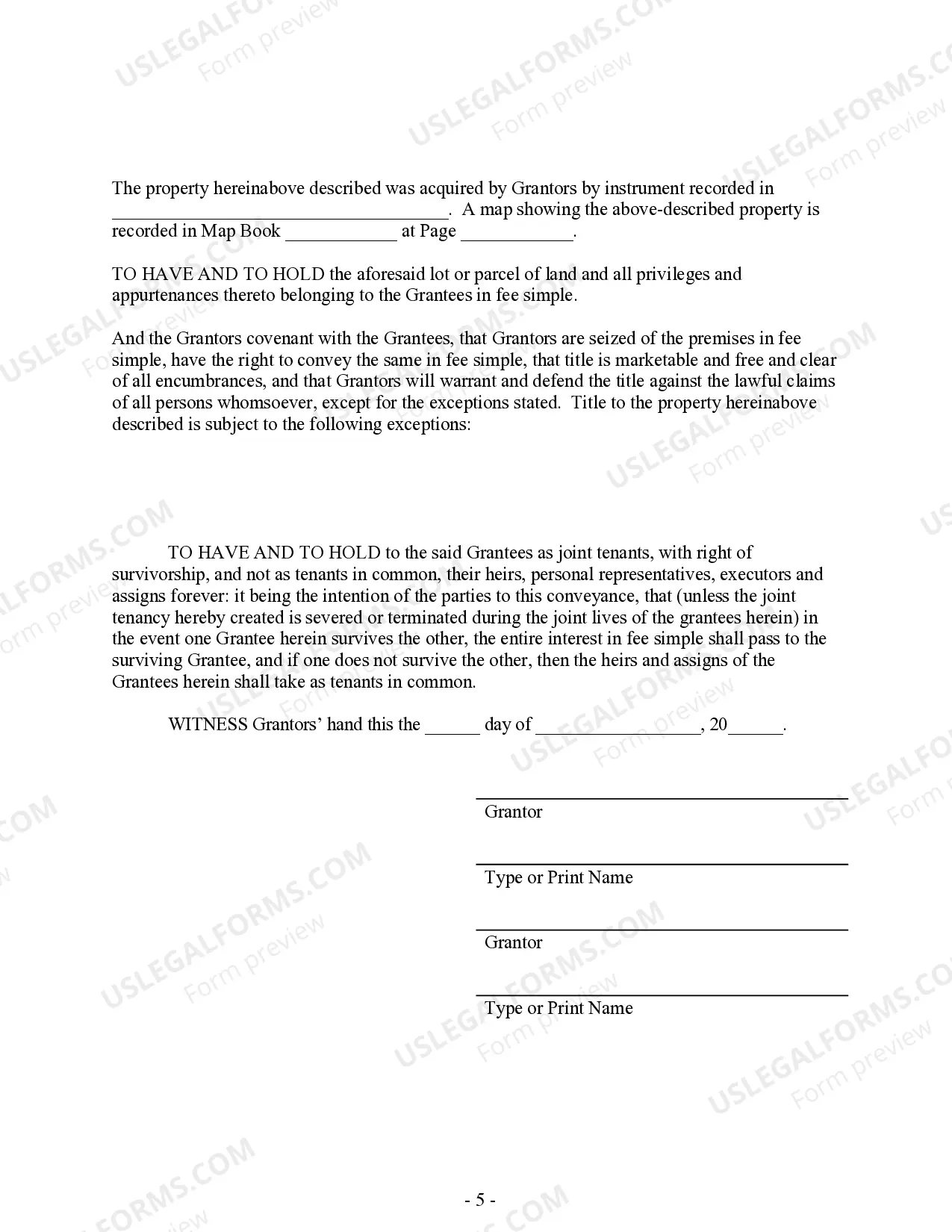
- Estate Type: Specifies that the property is held as joint tenants with the right of survivorship.
- Warranties: Guarantees that the grantors have clear title to the property and will defend it against claims.
- Notarization: A section for the notary public to certify the execution of the deed, ensuring legal validity.




When to use this document
This form should be used when a married couple who currently own property as tenants in common wishes to convert their ownership to joint tenancy. This situation often arises when spouses want to simplify inheritance and ensure that the surviving spouse automatically receives full ownership upon the other's death.
Who can use this document
This form is intended for:
- Married couples seeking to update their property ownership structure.
- Individuals wishing to ensure survivorship rights for their spouse.
- Persons with limited legal experience who prefer clear and straightforward documentation.
How to prepare this document
To complete this form, follow these steps:
- Identify the grantors (husband and wife) and enter their names and addresses.
- Specify the names and addresses of the grantees (who will receive the property).
- Clearly describe the property being transferred, including its boundaries and any previous deed references.
- Enter the date of the transaction and ensure proper signatures from both grantors.
- Have the form notarized to ensure its legal validity.
Notarization guidance
Yes, this form must be notarized to be legally valid. U.S. Legal Forms offers integrated online notarization services, allowing users to notarize their documents securely via video call, 24/7, eliminating the need to travel to a notary in person.
Get your form ready online
Our built-in tools help you complete, sign, share, and store your documents in one place.
Make edits, fill in missing information, and update formatting in US Legal Forms—just like you would in MS Word.
Download a copy, print it, send it by email, or mail it via USPS—whatever works best for your next step.
Sign and collect signatures with our SignNow integration. Send to multiple recipients, set reminders, and more. Go Premium to unlock E-Sign.
If this form requires notarization, complete it online through a secure video call—no need to meet a notary in person or wait for an appointment.
We protect your documents and personal data by following strict security and privacy standards.

Make edits, fill in missing information, and update formatting in US Legal Forms—just like you would in MS Word.

Download a copy, print it, send it by email, or mail it via USPS—whatever works best for your next step.

Sign and collect signatures with our SignNow integration. Send to multiple recipients, set reminders, and more. Go Premium to unlock E-Sign.

If this form requires notarization, complete it online through a secure video call—no need to meet a notary in person or wait for an appointment.

We protect your documents and personal data by following strict security and privacy standards.
Avoid these common issues
- Failing to provide complete and accurate names and addresses of all parties involved.
- Not including a detailed description of the property being transferred.
- Omitting required signatures or notarization.
- Not specifying the right of survivorship, which is essential in a joint tenancy deed.
Advantages of online completion
- Convenient online access to the form allows for easy downloading and filling.
- Editability of the form gives users flexibility to make necessary adjustments before printing.
- Reliability of professionally drafted legal forms ensures compliance with current laws.
Key takeaways
- This Warranty Deed is used by married couples to convert property ownership from tenants in common to joint tenancy.
- Completing the form requires accurate details of the property and signatures from both spouses, along with notarization.
- Using this form can streamline the inheritance process, ensuring that the surviving spouse retains full ownership without complications.
Looking for another form?



Form popularity
FAQ
DISADVANTAGES OF TENANTS IN COMMONTenants in Common is a more complex arrangement and some people may prefer the simplicity and efficiency of the home passing by survivorship.
In California, most married couples hold real property (such as land and buildings) as joint tenants with right of survivorship.For instance, many married couples share real property as joint tenants. This way, upon the death of a spouse, the surviving spouse will own 100% share of the property.
Serve a written notice of the change (a 'notice of severance') on the other owners - a conveyancer can help you do this. Download and fill in form SEV to register a restriction without the other owners' agreement. Prepare any supporting documents you need to include.
' Spouses typically acquire title as tenants by the entireties, which only applies to spouses. Sometimes you will see a couple who acquired the property before marriage. In some states, a pre-marital joint tenancy automatically becomes tenants by the entireties upon marriage.
Often Tenants in Common is used for Inheritance Tax planning and can also be used to prevent having to sell your home if you need to go into long-term care. And is also a way for couples to protect their share in case of separation or divorce. A Tenant in Common can gift their share of the property in their Will.
Most married couples tend to hold their property as joint tenants.Should this happen, the property is then automatically held as Tenants in Common which means the co-owner is free to leave their share of the property to whoever they wish. As Tenants in Common, each co-owner owns a specific share of the property.
Each party has a full ownership interest in the property. The property will pass instantly to the survivor upon the death of the other without probate. Conveyance by one party without the other breaks the joint tenancy. Seller warrants that he/she has good title and will warrant and defend title.
You can change from being either: joint tenants to tenants in common, for example if you divorce or separate and want to leave your share of the property to someone else. tenants in common to joint tenants, for example if you get married and want to have equal rights to the whole property.
In estate law, joint tenancy is a special form of ownership by two or more persons of the same property. The individuals, who are called joint tenants, share equal ownership of the property and have the equal, undivided right to keep or dispose of the property. Joint tenancy creates a Right of Survivorship.