North Carolina Quitclaim Deed - Individual to Trust
About this form
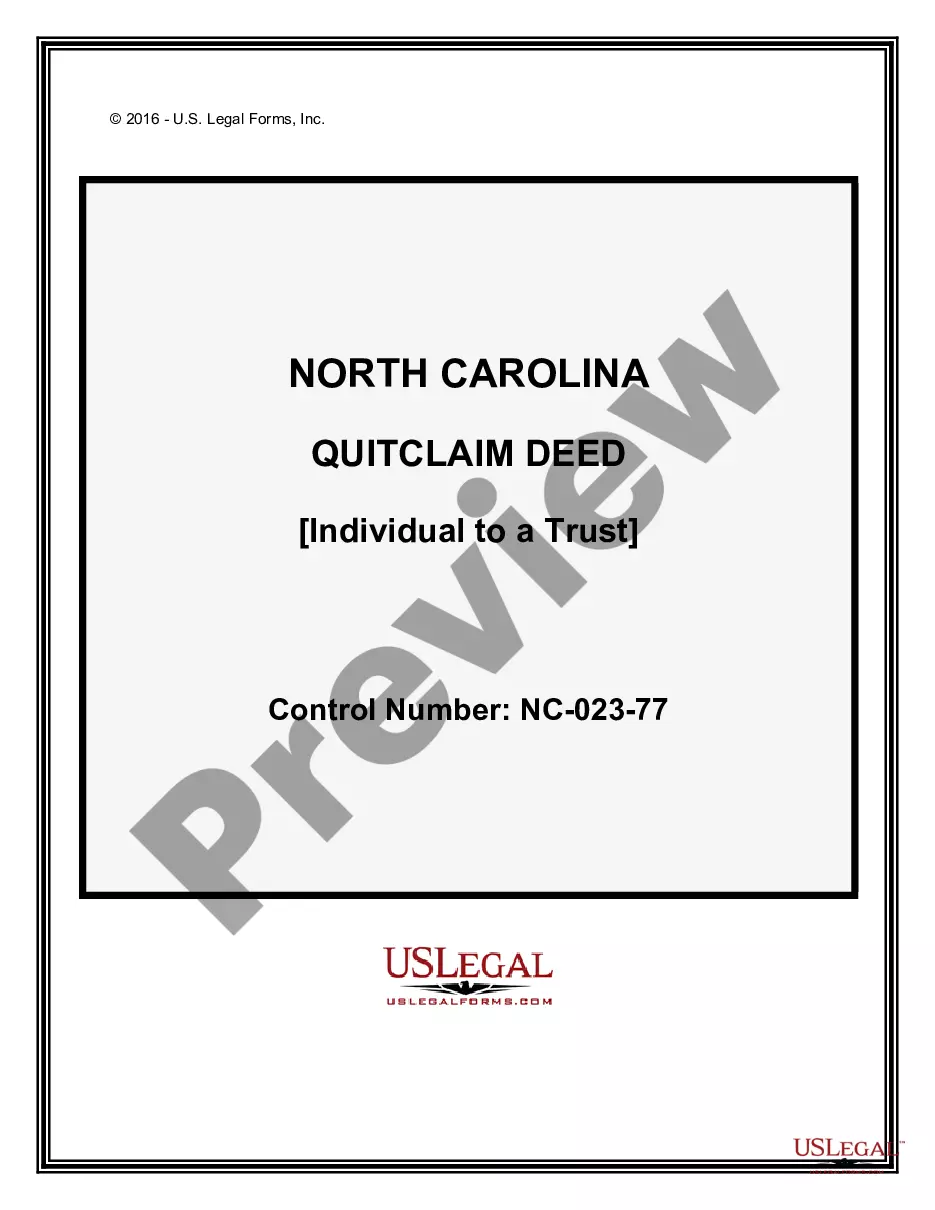
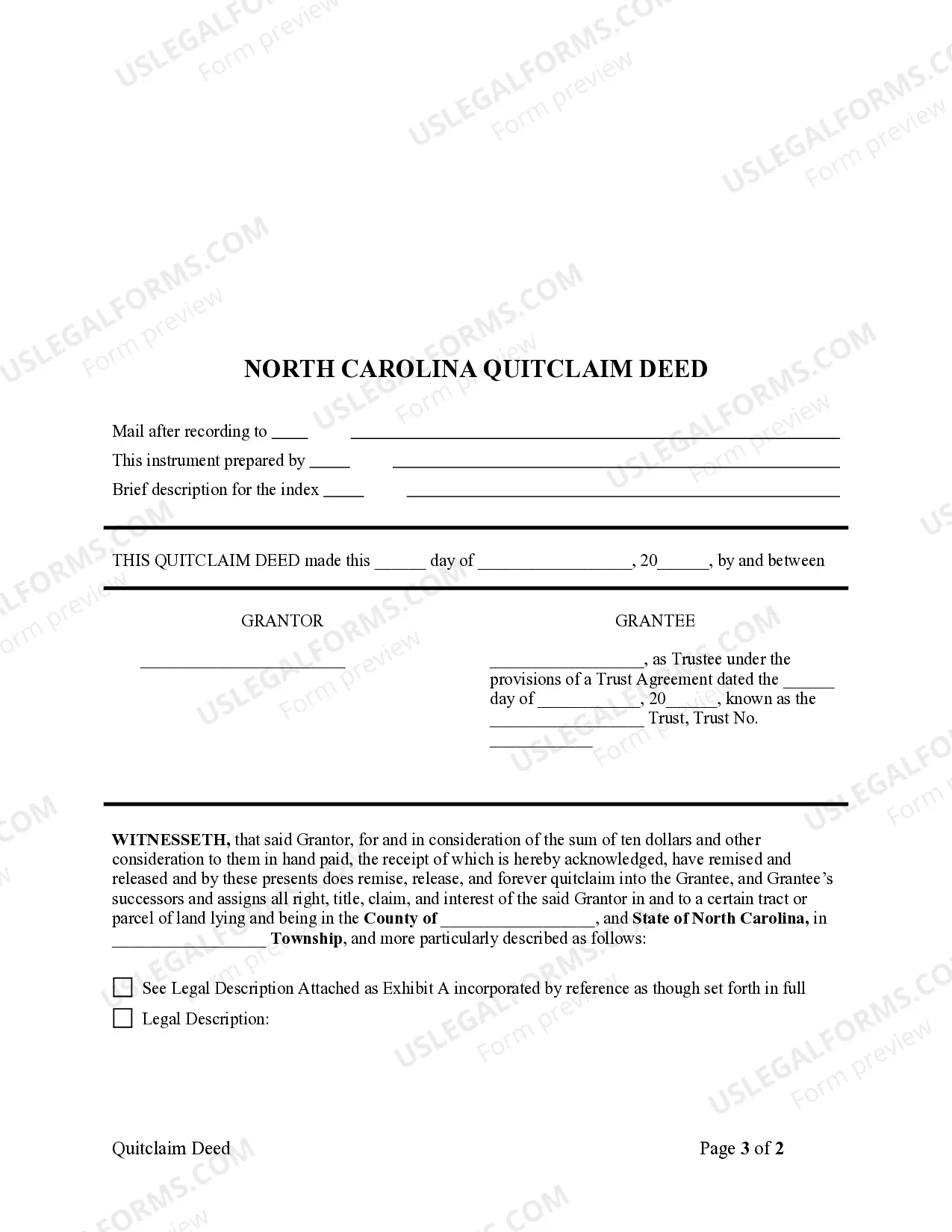
The Quitclaim Deed - Individual to Trust is a legal document that allows an individual (the grantor) to transfer their property interest to a trustee who acts on behalf of a trust. Unlike a warranty deed, this form only conveys whatever rights the grantor has in the property without guaranteeing clear title. This form is essential for estate planning and can help facilitate the management and transfer of assets within a trust.
Key parts of this document
- Identification of the grantor and grantee, including the name of the trustee.
- Description of the property being transferred, including parcel details.
- Statement of consideration, often a nominal amount like ten dollars.
- Trust agreement reference, indicating the trust's name and date.
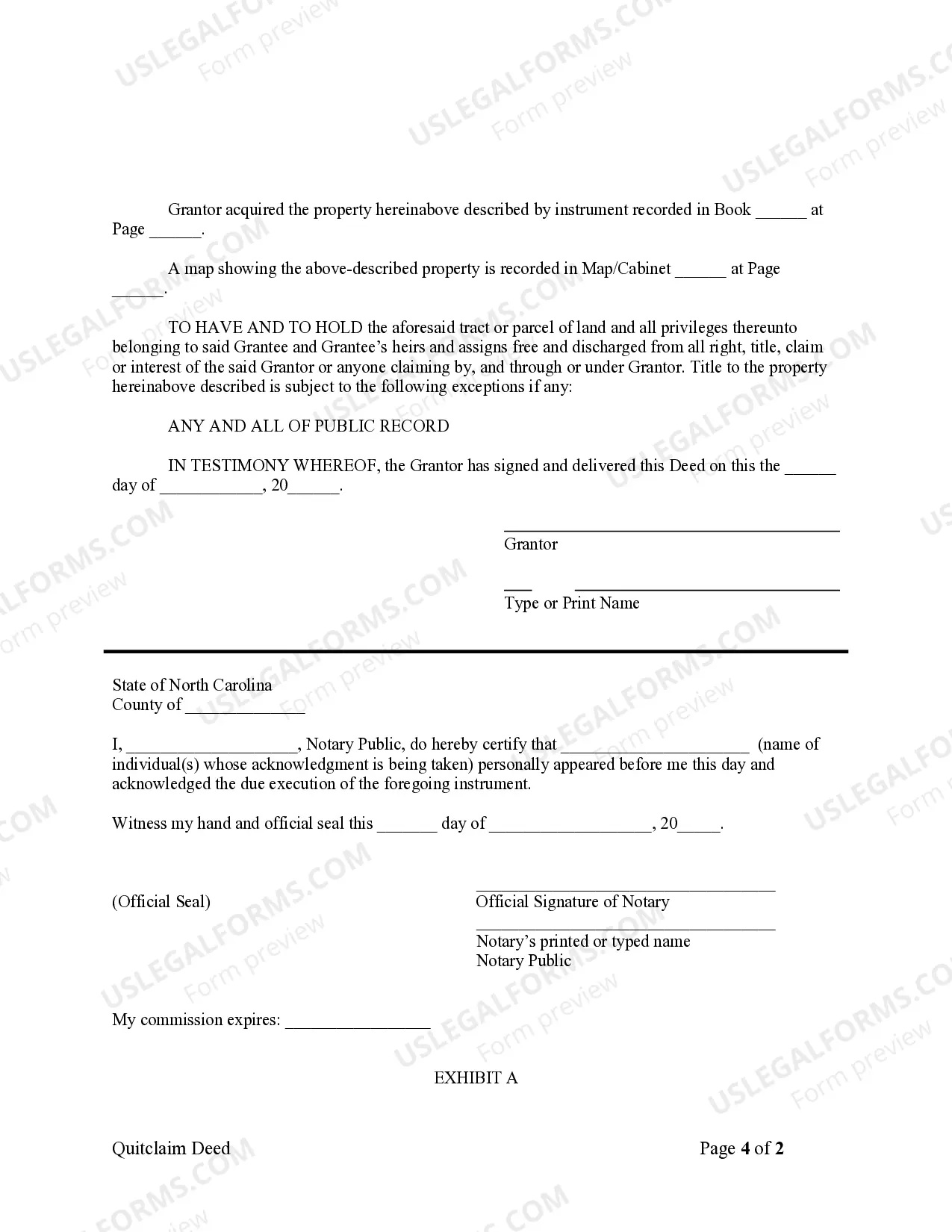
- Signature lines for the grantor and a notary public to validate the deed.




When to use this document
This form is used when an individual wishes to transfer property to a trust for various purposes, such as estate planning, asset protection, or managing property for beneficiaries. It is particularly useful when the grantor wants to ensure that their assets are managed according to their wishes after their passing.
Who needs this form
This form is intended for:
- Property owners looking to transfer their assets into a trust.
- Trustees who need official documentation to manage trust property.
- Individuals engaged in estate planning who want to simplify the transfer of property.
Instructions for completing this form
- Enter the names and contact information of the grantor and grantee (trustee).
- Provide a legal description of the property being transferred.
- Specify the nominal consideration amount, typically ten dollars.
- Complete the section referring to the trust agreement, including its name and date.
- Ensure the grantor signs the form in the presence of a notary public.
Notarization guidance
This form must be notarized to be legally valid. US Legal Forms provides secure online notarization powered by Notarize, allowing you to complete the process through a verified video call.
Get your form ready online
Our built-in tools help you complete, sign, share, and store your documents in one place.
Make edits, fill in missing information, and update formatting in US Legal Forms—just like you would in MS Word.
Download a copy, print it, send it by email, or mail it via USPS—whatever works best for your next step.
Sign and collect signatures with our SignNow integration. Send to multiple recipients, set reminders, and more. Go Premium to unlock E-Sign.
If this form requires notarization, complete it online through a secure video call—no need to meet a notary in person or wait for an appointment.
We protect your documents and personal data by following strict security and privacy standards.

Make edits, fill in missing information, and update formatting in US Legal Forms—just like you would in MS Word.

Download a copy, print it, send it by email, or mail it via USPS—whatever works best for your next step.

Sign and collect signatures with our SignNow integration. Send to multiple recipients, set reminders, and more. Go Premium to unlock E-Sign.

If this form requires notarization, complete it online through a secure video call—no need to meet a notary in person or wait for an appointment.

We protect your documents and personal data by following strict security and privacy standards.
Common mistakes to avoid
- Failing to provide a complete legal description of the property.
- Leaving out the trustee's details or incorrect names.
- Not having the deed notarized, which can invalidate it.
- Improperly filling out the date, which may cause delays.
Benefits of using this form online
- Convenient access to legal forms from the comfort of your home.
- Editability allows users to fill out the form accurately and easily.
- Reliable templates drafted by licensed attorneys, ensuring legal compliance.
Looking for another form?
Form popularity
FAQ
But you might be wondering if an owner can transfer a deed to another person without a real estate lawyer. The answer is yes. Parties to a transaction are always free to prepare their own deeds.A quitclaim deed, for example, is far simpler than a warranty deed.
The drawback, quite simply, is that quitclaim deeds offer the grantee/recipient no protection or guarantees whatsoever about the property or their ownership of it. Maybe the grantor did not own the property at all, or maybe they only had partial ownership.
Laws § 47B-8. Recording This form must be submitted, after completion and signature, to the Register of Deeds in the county where the real estate is located. Signing (A§ 47-38) All quit claim deeds are required to be signed with the Grantor(s) being witnessed by a Notary Public.
No. And unless the deed identifies the trust as an owner, then father is the owner of an interest. It is a common mistake to set up a trust and then fail to deed property into the trust. However, you cannot force him to make the changes you are...
Yes, a quit claim deed supercedes the trust. The only thing that can be done is to file a suit in court challenging the deed as the product of fraud and undue influence. A court action like that will cost thousands of dollars, but might be worth it if the house was owned free and clear.
Locate your current deed. Use the proper deed. Check with your title insurance company and lender. Prepare a new deed. Sign in the presence of a notary. Record the deed in the county clerk's office. Locate the deed that's in trust. Use the proper deed.
It's usually a very straightforward transaction, but it's possible for a quitclaim deed to be challenged. If a quitclaim deed is challenged in court, the issue becomes whether the property was legally transferred and if the grantor had the legal right to transfer the property.
If the quitclaim deed requires the signature of all co-owners, the deed is invalid unless all co-owners have signed it and the deed is then delivered to the grantee.If one individual owns real estate and desires to add a co-owner such as a spouse, a quitclaim deed might be used.
Locate your current deed. Use the proper deed. Check with your title insurance company and lender. Prepare a new deed. Sign in the presence of a notary. Record the deed in the county clerk's office. Locate the deed that's in trust. Use the proper deed.