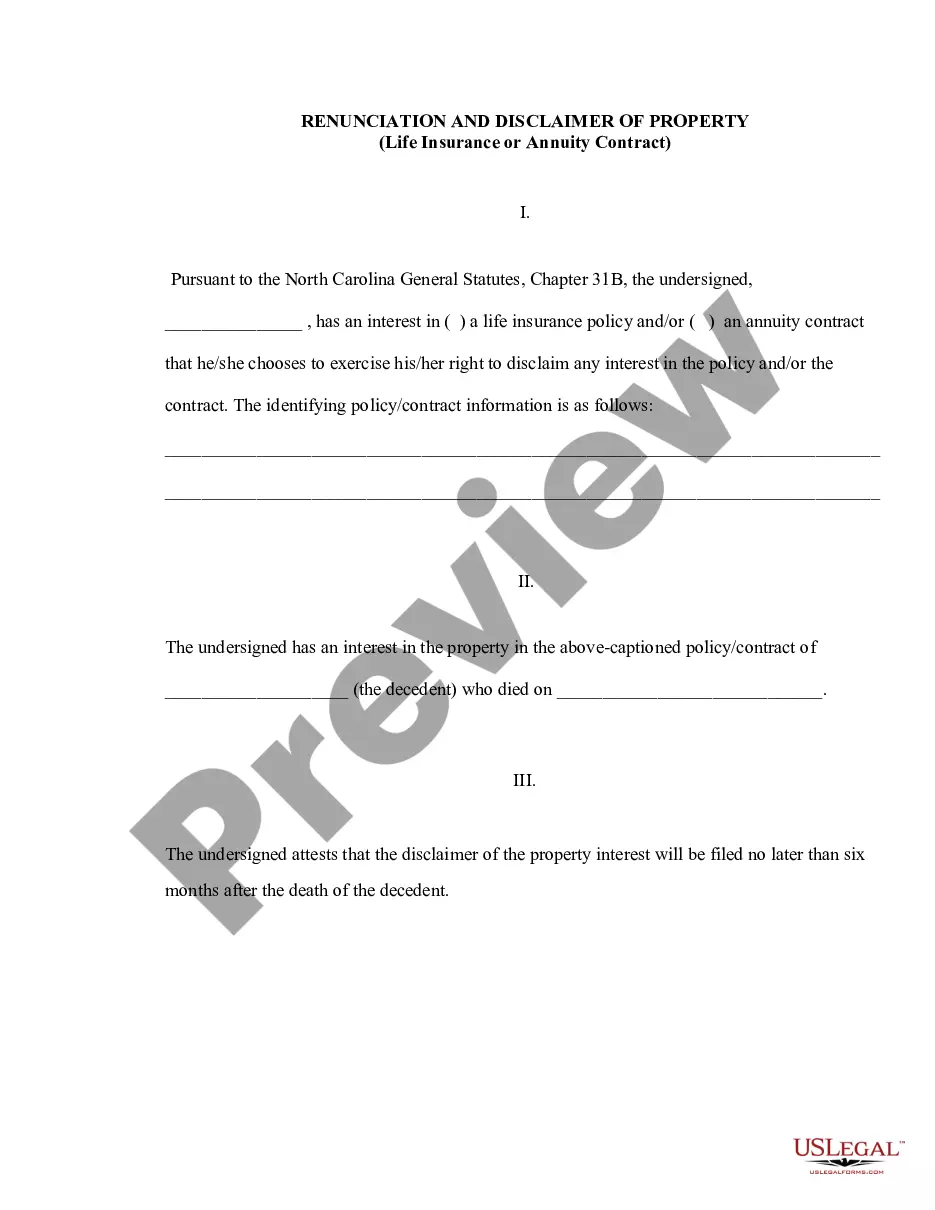
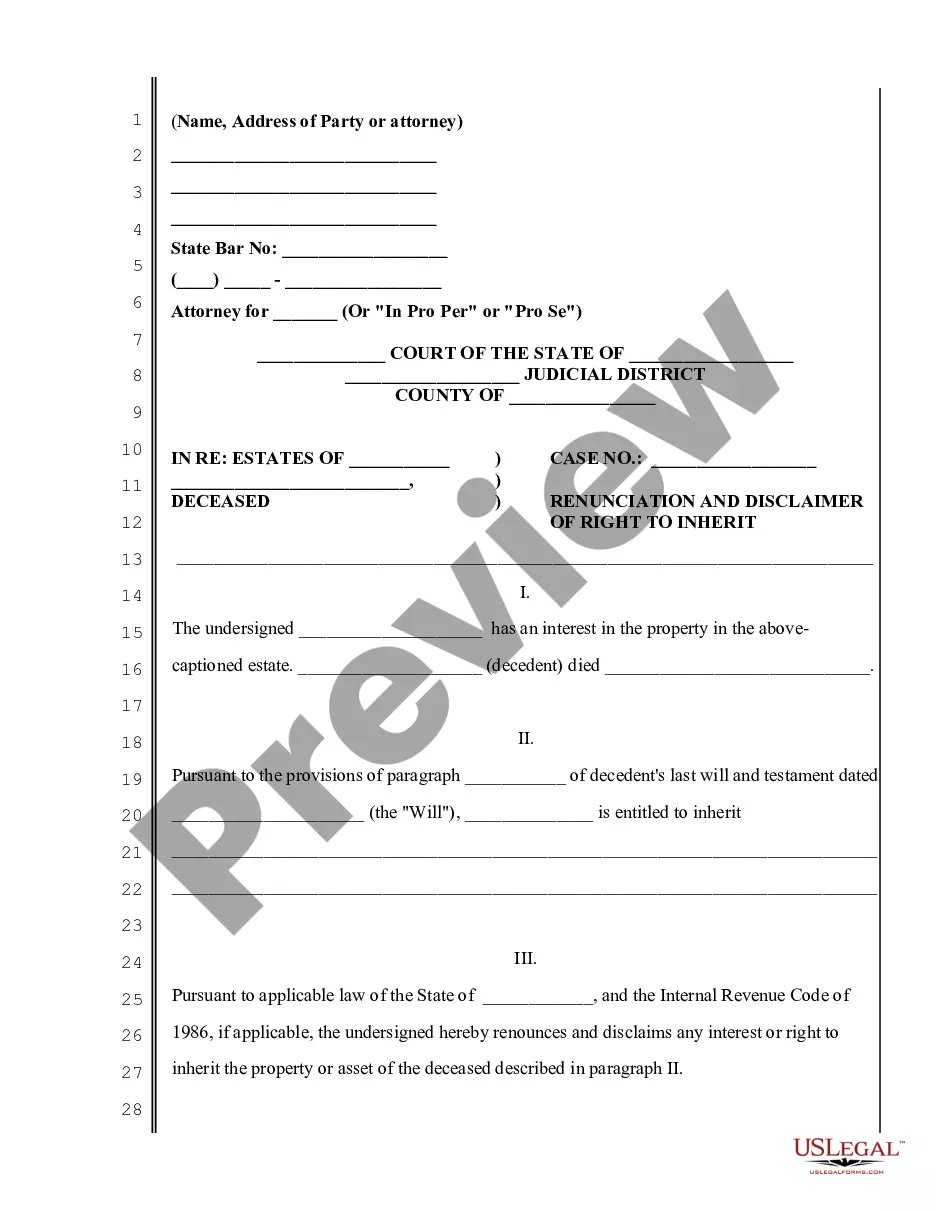
North Carolina Renunciation and Disclaimer of Property - Individual Retirement Account, Annuity, or Bond
Disclaimer of Property
Interest-North Carolina
North Carolina General Statutes
Chapter 31B Renunciation of Property and Renunciation of Fiduciary
Powers Act.
Right to renounce succession.
(a) A person who succeeds to a property interest as:
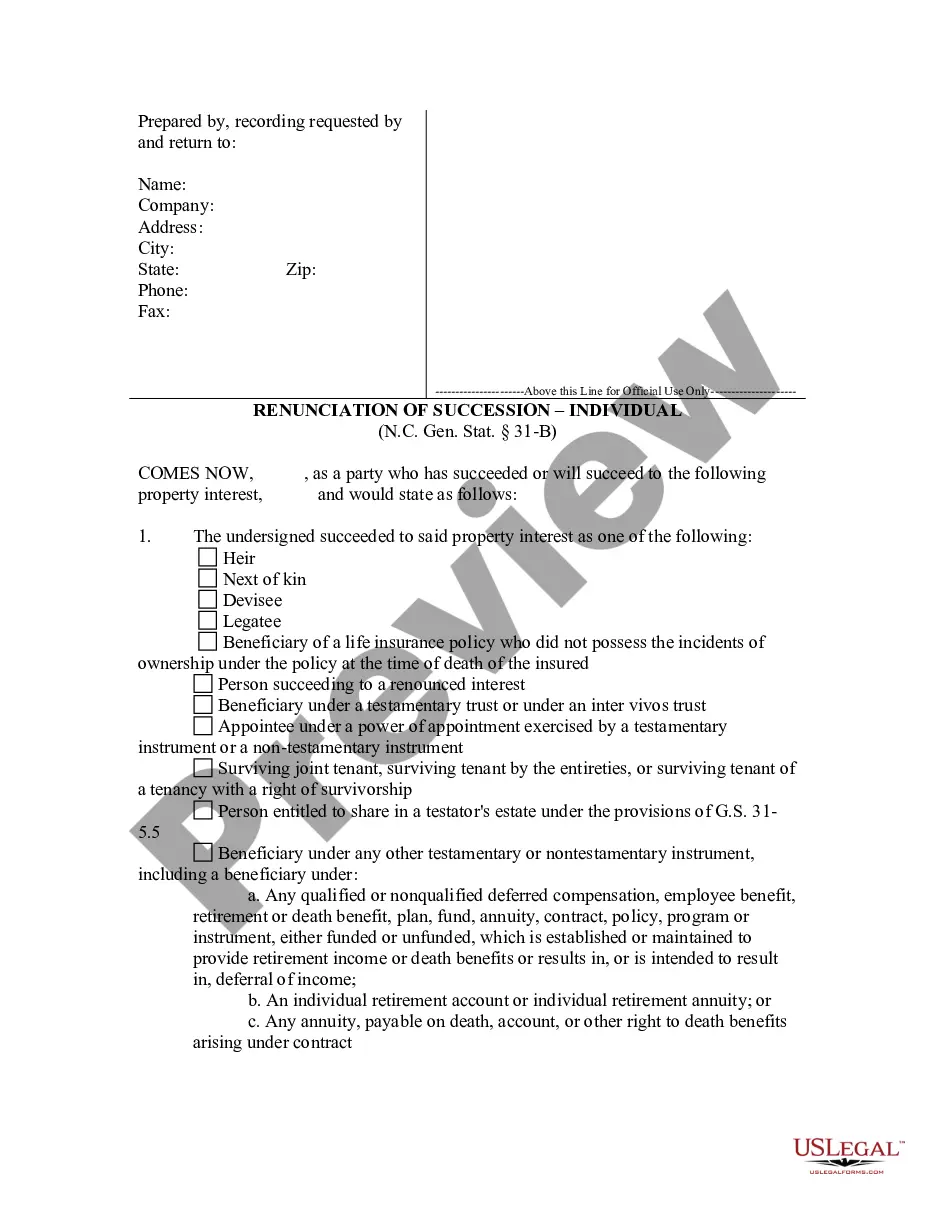
(5) Beneficiary of a life insurance policy who did not possess
the incidents of ownership under the policy at the time of death of the
insured, or
(6) Person succeeding to a renounced interest, or
(7) Beneficiary under a testamentary trust or under an inter vivos
trust, or
(8) Appointee under a power of appointment exercised by a testamentary
instrument or a nontestamentary instrument, or
(9) Repealed by Session Laws 1989, c. 684, s. 2.
(9a) Surviving joint tenant, surviving tenant by the entireties,
or surviving tenant of a tenancy with a right of survivorship, or
(9b) Person entitled to share in a testator's estate under the
provisions of G.S. 31-5.5, or
(9c) Beneficiary under any other testamentary or nontestamentary
instrument, including a beneficiary under:
a. Any qualified or nonqualified deferred compensation,
employee benefit, retirement or death benefit, plan, fund, annuity, contract,
policy, program or instrument, either funded or unfunded, which is established
or maintained to provide retirement income or death benefits or results
in, or is intended to result in, deferral of income;
c. Any annuity, payable on death, account, or other right to death
benefits arising under contract; or
(9d) The duly authorized or appointed guardian with the prior or subsequent
approval of the clerk of superior court, or of the resident judge of the
superior court, of any of the above.
(10) The personal representative appointed under Chapter 28A of
any of the above, or the attorney-in-fact of any of the above may renounce
in whole or in part the right of succession to any property or interest
therein, including a future interest, by filing a written instrument under
the provisions of this Chapter. A renunciation may be of a fractional share
or any limited interest or estate. Provided, however, there shall be no
right of partial renunciation if the decedent or donee of the power expressly
so provided in the instrument creating the interest.
(b) This Chapter shall apply to all renunciations of present and future
interests, whether qualified or nonqualified for federal and State inheritance,
estate, and gift tax purposes, unless expressly provided otherwise in the
instrument creating the interest.
(c) The instrument shall (i) describe the property or interest renounced,
(ii) declare the renunciation and extent thereof, (iii) be signed and acknowledged
by the person authorized to renounce.
Chap. 31B, § 31B-1.
(1975, c. 371, s. 1; 1983, c. 66, s. 1; 1989, c. 684, s. 2; 1998-148,
s. 1.)
Right to renounce fiduciary powers.
(a) Except as otherwise provided in the testamentary or
nontestamentary instrument, a fiduciary under a testamentary or nontestamentary
instrument may renounce, in whole or in part, fiduciary rights, privileges,
powers, and immunities by executing and by delivering, filing, or recording
a written renunciation pursuant to the provisions of G.S. 31B-2.
A fiduciary may not renounce the rights of beneficiaries unless the instrument
creating the fiduciary relationship authorizes such a renunciation.
(b) The instrument of renunciation shall (i) describe any fiduciary
right, power, privilege, or immunity renounced, (ii) declare the renunciation
and the extent thereof, and (iii) be signed and acknowledged by the fiduciary
authorized to renounce.
Chap. 31B, §31B-1A.
(1989, c. 684, s. 3.)
Time and place of filing renunciation.
(a) To be a qualified disclaimer for federal and State inheritance,
estate, and gift tax purposes, an instrument renouncing a present interest
shall be filed within the time period required under the applicable federal
statute for a renunciation to be given effect as a disclaimer for federal
estate and gift tax purposes. If there is no such federal statute the instrument
shall be filed not later than nine months after the date the transfer of
the renounced interest to the renouncer was complete for the purpose of
such taxes.
(b) An instrument renouncing a future interest shall be filed not
later than six months after the event by which the taker of the property
or interest is finally ascertained and his interest indefeasibly vested
and he is entitled to possession even though such renunciation may not
be recognized as a disclaimer for federal estate tax purposes.
(c) The renunciation shall be filed with the clerk of court of the
county in which proceedings have been commenced for the administration
of the estate of the deceased owner or deceased donee of the power or,
if they have not been commenced, in which they could be commenced. A copy
of the renunciation shall be delivered in person or mailed by registered
or certified mail to any personal representative, or other fiduciary of
the decedent or donee of the power. If the property interest renounced
includes any proceeds of a life insurance policy being renounced pursuant
to G.S. 31B-1(a)(5) the person renouncing shall mail, by registered or
certified mail, a copy of the renunciation to the insurance company issuing
the policy. If the property or property interest renounced is created by
nontestamentary instrument, a copy of the renunciation shall be delivered
in person, or mailed by registered or certified mail, to the trustee or
other person who has legal title to, or possession of, the property or
property interest renounced.
(d) If real property or an interest therein is renounced, a copy
of the renunciation shall also be filed for recording in the office of
the register of deeds of all counties wherein any part of the interest
renounced is situated. The renunciation shall be indexed in the grantor's
index under (i) the name of the deceased owner or donee of the power, and
(ii) the name of the person renouncing. The renunciation of an interest,
or a part thereof, in real property shall not be effective to renounce
such interest until a copy of the renunciation is filed for recording in
the office of the register of deeds in the county wherein such interest
or part thereof is situated. A spouse of a person renouncing real property
or an interest in real property shall have no statutory dower, inchoate
marital rights, or any other interest in the real property or real property
interest renounced.
Chap. 31B, §31B-2.
(1975, c. 371, s. 1; 1979, c. 525, s. 7; 1983, c. 66, s. 2; 1989,
c. 684, s. 4; 1991, c. 744, s. 1; 1998-148, s. 2.)
Effect of renunciation.
(a) Unless the decedent, donee of a power of appointment,
or creator of an interest under an inter vivos instrument has otherwise
provided in the instrument creating the interest, the property or interest
renounced devolves as follows:
(1) If the renunciation is filed within the time period
described in G.S. 31B-2(a), the property or interest renounced devolves
as if the renouncer had predeceased the date the transfer of the renounced
interest to the renouncer was complete for federal and State inheritance,
estate, and gift tax purposes, or, in the case of the renunciation of a
fiduciary right, power, privilege, or immunity, the property or interest
subject to the power devolves as if the fiduciary right, power, privilege,
or immunity never existed. Any such renunciation relates back for all purposes
to the date the transfer of the renounced interest to the renouncer was
complete for the purpose of those taxes.
(2) If the renunciation is not filed within the time period described
in G.S. 31B-2(a), the property or interest devolves as if the renouncer
had died on the date the renunciation is filed, or, in the case of the
renunciation of a fiduciary right, power, privilege, or immunity, the property
or interest subject to the power devolves as if the fiduciary right, power,
privilege, or immunity ceased to exist as of the date the renunciation
is filed.
(3) Any future interest that takes effect in possession or enjoyment
after the termination of the estate or interest renounced takes effect
as if the renouncer had died on the date determined under subdivision (1)
or (2) of this subsection, and upon the filing of the renunciation the
persons in being as of the time the renouncer is deemed to have died will
immediately become entitled to possession or enjoyment of any such future
interest.
(b) In the event that the property or interest renounced was created
by testamentary disposition, the devolution of the property or interest
renounced shall be governed by G.S. 31-42(a) notwithstanding that in fact
the renouncer has not actually died before the testator.
(c) In the event that the decedent dies intestate, or the ownership
or succession to property or to an interest is to be determined as though
a decedent had died intestate, and the renouncer has living issue who would
have been entitled to an interest in the property or interest if the renouncer
had predeceased the decedent, then the property or interest renounced shall
be distributed to such issue, per stirpes. If the renouncer does not have
such issue, then the property or interest shall be distributed as though
the renouncer had predeceased the decedent.
Chap. 31B, §31B-3.
(1975, c. 371, s. 1; 1979, c. 525, s. 6; 1989, c. 684, s. 5; 1993,
c. 308, ss. 1, 2; 1998-148, s. 3.)
Waiver and bar.
(a) The right to renounce property or an interest therein
is barred by:
(1) An assignment, conveyance, encumbrance, pledge, or
transfer of the property or interest, or a contract therefor by the person
authorized to renounce,
(2) A written waiver of the right to renounce, or
(3) Repealed by Session Laws 1998-148, s. 4.
(4) A sale of the property or interest under judicial sale made
before the renunciation is effected.
(b) The renunciation or the written waiver of the right to renounce
is binding upon the renouncer or person waiving and all persons claiming
through or under him.
(c) A fiduciary's application for appointment or assumption of duties
as fiduciary does not waive or bar the fiduciary's right to renounce a
right, power, privilege, or immunity.
(d) No person shall be liable for distributing or disposing of property
in reliance upon the terms of a renunciation that is invalid for the reason
that the right of renunciation has been waived or barred, if the distribution
or disposition is otherwise proper, and the person has no actual knowledge
of the facts that constitute a waiver or bar to the right of renunciation.
(e) The right to renounce property or an interest in property pursuant
to this Chapter is not barred by an acceptance of the property, interest,
or benefit thereunder; provided, however, an acceptance of the property,
interest, or benefit thereunder may preclude such renunciation from being
a qualified renunciation for federal and State inheritance, estate, and
gift tax purposes.
Chap. 31B, §31B-4.
(1975, c. 371, s. 1; 1989, c. 684, s. 6; 1998-148, ss. 4, 5; 2000-140,
s. 8.)
Exclusiveness of remedy.
This Chapter does not exclude or abridge any
other rights or procedures existing under any other statute or otherwise
provided by law to waive, release, refuse to accept, disclaim or renounce
property or an interest therein, or any fiduciary right, power, privilege,
or immunity.
Chap. 31B, §31B-5.
(1975, c. 371, s. 1; 1989, c. 684, s. 7.)
Application of Chapter.
A present interest in property existing on October
1, 1975, as to which the time for filing a renunciation under this Chapter
has not expired may be renounced within six months after October 1, 1975.
A future interest in property existing on October 1, 1975, as to which
the time for filing a renunciation under this Chapter has not expired
may be renounced within six months after October 1, 1975, or within six
months after the future interest has become indefeasibly vested and the
taker is entitled to possession, whichever is later.
Chap. 31B, §31B-6.
(1975, c. 371, s. 1.)
Short title.
This Chapter may be cited as the Renunciation
of Property and Renunciation of Fiduciary Powers Act.
Chap. 31B, §31B-7.
(1975, c. 371, s. 1; 1989 (Reg. Sess., 1990), c. 1024, s. 11.)