Michigan Landlord Tenant Eviction / Unlawful Detainer Forms Package
Understanding this form package
The Michigan Landlord Tenant Eviction / Unlawful Detainer Forms Package provides essential forms for landlords seeking to evict tenants in Michigan. This package ensures compliance with state-specific legal requirements, offering a thorough solution to manage the eviction process effectively. It includes various forms that address different reasons for eviction, setting it apart from general eviction form packages by focusing on Michigan statutes and guidelines.
Forms you’ll find in this package
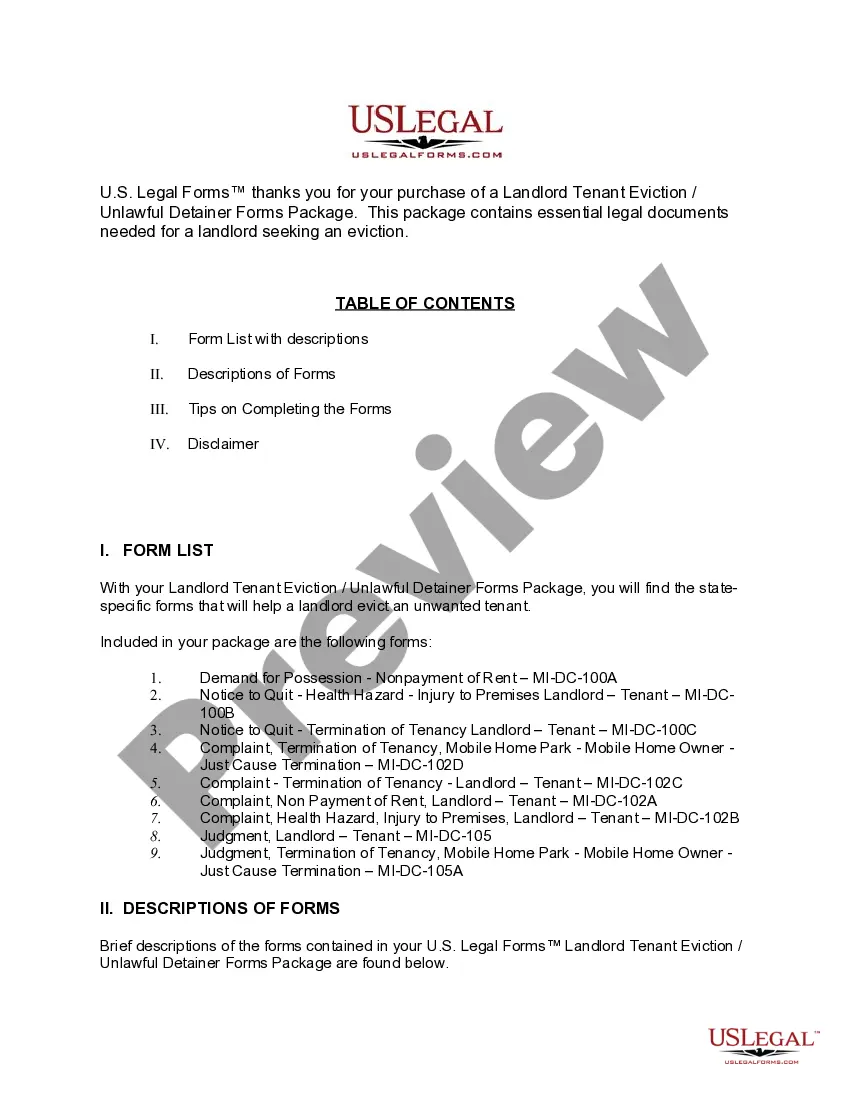
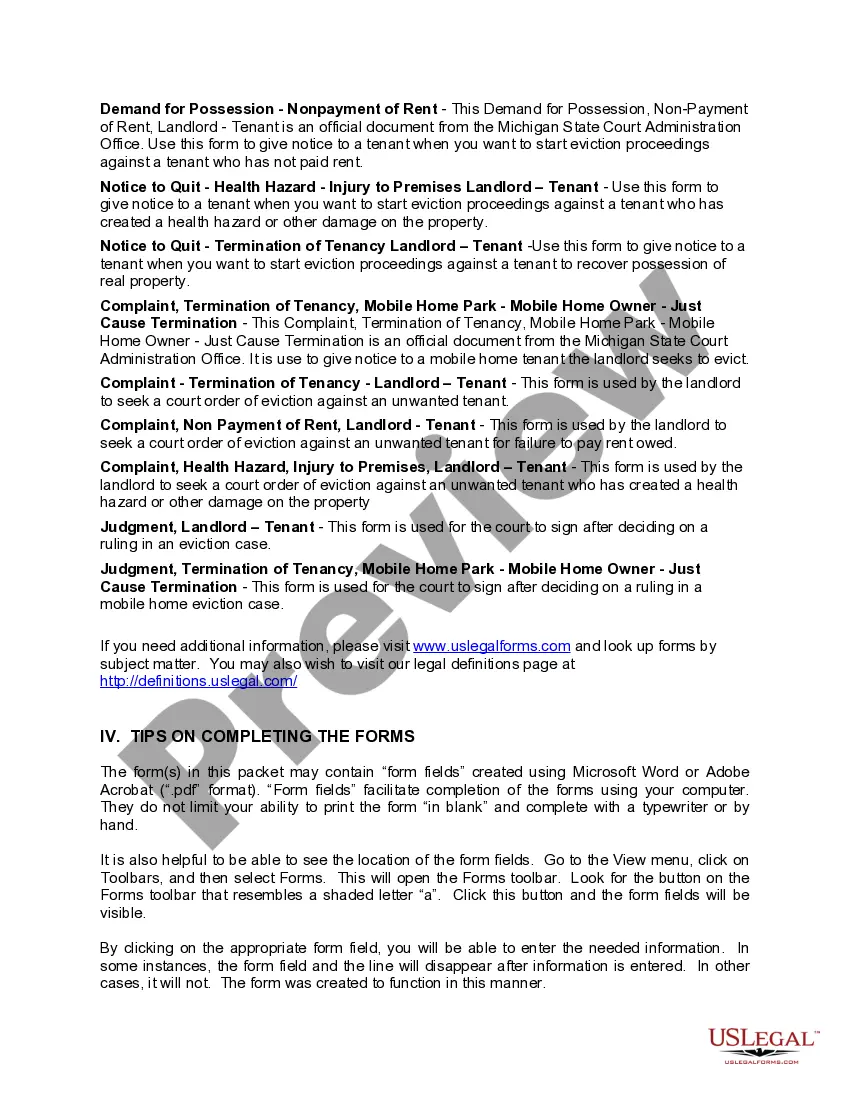
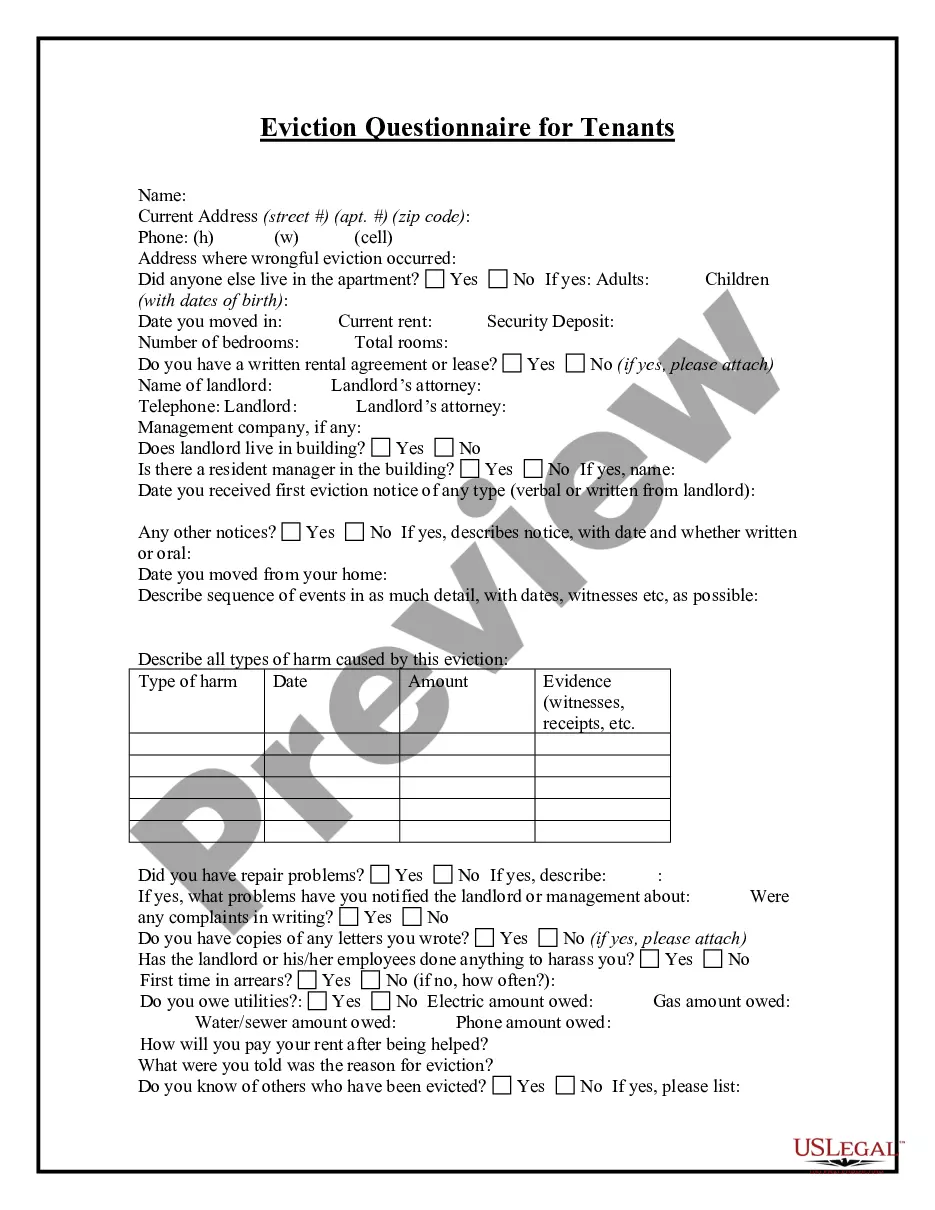
- Demand for Possession, Nonpayment of Rent, Landlord-Tenant
- Demand for Possession, Damage/Health Hazard to Property, Landlord-Tenant
- Notice to Quit - Termination of Tenancy Landlord - Tenant
- Complaint, Non Payment of Rent, Landlord - Tenant
- Complaint, Health Hazard, Injury to Premises, Landlord - Tenant
- Complaint to Recover Possession of Property
- Judgment, Landlord-Tenant
- Judgment, Termination of Tenancy, Mobile Home Park - Mobile Home Owner - Just Cause Termination

When to use this form package
This form package is needed in several scenarios, including:
- When a tenant has failed to pay rent.
- When there are health hazards or damage caused by a tenant.
- When a landlord wants to terminate a tenancy for other lawful reasons.
- When a landlord needs to initiate eviction proceedings against a tenant in a mobile home park.
Who can use this document
- Residential landlords in Michigan.
- Property owners managing rental homes or apartments.
- Landlords dealing with mobile home parks.
- Anyone looking for effective legal forms to handle tenant eviction processes.
Completing these forms step by step
- Review the included forms to identify which apply to your situation.
- Fill in the necessary details, including tenant information and reasons for eviction.
- Ensure all required signatures are obtained.
- Serve the forms to the tenant as specified by Michigan law.
- File the forms with the appropriate court if necessary.
Do documents in this package require notarization?
Forms in this package usually don’t need notarization, but certain jurisdictions or signing circumstances may require it. US Legal Forms provides a secure online notarization option powered by Notarize, accessible 24/7 from anywhere.
Get your form ready online
Our built-in tools help you complete, sign, share, and store your documents in one place.
Make edits, fill in missing information, and update formatting in US Legal Forms—just like you would in MS Word.
Download a copy, print it, send it by email, or mail it via USPS—whatever works best for your next step.
Sign and collect signatures with our SignNow integration. Send to multiple recipients, set reminders, and more. Go Premium to unlock E-Sign.
If this form requires notarization, complete it online through a secure video call—no need to meet a notary in person or wait for an appointment.
We protect your documents and personal data by following strict security and privacy standards.

Make edits, fill in missing information, and update formatting in US Legal Forms—just like you would in MS Word.

Download a copy, print it, send it by email, or mail it via USPS—whatever works best for your next step.

Sign and collect signatures with our SignNow integration. Send to multiple recipients, set reminders, and more. Go Premium to unlock E-Sign.

If this form requires notarization, complete it online through a secure video call—no need to meet a notary in person or wait for an appointment.

We protect your documents and personal data by following strict security and privacy standards.
Common mistakes to avoid
- Failing to provide proper notice to the tenant before filing an eviction.
- Using incorrect forms or not adhering to Michigan's specific form requirements.
- Not signing or dating the forms before submission.
- Neglecting to keep copies of all documents for record-keeping.
Why complete this package online
- Convenience of downloading forms instantly from your computer.
- Editability of forms allows for customization to fit specific circumstances.
- Reliability of having state-specific forms drafted by licensed attorneys.
- Time-saving by avoiding the need to gather forms from multiple sources.
Legal use & context
- These forms are designed for landlords looking to initiate eviction proceedings in accordance with Michigan statute.
- Legal effectiveness is contingent on proper completion and filing per local court rules.
- While these forms provide a self-help avenue, consultation with a legal professional is advisable for complex situations.
Summary of main points
- The Michigan Landlord Tenant Eviction / Unlawful Detainer Forms Package is essential for landlords in eviction scenarios.
- Understanding and following Michigan-specific legal requirements is crucial for effective evictions.
- Using these forms online offers a convenient and legally compliant way to handle tenant evictions.
Looking for another form?



Form popularity
FAQ
In Michigan, tenants generally cannot be evicted without a court order. The Michigan Landlord Tenant Eviction / Unlawful Detainer Forms Package provides comprehensive forms necessary for filing in court, making sure you follow proper procedures. It's crucial to serve the required notices and wait for the appropriate time frames before seeking a court's involvement. Understanding the legal requirements can help you navigate the eviction process smoothly and efficiently.
Evicting a tenant in Michigan typically takes about 30 to 60 days, depending on various factors such as court schedules and tenant responses. If you use the Michigan Landlord Tenant Eviction / Unlawful Detainer Forms Package, you can ensure that you have the correct documentation to expedite the process. Various timelines may vary based on the specifics of your situation, including the types of notices you provide. Maintaining compliance with Michigan laws can help streamline your eviction efforts.
To legally evict a tenant in Michigan, follow a structured process that begins with the proper notice. Use the Michigan Landlord Tenant Eviction / Unlawful Detainer Forms Package to obtain the necessary documents and instructions. This package equips you with the tools to navigate the legal landscape confidently. Remember, adhering to Michigan laws not only protects your interests but also respects tenant rights.
Filling out form dc100c requires attention to detail and accuracy. Start by reviewing the Michigan Landlord Tenant Eviction / Unlawful Detainer Forms Package, which includes clear instructions on completing this form. Make sure to provide all necessary information, such as tenant details and grounds for eviction. Take your time to ensure everything is correct to facilitate a smooth eviction process.
If someone refuses to leave your property, you must follow the legal eviction process in Michigan. Start by using the Michigan Landlord Tenant Eviction / Unlawful Detainer Forms Package to file the appropriate forms. This package provides guidance on how to handle such situations effectively. Proper documentation ensures you follow the legal steps required to regain possession of your property.
To evict a tenant in Michigan, you will need the Michigan Landlord Tenant Eviction / Unlawful Detainer Forms Package. This package includes all necessary forms to initiate the eviction process legally. Ensure you complete the forms accurately to avoid delays. Additionally, it is essential to follow Michigan's legal guidelines for eviction to protect your rights as a landlord.
Be in writing. Be addressed to the tenant. Describe the rental property, usually by giving the address. Give the reason for the eviction. State how much time the tenant has to fix the problem, if there is one. Include the landlord's address and the date of the notice.
Know Your Rights. It goes without saying, but take some time to know your rights as a tenant. Keep Good Records. Make Sure Notice is Proper. Service of the Unlawful Detainer. Talking to an Attorney. Managing Partner Lipton Legal Group, A PC Beverly Hills, CA.
If you do not vacate by the day in the notice, the landlord can then apply to the NSW Civil and Administrative Tribunal (NCAT) for a termination order. A termination order ends the tenancy and specifies the day by which you must give vacant possession.
Courts commonly refer to eviction actions as "forcible entry and detainer" or "unlawful detainer" actions. The legal theory is that the landlord alleges the tenant unlawfully continues to have use and possession of the rental property, and the landlord seeks the assistance of the court to have the tenant removed.