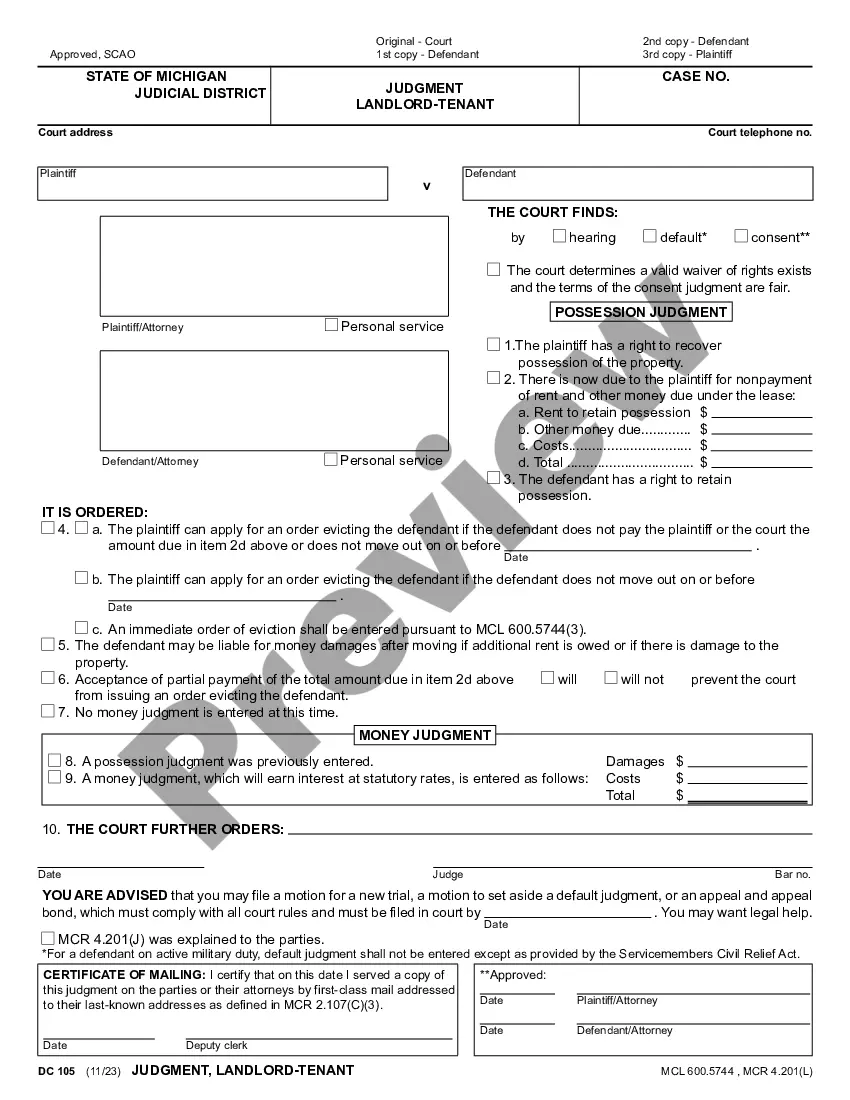
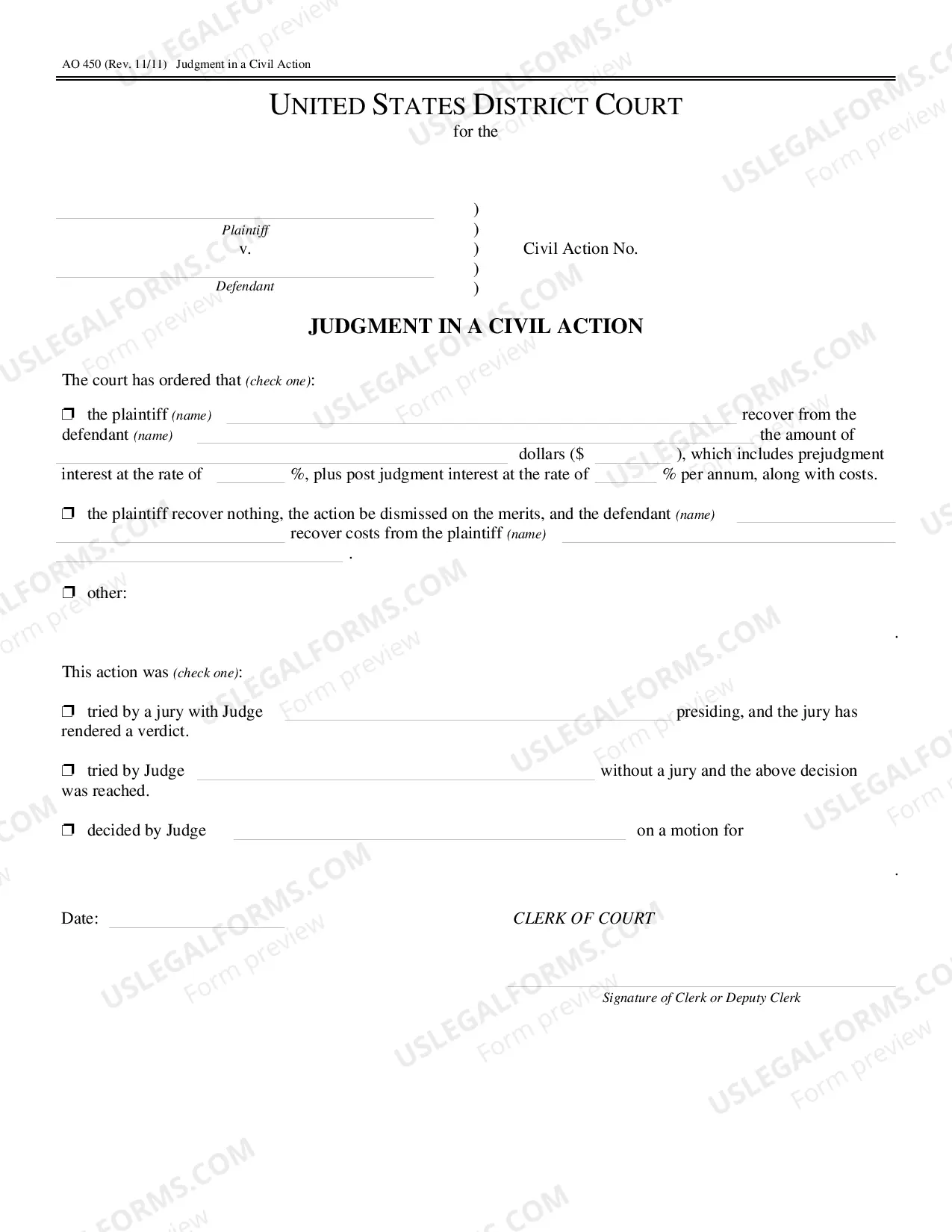
This Judgment, Landlord - Tenant is an official document from the Michigan State Court Administration Office, and it complies with all applicable state and Federal codes and statutes. USLF updates all state and Federal forms as is required by state and Federal statutes and law.
Michigan Judgment, Landlord-Tenant
Instant download
This website is not affiliated with any governmental entity
Public form
Description
Get your form ready online
Our built-in tools help you complete, sign, share, and store your documents in one place.
Built-in online Word editor
Make edits, fill in missing information, and update formatting in US Legal Forms—just like you would in MS Word.
Export easily
Download a copy, print it, send it by email, or mail it via USPS—whatever works best for your next step.
E-sign your document
Sign and collect signatures with our SignNow integration. Send to multiple recipients, set reminders, and more. Go Premium to unlock E-Sign.
Notarize online 24/7
If this form requires notarization, complete it online through a secure video call—no need to meet a notary in person or wait for an appointment.
Store your document securely
We protect your documents and personal data by following strict security and privacy standards.

Make edits, fill in missing information, and update formatting in US Legal Forms—just like you would in MS Word.

Download a copy, print it, send it by email, or mail it via USPS—whatever works best for your next step.

Sign and collect signatures with our SignNow integration. Send to multiple recipients, set reminders, and more. Go Premium to unlock E-Sign.

If this form requires notarization, complete it online through a secure video call—no need to meet a notary in person or wait for an appointment.

We protect your documents and personal data by following strict security and privacy standards.
Looking for another form?


How to fill out Michigan Judgment, Landlord-Tenant?
Access over 85,000 legal templates including Michigan Judgment, Landlord - Tenant online with US Legal Forms. Each form is crafted and maintained by state-certified legal experts.
If you have a membership, Log In. Once on the form’s page, click the Download button and navigate to My documents to access it.
If you haven’t subscribed yet, follow these guidelines.
Once your reusable template is downloaded, you can print it or save it to your device. With US Legal Forms, you’ll always have prompt access to the appropriate downloadable form. The service organizes forms into categories to make your search easier. Use US Legal Forms to obtain your Michigan Judgment, Landlord - Tenant quickly and efficiently.
- Verify the state-specific requirements for the Michigan Judgment, Landlord - Tenant form you need.
- Review the description and look at the sample.
- When you are sure the template fits your needs, simply click Buy Now.
- Select a subscription plan that aligns with your financial situation.
- Set up a personal account.
- Complete the payment using one of two convenient options: credit card or PayPal.
- Select a format to download the document; two options are available (PDF or Word).
- Download the file to the My documents section.
Form popularity
FAQ
Filing a judgment lien in Michigan involves several clear steps. First, you need to obtain a certified copy of the judgment from the court where your case was heard. Next, you must file this certified copy with the register of deeds in the county where the property is located. This action effectively creates a Michigan Judgment, Landlord-Tenant lien on the property, securing your right to collect the debt owed.
In Michigan, you receive a summons to landlord-tenant court when a landlord initiates eviction proceedings against you. The landlord files the necessary paperwork with the court, which then issues a summons that details the court date and relevant information. It is essential to respond to the summons promptly, as failure to appear may result in a default judgment against you. Familiarizing yourself with these procedures can assist you in navigating the complexities of a Michigan judgment in landlord-tenant disputes.
In Michigan, a tenant generally cannot be evicted without going through the court system, as the law requires a legal process to protect tenants' rights. Landlords must file for eviction and obtain a court judgment to proceed with the eviction. There are rare exceptions but those usually involve situations where a tenant poses an immediate threat, warranting emergency action. Thus, understanding the processes surrounding judgments in landlord-tenant relationships becomes crucial.
Enforcing a judgment in Michigan involves several steps intended to compel the debtor to fulfill the court's decision. You may start by obtaining a writ of execution from the court, which allows you to pursue collection methods such as wage garnishment or property seizure. It's essential to comply with Michigan laws during this process to ensure you do not violate any rights. Resources like US Legal Forms can provide you with the necessary templates and guidance to streamline enforcement actions related to a Michigan judgment in landlord-tenant cases.
A judgment is enforceable when it meets specific legal requirements, such as being finalized and not under appeal. In Michigan, a judgment related to landlord-tenant disputes typically becomes enforceable after the court issues it, allowing you to take necessary actions like garnishments or liens. Moreover, you must ensure that the judgment is properly filed with the court to invoke the collection process effectively. Understanding these nuances can help you navigate the complexities of a Michigan judgment in landlord-tenant situations.
A judgment on a rental application typically reflects the history of a person's previous rental agreements. Landlords use these judgments to decide whether to approve a potential tenant based on past behavior, such as evictions or late payments. A negative Michigan Judgment can adversely affect your rental prospects. To enhance your chances, consider using uslegalforms to ensure your application meets all necessary requirements.
Yes, you can sue your landlord in Michigan, particularly if they fail to fulfill their legal obligations. Common reasons include violations of the lease, safety and health code breaches, and discrimination cases. A successful claim may lead to a favorable Michigan Judgment, allowing tenants to recover damages. If you're considering this step, uslegalforms can help you navigate the legal process effectively.
After a default judgment is issued in Michigan, the winning party typically receives a legal ruling that can allow for enforcement actions. This means that the landlord may be able to take possession of the property or collect owed rent. The losing party still has options, including the possibility of appealing the judgment under certain conditions. For anyone facing such situations, leveraging platforms like UsLegalForms can provide valuable resources and templates to navigate the Michigan Judgment, Landlord-Tenant framework efficiently.
In Michigan, certain properties are exempt from judgment under specific circumstances. Generally, a primary residence may be protected, along with necessary personal belongings and certain public benefits. This exemption helps safeguard tenants and may provide some relief during legal disputes. Knowing these exemptions is key when dealing with Michigan Judgment, Landlord-Tenant issues.
The 554.134 law in Michigan addresses the ability of landlords to recover possession of rental property through specific procedures. This law helps landlords enforce their rights and protects their investment. It outlines the legal grounds for eviction and ensures that tenants are given appropriate notice before any action is taken. Understanding this law is crucial for both landlords and tenants navigating the Michigan Judgment, Landlord-Tenant landscape.