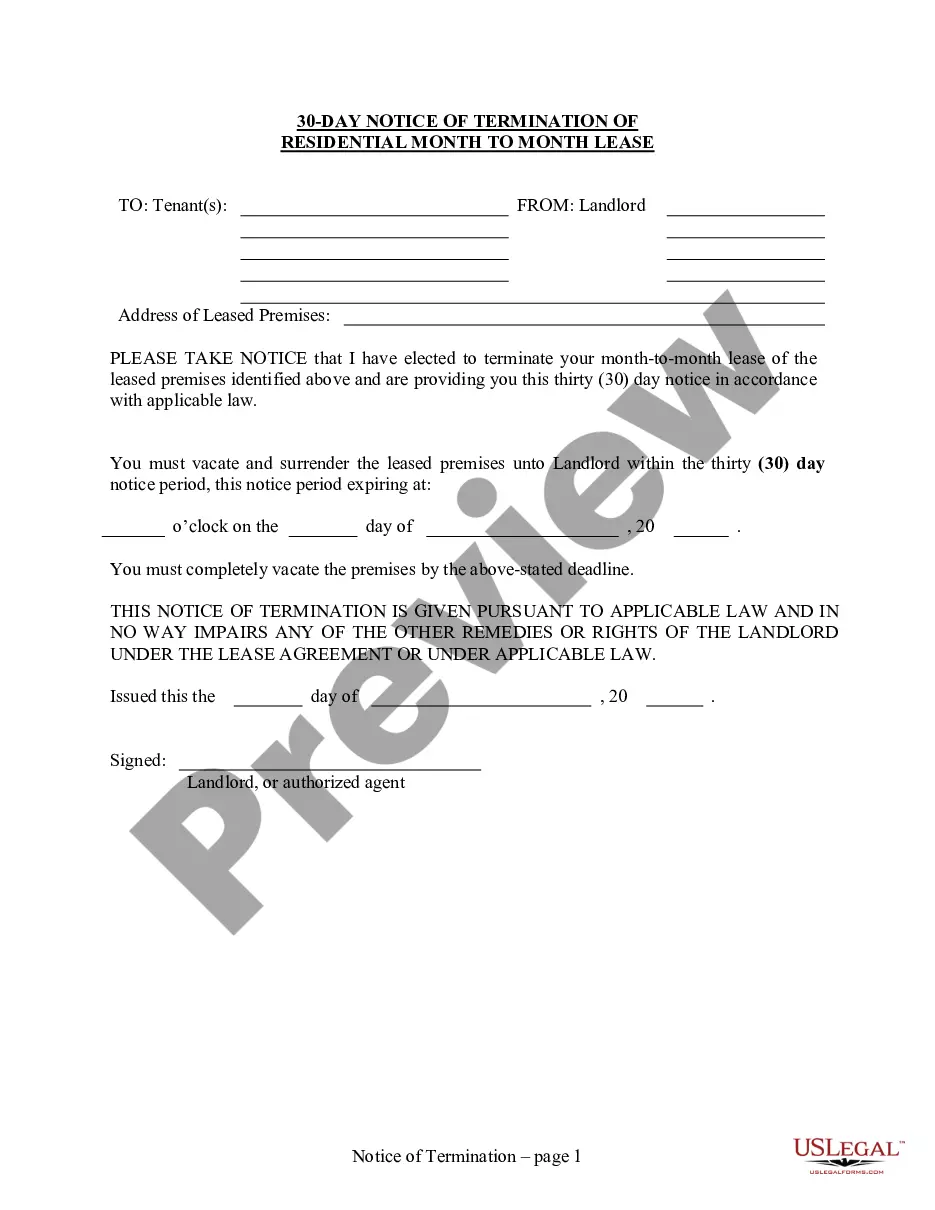
Louisiana Judgment on Rule for Reciprocal Injunctions
What is this form?
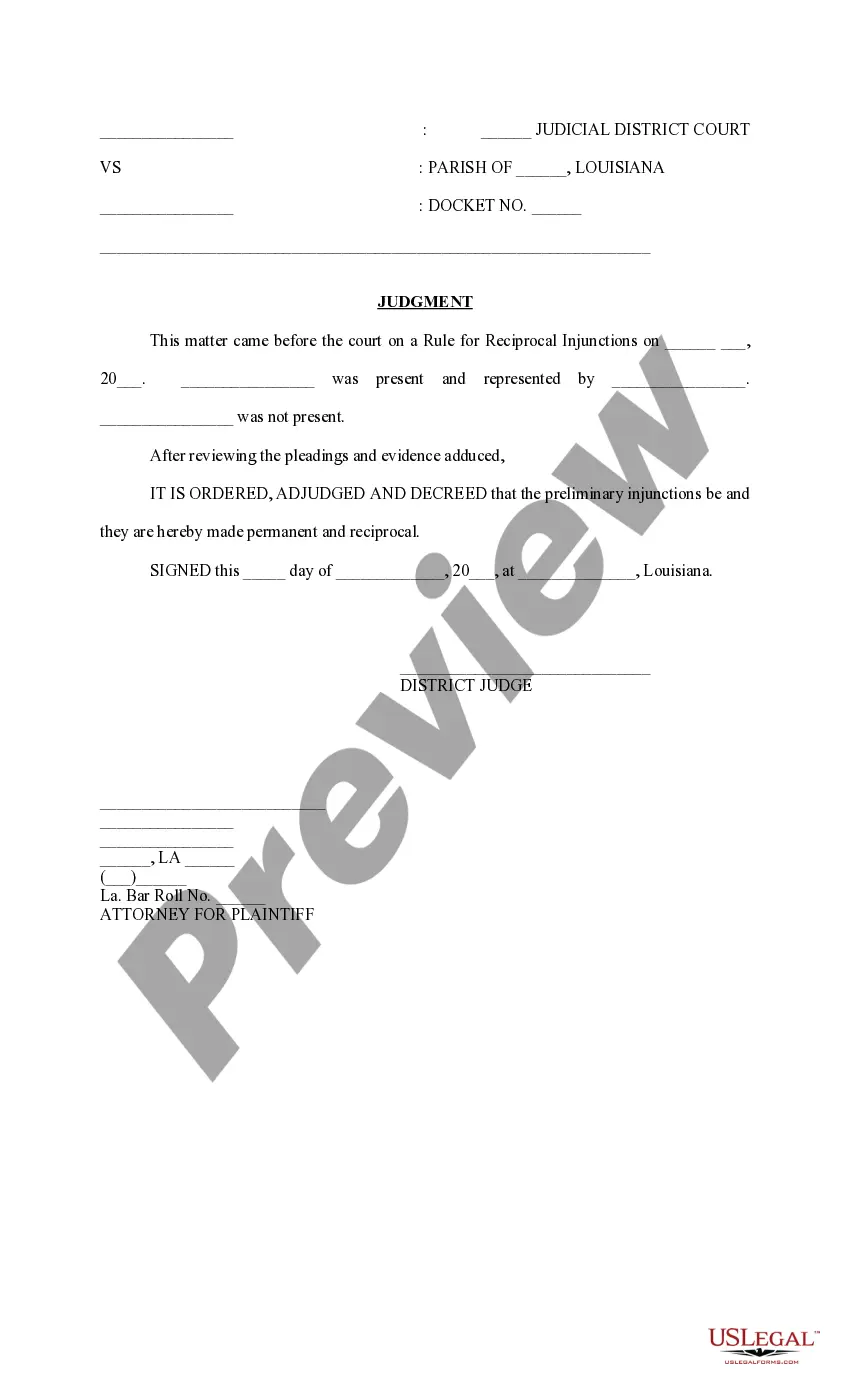
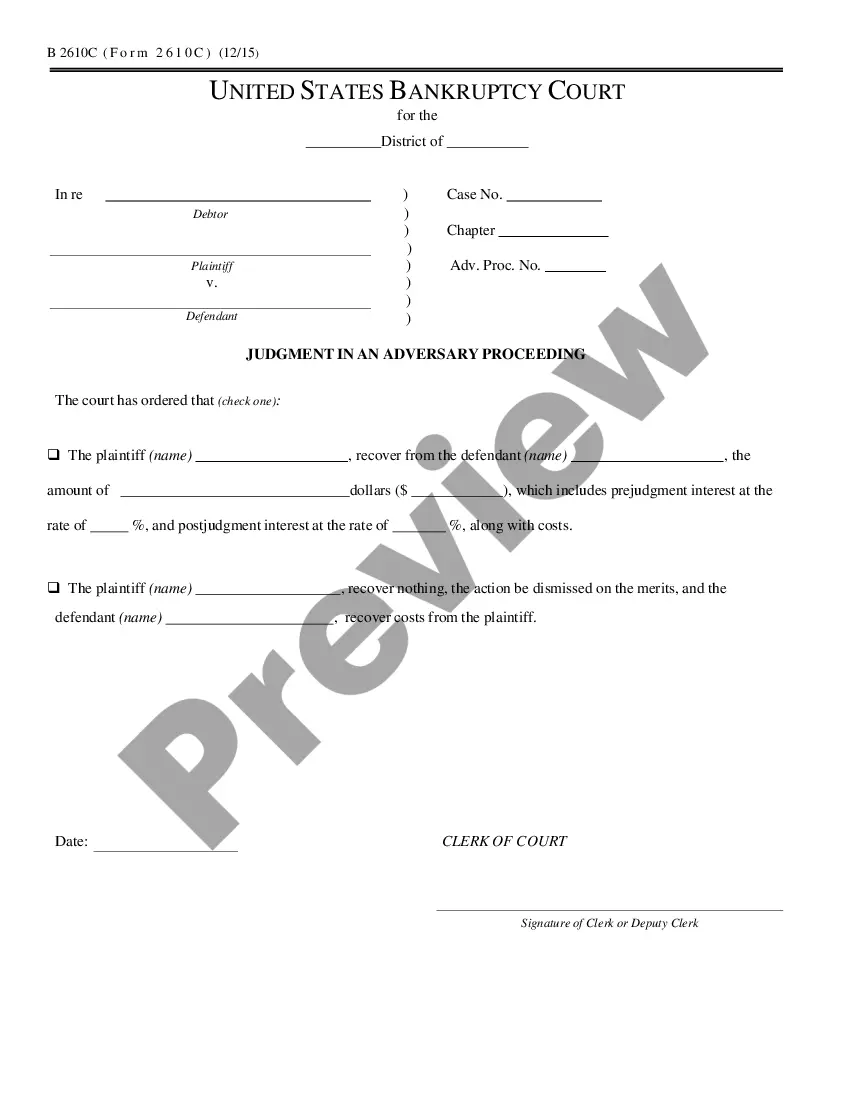
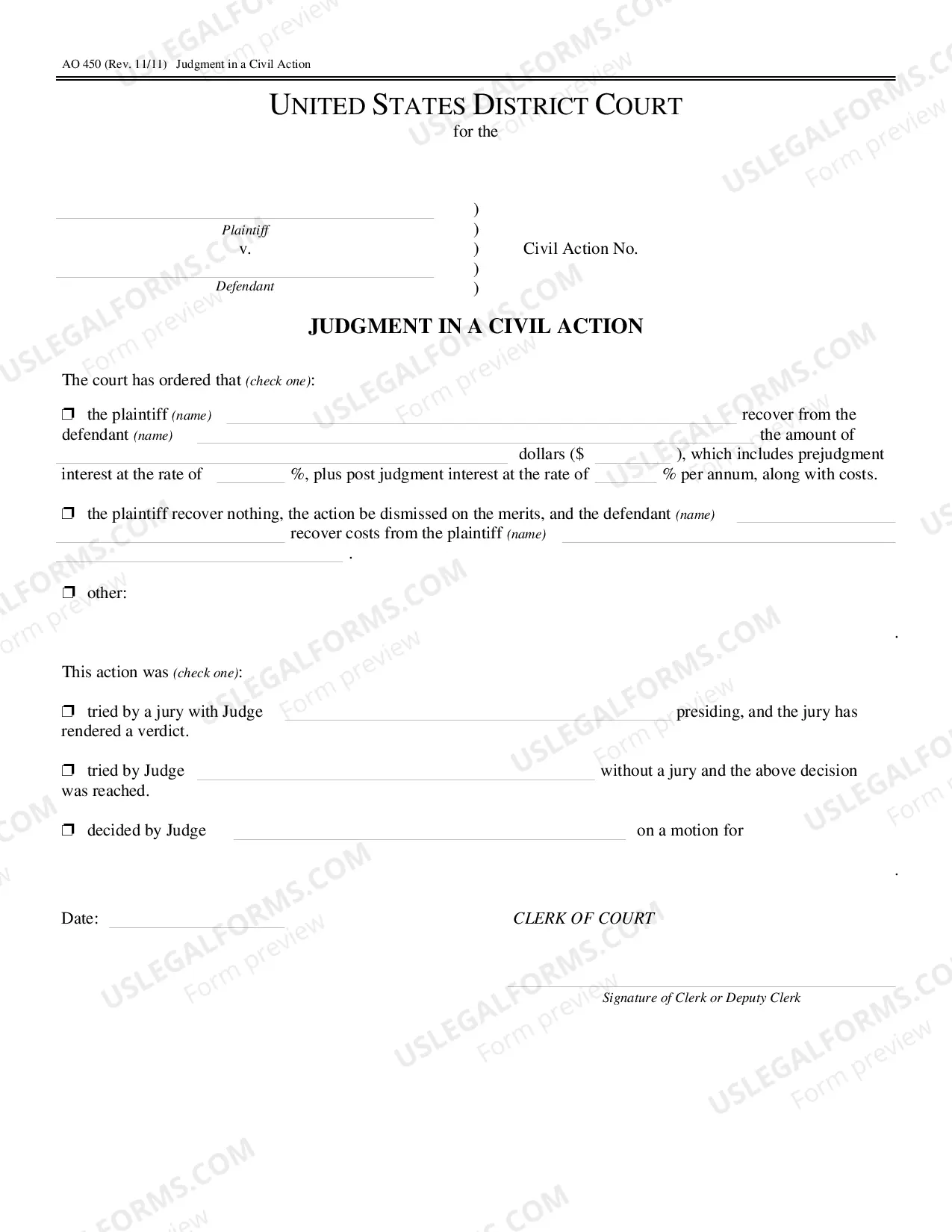
The Judgment on Rule for Reciprocal Injunctions is a legal document issued by a court that makes preliminary injunctions permanent and reciprocal. This form is used in extraordinary situations where a party seeks to maintain a specific state of affairs or prevent injustice. Unlike standard judgments, this form establishes enforceable directives for both parties involved, ensuring that any actions or restrictions are mutual and lasting.
What’s included in this form
- Judicial district and docket number details for identification.
- Information about the case date and parties present or represented.
- Order stating that preliminary injunctions are made permanent and mutual.
- Signature lines for the district judge and attorney for the plaintiff.
- Location and verification details in Louisiana.
Situations where this form applies
This form is typically used in legal cases where preliminary injunctions have been issued to prevent harm or preserve the status quo while the case is pending. Situations could include disputes involving property rights, family law, or business operations, where it is necessary to secure a definitive arrangement before a final ruling is made.
Who this form is for
This form is intended for:
- Parties involved in a legal dispute that requires ongoing court orders.
- Attorneys representing clients seeking to make preliminary injunctions permanent.
- Individuals or businesses impacted by injunctions that need to be codified legally.
Steps to complete this form
- Identify the judicial district and fill in the docket number for your case.
- Enter the date of the court session and parties involved.
- Specify if the parties were present and who represented them during the hearing.
- Include the permanent injunction order details, stating it is reciprocal.
- Sign and date the form in the appropriate sections for the district judge and attorney.
Is notarization required?
Notarization is generally not required for this form. However, certain states or situations might demand it. You can complete notarization online through US Legal Forms, powered by Notarize, using a verified video call available anytime.
Get your form ready online
Our built-in tools help you complete, sign, share, and store your documents in one place.
Make edits, fill in missing information, and update formatting in US Legal Forms—just like you would in MS Word.
Download a copy, print it, send it by email, or mail it via USPS—whatever works best for your next step.
Sign and collect signatures with our SignNow integration. Send to multiple recipients, set reminders, and more. Go Premium to unlock E-Sign.
If this form requires notarization, complete it online through a secure video call—no need to meet a notary in person or wait for an appointment.
We protect your documents and personal data by following strict security and privacy standards.

Make edits, fill in missing information, and update formatting in US Legal Forms—just like you would in MS Word.

Download a copy, print it, send it by email, or mail it via USPS—whatever works best for your next step.

Sign and collect signatures with our SignNow integration. Send to multiple recipients, set reminders, and more. Go Premium to unlock E-Sign.

If this form requires notarization, complete it online through a secure video call—no need to meet a notary in person or wait for an appointment.

We protect your documents and personal data by following strict security and privacy standards.
Common mistakes
- Failing to include the docket number or judicial district information.
- Not specifying the date of the judgment correctly.
- Missing signatures of the judge or attorney, which could make the form invalid.
- Omitting details on the parties present, leading to confusion on representation.
Why use this form online
- Convenient access to a professionally drafted legal document.
- Editable and downloadable format that allows for customization to your needs.
- Reduced risk of errors compared to handwritten forms or templates.
Looking for another form?

Form popularity
FAQ
Courts often issue preliminary injunctions for the purpose of stopping action until such time as a hearing can be held to determine what the course of action should be. For example: Mary and Tom have lived in their home for more than 40 years, and have cultivated a lovely property, filled with mature shade trees.
Generally speaking, there are two types of injunctions under the act, as mentioned below: Temporary Injunction. Perpetual/Permanent Injunction.
The usual purpose of an injunction is to preserve the status quo in situations in which further acts of the specified type, or the failure to perform such acts, would cause one of the parties irreparable harm (i.e., harm that cannot be adequately remedied by an award of monetary damages).
An injunction is an order by a court commanding or prohibiting a specific action. If a defendant fails to abide by an injunction issued against them, they can be held in contempt of court and punished with imprisonment or fines.The rules regarding the issuance of injunctions vary somewhat by jurisdiction.
Temporary and Permanent Injunctions ( Sections 36 & 37) Perpetual Injunctions ( Section 38) Mandatory Injunctions ( section 39) Damages in lieu of or in addition to Injection( Section 40) Injunction to perform a negative covenant( section 42)
An injunction is a court order requiring a person to do or cease doing a specific action. There are three types of injunctions: Permanent Injunctions,Temporary restraining orders and preliminary injunctions.
An injunction is a court order requiring a person to do or cease doing a specific action. There are three types of injunctions: Permanent Injunctions,Temporary restraining orders and preliminary injunctions.
An injunction is a court order stating that a company must do something or seize from doing a certain action. Injunctions are often granted when monetary damages are not sufficient to remedy a given situation.
Oppression or injustice from harsh judgements of common law courts. o Petitions dealt with through common injunctions orders preventing opposing party from. putting forward claim which equity found obnoxious/executing obnoxious common law judgement.