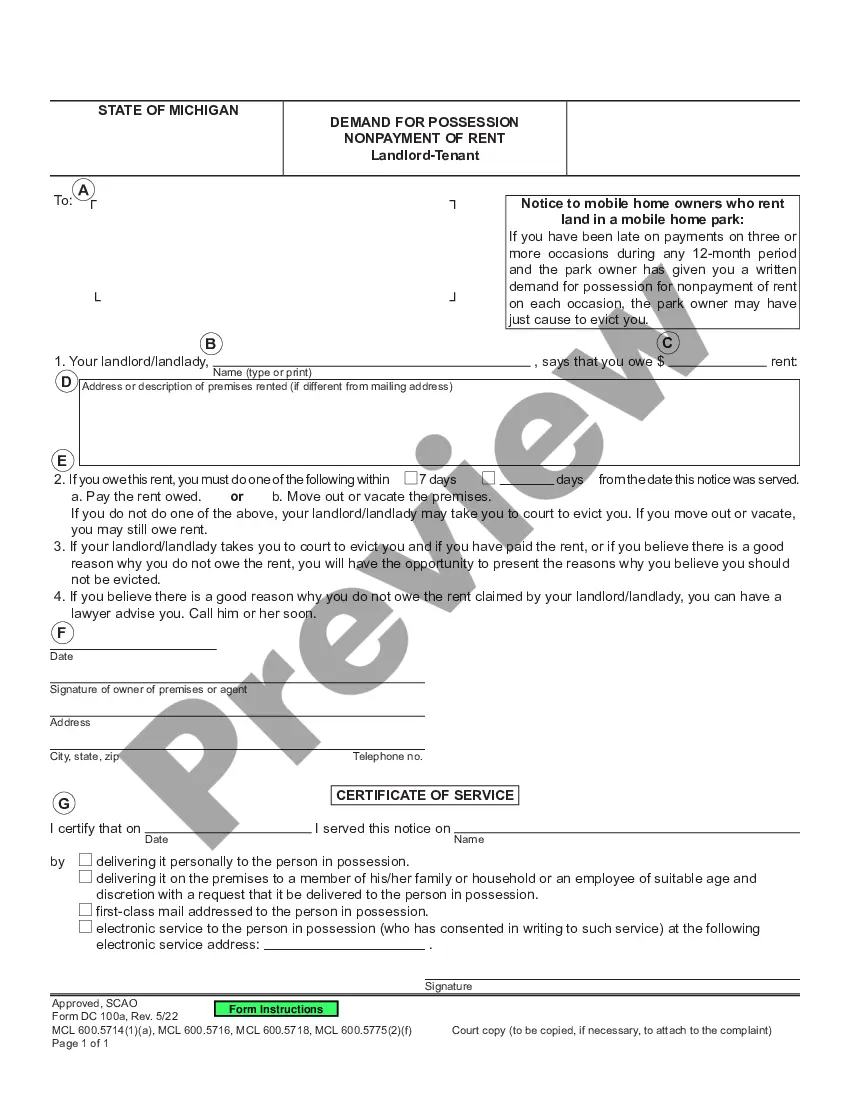
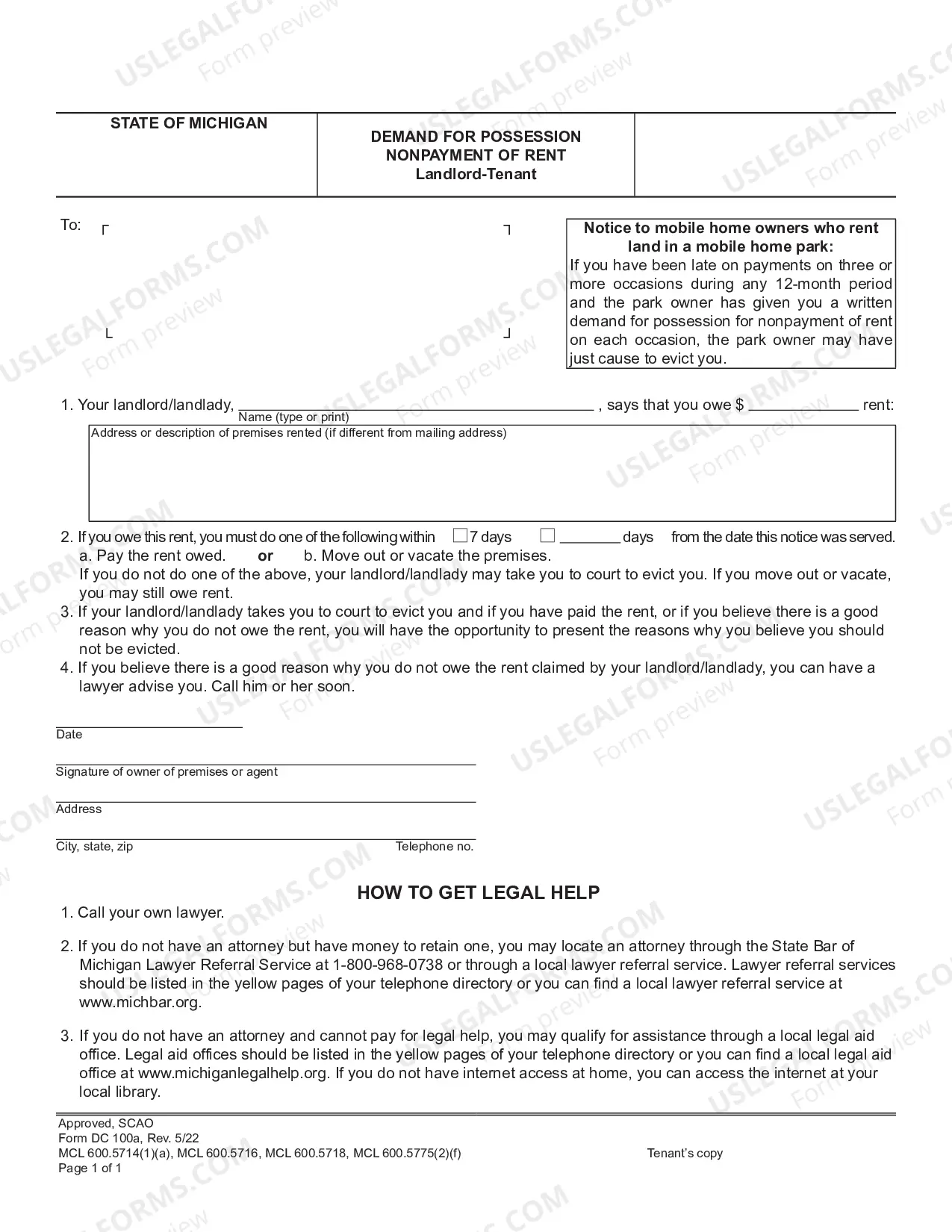
This Demand for Possession, Non-Payment of Rent, Landlord - Tenant is an official document from the Michigan State Court Administration Office, and it complies with all applicable state and Federal codes and statutes. USLF updates all state and Federal forms as is required by state and Federal statutes and law.
Michigan Demand for Possession, Nonpayment of Rent, Landlord-Tenant
State:
Michigan
Control #:
MI-DC-100A
Format:
PDF
Instant download
This website is not affiliated with any governmental entity
Public form
Description
Free preview
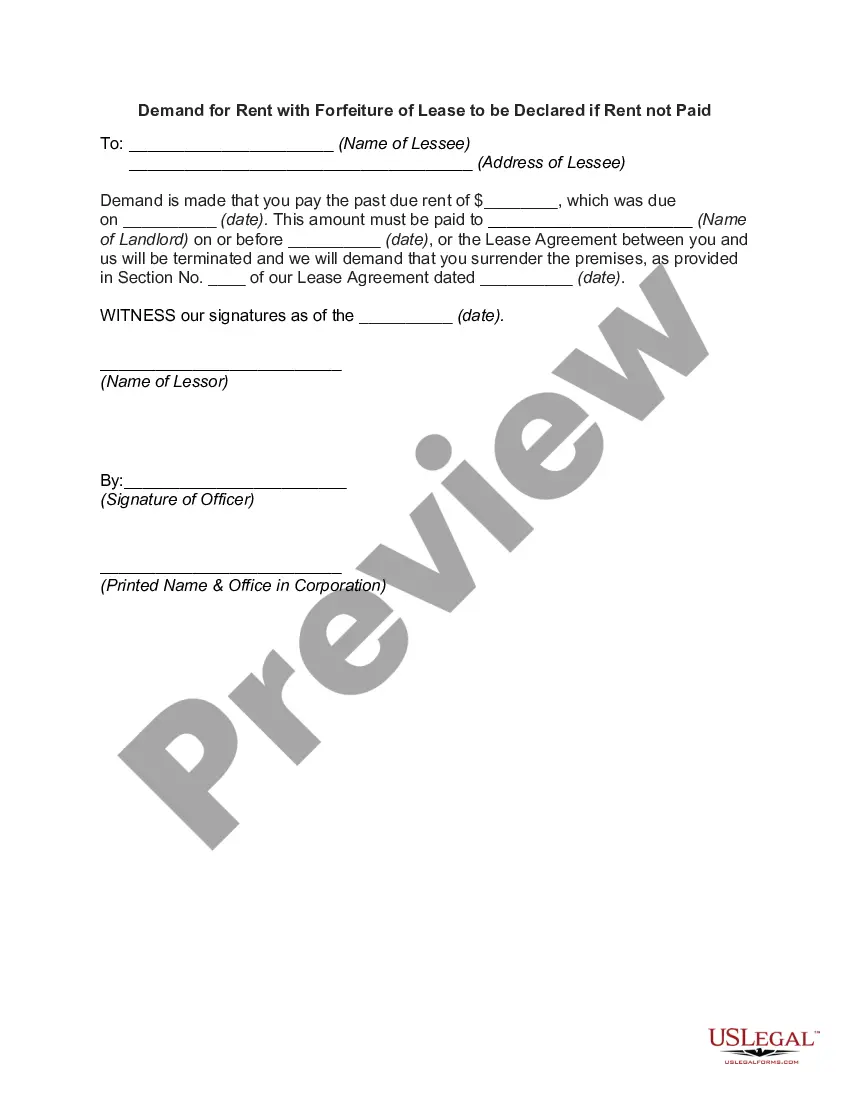

Get your form ready online
Our built-in tools help you complete, sign, share, and store your documents in one place.
Built-in online Word editor
Make edits, fill in missing information, and update formatting in US Legal Forms—just like you would in MS Word.
Export easily
Download a copy, print it, send it by email, or mail it via USPS—whatever works best for your next step.
E-sign your document
Sign and collect signatures with our SignNow integration. Send to multiple recipients, set reminders, and more. Go Premium to unlock E-Sign.
Notarize online 24/7
If this form requires notarization, complete it online through a secure video call—no need to meet a notary in person or wait for an appointment.
Store your document securely
We protect your documents and personal data by following strict security and privacy standards.

Make edits, fill in missing information, and update formatting in US Legal Forms—just like you would in MS Word.

Download a copy, print it, send it by email, or mail it via USPS—whatever works best for your next step.

Sign and collect signatures with our SignNow integration. Send to multiple recipients, set reminders, and more. Go Premium to unlock E-Sign.

If this form requires notarization, complete it online through a secure video call—no need to meet a notary in person or wait for an appointment.

We protect your documents and personal data by following strict security and privacy standards.
Looking for another form?

How to fill out Michigan Demand For Possession, Nonpayment Of Rent, Landlord-Tenant?
Obtain any template from 85,000 legal documents including Michigan Demand for Possession - Nonpayment of Rent Landlord - Tenant online with US Legal Forms. Each template is composed and revised by state-certified attorneys.
If you have an existing subscription, sign in. Once you are on the form’s page, press the Download button and navigate to My documents to gain access to it.
If you have not yet subscribed, adhere to the steps outlined below.
After your reusable template is downloaded, print it or save it to your device. With US Legal Forms, you will always have instant access to the suitable downloadable template. The service provides you with document access and organizes them into categories to ease your search. Use US Legal Forms to acquire your Michigan Demand for Possession - Nonpayment of Rent Landlord - Tenant quickly and effortlessly.
- Verify the state-specific criteria for the Michigan Demand for Possession - Nonpayment of Rent Landlord - Tenant you wish to utilize.
- Examine the description and preview the template.
- Once you’re certain the template meets your requirements, click on Buy Now.
- Choose a subscription plan that fits your financial needs.
- Set up a personal account.
- Make payment using either a credit card or PayPal.
- Select a format to download the document in; two choices are available (PDF or Word).
- Download the document to the My documents section.
Form popularity
FAQ
The 554.613 law in Michigan relates to the Michigan Demand for Possession in cases of nonpayment of rent between landlords and tenants. This law outlines the procedures landlords must follow to formally notify tenants about unpaid rent before pursuing eviction actions. Understanding this law is essential for both parties, as it protects tenant rights while giving landlords necessary recourse for nonpayment. Using USLegalForms can help you navigate this process efficiently, ensuring compliance with Michigan's regulations.
When writing a demand letter for unpaid rent, start by clearly stating your request for payment and outlining the specific amount owed. Be sure to mention the lease agreement terms and any relevant dates, including when the payment was due. Conclude with a deadline for payment to avoid further legal action, which may lead to a Michigan Demand for Possession if unmet. Use platforms like uslegalforms to create a professional demand letter easily.
A demand for possession in Michigan is a legal document that landlords use to notify tenants that they must vacate the rental property. It is commonly used in cases of nonpayment of rent, initiating the eviction process. This document outlines the reason for the eviction, typically including an amount due for unpaid rent. Understanding this process is key for landlords dealing with tenant issues in a timely manner.
A landlord starts an eviction case by filing a summons and complaint with your local district court. A copy of your lease, a copy of the demand for possession that the landlord served on you, and a certificate of service stating how the landlord served you must be attached to the summons and complaint.
If you have rent arrears, your landlord may try and evict you. This is called seeking possession. To do this, in most cases they will need to follow a procedure which involves getting a court order. They can't make you leave your home without going to court first.
Putting all this together, you can see that even if the tenant does not show up to contest the eviction hearing, it will take an absolute minimum of four weeks to get an eviction in Michigan. In reality, an official eviction is likely to take longer, in the region of six to eight weeks.
Michigan has an expedited legal process for eviction called summary proceedings. It enables eviction hearings to be scheduled very quickly after the landlord first makes the filing in court. Landlords cannot evict a tenant in Michigan without a court order.
In the state of Michigan, if tenants hold over, or stay in the rental unit after the rental term has expired, then the landlord may be required to give tenants notice before evicting them. This can include tenants without a written lease and week-to-week and month-to-month tenants.
Persons who have complaints against landlords/property owners can file a complaint with the Michigan Attorney General's Consumer Protection Division at 517-373-1140.
In Michigan, the landlord must give the tenant at least 7 days' notice before filing to evict for non-payment of rent, for causing damage to the home, or for creating a health hazard.