Michigan Seller's Disclosure of Financing Terms for Residential Property in connection with Contract or Agreement for Deed a/k/a Land Contract
About this form
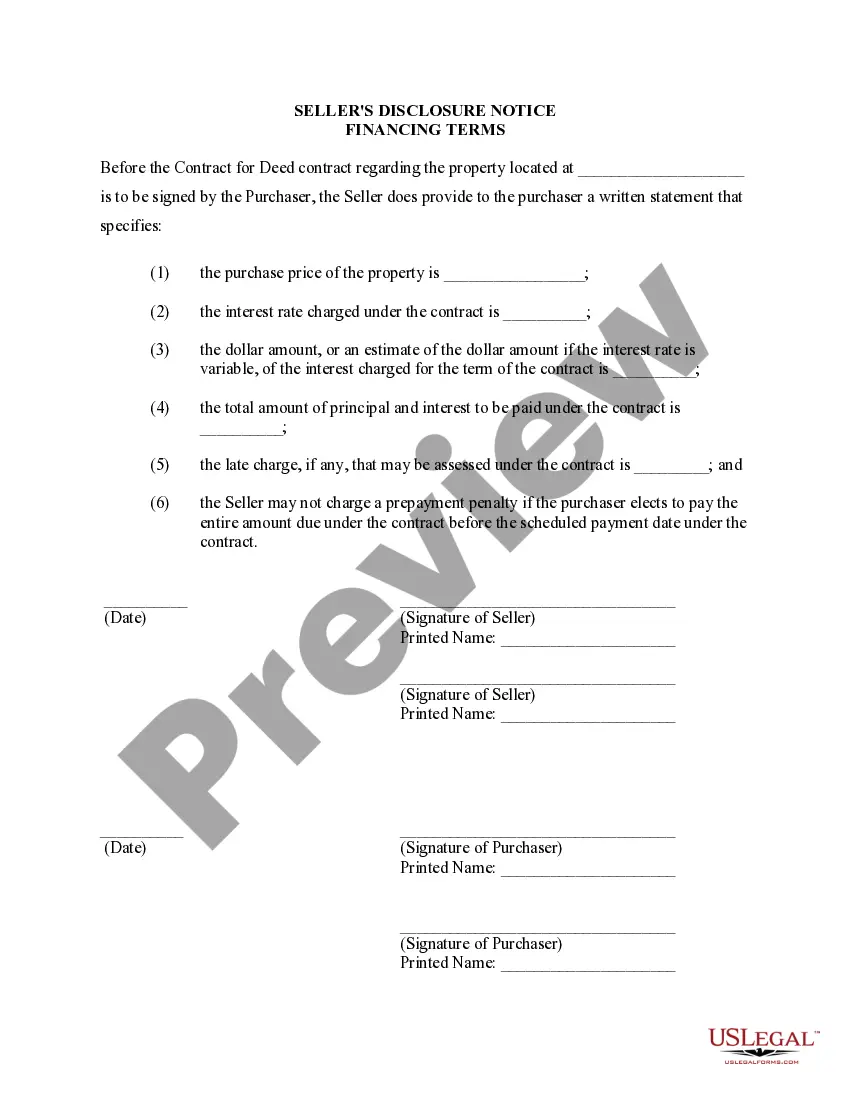
The Seller's Disclosure of Financing Terms for Residential Property serves to inform the purchaser about the key financial aspects of a property being sold through a contract for deed. This form outlines details such as the purchase price, payment schedule, interest rates, and any applicable late charges. Unlike general sales agreements, this document specifically addresses the financing terms involved in land contracts, making it essential for transparent communication between the seller and purchaser.
What’s included in this form
- Purchase price of the property
- Interest rate applicable to the financing
- Payment schedule detailing due dates
- Information on late charges if payments are missed
- Signatures of both seller and purchaser to acknowledge the terms
When this form is needed
This form should be used when a buyer and seller enter into a land contract, especially in transactions where the buyer will make payments directly to the seller rather than securing traditional financing. It is often appropriate in situations where the seller is willing to provide financing and establish specific terms related to that financing.
Who needs this form
- Property sellers offering financing through a land contract
- Purchasers interested in understanding the financing terms before finalizing the purchase
- Real estate agents or brokers facilitating the transaction
Steps to complete this form
- Identify the parties involved: seller and purchaser
- Specify the details of the property being sold
- Enter the purchase price and applicable interest rate
- Detail the payment schedule, including due dates
- Include terms regarding late charges for missed payments
- Secure signatures from both the seller and purchaser
Is notarization required?
This document requires notarization to meet legal standards. US Legal Forms provides secure online notarization powered by Notarize, allowing you to complete the process through a verified video call, available 24/7.
Get your form ready online
Our built-in tools help you complete, sign, share, and store your documents in one place.
Make edits, fill in missing information, and update formatting in US Legal Forms—just like you would in MS Word.
Download a copy, print it, send it by email, or mail it via USPS—whatever works best for your next step.
Sign and collect signatures with our SignNow integration. Send to multiple recipients, set reminders, and more. Go Premium to unlock E-Sign.
If this form requires notarization, complete it online through a secure video call—no need to meet a notary in person or wait for an appointment.
We protect your documents and personal data by following strict security and privacy standards.

Make edits, fill in missing information, and update formatting in US Legal Forms—just like you would in MS Word.

Download a copy, print it, send it by email, or mail it via USPS—whatever works best for your next step.

Sign and collect signatures with our SignNow integration. Send to multiple recipients, set reminders, and more. Go Premium to unlock E-Sign.

If this form requires notarization, complete it online through a secure video call—no need to meet a notary in person or wait for an appointment.

We protect your documents and personal data by following strict security and privacy standards.
Common mistakes to avoid
- Failing to accurately state the purchase price
- Not specifying the interest rate clearly
- Omitting payment due dates
- Forgetting to include late charge information
- Missing signatures from the parties involved
Why complete this form online
- Convenient download and completion at your own pace
- Easily editable to suit specific transaction needs
- Access to templates drafted by licensed attorneys for reliability
Looking for another form?
Form popularity
FAQ
Michigan disclosure laws require a seller to disclose what is personally known about the home, including any imperfections. This could include things like lead-based paint, water damage, hazardous conditions, pest damage, past repairs, past insurance claims, etc.
But if it can be proven that something was known and omitted, a seller can get in big trouble. A seller may be liable to the buyer for the nondisclosure of material facts, negligent misrepresentation of facts, intentional misrepresentation of facts, or suppression or concealment of facts, Zuetel explains.
California, like many states, requires its residential property sellers to disclose, in writing, details about the property they have on the market.
In Michigan, the principle of Caveat emptor prevails in land sales and normally the vendor is not liable for any harm due to defects existing at the time of sale.The first exception requires the seller to disclose to the purchaser any concealed condition known to the seller. Id.
A seller is supposed to be truthful when answering the disclosure statement for the buyer.And, if a seller lies, the buyer is entitled to go after the seller for damages sustained because of an omission in the disclosure statement given to the buyer.
In Michigan, seller's of owner occupied residential property up to 4 units, are required by law to complete a Seller's Disclosure Statement.In this statement the seller must disclose the condition of the property and any other information concerning the property that is known to the seller.
The seller is not providing a seller disclosure form and is selling the property as is, although he is allowing a home inspection.For example, if the seller's home is part of an estate or a foreclosure sale by a sheriff or court, a seller disclosure form may not be required. The rules are governed on a state level.
If the sellers concealed a known defect, you can sue for fraudulent misrepresentation. You will have to prove that they actually concealed the defect, as opposed to having perhaps been unaware of it.
To hold a seller responsible for repairs after the closing, a buyer must prove that the seller withheld material facts about the home's condition. A seller is unlikely to be held liable for repairs after the close of escrow if the seller disclosed all known defects to the buyer.