Idaho Last Will and Testament with All Property to Trust called a Pour Over Will
What this document covers
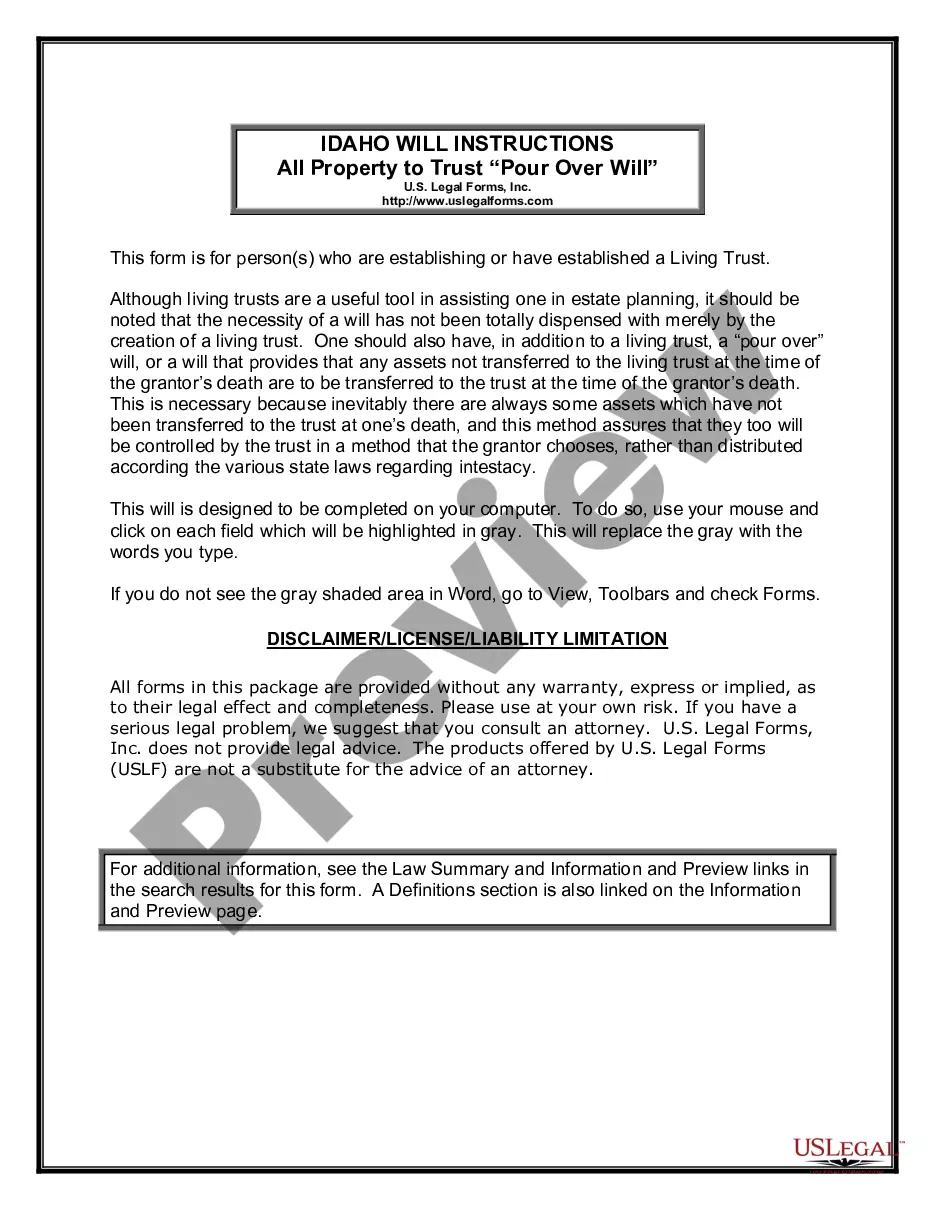
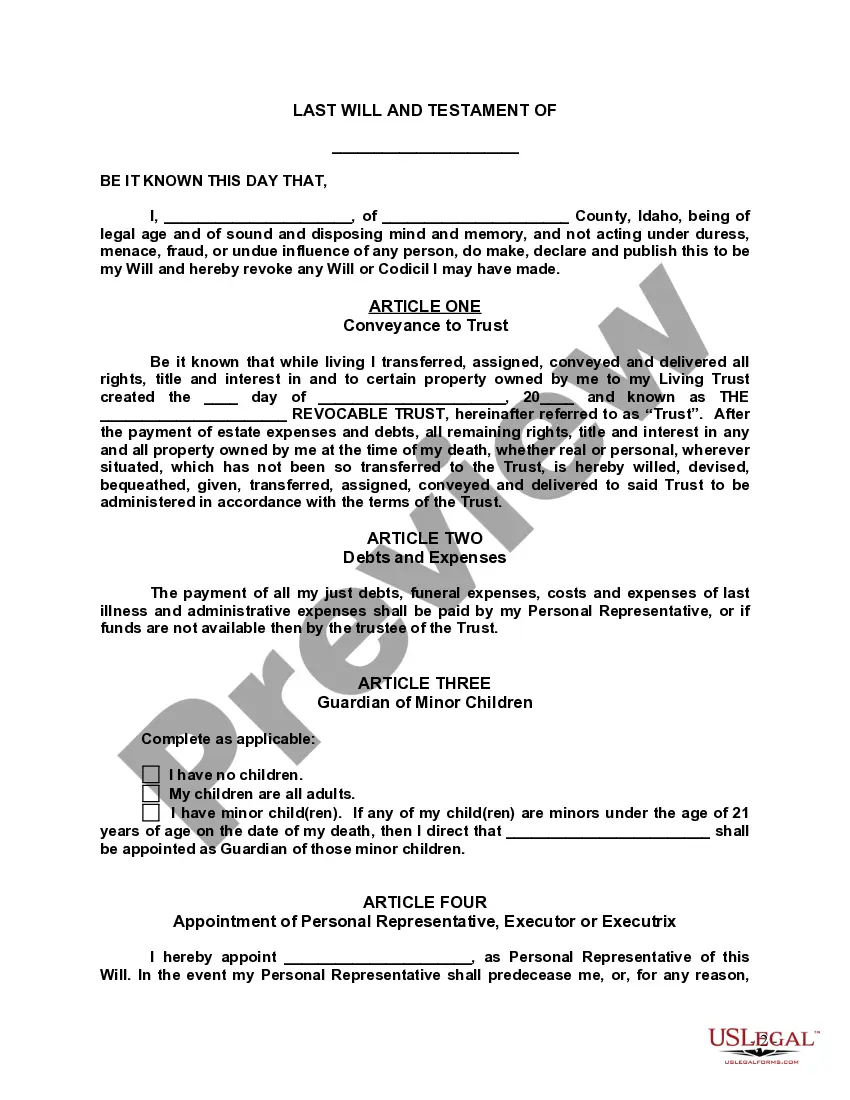
The Last Will and Testament with All Property to Trust, commonly known as a Pour Over Will, is a legal document that ensures all assets not already placed in a living trust are transferred to that trust upon your death. This form serves as a critical estate planning tool for individuals who have created or are in the process of creating a living trust, guaranteeing that any remaining assets are managed according to their wishes, rather than default state intestacy laws.
What’s included in this form
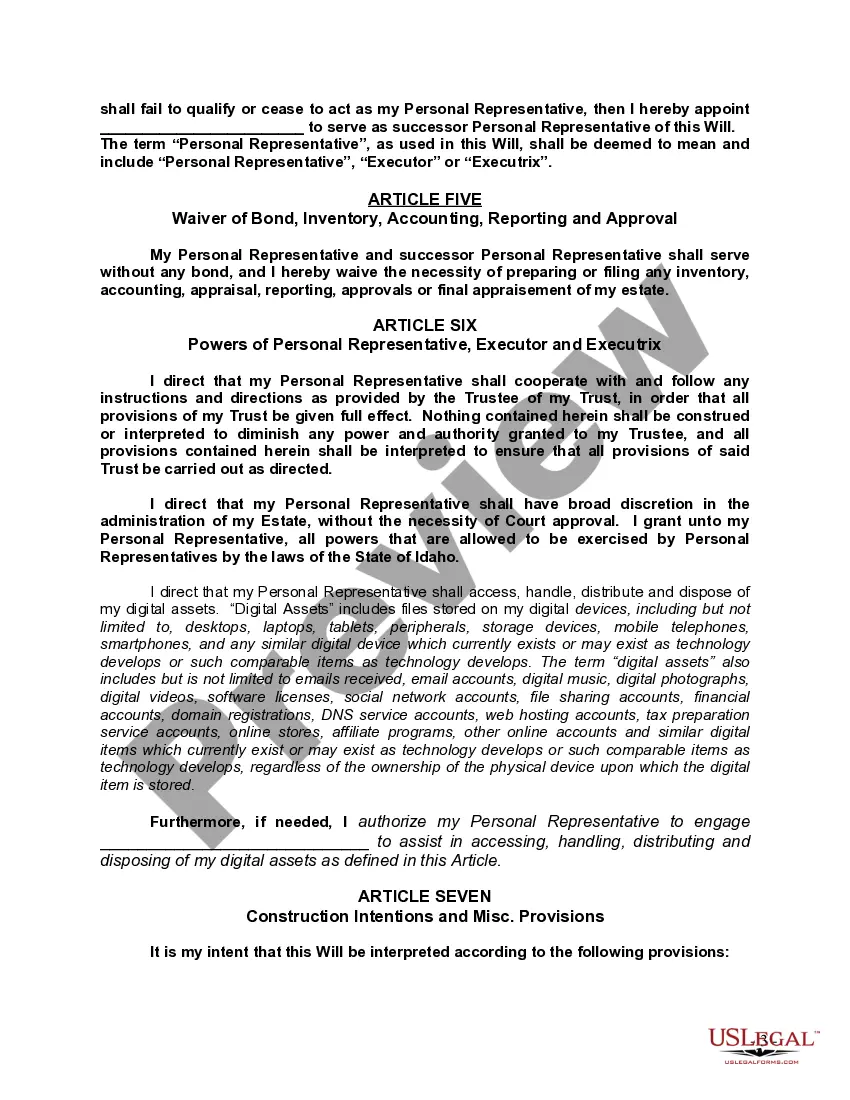
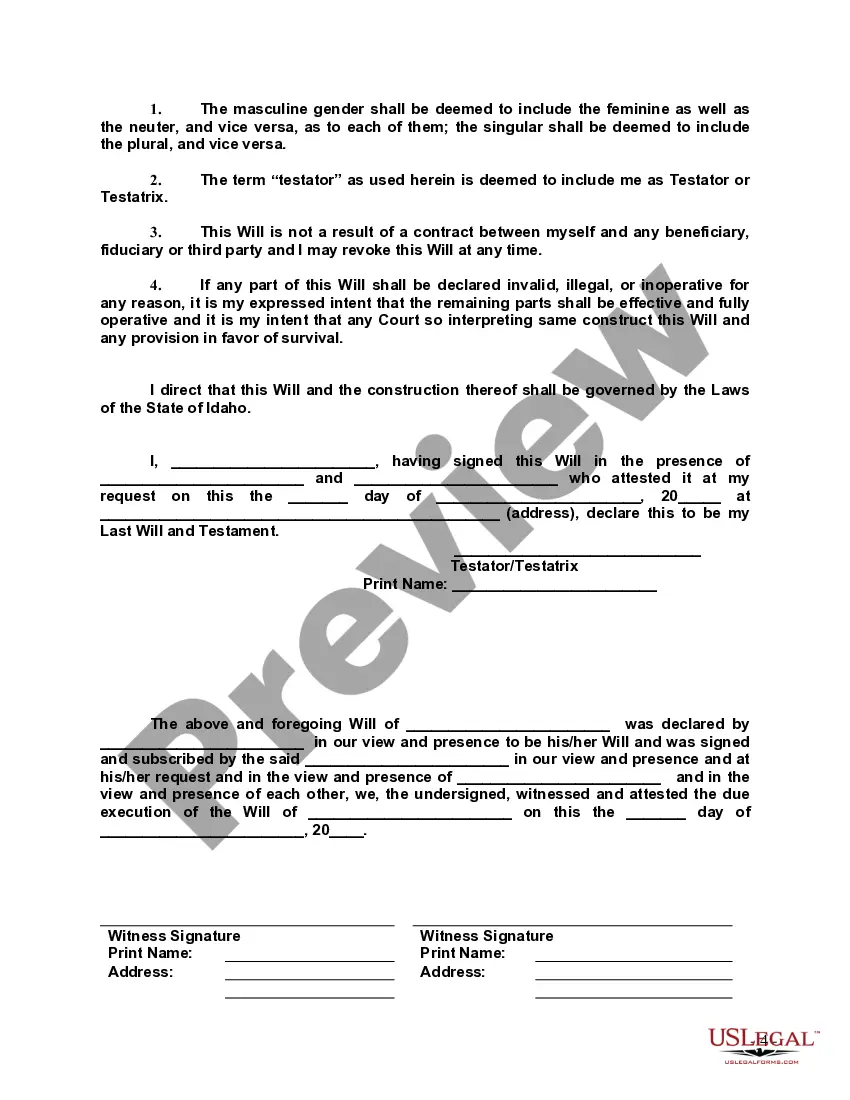
- Conveyance to Trust: Details how property is transferred to the living trust upon death.
- Debts and Expenses: Outlines the payment of debts and final expenses from the estate.
- Guardian of Minor Children: Specifies who will serve as guardian for any minor children.
- Appointment of Personal Representative: Designates an individual to administer the will.
- Waiver of Bond: States that the personal representative will not be required to post a bond.
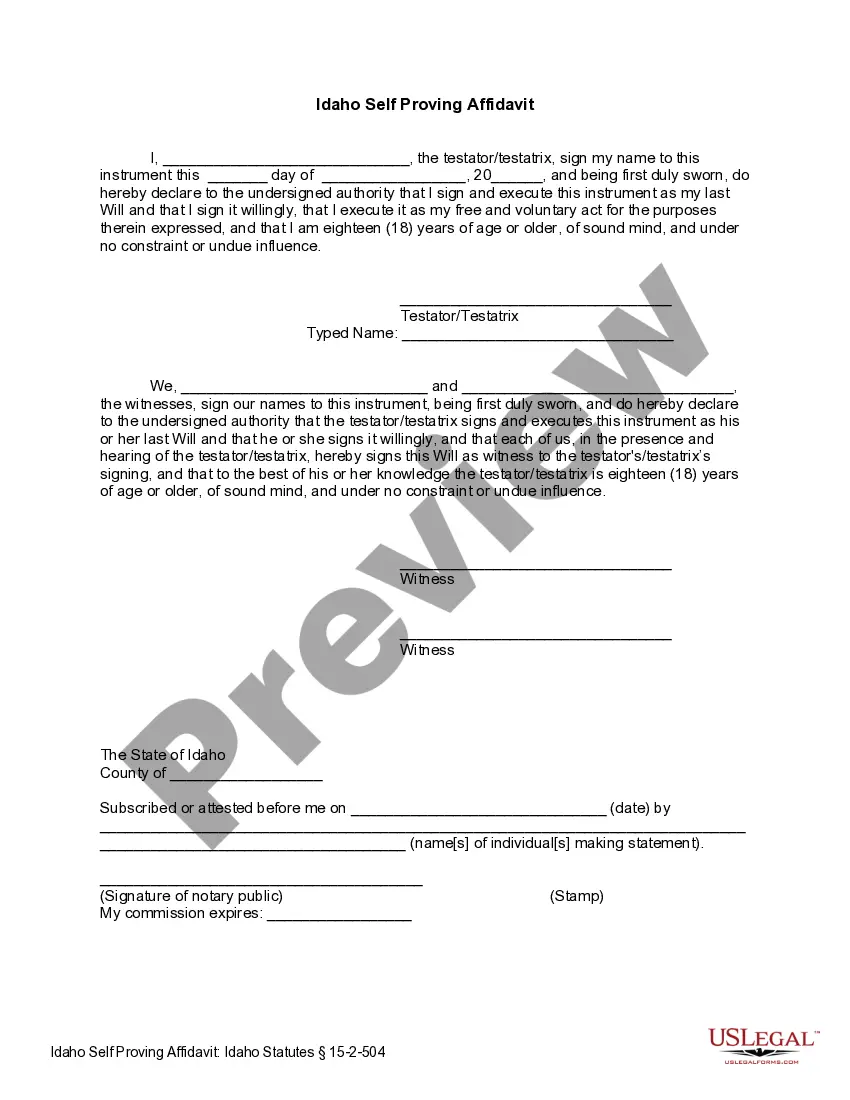
- Self-Proving Affidavit: Provides a sworn statement affirming the will is valid.




When to use this document
This form is essential for individuals who have established or are establishing a living trust. You should consider using a Pour Over Will if you want to ensure that any assets not otherwise transferred to your trust during your life will still be included in the trust after your passing. It serves to avoid complications in asset distribution and helps ensure that all assets are managed according to your specifications.
Who needs this form
- Individuals creating or who have already set up a living trust.
- Anyone seeking to simplify the transfer of assets at death.
- Persons who want to ensure their assets are distributed according to their wishes.
Completing this form step by step
- Identify the testator's full name and residential address.
- Specify the living trust name and the date it was created.
- Designate a personal representative and any potential guardians for minor children.
- Enter instructions for the settlement of debts and allocation of assets.
- Review the entire document for accuracy before signing.
Notarization requirements for this form
This document requires notarization to meet legal standards. US Legal Forms provides secure online notarization powered by Notarize, allowing you to complete the process through a verified video call, available 24/7.
Get your form ready online
Our built-in tools help you complete, sign, share, and store your documents in one place.
Make edits, fill in missing information, and update formatting in US Legal Forms—just like you would in MS Word.
Download a copy, print it, send it by email, or mail it via USPS—whatever works best for your next step.
Sign and collect signatures with our SignNow integration. Send to multiple recipients, set reminders, and more. Go Premium to unlock E-Sign.
If this form requires notarization, complete it online through a secure video call—no need to meet a notary in person or wait for an appointment.
We protect your documents and personal data by following strict security and privacy standards.

Make edits, fill in missing information, and update formatting in US Legal Forms—just like you would in MS Word.

Download a copy, print it, send it by email, or mail it via USPS—whatever works best for your next step.

Sign and collect signatures with our SignNow integration. Send to multiple recipients, set reminders, and more. Go Premium to unlock E-Sign.

If this form requires notarization, complete it online through a secure video call—no need to meet a notary in person or wait for an appointment.

We protect your documents and personal data by following strict security and privacy standards.
Common mistakes
- Failing to update the will after significant life changes (e.g., marriage, divorce).
- Not naming a personal representative or guardian for minor children.
- Leaving out assets that should be transferred to the trust.
- Not signing the will in the presence of witnesses as required.
Advantages of online completion
- Convenient access to legal forms without needing to visit an attorney's office.
- Ability to complete the document digitally for ease of editing and saving.
- Reduces the risk of errors due to clear, structured instructions provided.
Legal use & context
- This Pour Over Will is legally enforceable in Idaho, provided it meets state law requirements.
- It helps avoid intestacy laws by ensuring all property is managed in accordance with the trust.
What to keep in mind
- A Pour Over Will complements a living trust by handling assets not yet transferred to the trust at death.
- Using this form streamlines the distribution of your estate and ensures your wishes are honored.
Looking for another form?

Form popularity
FAQ
A list of your assets such as property, bank accounts, superannuation and investments. the names and addresses of your beneficiaries (the people who'll receive your assets) if you have children under the age of 18, the name/s of whomever you'd like to appoint as their guardian(s)
No, in Idaho, you do not need to notarize your will to make it legal. However, Idaho allows you to make your will "self-proving" and you'll need to go to a notary if you want to do that. A self-proving will speeds up probate because the court can accept the will without contacting the witnesses who signed it.
The decision to draft your own will should be made hesitantly and only after careful consideration. Idaho law recognizes handwritten wills, referred to as holographic wills. Material provisions of the will and the signature must be in the handwriting of the person making the will.
As long as it was properly signed and witnessed by two adult independent witnesses who are present at the time you sign your will, it should be legally binding.Using the wrong wording could mean that your instructions aren't followed, or even that your will isn't valid.