Iowa Assignment of Contract for Deed by Seller
What this document covers
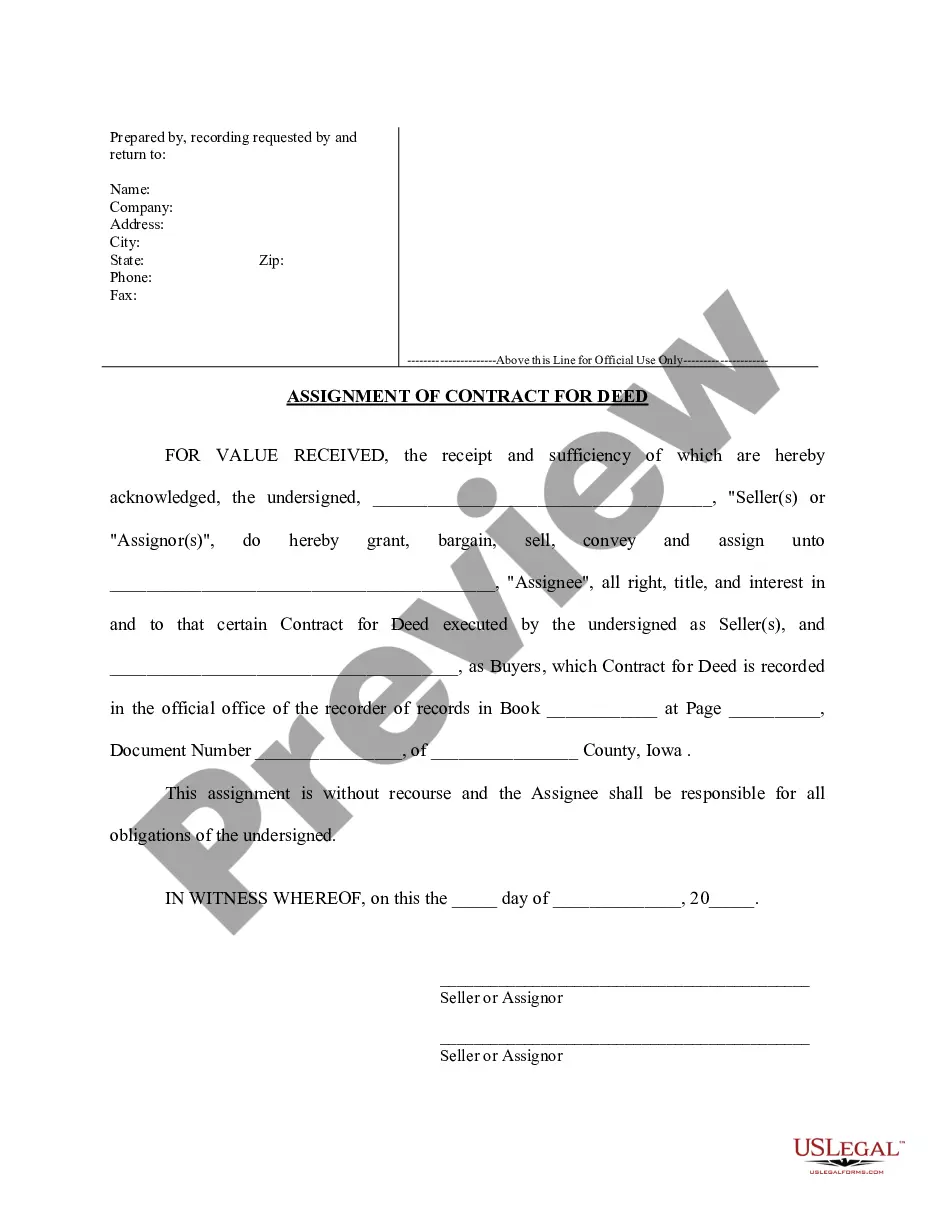
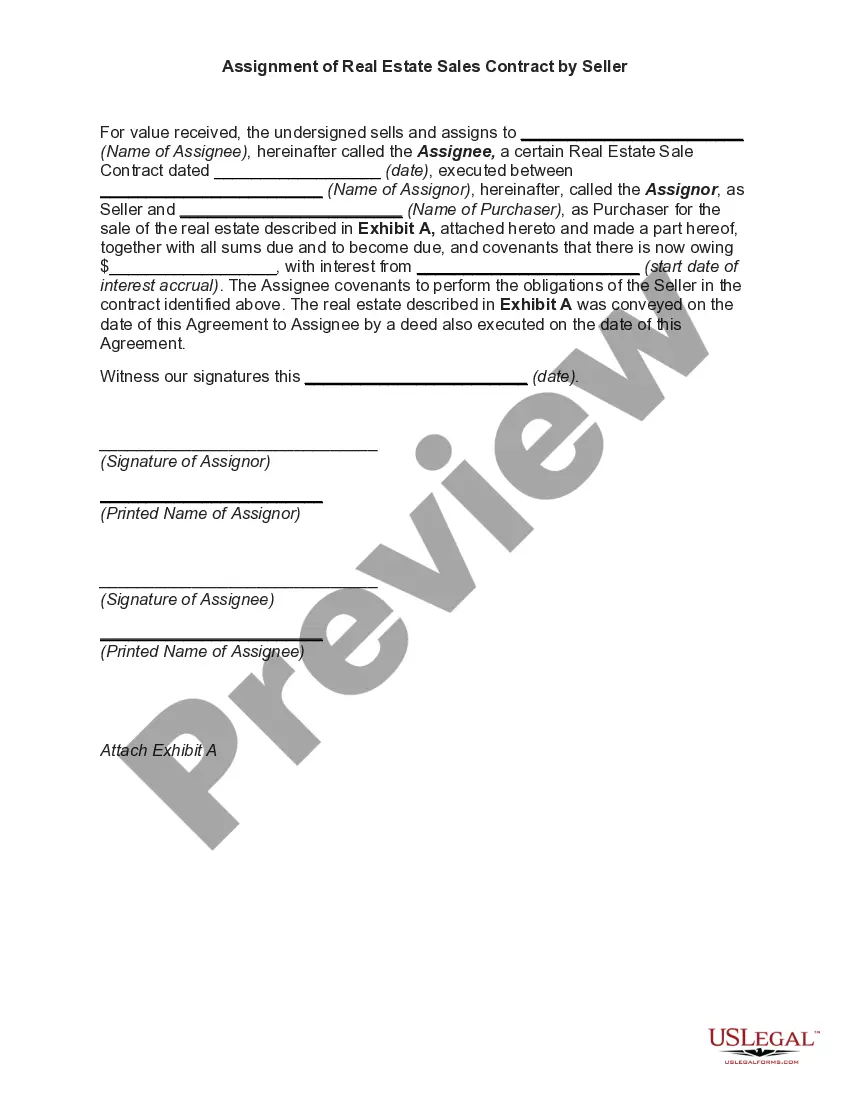
The Assignment of Contract for Deed by Seller is a legal document that allows a seller, who has an established contract for deed, to transfer their rights and obligations to a third party. This form is typically used when the seller wishes to assign their contract in exchange for a lump sum payment. By using this form, the assignee steps into the role of the seller, managing future payments from the purchaser. Unlike a standard sale, this arrangement focuses on the contractual rights rather than the outright transfer of the property itself.
Key parts of this document
- Identification of the original seller and the assignee.
- Details regarding the property involved in the contract.
- Clause indicating the assignment is without recourse, making the assignee responsible for obligations.
- Signature lines for both the seller and the assignee to execute the assignment.
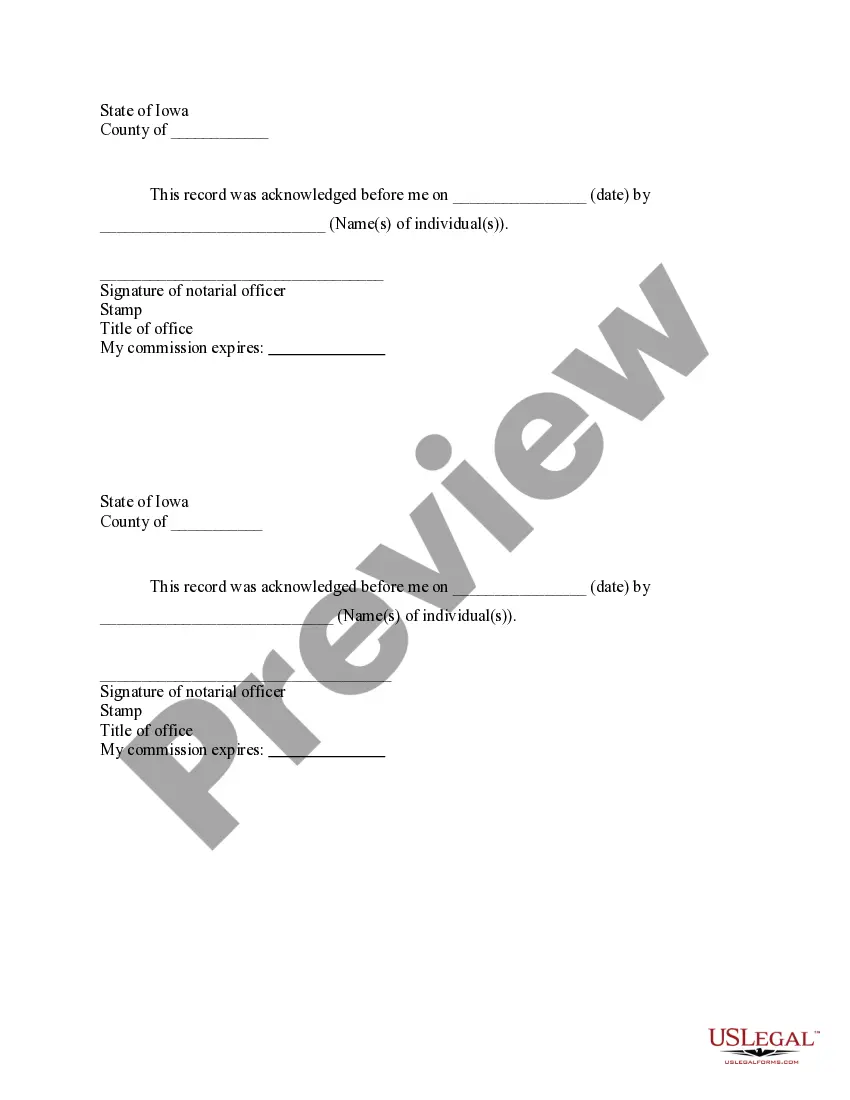
- Notary acknowledgment section to validate the agreement.
When to use this form
This form should be used when a seller who has a contract for deed wants to transfer their rights to another party, typically when they need immediate cash or to eliminate responsibilities associated with the contract. It is also applicable in situations where the seller may not wish to handle future payments and responsibilities directly.
Who this form is for
- Sellers of real estate who have a contract for deed and want to assign it to another party.
- Assignees seeking to step into an existing contract for deed agreement.
- Real estate investors looking to acquire contracts for deed from sellers in exchange for cash.
How to prepare this document
- Identify the parties involved, including the seller and the assignee.
- Provide a description of the property to ensure clarity about which contract is being assigned.
- Specify the date of the assignment in the appropriate field.
- Both the seller and the assignee should sign the document to validate the assignment.
- Arrange for a notary public to acknowledge the signatures to ensure the document is legally binding.
Is notarization required?
Notarization is required for this form to take effect. Our online notarization service, powered by Notarize, lets you verify and sign documents remotely through an encrypted video session, available 24/7.
Get your form ready online
Our built-in tools help you complete, sign, share, and store your documents in one place.
Make edits, fill in missing information, and update formatting in US Legal Forms—just like you would in MS Word.
Download a copy, print it, send it by email, or mail it via USPS—whatever works best for your next step.
Sign and collect signatures with our SignNow integration. Send to multiple recipients, set reminders, and more. Go Premium to unlock E-Sign.
If this form requires notarization, complete it online through a secure video call—no need to meet a notary in person or wait for an appointment.
We protect your documents and personal data by following strict security and privacy standards.

Make edits, fill in missing information, and update formatting in US Legal Forms—just like you would in MS Word.

Download a copy, print it, send it by email, or mail it via USPS—whatever works best for your next step.

Sign and collect signatures with our SignNow integration. Send to multiple recipients, set reminders, and more. Go Premium to unlock E-Sign.

If this form requires notarization, complete it online through a secure video call—no need to meet a notary in person or wait for an appointment.

We protect your documents and personal data by following strict security and privacy standards.
Typical mistakes to avoid
- Failing to include complete details of the property being assigned.
- Not having signatures from both the seller and the assignee.
- Missing the notary acknowledgment, which is needed for legal validity.
- Assuming the form is valid in all states without checking local regulations.
Advantages of online completion
- Convenient download and printing from anywhere.
- Editable fields that allow for customization to fit specific needs.
- Access to legally vetted content drafted by licensed attorneys.
Looking for another form?
Form popularity
FAQ
When reporting a contract for deed on your taxes in Iowa, it's essential to recognize the income generated from payments received. As the seller, you may need to report the interest portion as income. Consulting with a tax professional can provide clarity, and using USLegalForms can help you correctly document your financial records related to the contract.
In Iowa, land contracts, including contracts for deed, do not legally have to be recorded, but recording the document is highly recommended. Recording protects the buyer's interest in the property and provides public notice of the transaction. To confidently navigate this process, consider using the services offered by USLegalForms for streamlined documentation.
Executing a contract as a deed involves drafting the document to meet specific legal requirements, including providing clear terms and signatures from both parties. In Iowa, it often requires notarization to enhance its enforceability. For best practices, consider utilizing resources from USLegalForms to ensure your contract meets all necessary legal criteria.
To record a contract for deed in Iowa, you must file the document with your county recorder's office. This process ensures that the contract becomes part of the public record, providing protection for both parties involved. Using USLegalForms, you can easily access templates to guide you in preparing and recording your contract for deed.
In Iowa, the assignment of a contract for deed by seller does not strictly require a deed. Typically, the assignment is documented through an agreement that outlines the transfer of rights and responsibilities from the seller to the assignee. However, executing the assignment through a deed can provide additional legal clarity and security.
A Deed of transfer and a Deed of Assignment differ primarily in their function. A Deed of transfer conveys ownership of property directly, while a Deed of Assignment involves transferring rights under a contract without changing the ownership. In the context of an Iowa Assignment of Contract for Deed by Seller, the latter allows for the continuation of contractual obligations and benefits, creating a seamless transition for new buyers.
The Deed of Assignment refers to a document that facilitates the transfer of rights to assets or property from one party to another. Specifically, in an Iowa Assignment of Contract for Deed by Seller, this deed clarifies the rights and responsibilities of the parties involved. It ensures that the new buyer can step into the original buyer's position, maintaining continuity in the transaction.
A contract for deed in Iowa is a method of real estate financing where the buyer pays the seller in installments while taking possession of the property. The seller retains the title until the buyer completes all payments. This arrangement can be streamlined through an Iowa Assignment of Contract for Deed by Seller, allowing a new buyer to step into the shoes of the original buyer under the contract.
Iowa Code 558.5 pertains to the requirements for the transfer of real property in the state. This code outlines procedures and necessary documentation, including aspects of the Iowa Assignment of Contract for Deed by Seller. Understanding this code is crucial for anyone involved in property transactions in Iowa, as it ensures compliance and protects the interests of both parties.
The Deed of Assignment of contract serves as the official document that records the transfer of rights from one party to another. When dealing with an Iowa Assignment of Contract for Deed by Seller, this deed provides the legal framework for the transaction. It details the responsibilities and rights of both the seller and the new buyer, ensuring clarity and enforceability.