Iowa Notice of Intent to Enforce Forfeiture Provisions of Contact for Deed
Understanding this form
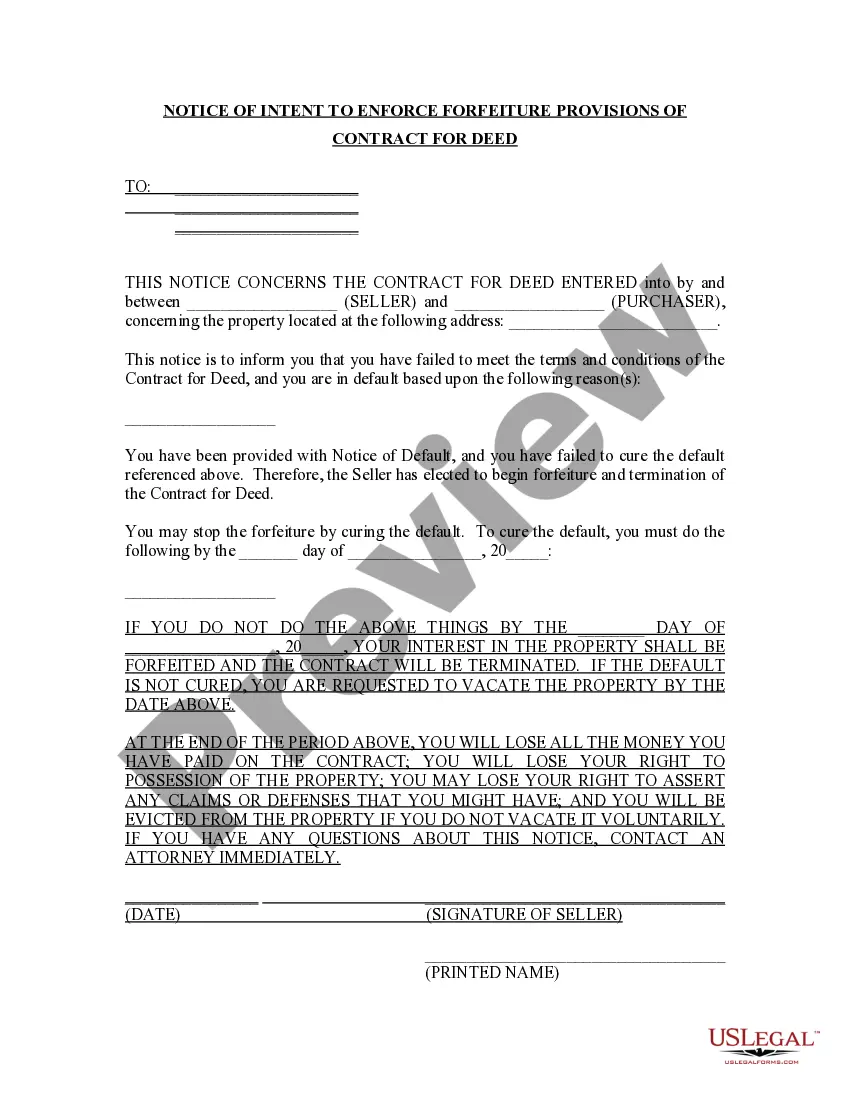
The Notice of Intent to Enforce Forfeiture Provisions of Contract for Deed is a legal form that notifies the buyer of their default on the terms of the contract for deed. This form serves as an initial step for the seller, indicating their intent to enforce forfeiture provisions due to nonpayment or other breaches. It is distinct from general eviction notices and emphasizes the contractual obligations specific to the contract for deed arrangement.
Key parts of this document
- Identification of the parties involved, including the seller and buyer.
- Details of the contract for deed and specific terms that have been breached.
- Notice of default indicating the type of breach (e.g., nonpayment).
- Timeframe for the buyer to rectify the breach before forfeiture actions are taken.
- Provision for potential legal actions if the terms remain unfulfilled.

When this form is needed
This form should be used when the seller of a property under a contract for deed needs to formally notify the buyer of a default. Common scenarios include missed payments or failures to maintain the property as agreed. The form ensures that the buyer is aware of their noncompliance and the consequences of not addressing the issue within a specified timeframe.
Who can use this document
This form is intended for:
- Sellers who have entered into a contract for deed and are experiencing buyer default.
- Real estate agents representing sellers in contract for deed transactions.
- Attorneys assisting clients in real estate matters related to contract for deed enforcement.
How to prepare this document
- Identify and enter the names and contact information of the seller and buyer.
- Specify the property address that is subject to the contract for deed.
- Detail the specific breach or default that has occurred (e.g., missed payment).
- Include the deadlines for the buyer to remedy the breach.
- Sign and date the notice to formalize the intent to enforce forfeiture provisions.
Does this form need to be notarized?
Notarization is generally not required for this form. However, certain states or situations might demand it. You can complete notarization online through US Legal Forms, powered by Notarize, using a verified video call available anytime.
Get your form ready online
Our built-in tools help you complete, sign, share, and store your documents in one place.
Make edits, fill in missing information, and update formatting in US Legal Forms—just like you would in MS Word.
Download a copy, print it, send it by email, or mail it via USPS—whatever works best for your next step.
Sign and collect signatures with our SignNow integration. Send to multiple recipients, set reminders, and more. Go Premium to unlock E-Sign.
If this form requires notarization, complete it online through a secure video call—no need to meet a notary in person or wait for an appointment.
We protect your documents and personal data by following strict security and privacy standards.

Make edits, fill in missing information, and update formatting in US Legal Forms—just like you would in MS Word.

Download a copy, print it, send it by email, or mail it via USPS—whatever works best for your next step.

Sign and collect signatures with our SignNow integration. Send to multiple recipients, set reminders, and more. Go Premium to unlock E-Sign.

If this form requires notarization, complete it online through a secure video call—no need to meet a notary in person or wait for an appointment.

We protect your documents and personal data by following strict security and privacy standards.
Mistakes to watch out for
- Failing to provide accurate details about the breach.
- Not specifying the timeframe for the buyer to resolve the default.
- Neglecting to sign or date the form before sending it.
- Using vague language that may lead to misunderstandings about the terms of the contract.
Why use this form online
- Convenience of downloading the form at any time from anywhere.
- Easy to customize for specific terms applicable to your contract.
- Accessible legal form templates that are clear and user-friendly.
- Reliability, knowing that the forms are drafted by licensed attorneys.
Looking for another form?
Form popularity
FAQ
A contract for deed can be advantageous for sellers, as it allows them to receive steady income from monthly payments. This arrangement can also attract buyers who may struggle to secure traditional financing. However, sellers should carefully consider the implications of the Iowa Notice of Intent to Enforce Forfeiture Provisions of Contact for Deed, ensuring that they are protected should a buyer default on the agreement.
In Iowa, a contract for deed allows a buyer to make payments directly to the seller while living in the property. The seller holds the title until the buyer completes the payment terms, which is typically outlined in the contract. This method can ease the path to homeownership but requires careful attention to the Iowa Notice of Intent to Enforce Forfeiture Provisions of Contact for Deed, ensuring that all terms are met to protect both parties.
One disadvantage of a contract for deed is the potential for forfeiture, where the buyer may lose the property and any payments made if they fail to meet the terms. Additionally, the seller retains legal title until the buyer fulfills the agreement, which can complicate ownership rights. Understanding these risks helps both buyers and sellers navigate the complexities associated with the Iowa Notice of Intent to Enforce Forfeiture Provisions of Contact for Deed.
To forfeit a deed means that the buyer loses their rights to the property typically due to failing to meet payment obligations. This action allows the seller to reclaim ownership and may involve legal procedures outlined in the Iowa Notice of Intent to Enforce Forfeiture Provisions of Contract for Deed. A clear understanding of this process is essential for both buyers and sellers.
Forfeiture and foreclosure are related yet distinct processes. Forfeiture generally applies to agreements like contracts for deed, where the seller retains title until complete payment. Foreclosure, on the other hand, is a legal remedy for lenders against buyers who default on a mortgage. Understanding the differences is critical, especially when dealing with the Iowa Notice of Intent to Enforce Forfeiture Provisions of Contract for Deed.
Forfeiture of the agreement means that one party, typically the seller, is terminating the contract due to the other party's failure to meet obligations. In the case of a contract for deed in Iowa, this allows the seller to regain ownership of the property. The Iowa Notice of Intent to Enforce Forfeiture Provisions of Contract for Deed provides a framework for enforcing this agreement.
The forfeiture clause on a land contract specifies the conditions under which the seller can reclaim the property if the buyer defaults. This clause typically outlines the required notice period and procedures, ensuring both parties are aware of their rights. With the Iowa Notice of Intent to Enforce Forfeiture Provisions of Contract for Deed, this clause plays a key role in ensuring compliance.
A forfeiture deed serves as a formal notice that the seller is reclaiming ownership of the property due to the buyer's failure to uphold the terms of the contract for deed. It effectively nullifies the buyer's rights to the property. Knowing the implications of a forfeiture deed is crucial when navigating the Iowa Notice of Intent to Enforce Forfeiture Provisions of Contract for Deed.
Forfeiture in legal terms refers to the loss of property or rights due to the failure to comply with a contract or law. In the context of a contract for deed, it means the seller can reclaim the property if the buyer does not meet payment obligations. The Iowa Notice of Intent to Enforce Forfeiture Provisions of Contract for Deed outlines these specific legal actions.
A forfeit deed is a legal document that transfers ownership of property back to the original owner after the buyer fails to meet the terms of a contract for deed. In Iowa, when a buyer misses payments, the seller can enforce this deed. It's essential to understand the implications of this process under the Iowa Notice of Intent to Enforce Forfeiture Provisions of Contract for Deed.