Georgia Letter from Tenant to Landlord containing Notice to landlord to withdraw retaliatory rent increase
What is this form?
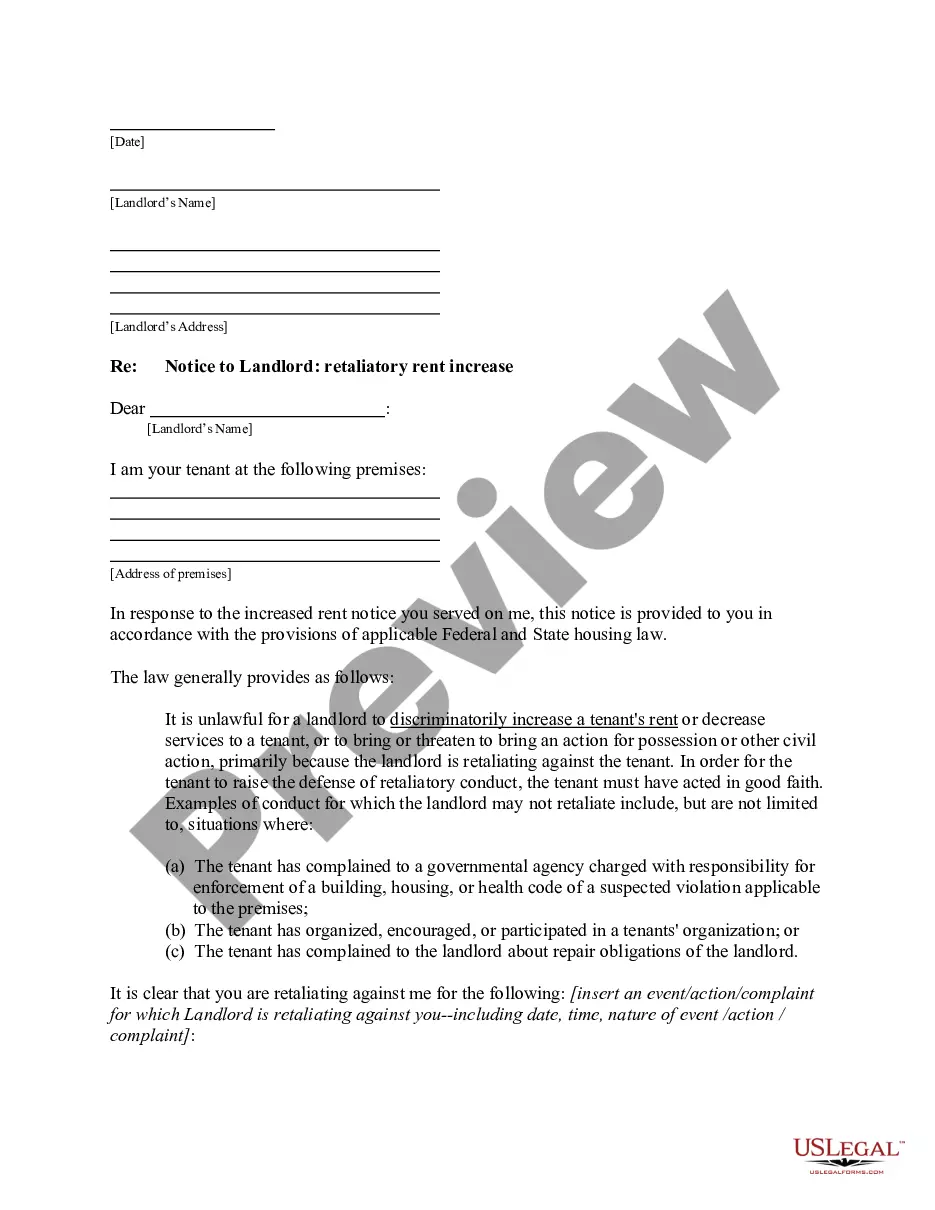
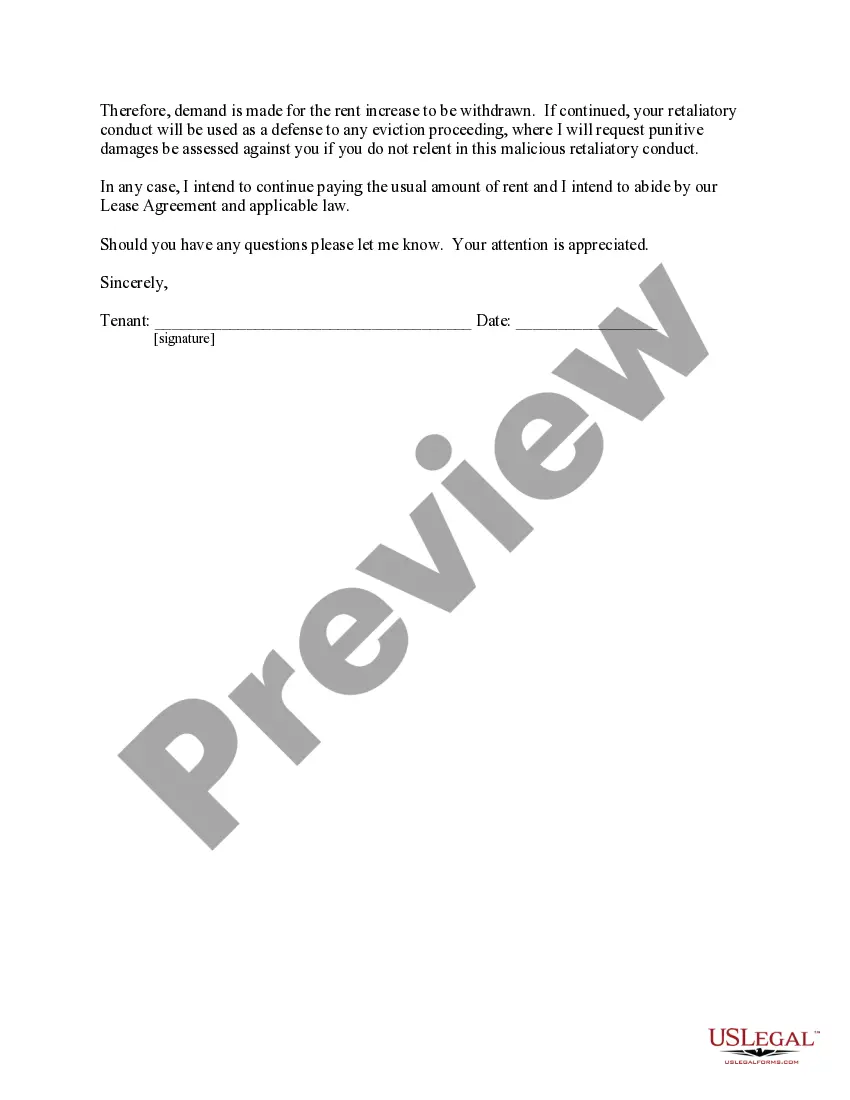
This Letter from Tenant to Landlord containing Notice to landlord to withdraw retaliatory rent increase is a legal document that informs a landlord about the unlawful nature of increasing rent or reducing tenant services as a form of retaliation. It serves to protect tenants' rights by notifying landlords that such actions are prohibited under housing laws. This form specifically addresses situations where the tenant has engaged in protected activities, ensuring they are not discriminated against for asserting their rights.
Form components explained
- Tenant's name and contact information
- Landlord's name and contact information
- Date of the notice
- Statement of the tenant's intent to pay rent
- Details of the retaliatory conduct by the landlord
- Tenant's signature

When this form is needed
This form should be used when a tenant believes their landlord has increased rent or decreased services in retaliation for taking legal actions, such as reporting code violations or participating in tenant's rights activities. It can also be used if a tenant feels the landlord is threatening legal action due to their complaints or assertive behavior regarding housing conditions.
Intended users of this form
- Tenants who have experienced a retaliatory rent increase
- Individuals concerned about their landlord's retaliatory actions
- People seeking to assert their rights under housing laws
How to prepare this document
- Identify and enter the tenant's and landlord's names and addresses.
- Specify the date of the notice.
- Clearly state your intention to continue paying the usual rent amount.
- Describe the retaliatory actions taken by the landlord.
- Sign and date the form at the bottom, indicating your acknowledgment.
Is notarization required?
This form does not typically require notarization to be legally valid. However, some jurisdictions or document types may still require it. US Legal Forms provides secure online notarization powered by Notarize, available 24/7 for added convenience.
Get your form ready online
Our built-in tools help you complete, sign, share, and store your documents in one place.
Make edits, fill in missing information, and update formatting in US Legal Forms—just like you would in MS Word.
Download a copy, print it, send it by email, or mail it via USPS—whatever works best for your next step.
Sign and collect signatures with our SignNow integration. Send to multiple recipients, set reminders, and more. Go Premium to unlock E-Sign.
If this form requires notarization, complete it online through a secure video call—no need to meet a notary in person or wait for an appointment.
We protect your documents and personal data by following strict security and privacy standards.

Make edits, fill in missing information, and update formatting in US Legal Forms—just like you would in MS Word.

Download a copy, print it, send it by email, or mail it via USPS—whatever works best for your next step.

Sign and collect signatures with our SignNow integration. Send to multiple recipients, set reminders, and more. Go Premium to unlock E-Sign.

If this form requires notarization, complete it online through a secure video call—no need to meet a notary in person or wait for an appointment.

We protect your documents and personal data by following strict security and privacy standards.
Avoid these common issues
- Failing to include relevant dates related to the retaliatory conduct.
- Not signing the form before sending it to the landlord.
- Using vague language instead of clearly outlining the specific retaliatory actions.
Benefits of using this form online
- Convenience of downloading and filling out the form at any time.
- Editable format allows for customization to fit individual circumstances.
- Access to professionally drafted content enhances reliability.
Legal use & context
- This form is designed to protect tenants from retaliatory actions.
- Retaliation can include unjust rent increases or threats of eviction.
- Using this form can help establish your rights and serve as a formal record of your complaint.
Key takeaways
- This form helps protect tenants from retaliatory rent increases.
- It clearly outlines tenant rights under housing laws.
- Properly completing and sending this letter can prevent illegal actions by landlords.
Looking for another form?
Form popularity
FAQ
When writing a formal complaint letter to your landlord, use a polite tone and state your issue clearly. Begin with the details of your rental agreement and the nature of your complaint. You might want to reference a Georgia Letter from Tenant to Landlord containing Notice to landlord to withdraw retaliatory rent increase, as this can support your case and illustrate that you are serious about resolving the issue.
To write a letter requesting necessary repairs, start with a friendly greeting. Clearly specify the repairs needed, giving descriptions and locations of the issues. If possible, mention any previous conversations you had regarding these repairs and frame your request through formal templates like a Georgia Letter from Tenant to Landlord containing Notice to landlord to withdraw retaliatory rent increase, which can help reinforce your point.
You can start an email to your landlord with a respectful salutation, such as 'Dear Landlord's Name.' After that, introduce yourself briefly and mention your rental property. If your email includes a Georgia Letter from Tenant to Landlord containing Notice to landlord to withdraw retaliatory rent increase, summarize that topic right away to capture their attention.
When writing to your landlord, clearly state your purpose and include all necessary details. Begin with a polite greeting, followed by a concise explanation of your request or concern, such as a Georgia Letter from Tenant to Landlord containing Notice to landlord to withdraw retaliatory rent increase. Be sure to include your contact information for easy communication.
A retaliatory notice is a communication from a landlord to a tenant that indicates an eviction or rent increase after the tenant has exercised their legal rights. Such notices can be a tactic to deter tenants from speaking out about their living conditions or exercising their rights. Being aware of retaliatory notices is crucial for tenants, as they may need to respond with a Georgia Letter from Tenant to Landlord containing Notice to landlord to withdraw retaliatory rent increase.
Unfair eviction refers to the unlawful removal of a tenant from a rental property without just cause or without following proper legal procedures. This often includes actions taken in violation of tenant rights, such as not providing adequate notice before eviction or retaliating against a tenant for reporting issues. Understanding unfair eviction can empower tenants to seek legal relief and assert their rights.
Constructive eviction occurs when a landlord fails to maintain a livable property, effectively forcing a tenant to leave. On the other hand, retaliatory eviction is a landlord's response to a tenant's legal actions, such as complaints about the property or rent practices. Knowing the difference can help tenants address their situations correctly and seek appropriate solutions, such as drafting a Georgia Letter from Tenant to Landlord containing Notice to landlord to withdraw retaliatory rent increase.
To write a formal letter to your landlord, start with a clear subject line indicating the purpose of your letter, such as a request to withdraw a retaliatory rent increase. Include the date, your personal details, and a respectful greeting. Be concise in your message, detailing your concerns and what actions you expect from your landlord while maintaining a polite tone throughout the letter.
Retaliatory eviction occurs when a landlord takes action against a tenant for exercising their legal rights, such as filing a complaint about property conditions. Key elements include the tenant's legal action, the timing of the landlord's eviction notice, and any evidence that suggests retaliation. Understanding these components can help tenants protect their rights effectively.
A notice from landlord to tenant regarding noncompliance is a formal document that informs the tenant of specific violations of the rental agreement or property codes. It typically outlines the issue, such as unpaid rent or failure to maintain the property, and demands action to remedy the situation. It is essential for tenants to respond to such notices promptly to avoid further legal action.