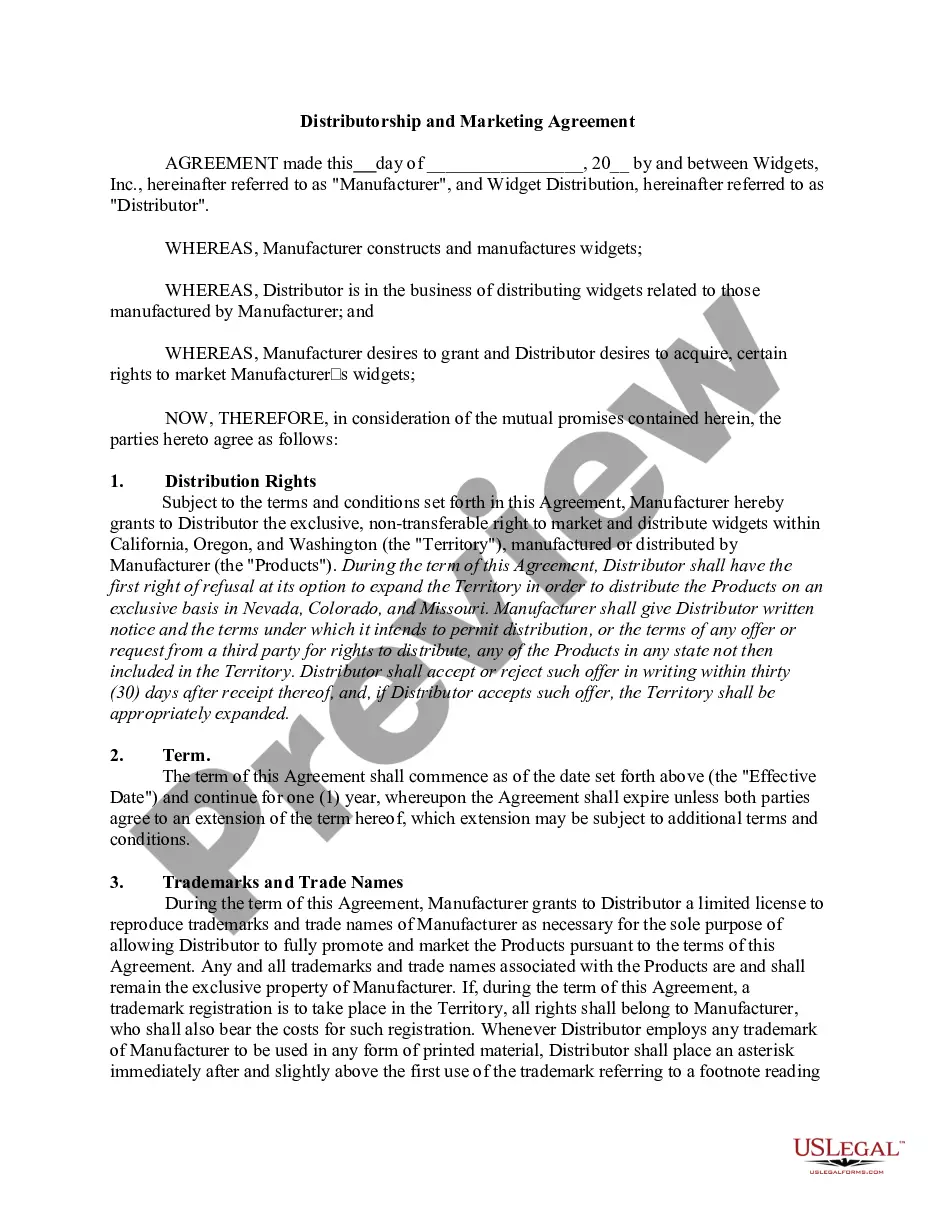
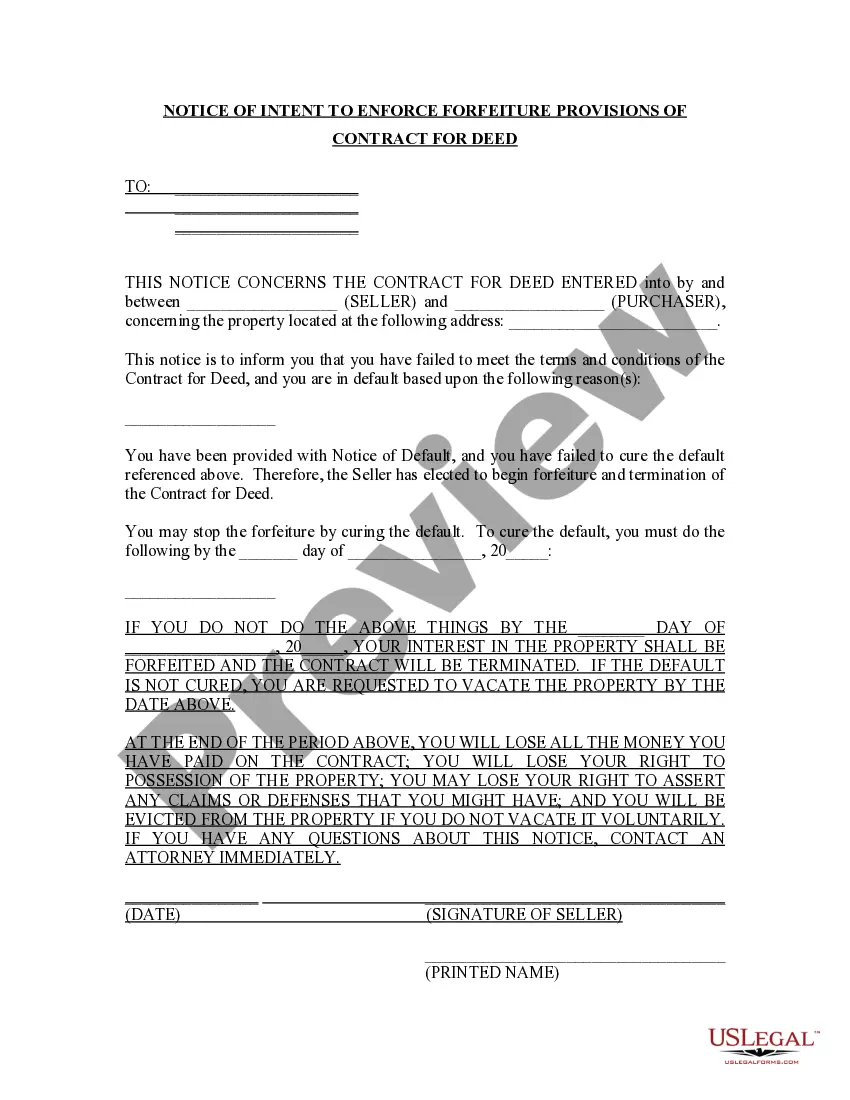
Georgia Notice of Intent to Enforce Forfeiture Provisions of Contact for Deed
What is this form?
The Notice of Intent to Enforce Forfeiture Provisions of Contract for Deed is a formal notification from the seller to the buyer regarding a default in the contract. It is specifically designed to alert the buyer that they have not fulfilled the terms of their contract for deed, which may result in the enforcement of forfeiture provisions. This form serves as an initial step before any legal action can be taken for nonpayment or other breaches of contract.
What’s included in this form
- Seller's information: Identifies the party initiating the notice.
- Buyer's information: Identifies the party in default.
- Default description: Details the nature of the breach, such as nonpayment.
- Notice requirements: Specifies how the notice should be delivered to the buyer.
- Consequences of noncompliance: Outlines the potential forfeiture actions that may follow.

Common use cases
This form should be used when a buyer has failed to comply with the terms of a contract for deed. Common scenarios include missed payments or other breaches of contract that have not been resolved. It serves to legally inform the buyer of their default status and to initiate the process toward enforcing forfeiture provisions as allowed by law.
Who should use this form
- Sellers who have entered into a contract for deed with a buyer.
- Real estate professionals representing sellers in such transactions.
- Legal representatives assisting sellers in enforcing contract terms.
How to prepare this document
- Identify the parties involved: Enter the seller's and buyer's full names and addresses.
- Describe the breach: Clearly outline the reasons for the default, such as missed payments.
- Specify the delivery method: Indicate how this notice will be delivered to the buyer.
- Sign and date the notice: The seller must sign and date the document to make it valid.
Does this form need to be notarized?
This form does not typically require notarization unless specified by local law. It is always advisable to check your local requirements to ensure compliance.
Get your form ready online
Our built-in tools help you complete, sign, share, and store your documents in one place.
Make edits, fill in missing information, and update formatting in US Legal Forms—just like you would in MS Word.
Download a copy, print it, send it by email, or mail it via USPS—whatever works best for your next step.
Sign and collect signatures with our SignNow integration. Send to multiple recipients, set reminders, and more. Go Premium to unlock E-Sign.
If this form requires notarization, complete it online through a secure video call—no need to meet a notary in person or wait for an appointment.
We protect your documents and personal data by following strict security and privacy standards.

Make edits, fill in missing information, and update formatting in US Legal Forms—just like you would in MS Word.

Download a copy, print it, send it by email, or mail it via USPS—whatever works best for your next step.

Sign and collect signatures with our SignNow integration. Send to multiple recipients, set reminders, and more. Go Premium to unlock E-Sign.

If this form requires notarization, complete it online through a secure video call—no need to meet a notary in person or wait for an appointment.

We protect your documents and personal data by following strict security and privacy standards.
Common mistakes
- Failing to include all necessary information about the buyer and seller.
- Not clearly specifying the reasons for the default.
- Omitting the method of delivery for the notice.
- Not signing or dating the form before sending it to the buyer.
Why complete this form online
- Convenient access: Download the form anytime from any device.
- Editability: Personalize the form to suit your specific situation.
- Reliable templates: Forms are drafted by licensed attorneys to ensure compliance.
Legal use & context
This form serves as a legal foundation for notifying the buyer of their default status under the terms of a contract for deed. It is crucial for ensuring that the seller has documented proof of the notice before proceeding with enforcement actions. The timely delivery of this notice is important to uphold the seller's rights under the contract.
Key takeaways
- The Notice of Intent to Enforce Forfeiture Provisions of Contract for Deed alerts buyers of default.
- It is vital for sellers to use this form to initiate any potential forfeiture actions.
- Completing the form accurately ensures legal compliance and protects the sellerâs interests.
Looking for another form?
Form popularity
FAQ
A deed of termination or termination agreement officially concludes a real estate contract. It essentially releases all parties from any future obligations tied to the agreement. Utilizing these documents correctly can help you avoid complications, particularly when involved in the legal processes related to the Georgia Notice of Intent to Enforce Forfeiture Provisions of Contract for Deed.
A notice of termination of a contract formally informs one party that the agreement will no longer be honored. This document serves to protect both parties, ensuring that the termination follows proper protocol. When dealing with real estate, the Georgia Notice of Intent to Enforce Forfeiture Provisions of Contract for Deed plays a significant role in the termination process.
A notice of termination of contract for deed notifies the buyer and other involved parties that the contract is ending. This notice must comply with specific legal requirements in Georgia. In situations where forfeiture is claimed, such as under the Georgia Notice of Intent to Enforce Forfeiture Provisions of Contract for Deed, timely notice is essential to protect the seller's interests.
If someone defaults on a land contract, the seller may initiate a legal process to reclaim the property. Often, this involves filing a notice such as the Georgia Notice of Intent to Enforce Forfeiture Provisions of Contract for Deed. It’s crucial to understand your rights and responsibilities, as the terms of the contract dictate the consequences of default.
The deed of termination signifies the formal end of a contract. It releases parties from their obligations and nullifies any claims related to the agreement. In relation to the Georgia Notice of Intent to Enforce Forfeiture Provisions of Contract for Deed, such a deed can clarify the legal standing when a property contract is terminated.
What Is Forfeiture? Forfeiture is the loss of any property without compensation as a result of defaulting on contractual obligations, or as a penalty for illegal conduct.When mandated by law, as a punishment for illegal activity or prohibited activities, forfeiture proceedings may be either criminal or civil.
In the first instance, if your deed is not recorded, there is nothing in the public record to stop the seller from conveying the property to another person.The second situation could happen if your seller fails to pay his or her debts and the seller's creditors file liens or judgments against your property.
A disadvantage to the seller is that a contract for deed is frequently characterized by a low down payment and the purchase price is paid in installments instead of one lump sum. If a seller needs funds from the sale to buy another property, this would not be a beneficial method of selling real estate.
Forfeiture. A foreclosure action extinguishes any claim the mortgagor may have to the real property securing a defaulted loan, whereas a forfeiture refers generally to the loss of a right to something as a result of nonperformance of an obligation or condition.
If a seller defaults, he must return all deposits, plus added reasonable expenses, to the buyer. The other party may also seek to compel the erring party to complete the deal under specific performance. From a buyer's point of view, it is advisable to get the sale agreement registered.