Florida Last Will and Testament for Divorced Person Not Remarried with Adult and Minor Children
Overview of this form
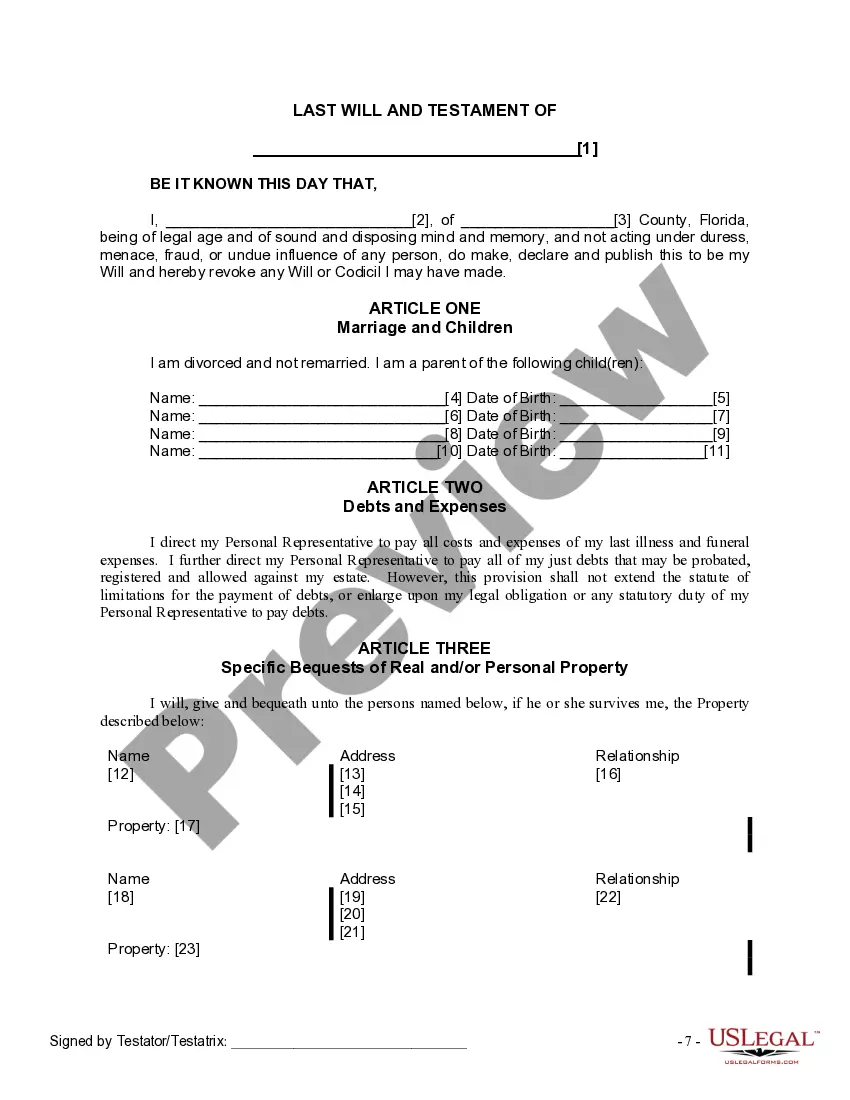
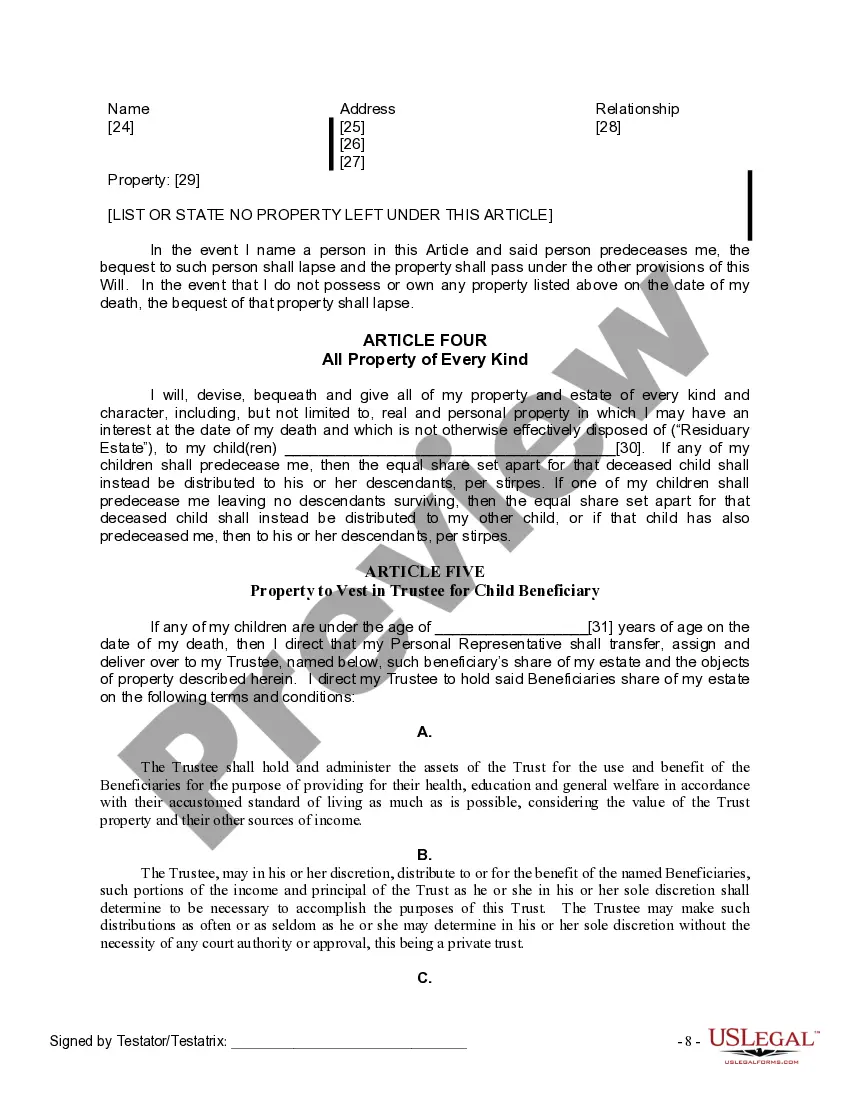
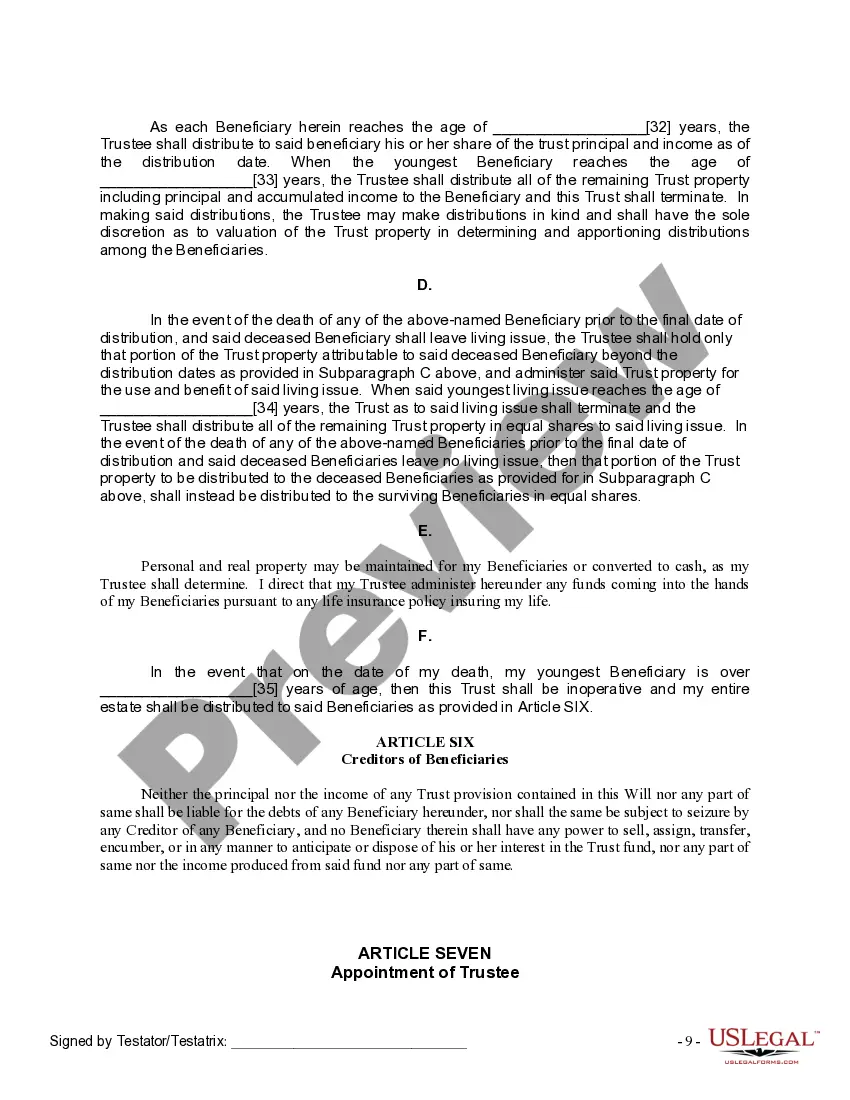
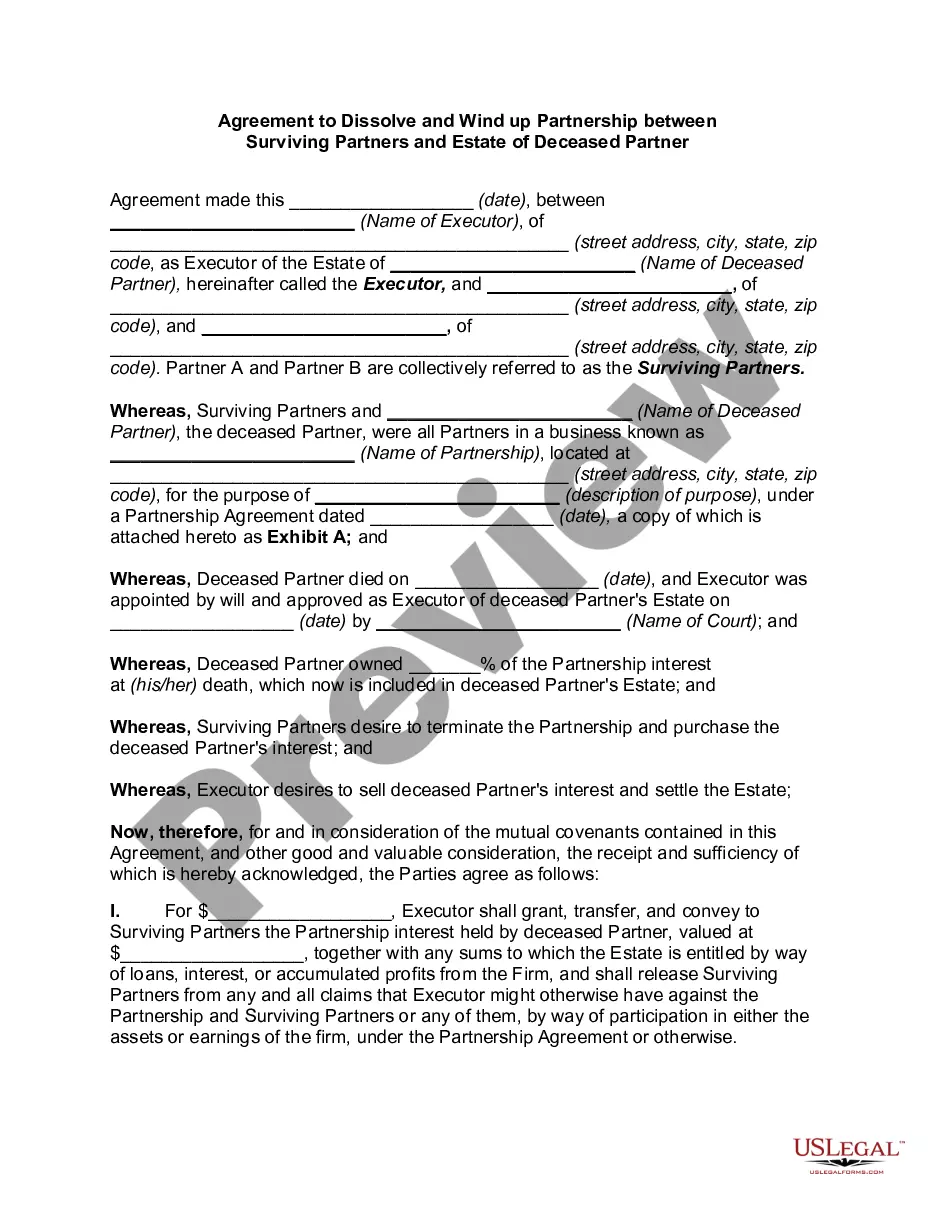
This Last Will and Testament is specifically designed for a divorced person who has not remarried and has both adult and minor children. This legal document ensures your property is distributed according to your wishes upon your death. Unlike other wills, this form includes provisions for appointing a personal representative, designating beneficiaries, and establishing a trust for minor children's inheritance. It also addresses the legal rights of child beneficiaries, ensuring their financial security until they reach adulthood.
Key parts of this document
- Personal information of the testator, including name and county of residence.
- List of beneficiaries, including both adult and minor children.
- Specific bequests of property to named individuals.
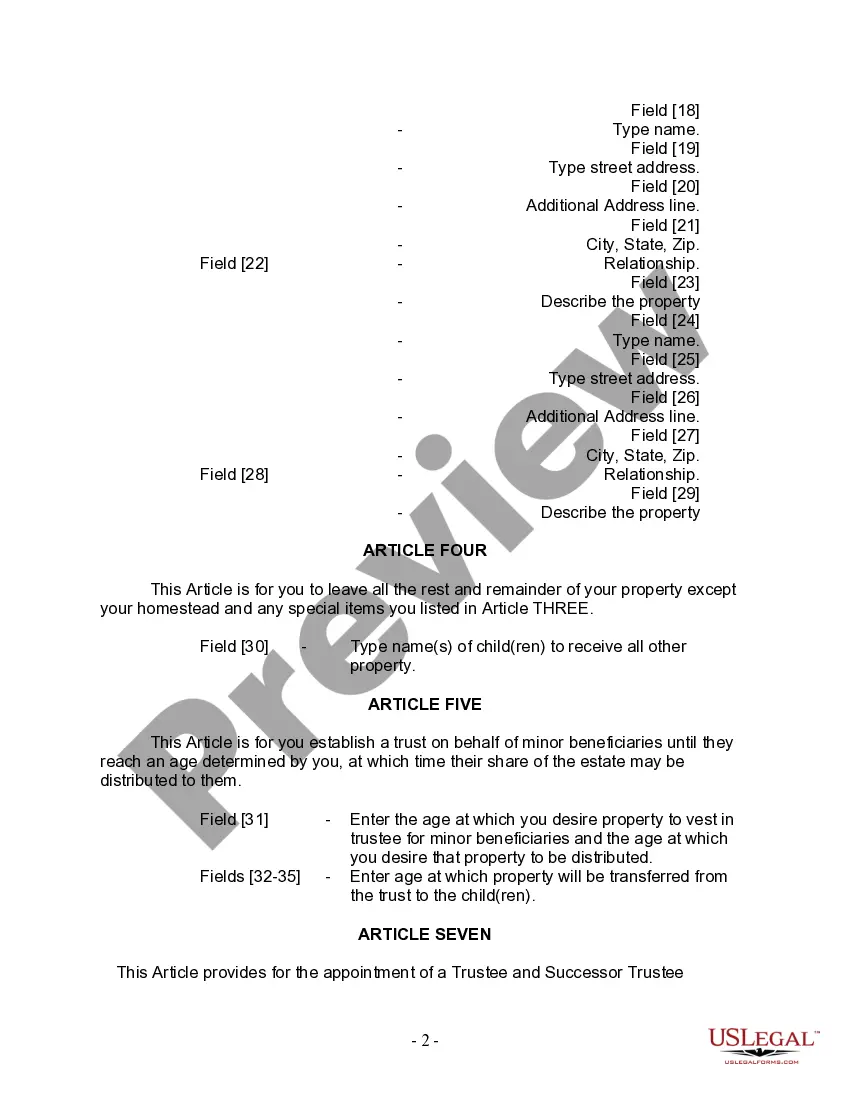
- Creation of a trust for minor children until they reach a specified age.
- Appointment of a trustee and guardian for minor children.
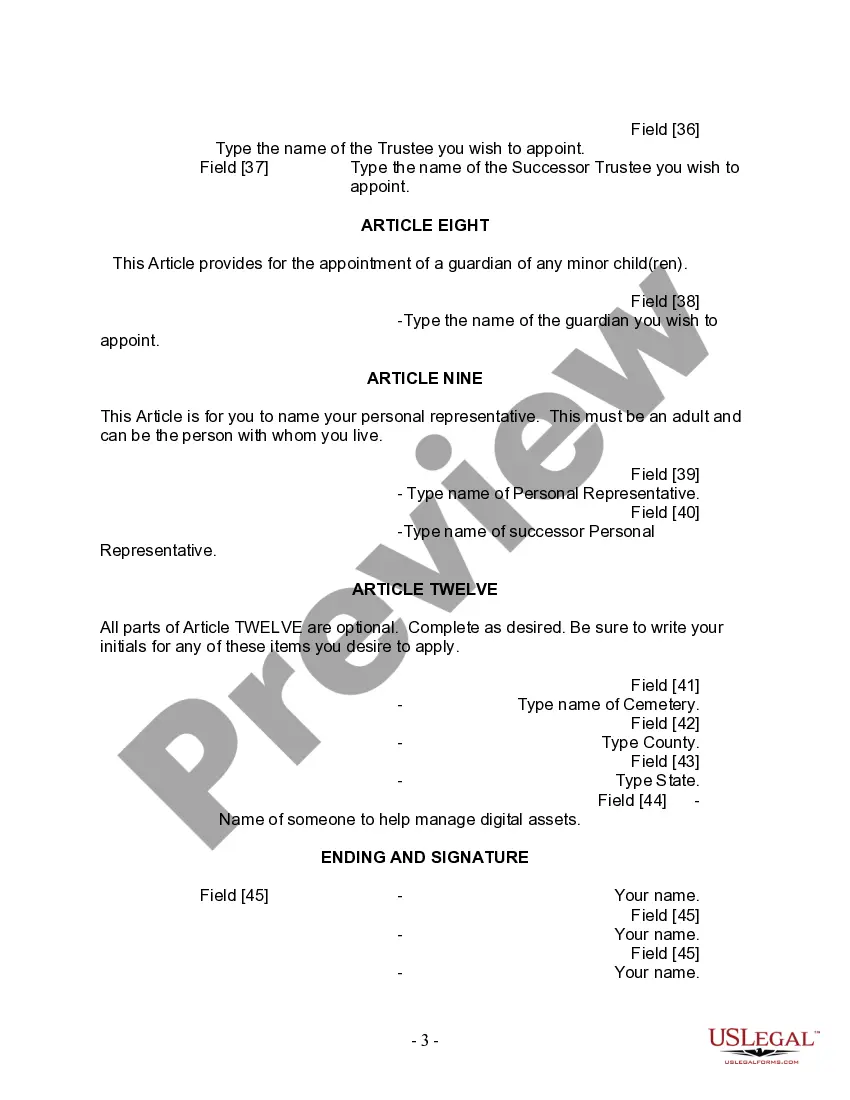
- Designation of a personal representative to administer the estate.




When to use this form
This Last Will and Testament is ideal for individuals who are divorced, have not remarried, and have children of varying ages. You should use this form when you want to clearly express how your assets should be distributed and who will take care of your minor children after your passing. This will also help prevent any conflict among beneficiaries and provide peace of mind regarding your children's future financial security.
Intended users of this form
- Individuals who have been divorced and are not currently remarried.
- Parents with both adult and minor children.
- Anyone wishing to allocate specific assets to named individuals.
- Persons looking to ensure their minor children are provided for until they reach adulthood.
- Individuals wanting to appoint a personal representative to manage their estate.
Completing this form step by step
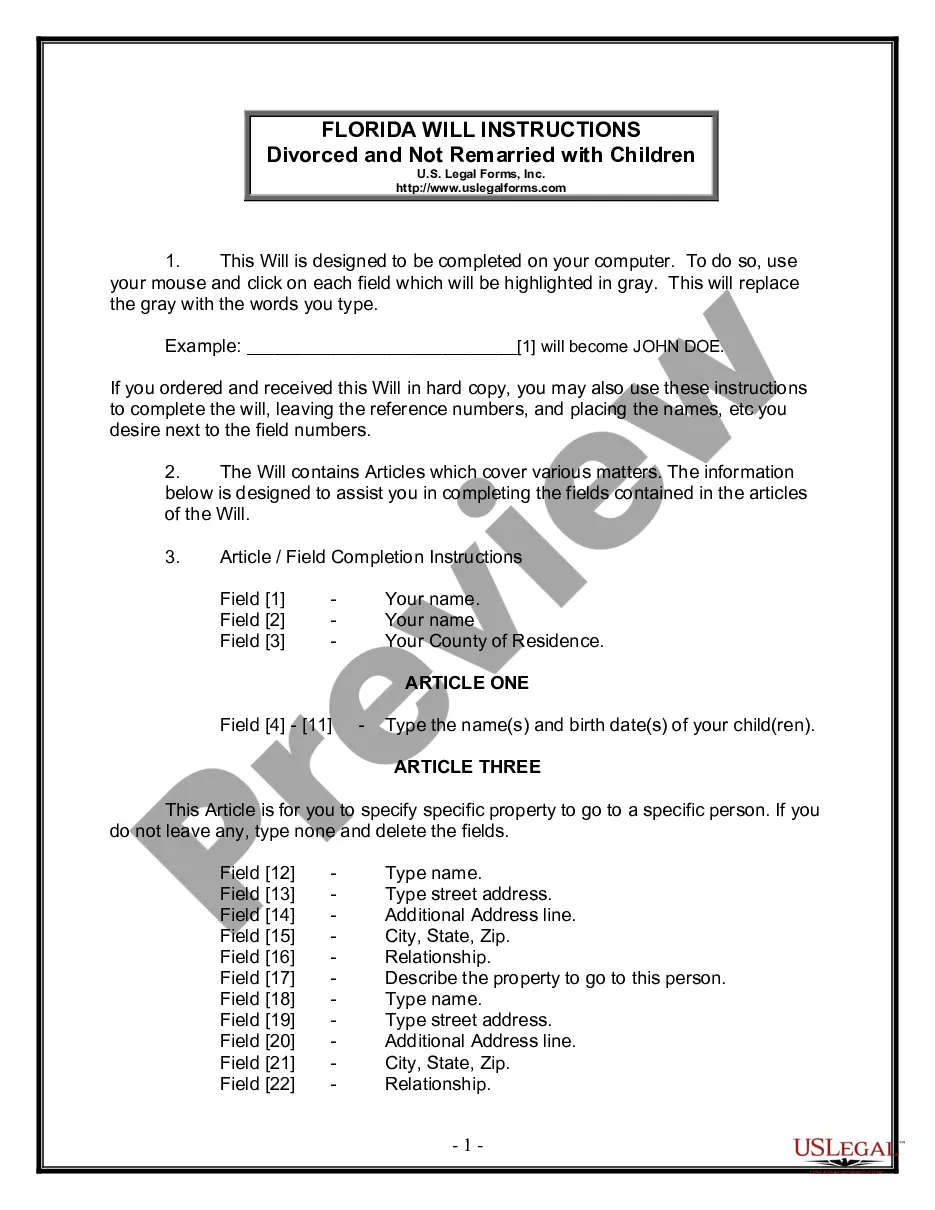
- Enter your full name and county of residence in the designated fields.
- List the names and birth dates of your children to ensure proper identification of beneficiaries.
- Specify any specific property you wish to bequeath to named individuals, or state "none" if there are no specific bequests.
- Indicate the age at which minor beneficiaries will receive their inheritance directly.
- Sign the document in the presence of two witnesses and, if desired, a notary public.
Does this form need to be notarized?
To make this form legally binding, it must be notarized. Our online notarization service, powered by Notarize, lets you verify and sign documents remotely through an encrypted video session.
Get your form ready online
Our built-in tools help you complete, sign, share, and store your documents in one place.
Make edits, fill in missing information, and update formatting in US Legal Forms—just like you would in MS Word.
Download a copy, print it, send it by email, or mail it via USPS—whatever works best for your next step.
Sign and collect signatures with our SignNow integration. Send to multiple recipients, set reminders, and more. Go Premium to unlock E-Sign.
If this form requires notarization, complete it online through a secure video call—no need to meet a notary in person or wait for an appointment.
We protect your documents and personal data by following strict security and privacy standards.

Make edits, fill in missing information, and update formatting in US Legal Forms—just like you would in MS Word.

Download a copy, print it, send it by email, or mail it via USPS—whatever works best for your next step.

Sign and collect signatures with our SignNow integration. Send to multiple recipients, set reminders, and more. Go Premium to unlock E-Sign.

If this form requires notarization, complete it online through a secure video call—no need to meet a notary in person or wait for an appointment.

We protect your documents and personal data by following strict security and privacy standards.
Mistakes to watch out for
- Failing to have the will signed by the required number of witnesses.
- Not clearly identifying beneficiaries, especially when multiple children are involved.
- Omitting critical details about the trust for minor children.
- Neglecting to update the will after significant life changes, such as remarriage.
Benefits of completing this form online
- Immediate access to the form allows for timely planning.
- Editable fields make it easy to customize the document according to personal circumstances.
- Secure storage options ensure that your completed will is easily retrievable.
- Comprehensive guidance is provided through each section of the document.
Key takeaways
- This Last Will and Testament is designed for divorced individuals with both adult and minor children.
- It allows you to specify who will inherit your assets and appoint a guardian for minor children.
- Proper execution in compliance with state requirements ensures that your wishes are honored after your death.
- Using this form can simplify the estate planning process and reduce legal complexities for your beneficiaries.
Looking for another form?
Form popularity
FAQ
In Florida, your wife cannot take your inheritance during a divorce, as it is generally recognized as separate property. To strengthen your position, ensure that your Florida Last Will and Testament for Divorced Person Not Remarried with Adult and Minor Children clearly delineates your inheritance as personal. This clarity can prevent misunderstandings and protect your legacy.
Yes, inheritance is legal and typically protected in Florida after a divorce. Inheritances are usually classified as individual property, separate from marital assets. Crafting a Florida Last Will and Testament for Divorced Person Not Remarried with Adult and Minor Children will help clarify your intentions regarding your assets.
After a divorce, your ex-spouse cannot claim your inheritance unless it was incorrectly classified as marital property. Protecting your inheritance in your Florida Last Will and Testament for Divorced Person Not Remarried with Adult and Minor Children provides you with additional peace of mind. Always consult a legal expert to ensure your wishes are clear.
In most cases, your ex-wife cannot legally go after your inheritance once the divorce is finalized. Florida law generally protects inheritances as separate assets, thus keeping them out of the marital property division. However, your Florida Last Will and Testament for Divorced Person Not Remarried with Adult and Minor Children should emphasize your intent to maintain the inheritance intact.
Your soon-to-be ex-wife does not have a legal claim to your inheritance simply because you are married, especially if you keep it as separate property. It’s wise to specify your intentions regarding your inheritance in your Florida Last Will and Testament for Divorced Person Not Remarried with Adult and Minor Children to protect your wishes. Doing so can help prevent any potential disputes.
In Florida, the general rule is that inheritances are considered separate property. Therefore, your wife does not typically have access to your inheritance unless you choose to include it in a joint asset or if you make it accessible through your Florida Last Will and Testament for Divorced Person Not Remarried with Adult and Minor Children. It is essential to clearly outline your wishes in your will.
After her husband's death, a wife has rights that are protected under Florida law. These rights may include entitlement to a share of the estate, depending on the existence of a will and any children from previous marriages. To navigate these complexities effectively, a Florida Last Will and Testament for Divorced Person Not Remarried with Adult and Minor Children should be created to clarify the wishes of the deceased and protect the interests of the surviving spouse and children.
Generally, yes, a valid will can override divorce papers in Florida, but certain exceptions might apply. If a former spouse is named in a will after a divorce, that designation may become invalid. Thus, creating a comprehensive Florida Last Will and Testament for Divorced Person Not Remarried with Adult and Minor Children is crucial to ensure your wishes regarding inheritance are clear and legally enforceable.
No, a surviving spouse does not automatically inherit everything in Florida. In cases where there are children, the estate is divided among the spouse and children according to state laws. However, having a well-drafted Florida Last Will and Testament for Divorced Person Not Remarried with Adult and Minor Children can ensure your wishes are honored and provide clarity on inheritance matters.
A surviving spouse in Florida has specific rights under the state's probate laws. One significant right is to claim a share of the estate, even if the deceased had a prior will. Additionally, the Florida Last Will and Testament for Divorced Person Not Remarried with Adult and Minor Children can bypass certain rules to preserve family unity, especially regarding minor and adult children.