Florida Amendment to Postnuptial Property Agreement
Overview of this form
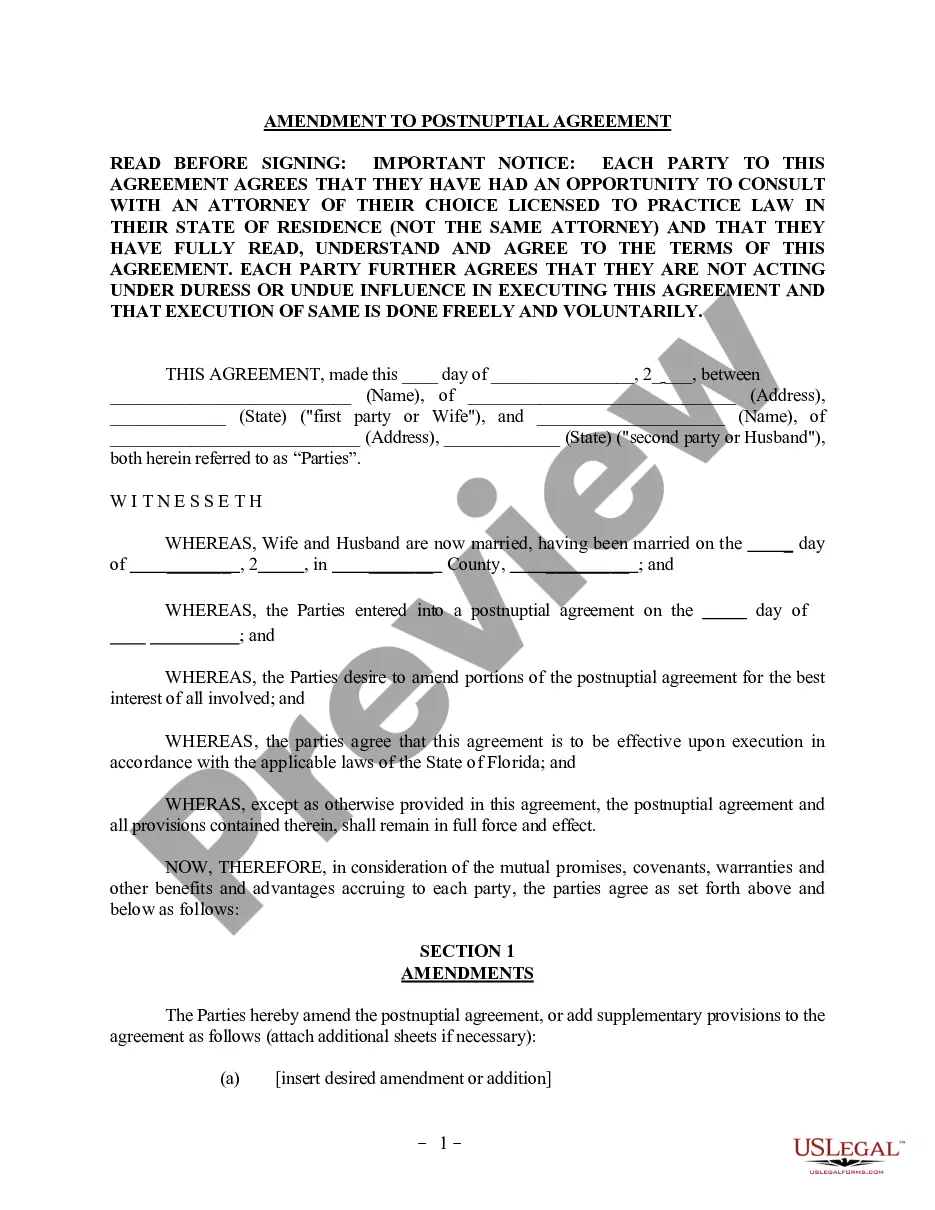
The Amendment to Postnuptial Property Agreement is a legal document used by married couples to make changes or additions to an existing postnuptial agreement. Unlike the initial agreement, this amendment allows both parties to clarify or alter previously established property rights while maintaining the binding nature of the original contract.
Main sections of this form
- Effective date and parties involved in the agreement.
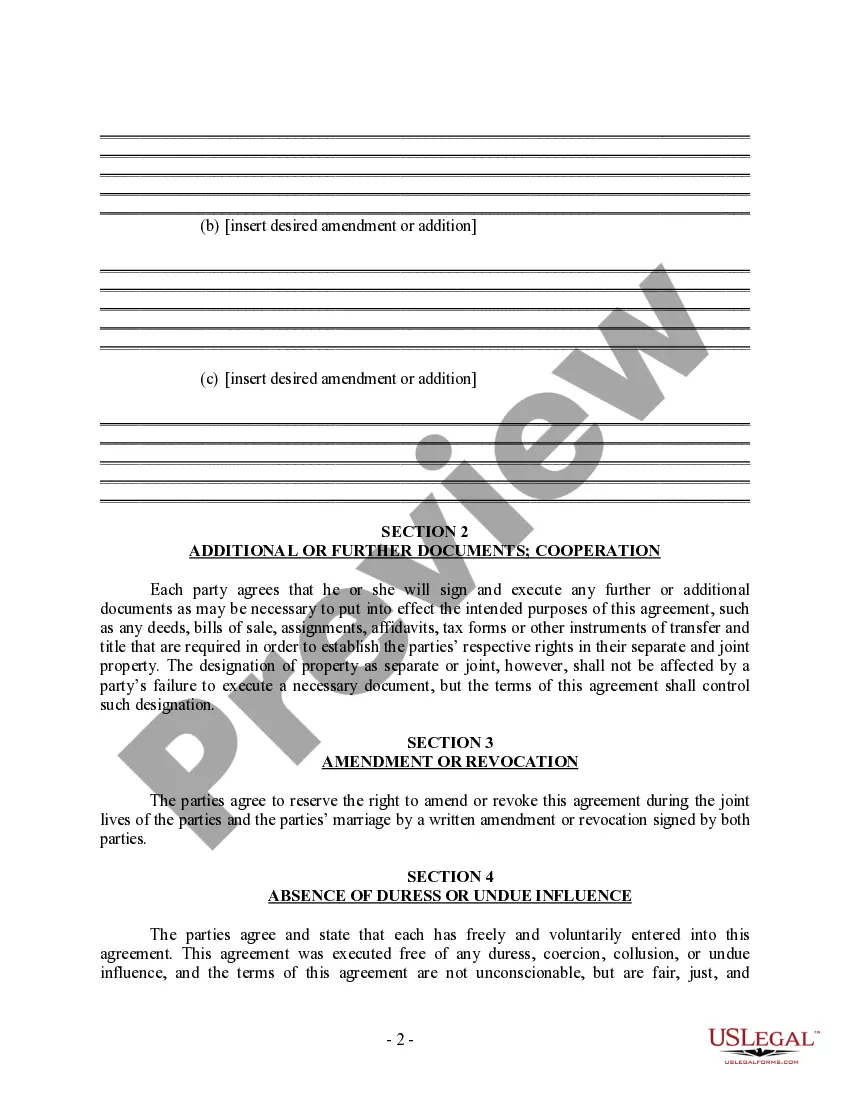
- Provisions for additional documents needed to enforce property rights.
- Clauses permitting future amendments or revocations.
- Statements confirming that the agreement is entered into voluntarily without duress.
- Severability clause ensuring validity of remaining provisions if part of the agreement is unenforceable.
- Jurisdiction specifying that Florida law governs the agreement.


Common use cases
This amendment form is useful when there are changes in circumstances that require adjusting property arrangements outlined in a postnuptial agreement. This might occur during life events such as the acquisition of new assets, changes in financial situations, or following major life changes like the birth of a child.
Intended users of this form
- Married couples wishing to update their postnuptial agreement.
- Individuals who have significant changes in their financial status or asset acquisition.
- Couples seeking clarification on property rights agreed in the original postnuptial agreement.
- Parties who previously consulted with separate attorneys regarding their agreement.
Instructions for completing this form
- Identify the date of the amendment and the parties involved.
- Insert specific amendments or additions to the original postnuptial agreement.
- Ensure both parties understand the agreement and have had an opportunity to consult their respective attorneys.
- Sign the document in the presence of a notary public, ensuring that witnesses are present.
- Keep a copy of the signed and notarized agreement for your records.
Notarization guidance
To make this form legally binding, it must be notarized. Our online notarization service, powered by Notarize, lets you verify and sign documents remotely through an encrypted video session.
Get your form ready online
Our built-in tools help you complete, sign, share, and store your documents in one place.
Make edits, fill in missing information, and update formatting in US Legal Forms—just like you would in MS Word.
Download a copy, print it, send it by email, or mail it via USPS—whatever works best for your next step.
Sign and collect signatures with our SignNow integration. Send to multiple recipients, set reminders, and more. Go Premium to unlock E-Sign.
If this form requires notarization, complete it online through a secure video call—no need to meet a notary in person or wait for an appointment.
We protect your documents and personal data by following strict security and privacy standards.

Make edits, fill in missing information, and update formatting in US Legal Forms—just like you would in MS Word.

Download a copy, print it, send it by email, or mail it via USPS—whatever works best for your next step.

Sign and collect signatures with our SignNow integration. Send to multiple recipients, set reminders, and more. Go Premium to unlock E-Sign.

If this form requires notarization, complete it online through a secure video call—no need to meet a notary in person or wait for an appointment.

We protect your documents and personal data by following strict security and privacy standards.
Common mistakes
- Failing to have the amendment notarized, which can invalidate the document.
- Not providing full disclosure of financial obligations between parties.
- Not involving separate legal counsel, which can lead to disputes over the agreement's terms.
- Overlooking the need for witnesses during the signing process.
Why use this form online
- Quick and easy access to the latest legal templates crafted by licensed attorneys.
- The ability to download and modify the form to meet your specific needs.
- Convenience of handling legal matters from the comfort of your home.
- Immediate availability of the form, reducing waiting times associated with traditional legal processes.
Quick recap
- This amendment form allows for modifications to a postnuptial agreement.
- Both parties must understand the terms and have legal counsel separately.
- Notarization is required for the validity of the amendment.
- It is essential to disclose financial information fully to ensure fairness.
Looking for another form?
Form popularity
FAQ
Several factors can void a postnuptial agreement in Florida. Key reasons include lack of capacity, coercion, or failure to comply with legal requirements. A flawed Florida Amendment to Postnuptial Property Agreement may lose validity if significant changes occur in circumstances or law. Therefore, regular updates and legal advice can help maintain the agreement's validity.
Yes, a postnuptial agreement can be challenged in Florida under certain circumstances. Common grounds for challenge include lack of voluntary consent, fraud, or if the agreement is deemed unconscionable. It's important to carefully draft your Florida Amendment to Postnuptial Property Agreement to minimize potential disputes. Consulting a legal expert can help ensure that your agreement stands strong against challenges.
Postnuptial agreements are generally enforceable in Florida, provided they meet certain legal criteria. The Florida Amendment to Postnuptial Property Agreement requires that the agreement be fair, made voluntarily, and with full disclosure of assets. When properly executed, these agreements hold considerable weight in court. Thus, couples can rely on them to uphold their wishes regarding property division.
Yes, Florida recognizes postnuptial agreements. These agreements can serve as a solid legal framework to define how property will be managed during a marriage. The Florida Amendment to Postnuptial Property Agreement allows couples to specify their intentions regarding assets. This ensures clarity and may help prevent disputes in the future.
Yes, you can contest a postnuptial agreement by filing a legal challenge in court. Common grounds for contesting include lack of proper legal representation, unfair terms, or the presence of undisclosed assets during its signing. If you find yourself in this situation, consider using a resource like uslegalforms to explore your options and gather necessary legal forms. This can simplify the contestation process and provide you with the tools to navigate your case efficiently.
To invalidate a Florida Amendment to Postnuptial Property Agreement, one spouse must prove specific grounds, such as fraud or lack of consent. If you believe that the agreement was signed without adequate understanding of its contents or due to pressure, you must gather evidence to support your claim. Consulting with a knowledgeable attorney can streamline this process and help you understand the conditions that could render your agreement invalid. This step is crucial to protect your rights.
Yes, a postnuptial agreement can be overturned under certain circumstances. For instance, if one spouse can prove that the agreement was signed under duress or without a full disclosure of assets, the court may invalidate it. Sometimes, changes in Florida law can affect the validity of your postnuptial agreement as well. Thus, staying informed can help both parties understand their rights and the agreement's potential limitations.
To establish a valid Florida Amendment to Postnuptial Property Agreement, both spouses must disclose their financial situations and enter the agreement voluntarily. The document must be in writing and signed by both parties, with no coercion present. Additionally, it's beneficial to have the agreement notarized, as this can help prove its legitimacy in the event of a dispute. Meeting these requirements reinforces the agreement's enforceability.
A postnuptial agreement in Florida remains valid as long as both parties comply with its terms. This means that the agreement does not have a specific expiration date, but it is essential to review it periodically. Life changes, economic situations, or additional children may warrant a reevaluation of your Florida Amendment to Postnuptial Property Agreement. Staying proactive can ensure that your agreement remains relevant and effective.
Yes, Florida recognizes postnuptial agreements as valid legal instruments. They serve as effective tools for couples to determine property rights and financial obligations, much like a prenuptial agreement, through a well-structured Florida Amendment to Postnuptial Property Agreement. Utilizing resources like USLegalForms can aid in drafting agreements that adhere to state regulations.