Connecticut Quitclaim Deed from Individual to Two Individuals in Joint Tenancy
What is this form?
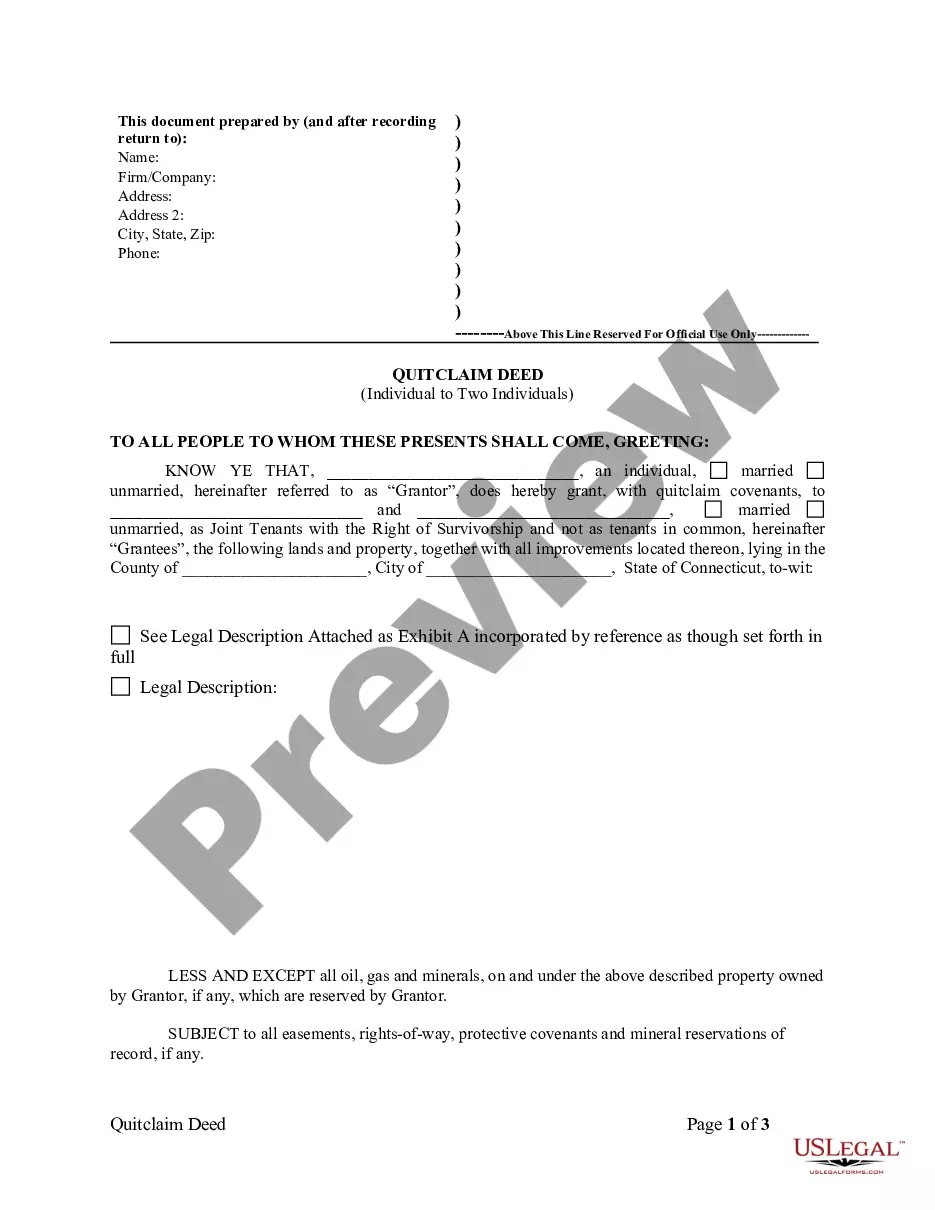
This Quitclaim Deed from Individual to Two Individuals in Joint Tenancy is a legal document that allows an individual (the Grantor) to transfer their ownership interest in a property to two individuals (the Grantees) as joint tenants. This means that both Grantees will share ownership of the property equally, with the right of survivorshipâallowing the surviving Grantee to inherit the deceased Grantee's share automatically. This form is specifically designed to comply with state statutory laws and is particularly useful for co-ownership situations.
Key parts of this document
- Identification of the Grantor and Grantees, including their names and addresses.
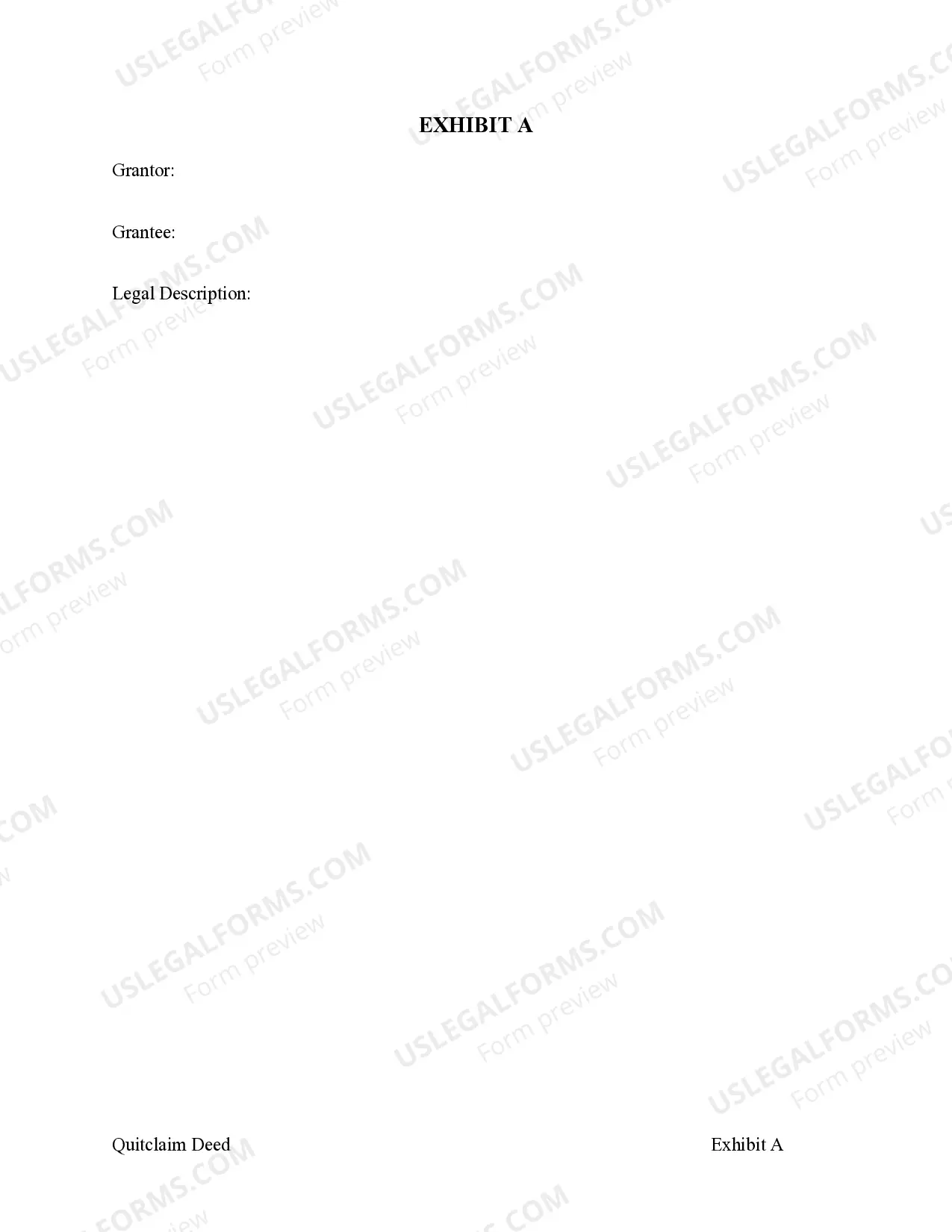
- A description of the property being conveyed, specifically referenced as an attached exhibit.
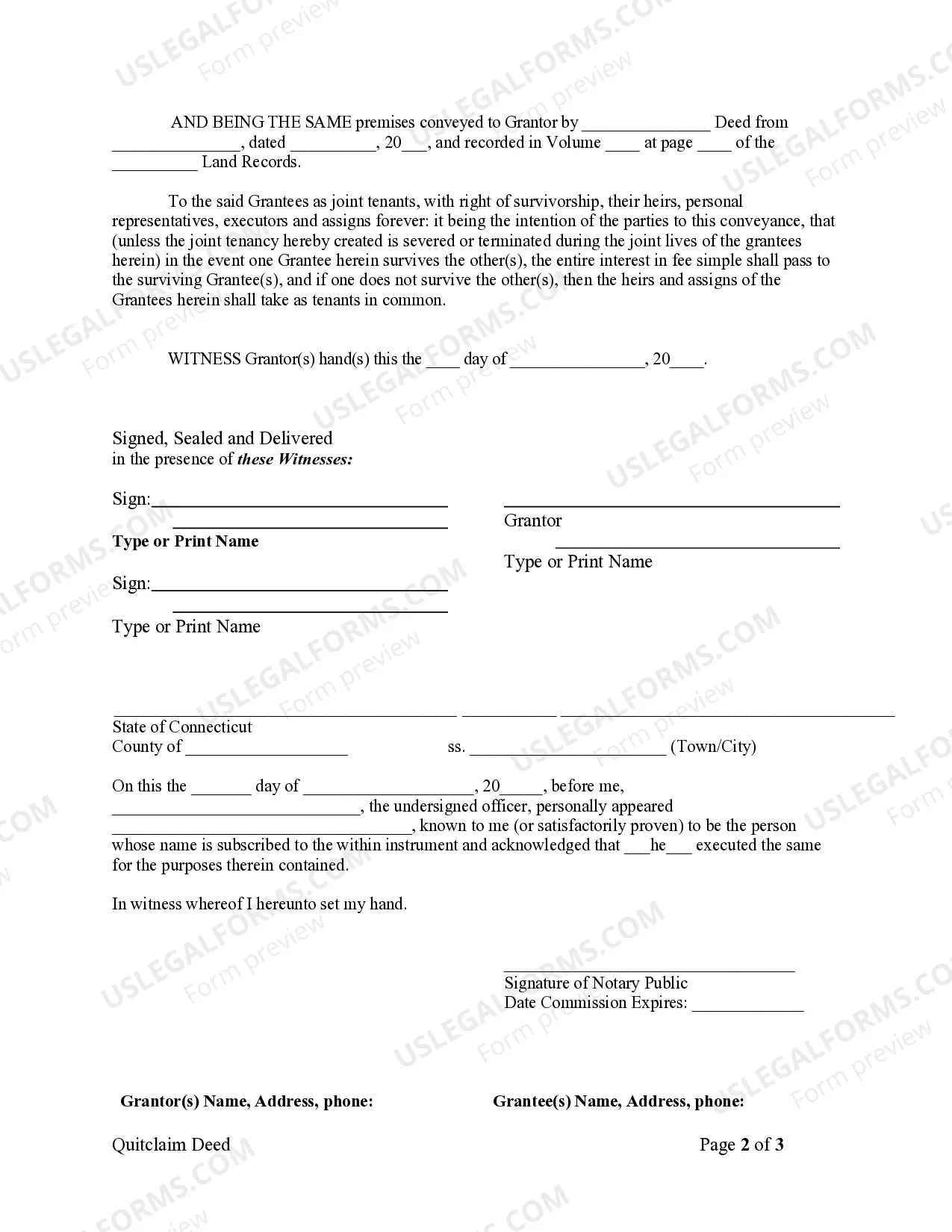
- Details about the intention of joint tenancy and the right of survivorship.
- Signature section for the Grantor and acknowledgment by a Notary Public.
- Reservation of rights concerning oil, gas, and minerals beneath the property, if applicable.




Common use cases
This Quitclaim Deed should be used when an individual wishes to transfer property ownership to two other individuals in a joint tenancy arrangement. Common scenarios include family members wanting to co-own a property, partners planning to share a marital home, or friends purchasing real estate together. This form simplifies the process, ensuring that both parties understand their rights and responsibilities regarding the property.
Who this form is for
This form is suitable for:
- Individuals transferring property to two other individuals.
- Co-owners looking to establish joint tenancy with right of survivorship.
- Any person needing a simple and effective way to convey property without warranties.
Steps to complete this form
- Identify the Grantor and Grantees by providing their full names and addresses.
- Attach a legal description of the property being conveyed as Exhibit A.
- Specify the date of the deed and details of any prior deeds, if applicable.
- Complete the signature block for the Grantor and include a Notary Public acknowledgment.
- Ensure the deed is dated and any necessary parties sign in the presence of the Notary.
Does this document require notarization?
Yes, this form must be notarized to be legally valid. The document requires the Grantor's signature to be witnessed by a Notary Public. US Legal Forms offers integrated online notarization, providing 24/7 availability via secure video call, ensuring legal equivalence without the need for travel.
Get your form ready online
Our built-in tools help you complete, sign, share, and store your documents in one place.
Make edits, fill in missing information, and update formatting in US Legal Forms—just like you would in MS Word.
Download a copy, print it, send it by email, or mail it via USPS—whatever works best for your next step.
Sign and collect signatures with our SignNow integration. Send to multiple recipients, set reminders, and more. Go Premium to unlock E-Sign.
If this form requires notarization, complete it online through a secure video call—no need to meet a notary in person or wait for an appointment.
We protect your documents and personal data by following strict security and privacy standards.

Make edits, fill in missing information, and update formatting in US Legal Forms—just like you would in MS Word.

Download a copy, print it, send it by email, or mail it via USPS—whatever works best for your next step.

Sign and collect signatures with our SignNow integration. Send to multiple recipients, set reminders, and more. Go Premium to unlock E-Sign.

If this form requires notarization, complete it online through a secure video call—no need to meet a notary in person or wait for an appointment.

We protect your documents and personal data by following strict security and privacy standards.
Common mistakes to avoid
- Failing to include the complete legal description of the property.
- Not having the deed notarized when required by local laws.
- Omitting to specify the joint tenancy rights clearly.
- Incorrectly identifying the parties involved in the transaction.
Benefits of using this form online
- Convenient access to legally drafted templates available for immediate download.
- Editability allows users to tailor the form to their specific needs without legal jargon.
- Reliable forms are regularly updated to comply with current state laws.
- Time-saving, removing the need for in-person legal consultations for straightforward property transfers.
Looking for another form?
Form popularity
FAQ
Yes, joint tenancy in Connecticut provides a right of survivorship. This means that if one of the individuals passes away, their share automatically transfers to the surviving individual without going through probate. When you use a Connecticut Quitclaim Deed from Individual to Two Individuals in Joint Tenancy, you ensure that the property ownership is clear and efficient. This arrangement offers peace of mind, knowing that your interests are protected and will seamlessly pass to your joint tenant.
A quitclaim deed can be deemed invalid if it is not properly executed, meaning all required signatures must be present, or if it lacks notarization. Furthermore, any errors in the legal description of the property or failure to file with the local clerk’s office can render the deed ineffective. Ensuring accuracy and compliance will help you maintain the validity of a Connecticut Quitclaim Deed from Individual to Two Individuals in Joint Tenancy.
A quitclaim deed is not appropriate for transferring properties with existing mortgages unless the lender has provided written consent. Additionally, it may not be suitable for properties that require a detailed title report or for commercial transactions where buyer protection is essential. In cases like these, consider exploring more secure methods of transferring ownership.
Individuals looking to quickly transfer property without the need for extensive legal processes benefit the most from a quitclaim deed. This is particularly true for property transfers among family members or trusted individuals. By utilizing a Connecticut Quitclaim Deed from Individual to Two Individuals in Joint Tenancy, parties can save time and reduce legal costs in property transactions.
A quitclaim deed is most appropriate for transferring property between family members or friends without the need for a title search. For example, if a parent wants to gift a home to their children, a Connecticut Quitclaim Deed from Individual to Two Individuals in Joint Tenancy simplifies the process. In essence, it is a quick and easy solution when trust is not a concern.
To file a Connecticut Quitclaim Deed from Individual to Two Individuals in Joint Tenancy, first, obtain a quitclaim deed form, which can often be found online or at legal bookstores. Next, complete the form with accurate property and personal information, then sign it in the presence of a notary public. Finally, file the signed deed with your local town clerk's office to officially record the transfer.
You cannot use a quitclaim deed in instances where a mortgage needs to be refinanced or when a property is part of a divorce settlement that requires explicit title assurances. Furthermore, if the property has liens or ongoing disputes, a quitclaim deed might not be sufficient. In these cases, utilizing a Connecticut Quitclaim Deed from Individual to Two Individuals in Joint Tenancy may expose you to financial risks.
Using a Connecticut Quitclaim Deed from Individual to Two Individuals in Joint Tenancy may not be ideal in situations requiring warranty or title assurances. Unlike a warranty deed, a quitclaim deed does not guarantee that the transferor holds clear title to the property. If you want to protect your investment from possible claims, you might consider a different type of deed.
In Connecticut, the requirements for a quitclaim deed include identifying the parties involved and clearly stating the property description. You must include a statement of the type of tenancy—such as a Connecticut Quitclaim Deed from Individual to Two Individuals in Joint Tenancy—and ensure it is signed in front of a notary public. After the deed is prepared, you will need to file it with the local town clerk to finalize the transfer.
To remove someone from a deed in Connecticut, you can create a Connecticut Quitclaim Deed from Individual to Two Individuals in Joint Tenancy. This document allows for the transfer of ownership interests. You will need to fill out the quitclaim deed form, sign it before a notary, and then record it at your local town clerk's office. This process ensures clear title and reflects changes in ownership.