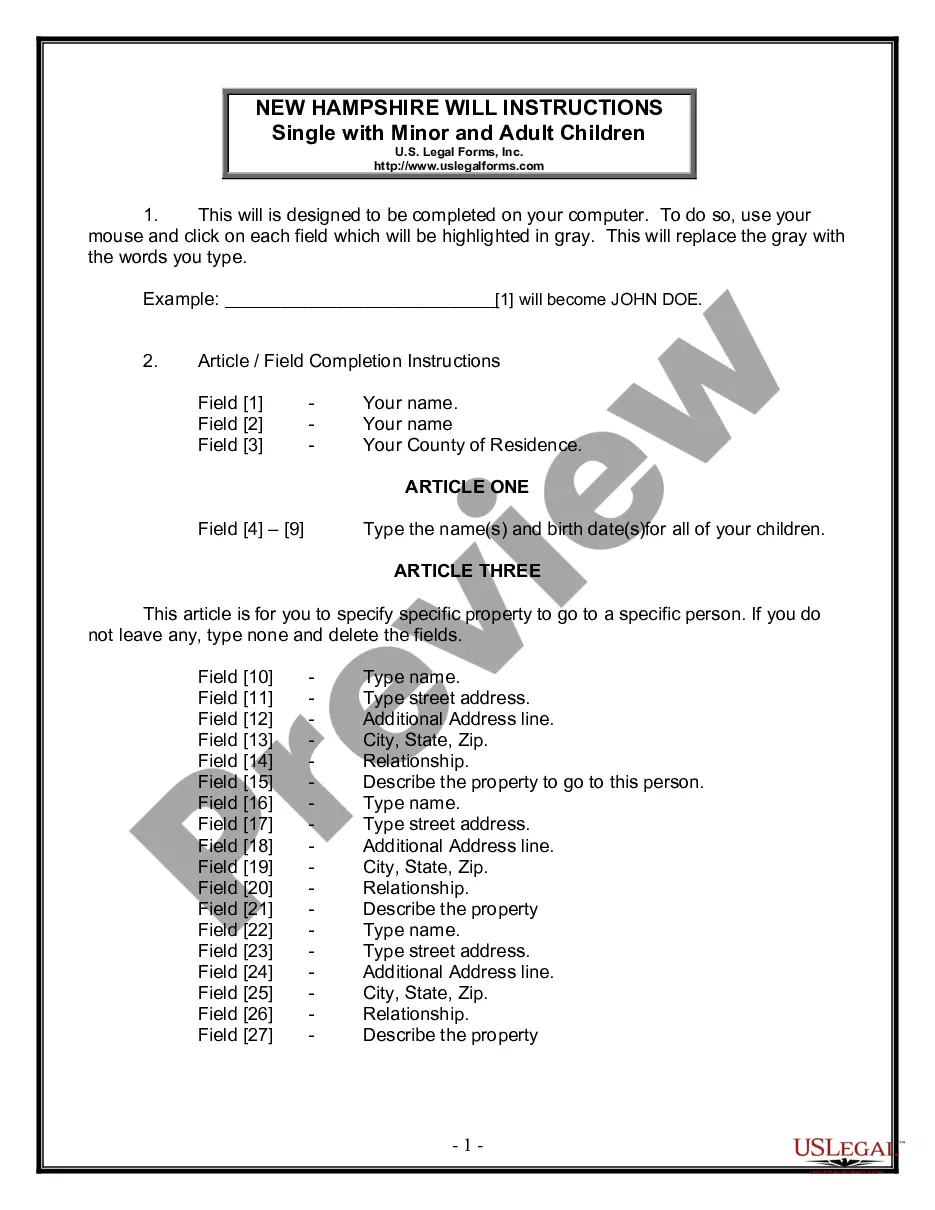
California Last Will and Testament with All Property to Trust called a Pour Over Will
Overview of this form
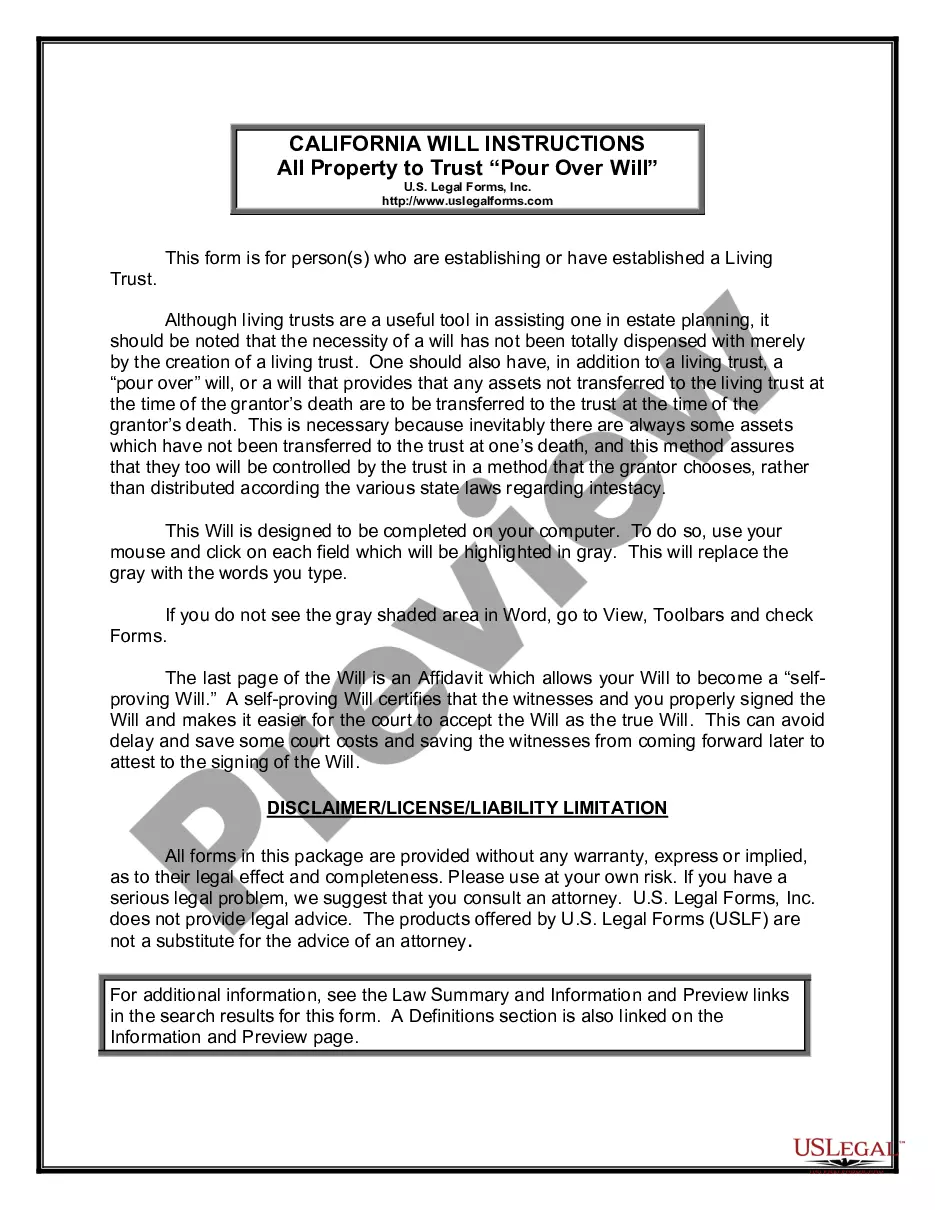
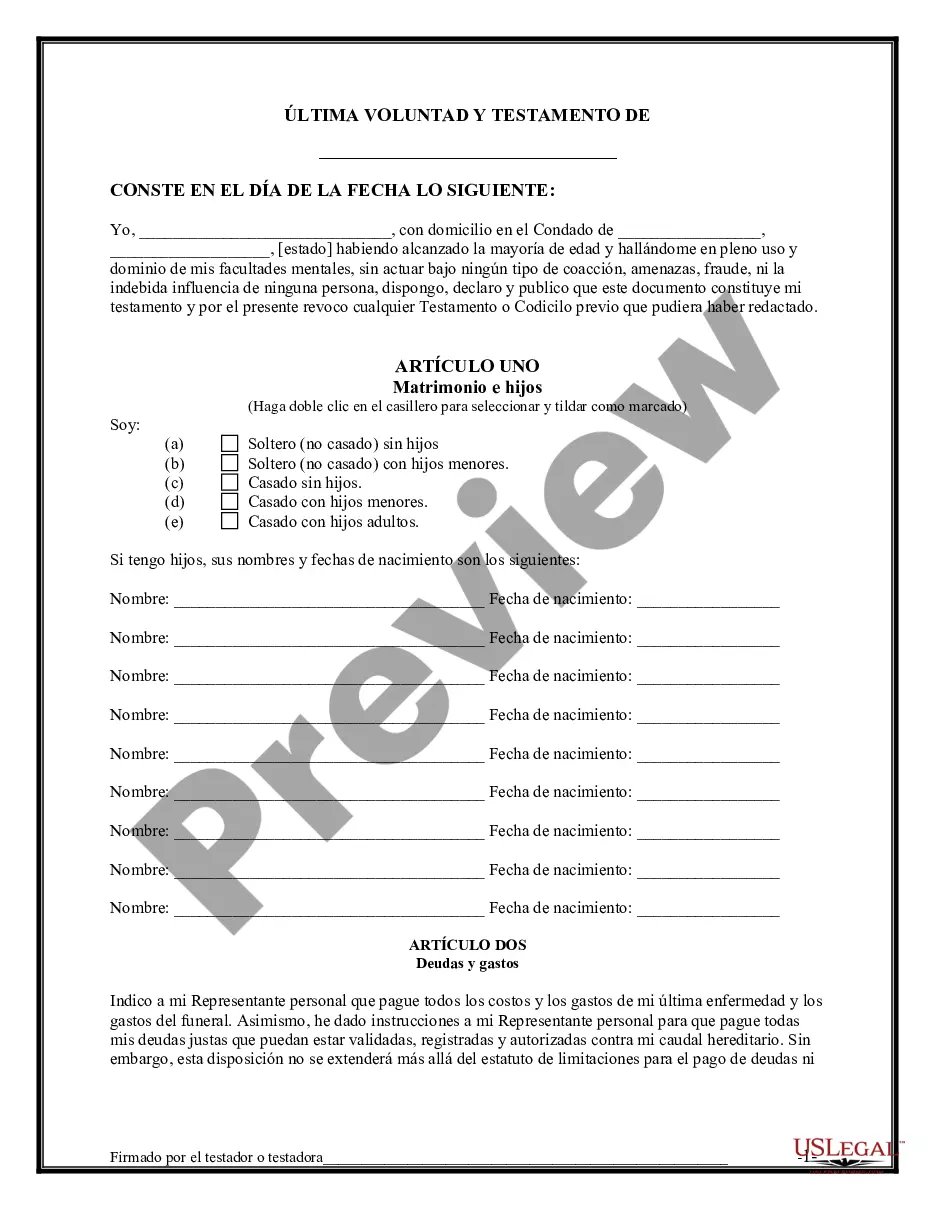
This Last Will and Testament with All Property to Trust, commonly known as a Pour Over Will, is a legal document that directs any property not already transferred to your living trust to be placed into that trust upon your death. This ensures that all assets are administered according to your designated trust provisions, allowing for a smoother estate settlement process. Unlike traditional wills that distribute assets outright, this form works in conjunction with a living trust to provide a more comprehensive estate plan.
Form components explained
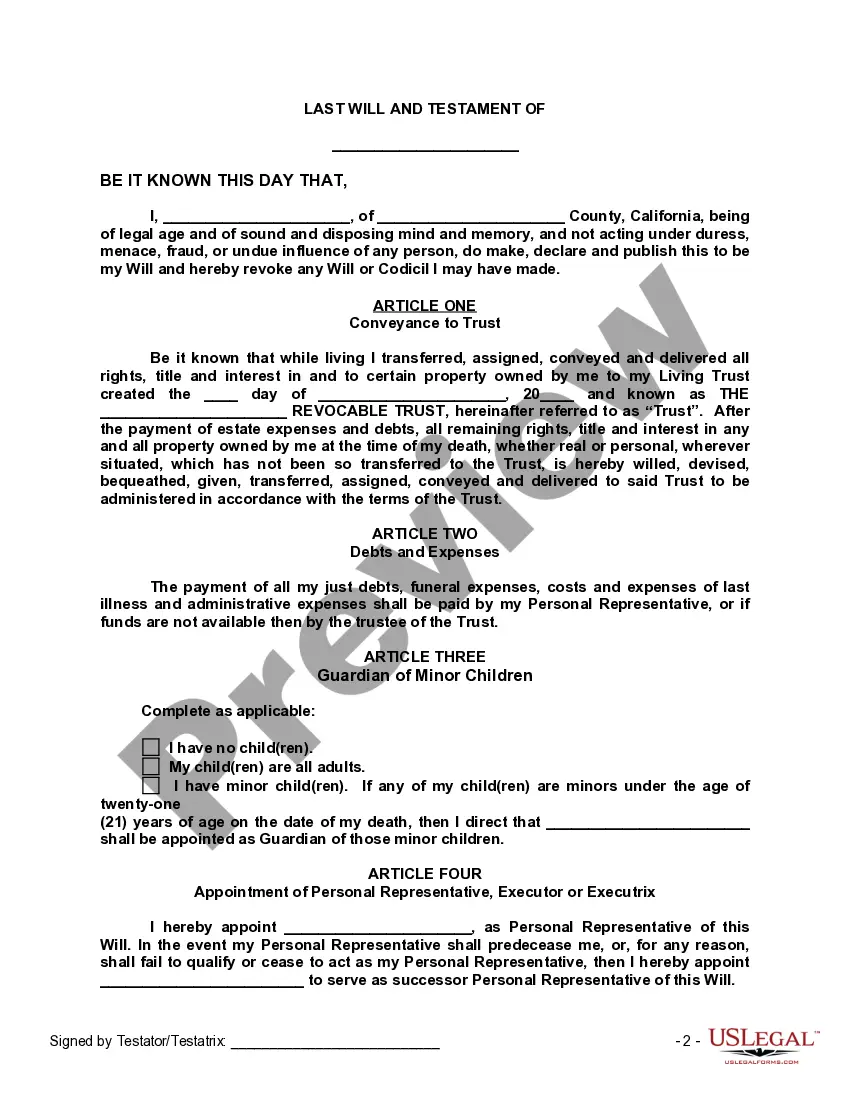
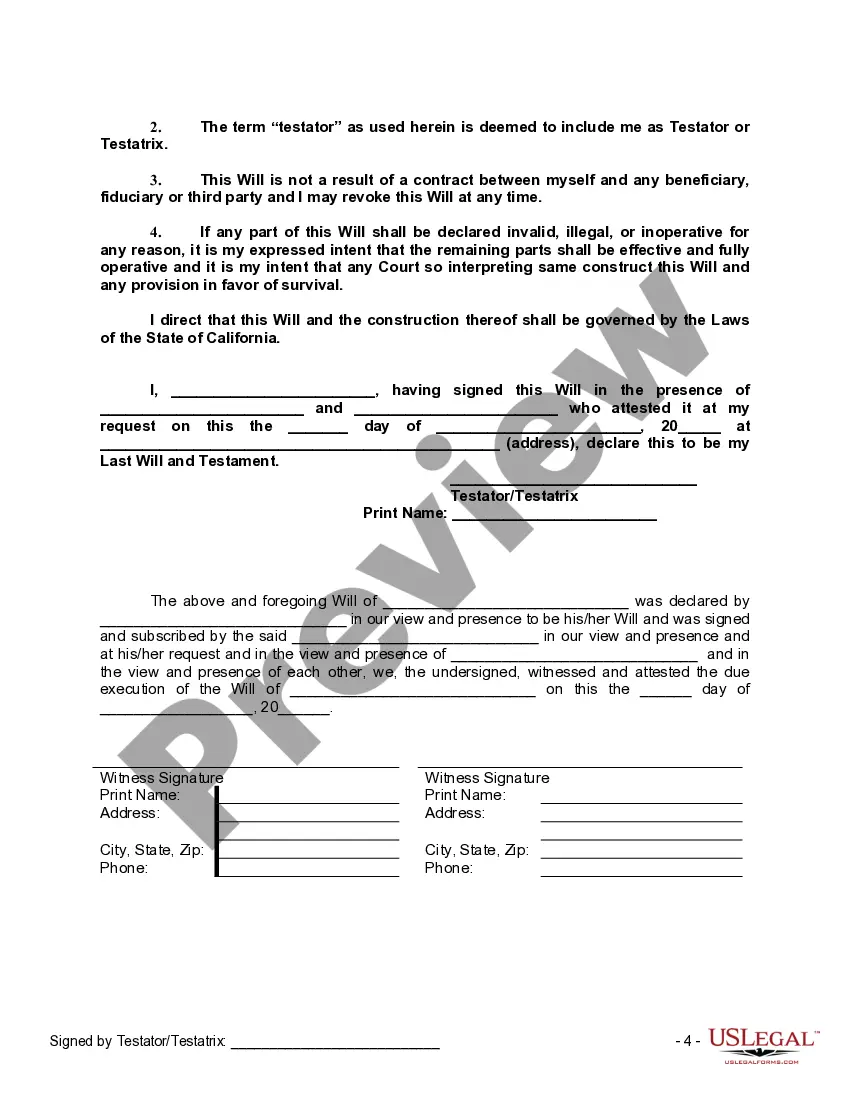
- Section for conveying all property to the living trust upon death.
- Provisions for paying debts and expenses from the estate.
- Designate guardianship for minor children, if applicable.
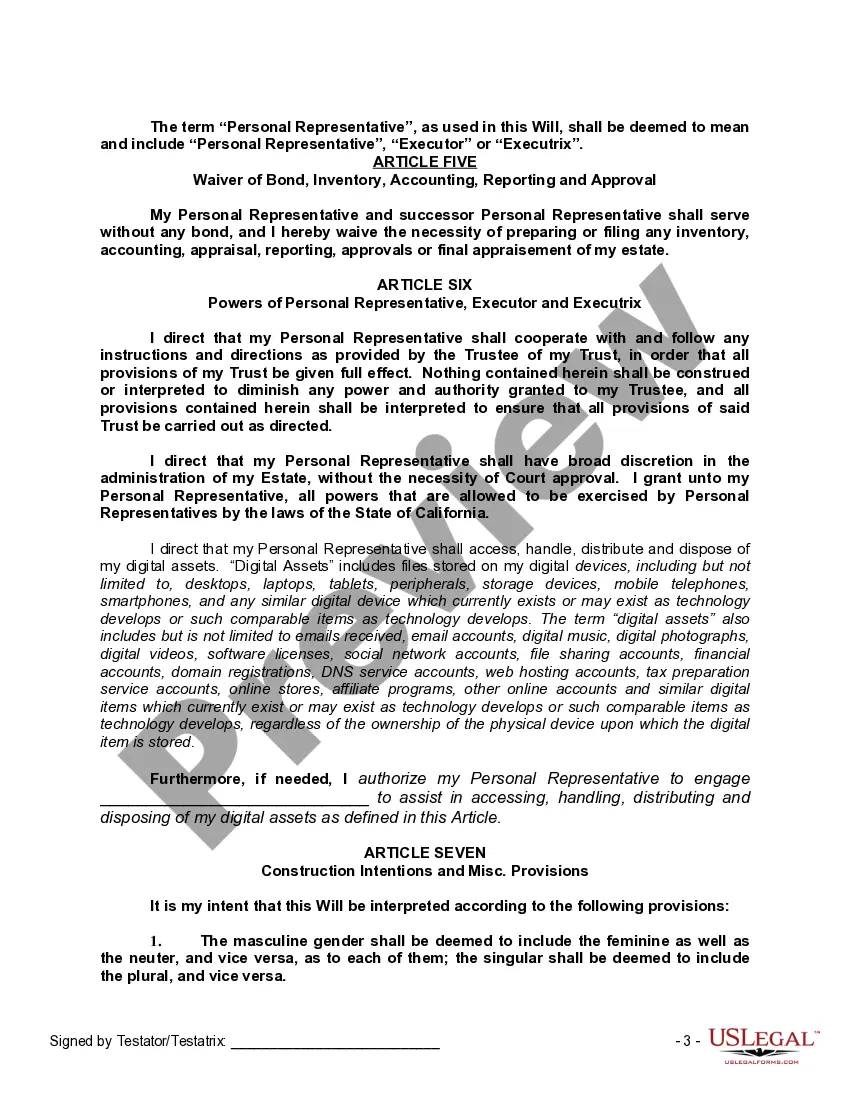
- Appointment of a personal representative to administer the estate.
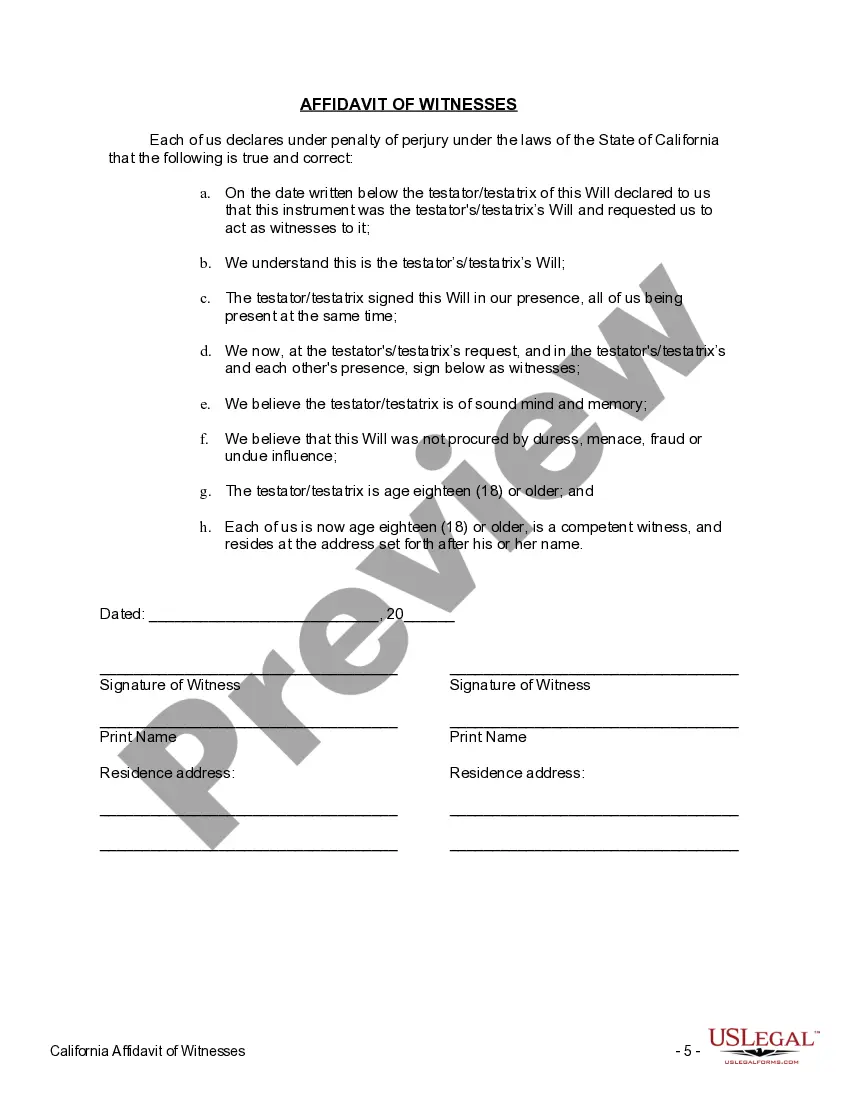
- Affidavit section for creating a self-proving will to simplify court acceptance.


Situations where this form applies
This form is ideal in situations where a person has established or is establishing a living trust and wants to ensure that all residual assets are transferred into that trust upon death. It helps prevent any assets from being subject to intestacy laws, streamlining the transfer process and ensuring that all assets are managed according to the decedent's wishes.
Who can use this document
This form is suitable for:
- Individuals creating a living trust.
- Those who wish to manage their estate effectively and avoid probate complications.
- Anyone wanting to ensure their property is handled according to their specific wishes after their death.
Completing this form step by step
- Identify and fill in your personal information in the designated fields.
- List all properties that will be conveyed to your trust upon your death.
- Determine and appoint a personal representative for your estate.
- Decide on guardianship for any minor children, if applicable.
- Have the document signed in the presence of witnesses to validate it.
Does this form need to be notarized?
This form does not typically require notarization unless specified by local law. However, having it notarized may further simplify the probate process in case of challenges.
Get your form ready online
Our built-in tools help you complete, sign, share, and store your documents in one place.
Make edits, fill in missing information, and update formatting in US Legal Forms—just like you would in MS Word.
Download a copy, print it, send it by email, or mail it via USPS—whatever works best for your next step.
Sign and collect signatures with our SignNow integration. Send to multiple recipients, set reminders, and more. Go Premium to unlock E-Sign.
If this form requires notarization, complete it online through a secure video call—no need to meet a notary in person or wait for an appointment.
We protect your documents and personal data by following strict security and privacy standards.
Make edits, fill in missing information, and update formatting in US Legal Forms—just like you would in MS Word.
Download a copy, print it, send it by email, or mail it via USPS—whatever works best for your next step.
Sign and collect signatures with our SignNow integration. Send to multiple recipients, set reminders, and more. Go Premium to unlock E-Sign.

If this form requires notarization, complete it online through a secure video call—no need to meet a notary in person or wait for an appointment.
We protect your documents and personal data by following strict security and privacy standards.
Mistakes to watch out for
- Failing to properly transfer all assets to the living trust before death.
- Not appointing a personal representative or guardian for minor children.
- Neglecting to have the will signed and witnessed appropriately.
- Overlooking revisions of the will after major life changes.
Advantages of online completion
- Provides easy access to legally vetted documents from licensed attorneys.
- Allows for convenient editing and personalization on your computer.
- Streamlines the estate planning process with clear instructions.
Legal use & context
- This Pour Over Will serves as a legal mechanism to ensure that all residual assets are integrated into a pre-existing trust.
- It is designed to be compliant with California law, promoting proper asset distribution and management.
Key takeaways
- A Pour Over Will works in tandem with a living trust to manage your estate effectively.
- Proper execution and witnessing are vital for the willâs validity.
- Using this form can help avoid probate and ensure your wishes are honored.
Looking for another form?
Form popularity
FAQ
To put your property in a trust in California, you first need to create a revocable living trust document that outlines your wishes. Then, transfer your property, such as real estate or bank accounts, into the trust by changing the title and beneficiary designations. This process may involve additional paperwork to ensure the transfer is legally binding. Using platforms like US Legal Forms can assist you in this process, offering clear guidance and necessary templates to create a California Last Will and Testament with All Property to Trust called a Pour Over Will.
Yes, a trust can override a California Last Will and Testament with All Property to Trust called a Pour Over Will. When you create a trust, assets placed in the trust typically bypass probate and go directly to your beneficiaries. This means that if there is any conflict between your trust and your will, the terms of the trust will take precedence. It is essential to ensure that your estate planning documents work together effectively to meet your wishes.
over will in California is an important document that acts as a safety net for your assets after you pass away. Essentially, it directs that all of your property not already placed in a trust will be transferred to a trust upon your death. This type of California Last Will and Testament with All Property to Trust called a Pour Over Will simplifies the estate planning process and ensures that your intentions are honored concerning asset distribution. By utilizing this legal approach, you can maintain control over your assets and streamline the transfer process for your loved ones.
Yes, a California Last Will and Testament with All Property to Trust called a Pour Over Will is closely linked to a trust. This type of will ensures that any assets not transferred to the trust during your lifetime will automatically go into the trust at your death. It acts as a safety net, capturing assets that may have been overlooked. Using this legal tool can provide peace of mind for you and your beneficiaries.
One disadvantage of a will compared to a trust is that a will must go through probate, which can be time-consuming and costly. A California Last Will and Testament with All Property to Trust called a Pour Over Will requires judicial approval, delaying asset distribution. In contrast, a trust generally avoids probate, allowing for quicker access to your assets. Considering using a trust can enhance your estate planning strategy.
Yes, a trust typically overrides a will in California. When you establish a trust, its terms dictate how your assets are distributed upon your death, even if a California Last Will and Testament with All Property to Trust called a Pour Over Will exists. It is essential to create a comprehensive estate plan that syncs your trust and will to avoid confusion. Doing so helps your family follow your intentions seamlessly.
In California, a California Last Will and Testament with All Property to Trust called a Pour Over Will generally does not override a trust. Instead, it works in conjunction with the trust to direct any remaining assets into it after your death. However, if there are conflicting provisions, the trust typically takes precedence. Having both documents aligned ensures clarity and reduces potential conflicts.
A California Last Will and Testament with All Property to Trust called a Pour Over Will serves as a bridge between a person’s estate and their trust. When the person passes away, any assets not already in the trust will be transferred to the trust through the pour-over will. This ensures that all assets are managed according to the trust's terms. The process simplifies estate settlement, making it easier for your loved ones.