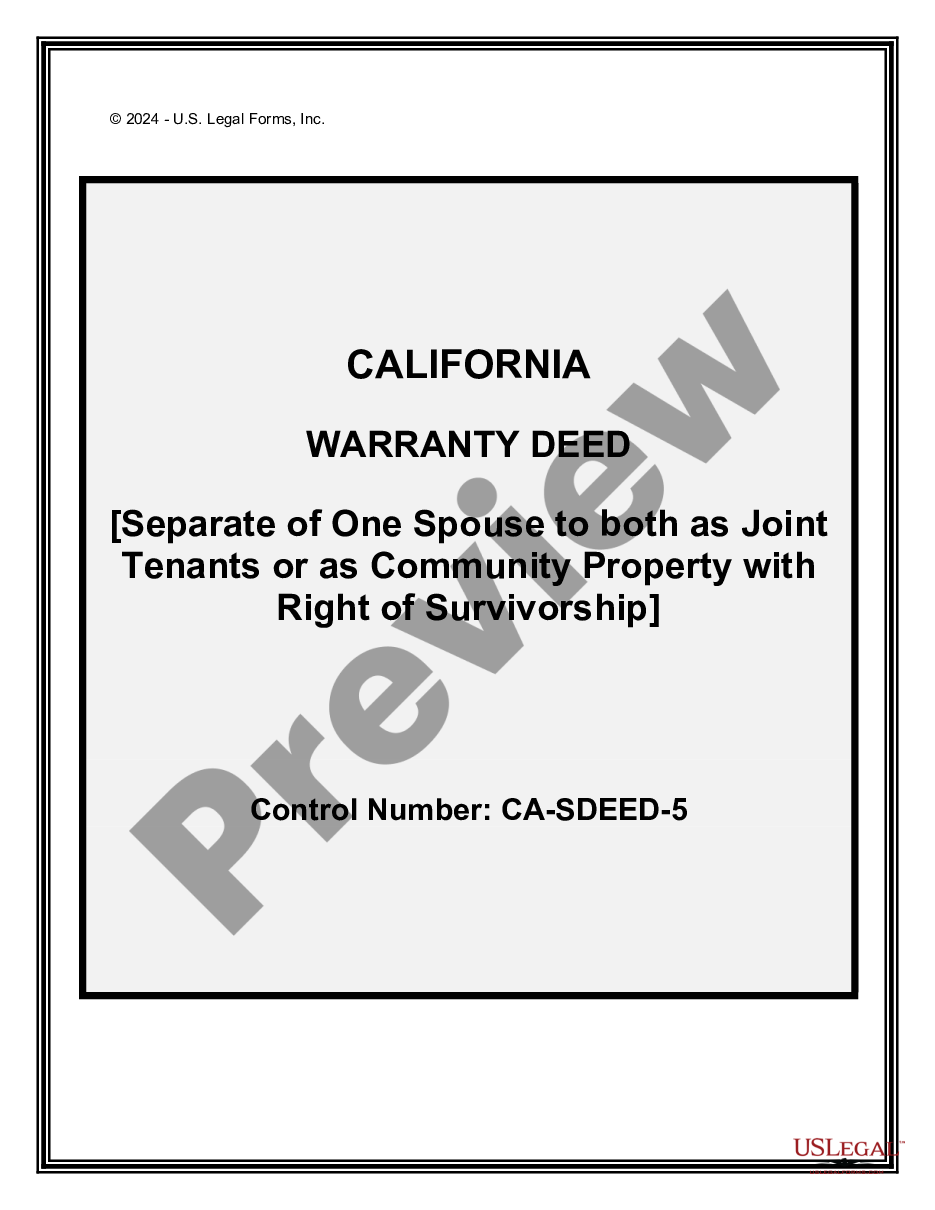
California Warranty Deed to Separate Property of one Spouse to both as Joint Tenants or as Community Property with Right of Survivorship
Understanding this form
This form is a Warranty Deed that allows one spouse to convey their interest in property to both spouses, either as Joint Tenants or as Community Property with Right of Survivorship. This is particularly important for couples looking to formalize their ownership of the property and ensure that it transfers smoothly to the surviving spouse in the event of death. Unlike general transfer documents, this deed specifies the joint ownership type, which can affect how property ownership is managed and inherited.
What’s included in this form
- Identification of the grantor (spouse conveying the property).
- Identification of the grantees (both spouses receiving the property).
- Description of the property being conveyed, including legal description.
- Statement specifying the type of joint ownership: Joint Tenants or Community Property with Right of Survivorship.
- Signature lines for both grantor and grantee, along with necessary seals.





When to use this form
You should use this Warranty Deed form when you want to transfer property ownership from one spouse to both spouses. Situations that may require this form include when a couple buys a property together, or during divorce proceedings when one spouse wishes to convey their interest in the property to the other. It is crucial when there are considerations for survivorship rights, ensuring that the property automatically goes to the surviving spouse without the need for probate.
Who this form is for
This form is intended for:
- Couples who legally own property and want to clarify their ownership interests.
- Individuals involved in property transactions where joint ownership is desired.
- Spouses undergoing divorce who need to transfer property interests as part of their settlement.
Completing this form step by step
- Identify the parties involved: the grantor and the grantees.
- Clearly describe the property being transferred, using its legal description.
- Select the form of ownership: Joint Tenants or Community Property with Right of Survivorship.
- Enter the date of the transfer and any relevant transaction details.
- Ensure both spouses sign the document in the designated areas.
Does this document require notarization?
This form does not typically require notarization unless specified by local law. However, having it notarized can provide an additional layer of authenticity and security in your property transfer process.
Get your form ready online
Our built-in tools help you complete, sign, share, and store your documents in one place.
Make edits, fill in missing information, and update formatting in US Legal Forms—just like you would in MS Word.
Download a copy, print it, send it by email, or mail it via USPS—whatever works best for your next step.
Sign and collect signatures with our SignNow integration. Send to multiple recipients, set reminders, and more. Go Premium to unlock E-Sign.
If this form requires notarization, complete it online through a secure video call—no need to meet a notary in person or wait for an appointment.
We protect your documents and personal data by following strict security and privacy standards.

Make edits, fill in missing information, and update formatting in US Legal Forms—just like you would in MS Word.

Download a copy, print it, send it by email, or mail it via USPS—whatever works best for your next step.

Sign and collect signatures with our SignNow integration. Send to multiple recipients, set reminders, and more. Go Premium to unlock E-Sign.

If this form requires notarization, complete it online through a secure video call—no need to meet a notary in person or wait for an appointment.

We protect your documents and personal data by following strict security and privacy standards.
Common mistakes
- Failing to correctly identify the property in the legal description.
- Not specifying the form of ownership appropriately.
- Missing signatures from both spouses.
- Neglecting to check local regulations that may require additional documentation.
Benefits of using this form online
- Easy access to legal form templates created by licensed attorneys.
- Convenient digital editing allows for quick completion of the deed.
- Secure downloading ensures you have a copy for your records.
- Guidance through the form ensures all necessary fields are filled accurately.
Looking for another form?
Form popularity
FAQ
Yes, separate property can become community property in California if both spouses agree to do so. This often occurs through mutual agreements or co-mingling of assets. If you're considering a California Warranty Deed to Separate Property of one Spouse to both as Joint Tenants or as Community Property with Right of Survivorship, understanding this transition can help you make informed decisions about your property.
Joint tenancy allows multiple owners to have equal rights to the property, while community property typically applies to assets obtained during marriage. In California, community property with rights of survivorship includes the benefit of avoiding probate when one spouse dies. Knowing the distinctions can help you choose between a California Warranty Deed to Separate Property of one Spouse to both as Joint Tenants or as Community Property with Right of Survivorship.
Joint ownership can lead to disputes between co-owners, especially if not clearly defined in a legal agreement. Financial liabilities can also affect the joint property, putting the entire ownership at risk. Therefore, comprehending the California Warranty Deed to Separate Property of one Spouse to both as Joint Tenants or as Community Property with Right of Survivorship is important for smooth co-ownership.
The main drawback of the right of survivorship is that it can lead to unintended inheritance outcomes. If an owner dies, the property goes directly to the surviving owner without consideration for other heirs. Understanding the implications of the California Warranty Deed to Separate Property of one Spouse to both as Joint Tenants or as Community Property with Right of Survivorship is essential to ensure your wishes are met.
Joint tenancy with right of survivorship can limit your control over the property. If one party faces financial issues, creditors may claim the property. Additionally, dissolving the arrangement can be complex and may involve legal proceedings, making the California Warranty Deed to Separate Property of one Spouse to both as Joint Tenants or as Community Property with Right of Survivorship a significant decision.
Yes, joint tenancy with right of survivorship generally takes precedence over a will. This means that if one owner passes away, the property automatically transfers to the surviving tenant, bypassing the probate process. Therefore, it’s crucial to consider how the California Warranty Deed to Separate Property of one Spouse to both as Joint Tenants or as Community Property with Right of Survivorship interacts with your estate planning.
When holding property as joint tenants with right of survivorship in California, tax implications can include potential capital gains tax upon sale. The property’s value may be reassessed, which could lead to increased property taxes. It’s important to consult a tax professional to understand how the California Warranty Deed to Separate Property of one Spouse to both as Joint Tenants or as Community Property with Right of Survivorship might affect your specific situation.
The purpose of an interspousal transfer deed is to facilitate the transfer of property interests between spouses, often during marriage or divorce proceedings. This type of deed helps clarify ownership and ensure that both spouses understand their rights regarding the property. For long-term ownership security, using a California Warranty Deed to Separate Property of one Spouse to both as Joint Tenants or as Community Property with Right of Survivorship is essential, as it conveys an equitable interest and surviving rights.
The main difference lies in the intent and legal assurances each provides. A quitclaim deed may lack any guarantees regarding ownership, while an interspousal transfer deed is specifically designed for married couples to reallocate property rights with more clarity and intention. Ultimately, a California Warranty Deed to Separate Property of one Spouse to both as Joint Tenants or as Community Property with Right of Survivorship secures joint ownership and surviving rights, making it a more robust choice for couples.
A quitclaim deed merely transfers any interest the grantor has, without warranties. In contrast, an interspousal transfer involves spouses transferring property rights between each other, often used to adjust ownership during marriage. When addressing ownership, using a California Warranty Deed to Separate Property of one Spouse to both as Joint Tenants or as Community Property with Right of Survivorship offers more legal clarity and protection.