California Agreed Written Termination of Lease by Landlord and Tenant
Overview of this form
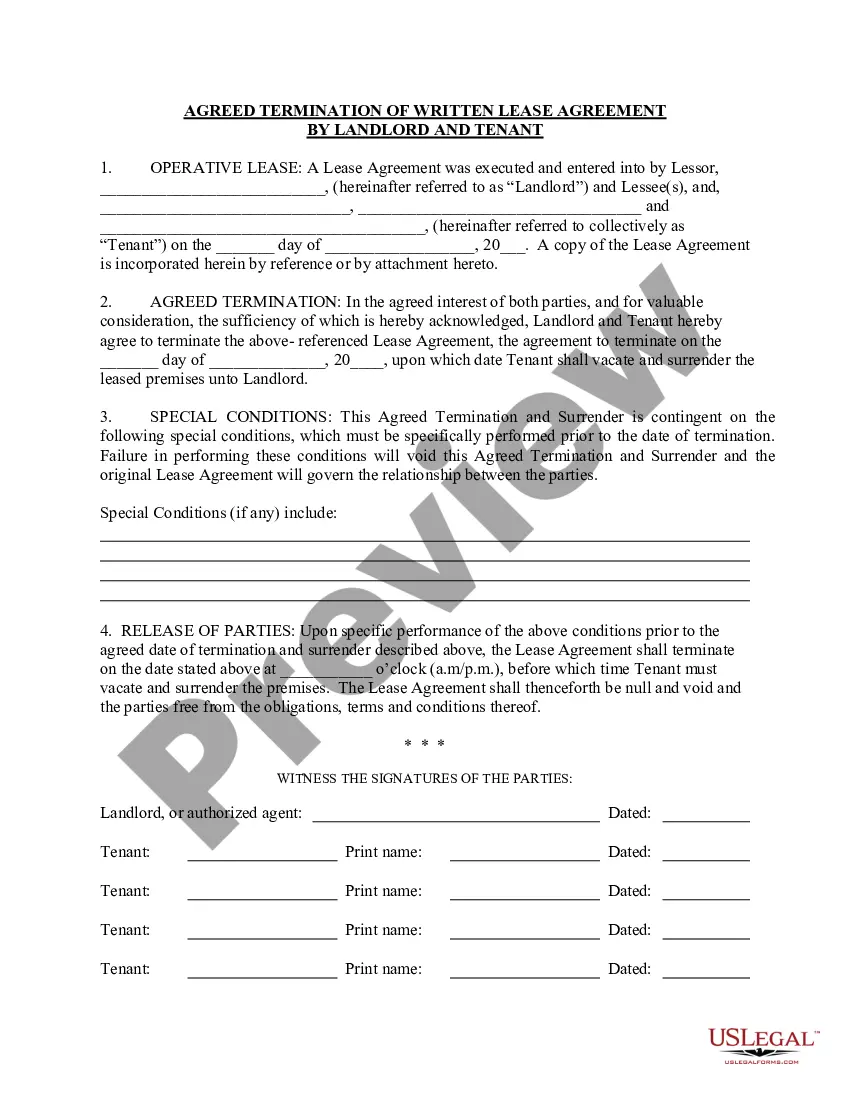
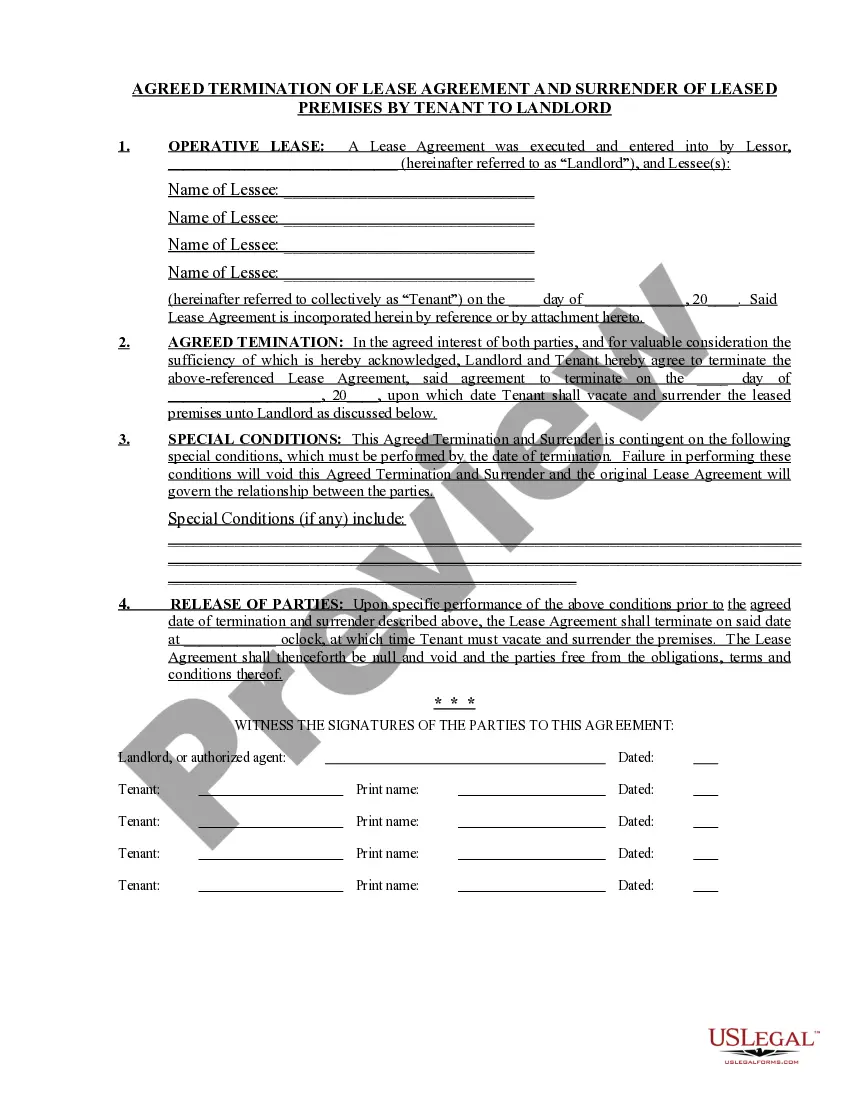
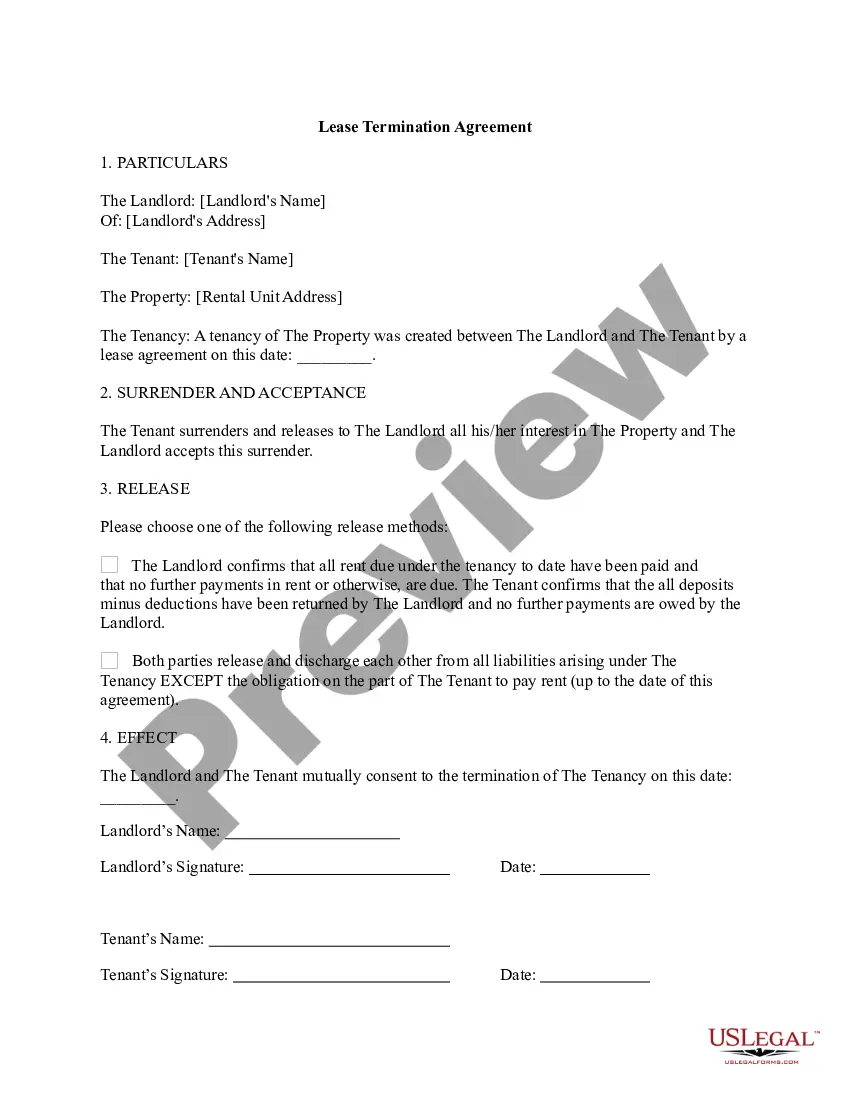
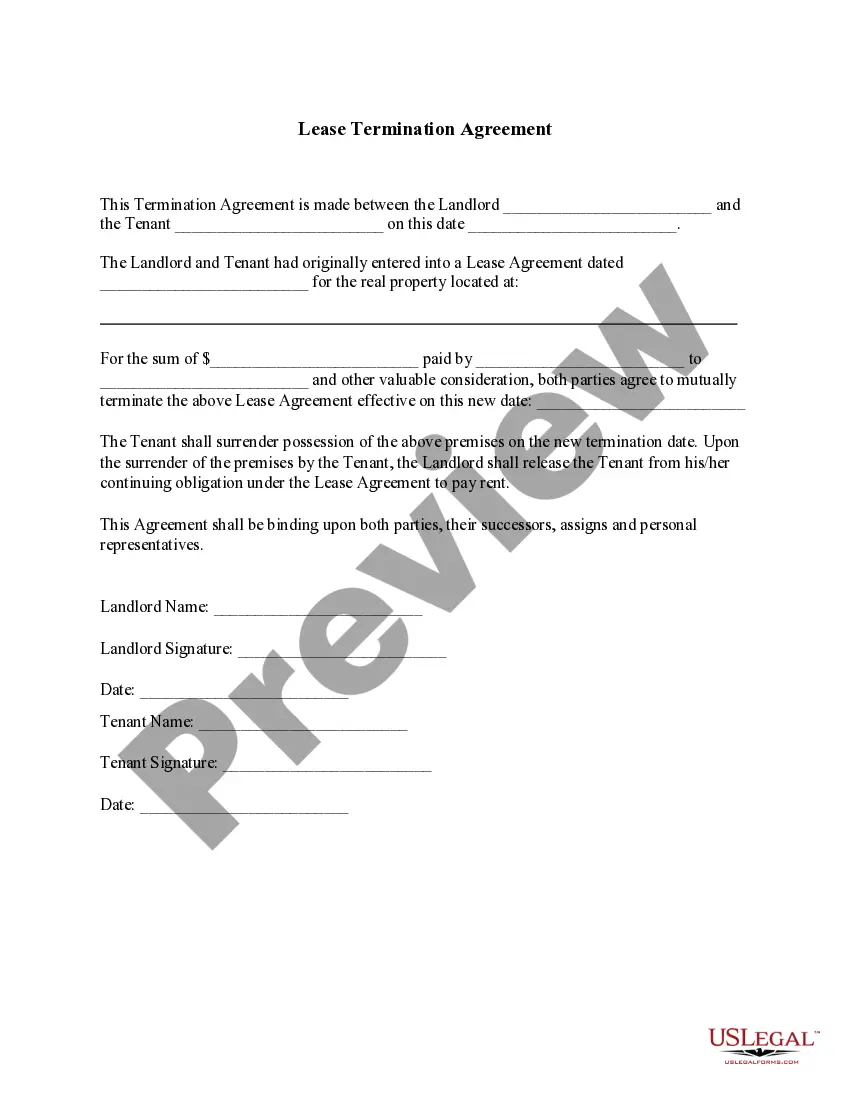
The Agreed Written Termination of Lease by Landlord and Tenant form allows both the landlord and the tenant to officially agree to terminate a lease. Unlike other forms of lease termination, this document requires mutual consent and may include specific conditions that must be fulfilled before the lease ends. This form ensures that both parties are released from further obligations under the lease upon completion of any stated conditions.
Key parts of this document
- Identification of the landlord and tenant involved in the lease.
- Reference to the original lease agreement that is being terminated.
- Agreed termination date upon which the tenant must vacate the premises.
- Special conditions that must be fulfilled before the termination is effective.
- A release clause that frees both parties from their lease obligations upon meeting the stated conditions.
- Signature lines for both parties to confirm agreement.

When this form is needed
This form is useful when both the landlord and tenant agree to end the lease agreement before the lease term expires. Whether due to mutual decision, financial considerations, or changes in circumstances, using this form helps clarify the terms for ending the rental relationship and ensures that both parties understand their rights and obligations.
Who needs this form
- Landlords who wish to amicably terminate a lease with their tenant.
- Tenants looking to mutually agree on lease termination to avoid penalties.
- Individuals seeking a clear, legally binding document to outline the terms of lease termination.
Steps to complete this form
- Identify the landlord and tenant by entering their full names and addresses.
- Reference the original lease agreement by noting the date it was executed.
- Enter the agreed termination date and the time by which the tenant must vacate the premises.
- Specify any special conditions that must be met prior to termination.
- Obtain signatures from all parties involved to finalize the agreement.
Is notarization required?
This form does not typically require notarization to be legally valid. However, some jurisdictions or document types may still require it. US Legal Forms provides secure online notarization powered by Notarize, available 24/7 for added convenience.
Get your form ready online
Our built-in tools help you complete, sign, share, and store your documents in one place.
Make edits, fill in missing information, and update formatting in US Legal Forms—just like you would in MS Word.
Download a copy, print it, send it by email, or mail it via USPS—whatever works best for your next step.
Sign and collect signatures with our SignNow integration. Send to multiple recipients, set reminders, and more. Go Premium to unlock E-Sign.
If this form requires notarization, complete it online through a secure video call—no need to meet a notary in person or wait for an appointment.
We protect your documents and personal data by following strict security and privacy standards.

Make edits, fill in missing information, and update formatting in US Legal Forms—just like you would in MS Word.

Download a copy, print it, send it by email, or mail it via USPS—whatever works best for your next step.

Sign and collect signatures with our SignNow integration. Send to multiple recipients, set reminders, and more. Go Premium to unlock E-Sign.

If this form requires notarization, complete it online through a secure video call—no need to meet a notary in person or wait for an appointment.

We protect your documents and personal data by following strict security and privacy standards.
Mistakes to watch out for
- Failing to clearly state special conditions, leading to misunderstandings.
- Not including the date by which the tenant must vacate the premises.
- Forgetting to obtain all required signatures, which could render the document unenforceable.
Advantages of online completion
- Convenient access: Download and complete the form from anywhere at any time.
- Editability: Easily modify the document to fit specific agreements between parties.
- Reliability: Forms are drafted by licensed attorneys, ensuring accuracy and legal compliance.
Legal use & context
- Enforceable once both parties have signed, indicating mutual consent.
- Special conditions, if any, must be fulfilled for the termination to be valid.
- Provides a clear record of the lease termination, protecting both landlord and tenant.
Quick recap
- The form facilitates a mutual lease termination between landlord and tenant.
- Special conditions can be added to customize the agreement.
- Proper completion ensures both parties are released from lease obligations.
Looking for another form?
Form popularity
FAQ
In California, the amount of notice required to terminate a lease depends on the duration of the tenancy. For most residential leases, landlords must provide either 30 or 60 days' notice before termination. This is in line with the California Agreed Written Termination of Lease by Landlord and Tenant, which aims to provide fair and clear communication between landlords and tenants.
A 60-day lease termination letter in California is a written notice that a landlord serves to a tenant, indicating that the lease will be terminated in 60 days. This letter should include important details such as the property address, effective date, and any necessary instructions for the move-out process. It's a significant part of the California Agreed Written Termination of Lease by Landlord and Tenant process, ensuring both parties are informed and on the same page.
Yes, you can ask for a copy of your lease in California. Landlords are typically required to provide tenants with a copy of the signed lease agreement upon request. Having this document is essential during the California Agreed Written Termination of Lease by Landlord and Tenant, as it can clarify terms and conditions agreed upon by both parties.
To calculate a 60-day notice, start from the date on which the notice is served to the tenant. Count forward 60 days, making sure to include all types of days, including weekends and holidays. This timeline helps ensure compliance with the California Agreed Written Termination of Lease by Landlord and Tenant requirements, protecting both parties involved.
Notice on termination of lease refers to the communication a landlord sends to a tenant indicating their intention to end the lease agreement. This notice outlines the effective date of the lease termination and informs the tenant of their responsibilities, including the move-out process. Proper notice is crucial in the California Agreed Written Termination of Lease by Landlord and Tenant to avoid misunderstandings and legal issues.
A 60-day notice to terminate a tenancy in California is a formal document that a landlord provides to a tenant when they intend to end a rental agreement. This notice gives the tenant a minimum of 60 days to vacate the property. It is important to ensure that this notice complies with state regulations, as it plays a vital role in the California Agreed Written Termination of Lease by Landlord and Tenant process.
In certain situations, tenants must give a 60-day notice to their landlord, especially if they have occupied the property for over a year. This requirement helps all parties prepare for the transition. Understanding the California Agreed Written Termination of Lease by Landlord and Tenant will ensure that both landlords and tenants fulfill their obligations.
Moving out without providing a 30-day notice can have legal repercussions in California. If a tenant neglects to give proper notice, they may remain responsible for rent until the notice period concludes. Therefore, it's advisable to follow the California Agreed Written Termination of Lease by Landlord and Tenant guidelines to avoid complications.
You must give a tenant either 30 or 60 days' notice to move out, depending on the length of their tenancy. For most month-to-month agreements, a 30-day notice suffices; however, for tenants who have lived in the unit for over a year, a 60-day notice is required. This requirement is crucial to adhere to the California Agreed Written Termination of Lease by Landlord and Tenant.
A landlord in California generally needs to provide a 30-day notice for terminating a month-to-month lease. If the tenant has resided in the property for longer than a year, the notice period extends to 60 days. This aligns with the principles of the California Agreed Written Termination of Lease by Landlord and Tenant, ensuring both parties have adequate time to prepare.