California Letter from Tenant to Landlord containing Notice to landlord to withdraw retaliatory rent increase
What is this form?
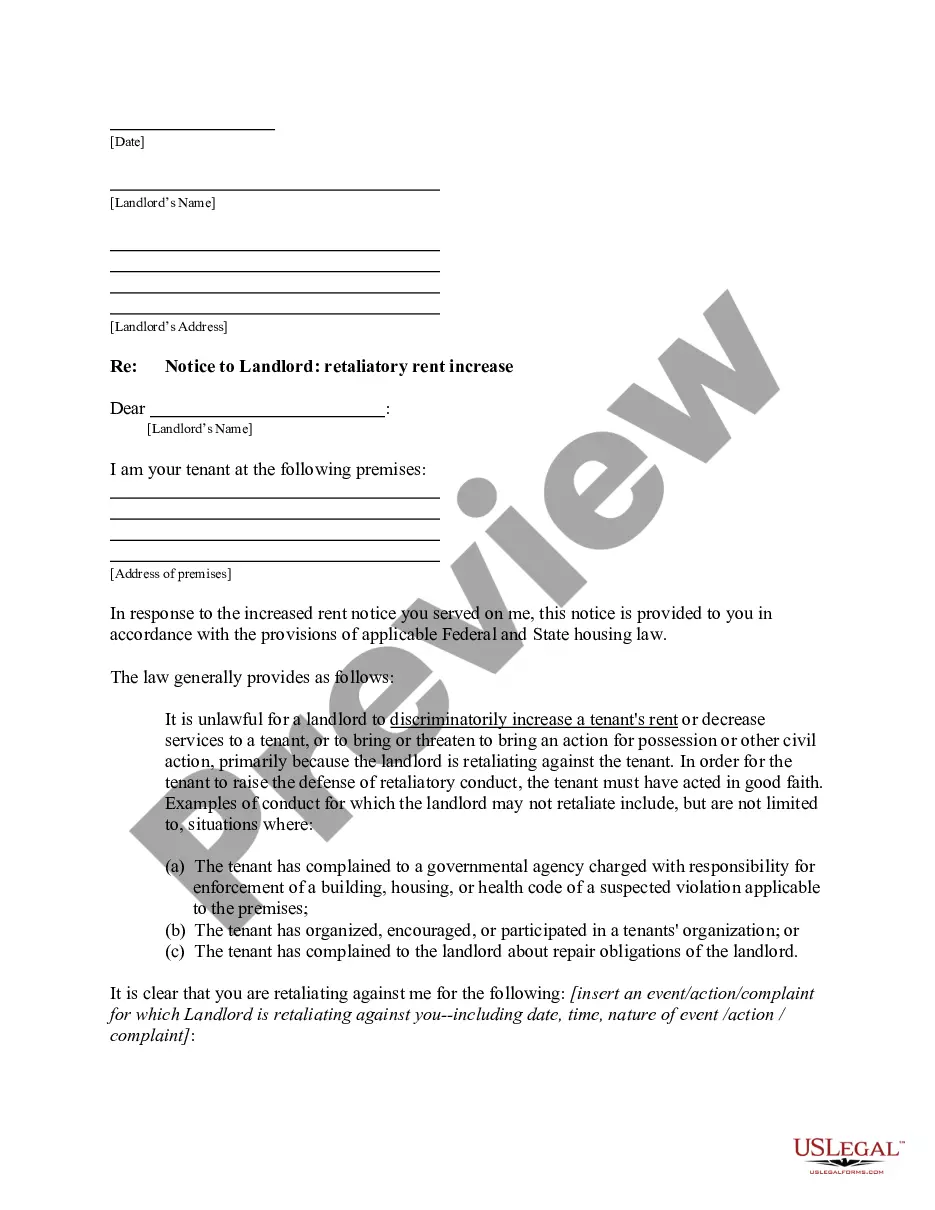
This form is a letter from a tenant to their landlord, notifying them of a retaliatory rent increase. It serves to inform the landlord that increasing rent or decreasing services in retaliation for the tenant's rights or complaints is unlawful. This form helps protect tenants from discriminatory practices and ensures that they continue to receive the services they are entitled to, all while maintaining their obligations under the lease agreement.
Main sections of this form
- Identification of the tenant and landlord.
- Clear statement regarding the notice of retaliatory rent increase.
- Reference to protected tenant actions (such as making complaints to authorities).
- Clarification of the tenant's intention to abide by the lease agreement.
- Signature lines for both the tenant and landlord.




When this form is needed
This form is necessary when a landlord has increased the tenant's rent in response to protected actions taken by the tenant, such as reporting health or safety issues, organizing with other tenants, or requesting necessary repairs. It can be used to formally communicate the tenant's position and assert their rights.
Who this form is for
- Tenants facing an unjust rent increase due to their rights being exercised.
- Individuals who have reported issues affecting their rental property.
- Members of tenants' organizations looking to protect their interests.
How to prepare this document
- Identify yourself as the tenant and provide your contact information.
- Clearly state the landlord's name and address.
- Detail the reason for your notice regarding the rent increase.
- Include evidence of your good faith actions that warrant protection under the law.
- Sign and date the letter, ensuring you keep a copy for your records.
Notarization requirements for this form
Notarization is generally not required for this form. However, certain states or situations might demand it. You can complete notarization online through US Legal Forms, powered by Notarize, using a verified video call available anytime.
Get your form ready online
Our built-in tools help you complete, sign, share, and store your documents in one place.
Make edits, fill in missing information, and update formatting in US Legal Forms—just like you would in MS Word.
Download a copy, print it, send it by email, or mail it via USPS—whatever works best for your next step.
Sign and collect signatures with our SignNow integration. Send to multiple recipients, set reminders, and more. Go Premium to unlock E-Sign.
If this form requires notarization, complete it online through a secure video call—no need to meet a notary in person or wait for an appointment.
We protect your documents and personal data by following strict security and privacy standards.

Make edits, fill in missing information, and update formatting in US Legal Forms—just like you would in MS Word.

Download a copy, print it, send it by email, or mail it via USPS—whatever works best for your next step.

Sign and collect signatures with our SignNow integration. Send to multiple recipients, set reminders, and more. Go Premium to unlock E-Sign.

If this form requires notarization, complete it online through a secure video call—no need to meet a notary in person or wait for an appointment.

We protect your documents and personal data by following strict security and privacy standards.
Common mistakes
- Failing to provide specific examples of the landlord's retaliatory actions.
- Not including necessary contact information for both parties.
- Neglecting to keep a copy of the notice for personal records.
Why complete this form online
- Quickly access a legally compliant template drafted by licensed attorneys.
- It's easy to tailor the form to meet your specific situation.
- Immediate availability allows for timely action to protect your rights.
- This form helps tenants document their claims against retaliatory actions by landlords.
- It is advisable to retain a copy for your records after sending it to your landlord.
- Understanding your stateâs specific legal context is crucial for enforceability.
Quick recap
- Retaliatory rent increases are unlawful and can be challenged.
- This form serves as an official notice to your landlord regarding their unlawful actions.
- Ensuring proper completion and delivery of this notice is crucial for tenant protection.
Looking for another form?
Form popularity
FAQ
Writing a notice letter for a rent increase involves clearly stating the new rental rate and the effective date of the increase. Make sure to follow any local laws regarding notice periods and include reasons for the increase if applicable. If necessary, refer to the California Letter from Tenant to Landlord containing Notice to landlord to withdraw retaliatory rent increase to protect yourself and ensure compliance with the law.
To write a letter of moving out, begin with your details and the date of the letter. Clearly state your intention to vacate and include your expected move-out date. It’s crucial to confirm any security deposit procedures as well, so consider using the California Letter from Tenant to Landlord containing Notice to landlord to withdraw retaliatory rent increase to communicate effectively.
When writing a formal letter to a tenant, use a professional tone and clear language. Start with the date, followed by the tenant’s address, and a clear subject line if necessary. State your purpose concisely and include any relevant legal references, such as the California Letter from Tenant to Landlord containing Notice to landlord to withdraw retaliatory rent increase, to ensure the message is understood.
To evict a nuisance tenant in California, document the behavior that constitutes a nuisance. Serve them with a notice to quit, providing them with the required time frame to leave, as dictated by California law. Consulting legal resources or using platforms like uslegalforms can be helpful for generating proper documents, such as a California Letter from Tenant to Landlord containing Notice to landlord to withdraw retaliatory rent increase, to protect your interests.
Writing a quit notice for a tenant involves stating the intention to terminate the lease. Start with the tenant’s name and address, followed by a clear statement that you are terminating the tenancy. Include the reason for the termination, if applicable, and reference any legal documents, like the California Letter from Tenant to Landlord containing Notice to landlord to withdraw retaliatory rent increase, to strengthen your position.
To write a letter asking someone to move out, start with a polite introduction. Clearly state your request for them to vacate the premises, and include a specific move-out date. Ensure you mention any applicable reasons, especially if they relate to your rights as a tenant, such as using a California Letter from Tenant to Landlord containing Notice to landlord to withdraw retaliatory rent increase, to ensure clarity and legality.
Yes, a landlord can give notice by email in California if such communication is agreed upon in the lease. Using email for notices can expedite the process, especially concerning urgent matters like a California Letter from Tenant to Landlord containing Notice to landlord to withdraw retaliatory rent increase. Always verify that your landlord is aware of this preference and keep documentation of all communications.
Yes, landlord retaliation is illegal in California. If a landlord retaliates against a tenant for exercising their legal rights, such as evicting them or increasing rent unfairly, the tenant can seek legal remedies. A California Letter from Tenant to Landlord containing Notice to landlord to withdraw retaliatory rent increase may provide a formal record of the tenant's position and difficulties faced due to retaliation.
While a 3-day notice may be sent via email in California, it must comply with specific legal requirements and applicable lease agreements. It's often advisable to deliver such notices using certified mail or in person to avoid disputes. If you feel the need to issue a notice, consider using a California Letter from Tenant to Landlord containing Notice to landlord to withdraw retaliatory rent increase to ensure clarity and legal compliance.
To request a rent abatement letter, initiate a discussion with your landlord about your situation and clearly articulate your request. You can also reference a California Letter from Tenant to Landlord containing Notice to landlord to withdraw retaliatory rent increase to strengthen your case. Be respectful, and consider sending your request in writing to ensure there's a record of your communication.