Arkansas Letter from Tenant to Landlord about Fair Housing Reduction or Denial of services to Family with Children
What this document covers
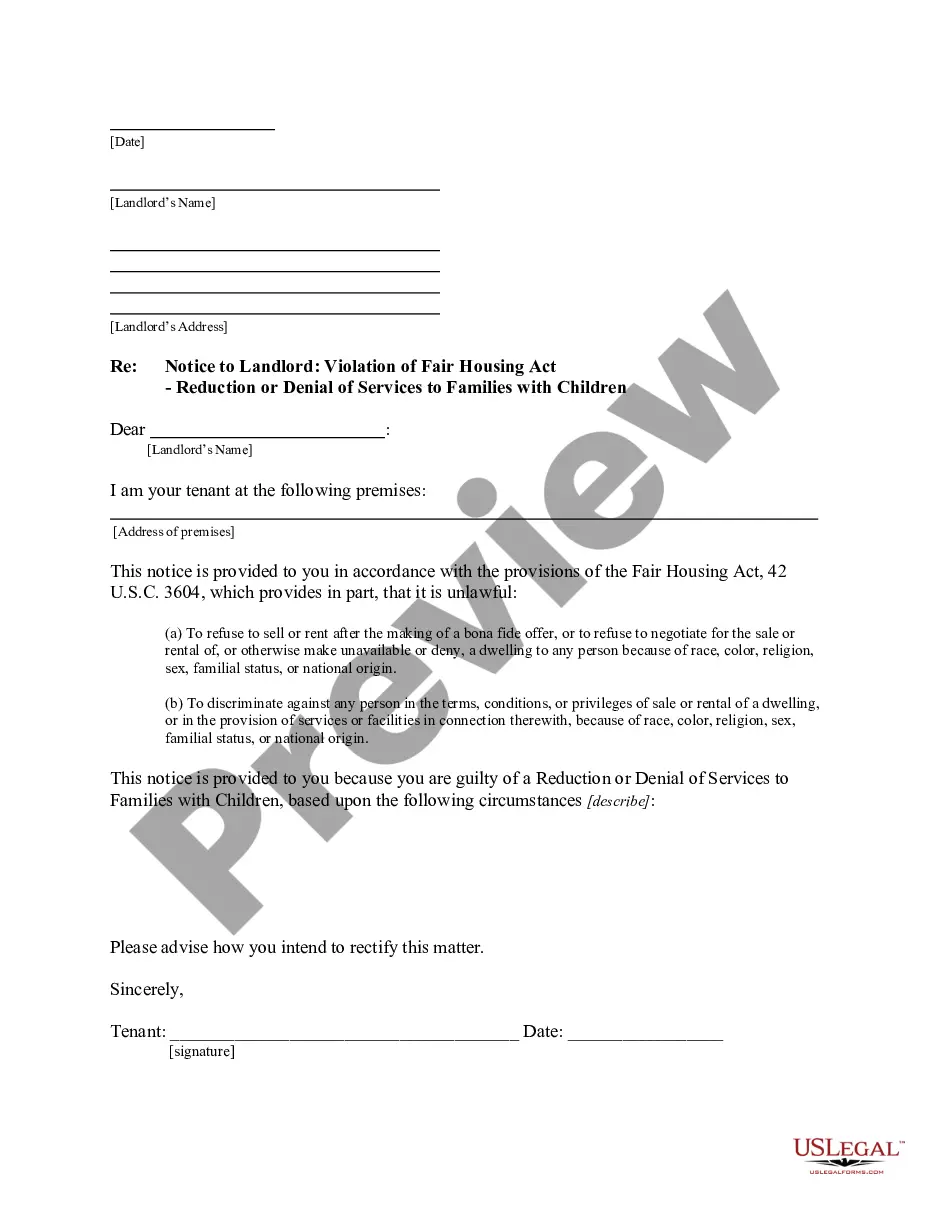
This form is a Letter from Tenant to Landlord about Fair Housing Reduction or Denial of services to Family with Children. Its primary purpose is to formally notify a landlord of violations related to the Fair Housing Act, specifically when there has been a reduction or denial of services to families with children. This letter serves as a vital tool for tenants seeking to uphold their rights and address discriminatory practices, distinguishing it from general tenant-landlord communication forms.
Key parts of this document
- Identifies the tenant and landlord involved in the complaint.
- Details specific incidences of fair housing violations related to familial status.
- References relevant sections of the Fair Housing Act prohibiting discrimination.
- Provides space for the tenant to describe the circumstances of the reduction or denial of services.
- Includes information on potential remedies or actions expected from the landlord.

Situations where this form applies
This form should be used when a tenant feels that their landlord has unlawfully reduced or denied services to them based on familial status, particularly when children are involved. For example, if a landlord imposes extra fees for families with children or restricts access to amenities that families typically utilize, this letter serves as an official complaint to address the injustice.
Intended users of this form
- Tenants who have children and feel they are facing discrimination from their landlord.
- Individuals seeking to assert their rights under the Fair Housing Act.
- Families who have encountered a reduction or denial of housing-related services based on their familial status.
- Advocacy groups assisting tenants in navigating fair housing issues.
Steps to complete this form
- Identify the parties involved by clearly stating the tenant's and landlord's names and addresses.
- Specify the property address where the issues occurred.
- Detail the specific actions taken by the landlord that constitute a reduction or denial of services.
- Include references to the Fair Housing Act to support the claims being made.
- Express the desired resolution or action expected from the landlord, including a request for a response.
Does this document require notarization?
In most cases, this form does not require notarization. However, some jurisdictions or signing circumstances might. US Legal Forms offers online notarization powered by Notarize, accessible 24/7 for a quick, remote process.
Get your form ready online
Our built-in tools help you complete, sign, share, and store your documents in one place.
Make edits, fill in missing information, and update formatting in US Legal Forms—just like you would in MS Word.
Download a copy, print it, send it by email, or mail it via USPS—whatever works best for your next step.
Sign and collect signatures with our SignNow integration. Send to multiple recipients, set reminders, and more. Go Premium to unlock E-Sign.
If this form requires notarization, complete it online through a secure video call—no need to meet a notary in person or wait for an appointment.
We protect your documents and personal data by following strict security and privacy standards.

Make edits, fill in missing information, and update formatting in US Legal Forms—just like you would in MS Word.

Download a copy, print it, send it by email, or mail it via USPS—whatever works best for your next step.

Sign and collect signatures with our SignNow integration. Send to multiple recipients, set reminders, and more. Go Premium to unlock E-Sign.

If this form requires notarization, complete it online through a secure video call—no need to meet a notary in person or wait for an appointment.

We protect your documents and personal data by following strict security and privacy standards.
Common mistakes
- Failing to provide specific details about the discriminatory actions taken by the landlord.
- Not citing the relevant laws, which can weaken the complaint's effectiveness.
- Neglecting to include the correct contact information for both parties.
- Using vague language instead of providing clear and factual descriptions.
Why use this form online
- Convenience of downloading and personalizing the form from any location.
- Immediate access to legally vetted content created by licensed attorneys.
- Time-saving editing capabilities that allow quick adjustments to fit individual circumstances.
- Affordable option for asserting rights without needing a lawyer for initial communications.
Legal use & context
- This form serves as formal documentation of the complaint, which can be useful if legal action is necessary later.
- Understanding your rights under the Fair Housing Act can empower tenants to address violations effectively.
- The form provides a clear record of communication between the tenant and landlord regarding discriminatory practices.
Looking for another form?

Form popularity
FAQ
To request a reduction in rent, begin by clearly stating the reason for your request and providing relevant details about your situation. Include your lease terms and any changes in your financial status that may justify a lower rent. Also, reference any applicable housing laws that support your request. Utilizing platforms like US Legal Forms can help you draft an effective Arkansas Letter from Tenant to Landlord about Fair Housing Reduction or Denial of services to Family with Children.
A violation under the Fair Housing Act could include refusing to rent to a family with children or evicting tenants based on familial status. Other examples include discriminatory advertising and different treatment in lease terms or conditions. It is crucial to recognize these violations to protect your rights. If you feel discriminated against, you may need to craft an Arkansas Letter from Tenant to Landlord about Fair Housing Reduction or Denial of services to Family with Children.
In Arkansas, there is no state-wide limit on how much a landlord can increase rent. However, landlords must provide adequate notice, typically 30 days, before any rent increase takes effect. It's essential to review your lease agreement for any specific terms regarding rent adjustments. If you believe a rent increase is unjust, you may consider writing an Arkansas Letter from Tenant to Landlord about Fair Housing Reduction or Denial of services to Family with Children.
To write a rental denial letter, start by clearly stating your intention to deny the rental application. Include the applicant’s name, address, and the specific reasons for the denial. Ensure you reference applicable laws, such as the Fair Housing Act, to support your decision. You may also want to suggest alternative options or resources available for families facing housing challenges.
In Arkansas, a landlord cannot refuse to rent to a tenant based solely on their familial status, which includes having children under 18. Additionally, landlords must not segregate families with children to different units or impose unfair rental conditions. If you face such discrimination, it's important to take action. A well-crafted Arkansas Letter from Tenant to Landlord about Fair Housing Reduction or Denial of services to Family with Children can serve as a powerful tool to protect your rights and hold landlords accountable.
In Arkansas, landlords can generally raise rent as specified in the lease agreement terms and must provide tenants with reasonable notice, usually 30 days. There is no statewide cap on how much rent can be increased, so it's essential to be aware of your lease terms. If you feel that a rent increase is unjust or discriminatory, consider drafting an Arkansas Letter from Tenant to Landlord about Fair Housing Reduction or Denial of services to Family with Children to express your concerns formally.
In Arkansas, a landlord can begin eviction proceedings if a tenant is more than one month behind on rent. However, the process must comply with state laws, including proper notification. If you find yourself in financial hardship, communication is vital, possibly using an Arkansas Letter from Tenant to Landlord about Fair Housing Reduction or Denial of services to Family with Children to explain your situation.
In Arkansas, the notice period a landlord must provide to a tenant generally ranges from 30 days to 60 days, depending on the terms outlined in the lease agreement. It is essential to review your rental contract to determine the exact timeframe. If you believe the notice is unjust, you may need to explore options like sending an Arkansas Letter from Tenant to Landlord about Fair Housing Reduction or Denial of services to Family with Children.
The new renters law in Arkansas includes provisions that enhance tenant rights, particularly regarding eviction processes and rental agreements. These changes aim to create more transparency and fairness for renters throughout the state. Staying informed about these laws allows tenants to understand their rights and responsibilities better, including avenues for filing an Arkansas Letter from Tenant to Landlord about Fair Housing Reduction or Denial of services to Family with Children.
To file a complaint against an apartment complex in Arkansas, you can gather evidence of your concerns and reach out to the Arkansas Attorney General's office or your local housing authority. It may also be beneficial to send an Arkansas Letter from Tenant to Landlord about Fair Housing Reduction or Denial of services to Family with Children, outlining your issues formally. Documentation and clear communication are key in this process.