Alaska Notice of Default for Violation of Lease or Rental Agreement - Nonresidential - 10 days notice
What is this form?
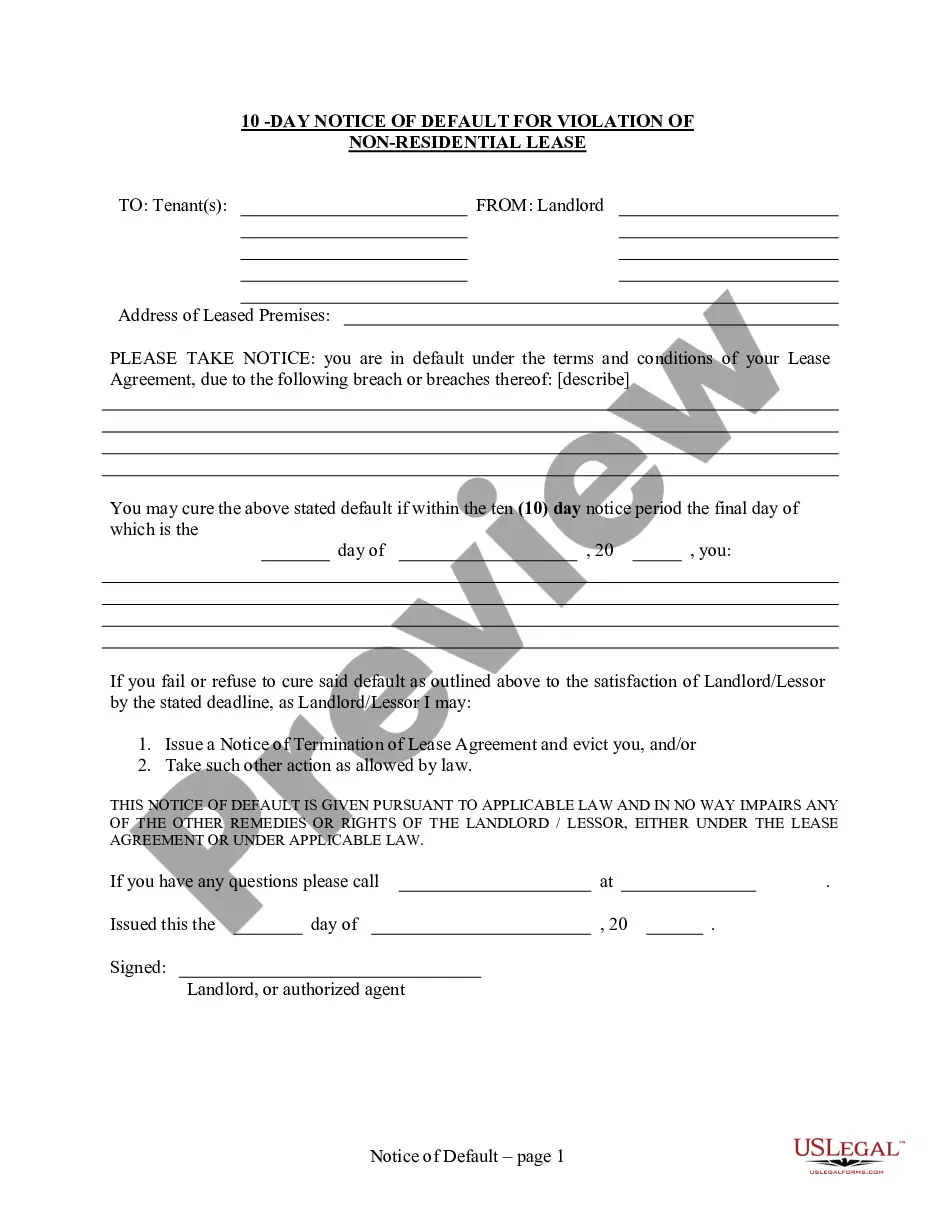
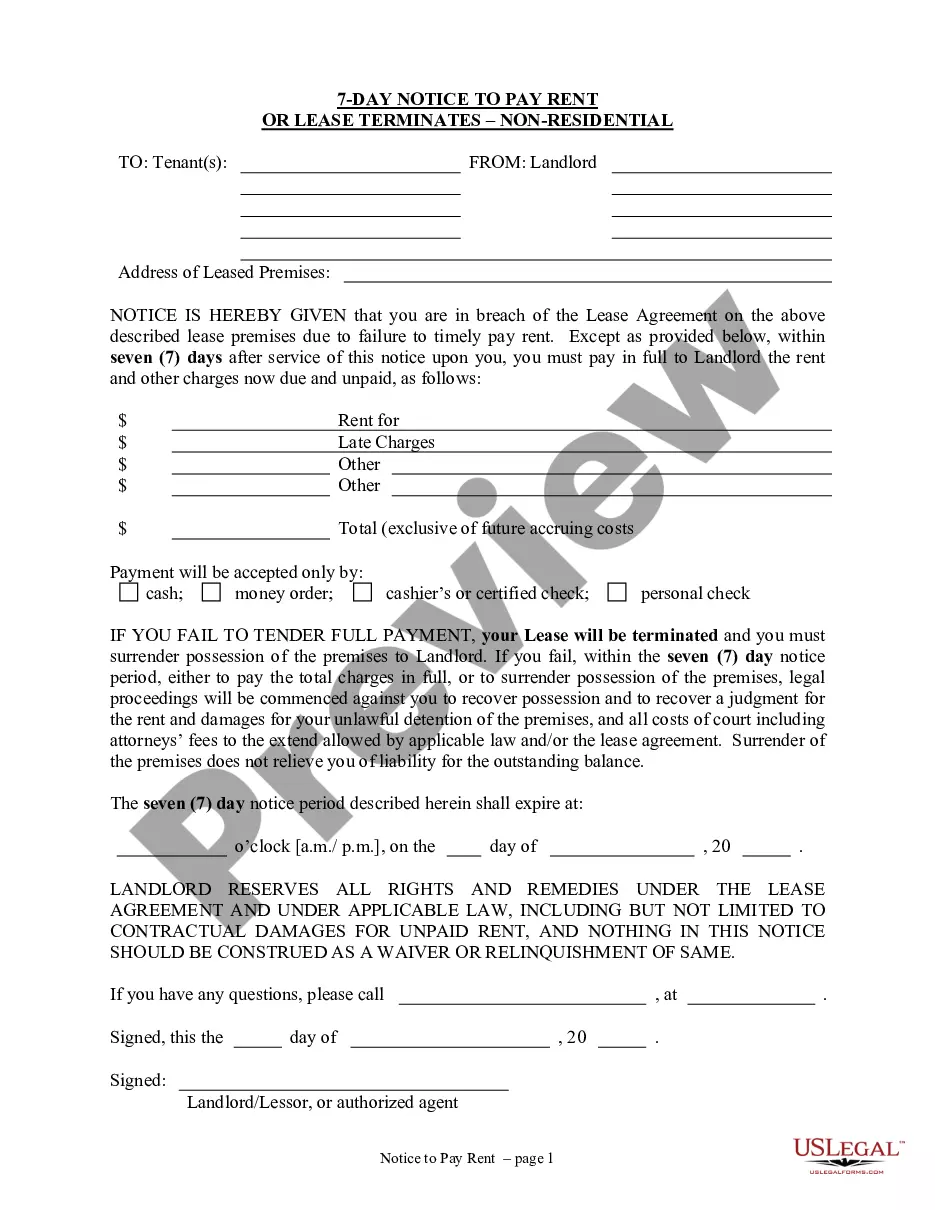
The Notice of Default for Violation of Lease or Rental Agreement - Nonresidential - 10 days notice is a legal document used by landlords to formally notify tenants of a default in their lease agreement, specifically regarding unpaid rent. This form serves as an official warning, providing the tenant with a set period (ten days) to remedy the situation before further legal actions, such as eviction, may occur. It is essential for landlords who need to communicate a breach of contract while ensuring compliance with local laws.
Form components explained
- Identification of the landlord and tenant, including addresses.
- Details of the lease violation, particularly the missed rental payment.
- A ten-day notice period for the tenant to remedy the default.
- Consequences of not addressing the default, including potential eviction.
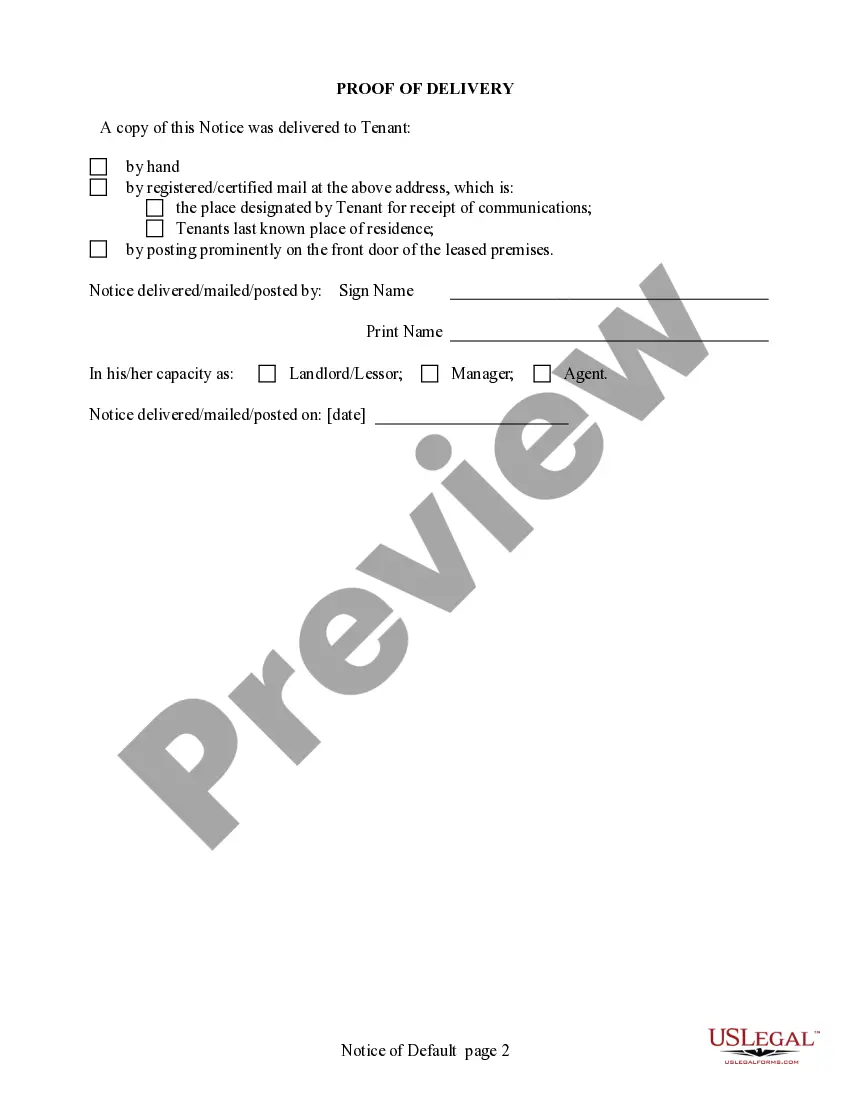
- Proof of delivery section to confirm the notice was communicated properly.


When this form is needed
This form is used when a landlord wishes to formally notify a commercial tenant about a default in rent payment. It is the first step in the eviction process, allowing the tenant a chance to pay their overdue rent within ten days. This notice is crucial in situations where timely payment is essential to the viability of a business and clarifies the responsibilities outlined in the lease agreement.
Who can use this document
- Commercial landlords seeking to address tenant defaults in rent payments.
- Property managers responsible for managing nonresidential lease agreements.
- Legal professionals assisting landlords in the eviction process.
How to prepare this document
- Enter the names and addresses of both the landlord and tenant at the top of the form.
- Clearly describe the breach of the lease agreement, specifying the unpaid rent.
- Specify the end date of the ten-day notice period, ensuring it is clear and prominent.
- Sign the form, including the date of issuance and your title (landlord, agent, etc.).
- Complete the proof of delivery section by noting how and when the notice was delivered to the tenant.
Does this form need to be notarized?
Notarization is generally not required for this form. However, certain states or situations might demand it. You can complete notarization online through US Legal Forms, powered by Notarize, using a verified video call available anytime.
Get your form ready online
Our built-in tools help you complete, sign, share, and store your documents in one place.
Make edits, fill in missing information, and update formatting in US Legal Forms—just like you would in MS Word.
Download a copy, print it, send it by email, or mail it via USPS—whatever works best for your next step.
Sign and collect signatures with our SignNow integration. Send to multiple recipients, set reminders, and more. Go Premium to unlock E-Sign.
If this form requires notarization, complete it online through a secure video call—no need to meet a notary in person or wait for an appointment.
We protect your documents and personal data by following strict security and privacy standards.

Make edits, fill in missing information, and update formatting in US Legal Forms—just like you would in MS Word.

Download a copy, print it, send it by email, or mail it via USPS—whatever works best for your next step.

Sign and collect signatures with our SignNow integration. Send to multiple recipients, set reminders, and more. Go Premium to unlock E-Sign.

If this form requires notarization, complete it online through a secure video call—no need to meet a notary in person or wait for an appointment.

We protect your documents and personal data by following strict security and privacy standards.
Common mistakes
- Failing to specify the exact amount of rent owed can lead to confusion.
- Not providing adequate notice time may invalidate the notice.
- Sending the notice incorrectly, such as not following local delivery requirements.
- Neglecting to keep a copy of the notice for your records.
Advantages of online completion
- Immediate access to a professionally drafted form ensures accuracy in legal language.
- Easy customization based on specific circumstances and tenant details.
- Instant downloads allow for quick implementation in urgent situations.
Looking for another form?
Form popularity
FAQ
The N5 Termination Notice can be given to tenants for: Interference with another tenant or the landlord's enjoyment or lawful rights; Damages; or. Overcrowding.
So landlords, if a tenant gives you an N9 notice which is short notice, accept it with good grace and try and re-rent the unit and get on with your life.If a landlord and tenant sign an N11, the tenant cannot be sued for short notice, and the landlord has in effect acquiesced to the short notice.
This means that you must tell your landlord in writing that you are moving. The form you use to do this is called a Tenant's Notice to Terminate the Tenancy (Form N9). You can get this form from the Landlord and Tenant Board. See Where to get help for contact information for the Board. It is best to use the Form N9.
Once rent is past due, the landlord must provide tenants with a 7-Day Notice to Pay if the landlord wants to file an eviction action with the court. Alaska landlords must provide tenants with a 10-Day Notice to Comply, giving tenants 10 days to correct the issue in order to avoid eviction.
Your Landlord is legally obligated to return your deposit within 10 days of you both agreeing how much you'll get back (after the tenancy has ended, of course).
Notice to terminate a tenancy given by email is not considered proper notice. You should insist that they give you notice on the proper N9 form. If they give you the N9 form, the 60 days' notice begins on the first of a rental period and ends on the last day of the rental period.
An N11: Agreement to End the Tenancy - is a form stating that the landlord and tenant both want to end a lease, and has to be signed by both of them. If you want to stay in your unit, you can refuse to sign the N11.
Self-Eviction Is Illegal in Alaska The good news is that if there are damages to the property in excess of $400 from squatting, a 24 hour notice can be served and the civil eviction process can begin immediately. A process server is best for this notice as anything sent by mail extends all deadlines by 72 hours.
Alaska state law limits how much a landlord can charge for a security deposit (two months' rent, unless the monthly rent exceeds $2,000), when it must be returned (within 14 days after a tenant moves if the tenant has given proper notice to end the tenancy or 30 days if the tenant has not), and sets other restrictions