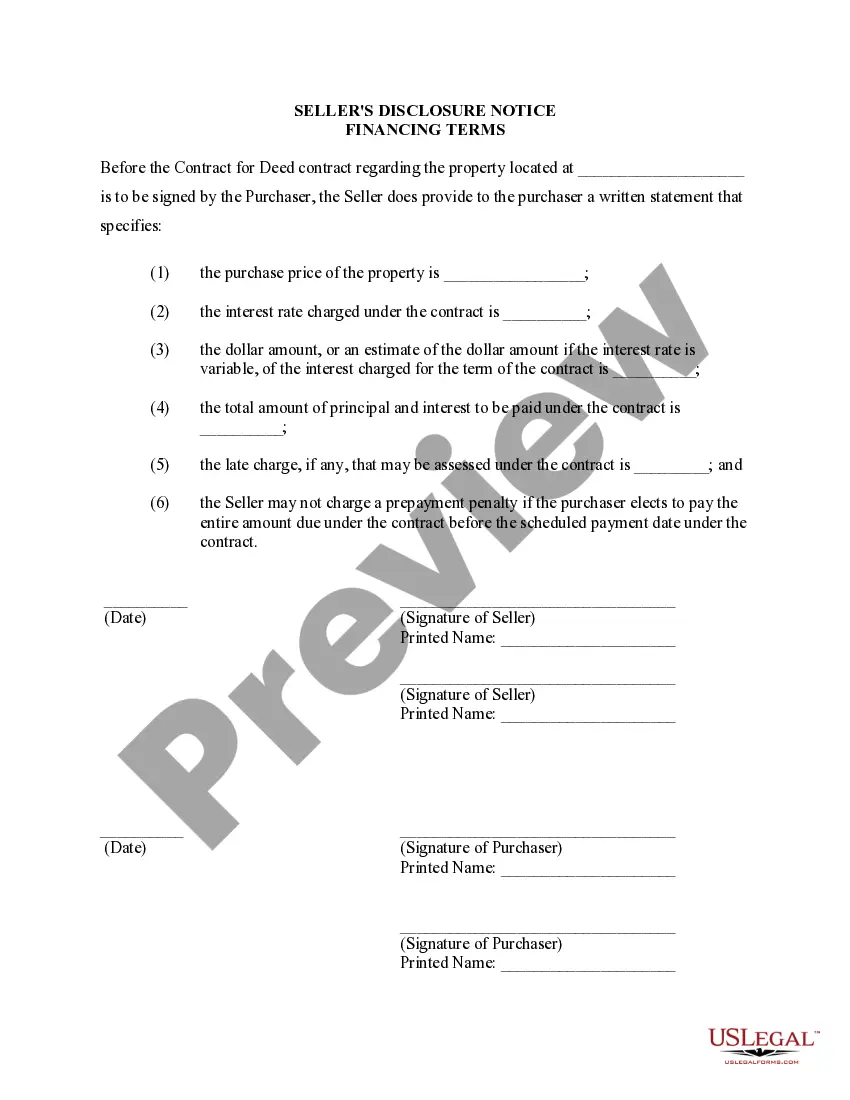
Alaska Seller's Disclosure of Financing Terms for Residential Property in connection with Contract or Agreement for Deed a/k/a Land Contract
About this form
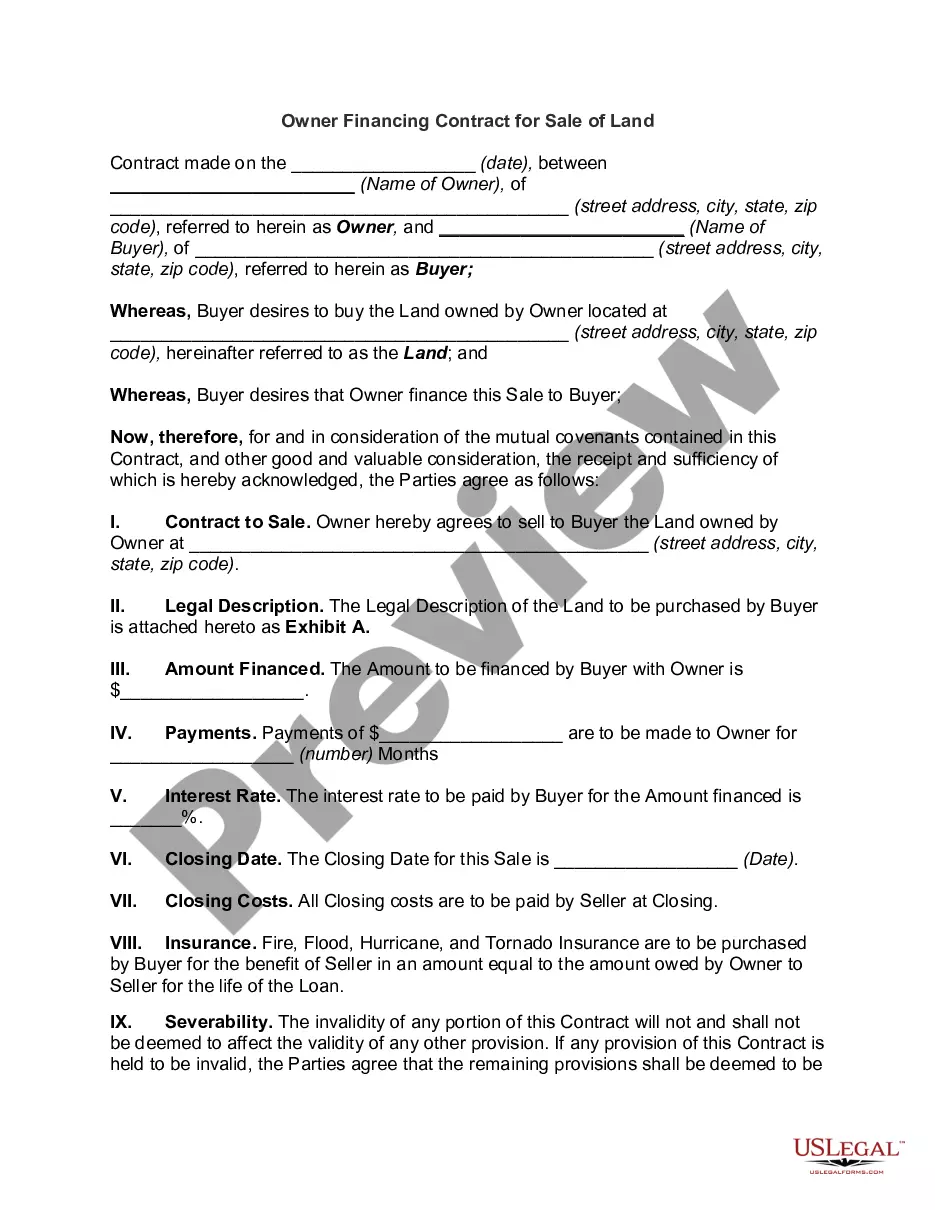
The Seller's Disclosure of Financing Terms for Residential Property is an essential document that provides potential purchasers with important details about the financing aspect of a property sale. This form outlines the purchase price, payment schedule, interest rates, and any late charges associated with a Contract for Deed, commonly known as a Land Contract. It ensures transparency between the seller and buyer, setting clear expectations regarding financial obligations.
Key parts of this document
- Property description: Identifies the residential property involved in the transaction.
- Purchase price: States the total amount agreed upon for the property.
- Payment terms: Includes details about the payment frequency, amount, and due dates.
- Interest rate: Specifies the interest rate that will apply to the financing.
- Late charges: Outlines any penalties for missed payments.
When this form is needed
This form is required when a seller is providing financing to the buyer under a Contract for Deed. It should be completed prior to finalizing the contract to ensure that both parties understand the financial terms of the transaction. Scenarios where this form is essential include purchasing a home with seller financing, negotiating terms for properties sold under land contracts, and clarifying payment obligations.
Intended users of this form
This form is intended for:
- Property sellers offering financing options to buyers.
- Buyers interested in understanding the financial details before signing a contract.
- Real estate agents or attorneys facilitating property transactions involving seller financing.
Completing this form step by step
- Identify the parties involved: Fill in the names of the seller and purchaser.
- Specify the property: Provide a detailed description of the residential property being sold.
- Enter the purchase price: Clearly state the total sales price for the property.
- Outline payment terms: Detail how payments will be made, including frequency and amount.
- Indicate interest and late charges: Add the applicable interest rate and potential late fees.
Notarization requirements for this form
This form does not typically require notarization unless specified by local law. However, having the document notarized can provide an additional layer of validity and protection in the transaction.
Get your form ready online
Our built-in tools help you complete, sign, share, and store your documents in one place.
Make edits, fill in missing information, and update formatting in US Legal Forms—just like you would in MS Word.
Download a copy, print it, send it by email, or mail it via USPS—whatever works best for your next step.
Sign and collect signatures with our SignNow integration. Send to multiple recipients, set reminders, and more. Go Premium to unlock E-Sign.
If this form requires notarization, complete it online through a secure video call—no need to meet a notary in person or wait for an appointment.
We protect your documents and personal data by following strict security and privacy standards.

Make edits, fill in missing information, and update formatting in US Legal Forms—just like you would in MS Word.

Download a copy, print it, send it by email, or mail it via USPS—whatever works best for your next step.

Sign and collect signatures with our SignNow integration. Send to multiple recipients, set reminders, and more. Go Premium to unlock E-Sign.

If this form requires notarization, complete it online through a secure video call—no need to meet a notary in person or wait for an appointment.

We protect your documents and personal data by following strict security and privacy standards.
Mistakes to watch out for
- Failing to update the purchase price or payment terms as negotiations progress.
- Neglecting to specify the interest rate, which can lead to confusion later.
- Not including all parties' names, which may invalidate the contract.
Advantages of online completion
- Immediate access to a comprehensive and legally vetted form.
- Convenient download and editing options to tailor the form as needed.
- Time-saving process that eliminates the need for physical visits to obtain forms.
Looking for another form?
Form popularity
FAQ
It is a form used when a seller offers financing under a Contract for Deed to disclose the essential financing terms for a residential property. It covers the property description, purchase price, payment terms, interest rate, and late charges, and it should be completed before finalizing the contract to ensure both parties understand the financial obligations.
Yes. Seller financing can be structured as a Contract for Deed, and this form is designed to disclose the financing terms in that arrangement. It records the property description, purchase price, payment terms, interest rate, and any late charges so both parties understand the deal before signing the contract.
Seller financing can be structured in several ways, but when a Contract for Deed is used, this form specifically discloses the main financing terms. It sets the purchase price, the payment schedule and due dates, the interest rate, and any late charges, giving both buyer and seller a clear, written record before closing.
No. Seller financing is a broad concept that covers any loan arrangement from the seller to the buyer, while a Contract for Deed is a specific form of seller financing used in Alaska. This form is used to disclose financing terms when the sale is conducted under a Contract for Deed rather than a traditional mortgage.
This disclosure covers five items: property description, purchase price, payment terms, interest rate, and late charges. It does not include other non-financing terms such as closing costs, property taxes, or insurance details, which may be addressed separately in the transaction.
This form is tailored for Alaska and specifically for seller financing used with a Contract for Deed (land contract). It requires disclosure of financing terms before finalizing the contract and focuses on five key items (property description, purchase price, payment terms, interest rate, late charges), distinguishing it from generic mortgage disclosures or other financing disclosures.