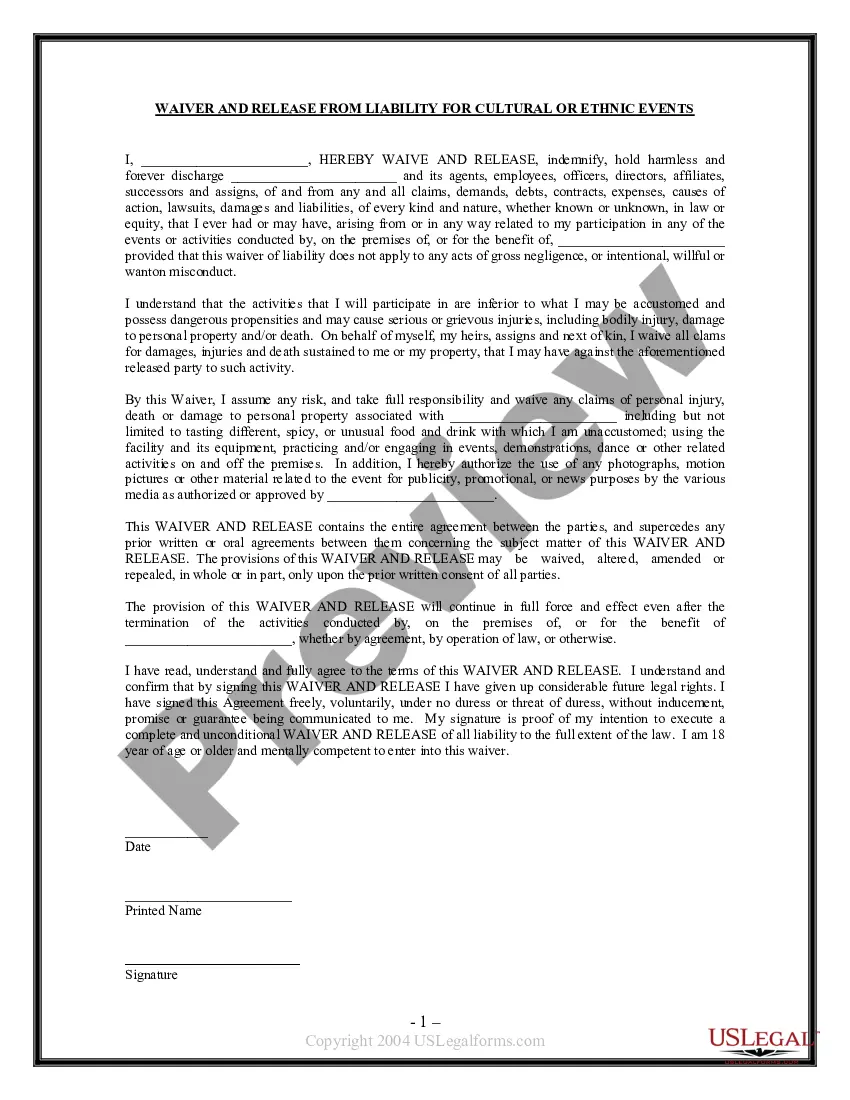
Waiver Form For Passport
Description
Get your form ready online
Our built-in tools help you complete, sign, share, and store your documents in one place.
Make edits, fill in missing information, and update formatting in US Legal Forms—just like you would in MS Word.
Download a copy, print it, send it by email, or mail it via USPS—whatever works best for your next step.
Sign and collect signatures with our SignNow integration. Send to multiple recipients, set reminders, and more. Go Premium to unlock E-Sign.
If this form requires notarization, complete it online through a secure video call—no need to meet a notary in person or wait for an appointment.
We protect your documents and personal data by following strict security and privacy standards.

Make edits, fill in missing information, and update formatting in US Legal Forms—just like you would in MS Word.

Download a copy, print it, send it by email, or mail it via USPS—whatever works best for your next step.

Sign and collect signatures with our SignNow integration. Send to multiple recipients, set reminders, and more. Go Premium to unlock E-Sign.

If this form requires notarization, complete it online through a secure video call—no need to meet a notary in person or wait for an appointment.

We protect your documents and personal data by following strict security and privacy standards.
Looking for another form?
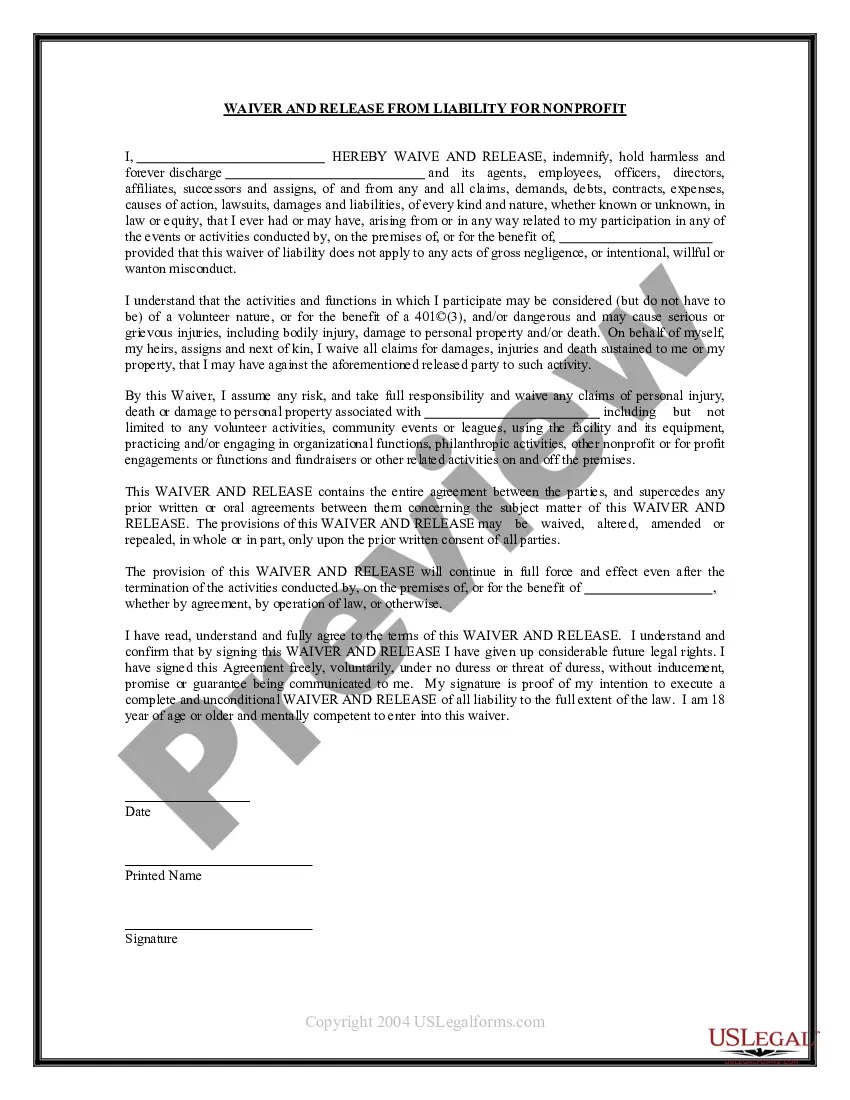
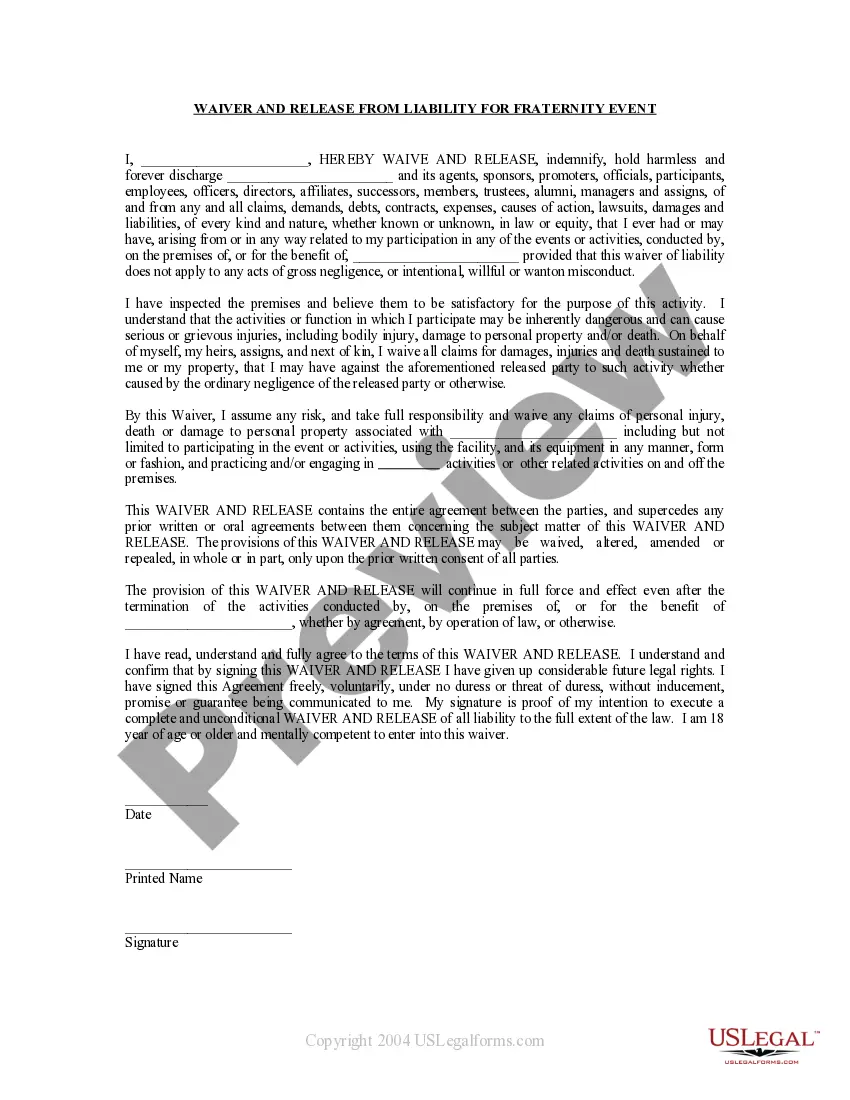
How to fill out Waiver And Release From Liability For Adult For Cultural And Ethnic Events?
Legal administration can be exasperating, even for seasoned professionals.
When you need a Waiver Form For Passport and are unable to take the time to search for the suitable and latest version, the tasks can become overwhelming.
Gain access to a valuable resource collection of articles, guides, and manuals pertinent to your circumstances and requirements.
Save effort and time searching for the documents you need, and utilize US Legal Forms’ sophisticated search and Review feature to locate Waiver Form For Passport and download it.
Leverage the US Legal Forms online library, supported by 25 years of knowledge and reliability. Simplify your everyday document management in a straightforward and user-friendly manner today.
- If you possess a subscription, Log In to your US Legal Forms account, locate the form, and download it.
- Check your My documents section to review the documents you have previously saved and to manage your folders as needed.
- If this is your initial experience with US Legal Forms, create an account for unlimited access to all platform benefits.
- Below are the steps to follow after reaching the form you require.
- Confirm that this is the correct form by previewing it and reviewing its description.
- Access state- or county-specific legal and business documents.
- US Legal Forms caters to all requirements you may have, from personal to corporate paperwork, all in one location.
- Utilize advanced tools to complete and manage your Waiver Form For Passport.
Form popularity
FAQ
You qualify as a Vermont resident for that part of the taxable year during which: You are domiciled in Vermont, or. You maintain a permanent home in Vermont, and you are present in Vermont for more than 183 days of the taxable year.
You qualify as a Vermont resident for that part of the taxable year during which: You are domiciled in Vermont, or. You maintain a permanent home in Vermont, and you are present in Vermont for more than 183 days of the taxable year.
Although all income earned in Vermont is considered Vermont income, out-of-state employers are not required to begin withholding Vermont Income Tax until an employee has been working from a Vermont location for thirty days.
Vermont Residency Utility bill (must list service address). Property tax bill with physical location. Lease or Landlord statement. Vermont EBT (Electronic Benefit Transfer) card or Vermont AIM (Advanced Information Management) identification card. Homeowners/Renters insurance (policy/proof of claim).
Understanding the 183-Day Rule Generally, this means that if you spent 183 days or more in the country during a given year, you are considered a tax resident for that year. Each nation subject to the 183-day rule has its own criteria for considering someone a tax resident.
Part-year Resident: An individual who is a resident of Vermont for only part of the year. Nonresident: An individual that has income earned in Vermont but who does not qualify as a resident of Vermont for any part of the year is a Nonresident.
Vermont Residency Utility bill (must list service address). Property tax bill with physical location. Lease or Landlord statement. Vermont EBT (Electronic Benefit Transfer) card or Vermont AIM (Advanced Information Management) identification card. Homeowners/Renters insurance (policy/proof of claim).
Ing to the Vermont website: A Resident is an individual that is domiciled in Vermont or maintains a permanent home, and is physically present in the state for 183 days or more. A Nonresident is an individual that does not qualify as a resident or part-year resident during the tax year.