Curfew Law For California
Description
Get your form ready online
Our built-in tools help you complete, sign, share, and store your documents in one place.
Make edits, fill in missing information, and update formatting in US Legal Forms—just like you would in MS Word.
Download a copy, print it, send it by email, or mail it via USPS—whatever works best for your next step.
Sign and collect signatures with our SignNow integration. Send to multiple recipients, set reminders, and more. Go Premium to unlock E-Sign.
If this form requires notarization, complete it online through a secure video call—no need to meet a notary in person or wait for an appointment.
We protect your documents and personal data by following strict security and privacy standards.

Make edits, fill in missing information, and update formatting in US Legal Forms—just like you would in MS Word.

Download a copy, print it, send it by email, or mail it via USPS—whatever works best for your next step.

Sign and collect signatures with our SignNow integration. Send to multiple recipients, set reminders, and more. Go Premium to unlock E-Sign.

If this form requires notarization, complete it online through a secure video call—no need to meet a notary in person or wait for an appointment.

We protect your documents and personal data by following strict security and privacy standards.
Looking for another form?
How to fill out Curfew Ordinance?
Creating legal documents from the ground up can frequently be overwhelming.
Certain cases may take countless hours of investigation and cost you hundreds of dollars.
If you’re looking for a more straightforward and economical method of preparing Curfew Law For California or any other documents without unnecessary complications, US Legal Forms is perpetually within reach.
Our digital collection of over 85,000 current legal templates encompasses nearly every dimension of your financial, legal, and personal matters.
But before proceeding to download the Curfew Law For California, consider the following suggestions: Review the document preview and descriptions to confirm that you are selecting the correct form. Ensure that the form you choose adheres to the statutes and regulations of your state and county. Choose the most appropriate subscription plan to acquire the Curfew Law For California. Download the form, then complete, validate, and print it out. US Legal Forms has a solid reputation and over 25 years of expertise. Join us today and simplify the form completion process into a convenient and efficient experience!
- With just a few clicks, you can immediately access state- and county-specific templates carefully curated for you by our legal professionals.
- Utilize our platform whenever you require dependable and trustworthy services to effortlessly find and download the Curfew Law For California.
- If you're already familiar with our services and have previously registered an account with us, simply Log In to your account, find the template, and download it or access it again at any time in the My documents section.
- Don’t have an account? No worries. Setting it up takes only a few minutes, allowing you to browse through the catalog.
Form popularity
FAQ
Minnesota’s curfew law generally requires minors to be home by 10 PM on weekdays and 11 PM on weekends. Enforcement of these curfews aims to safeguard youth in the community. While this information pertains to Minnesota, it’s beneficial to compare and understand the curfew law for California as well. This comparison can assist those moving between states or travelling with minors.
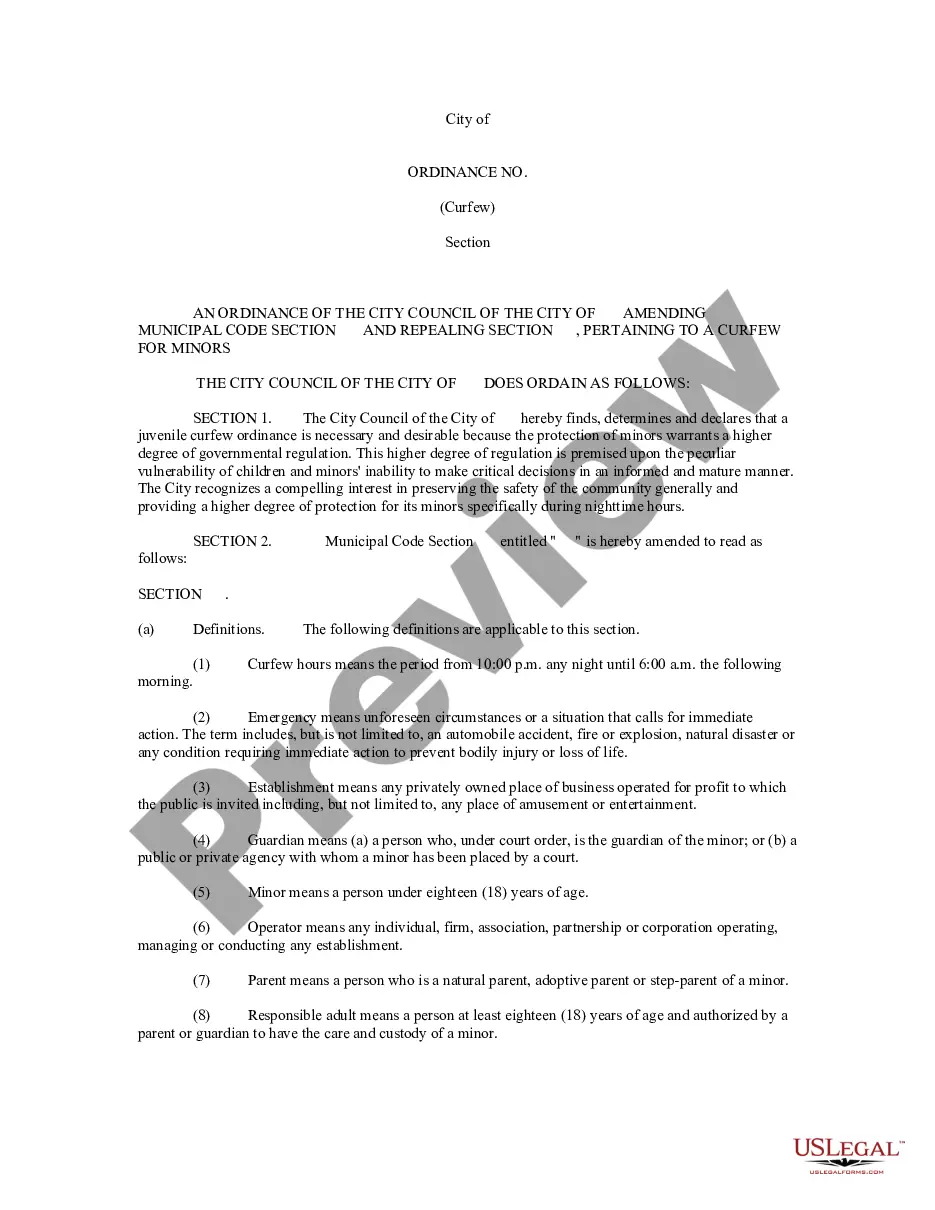
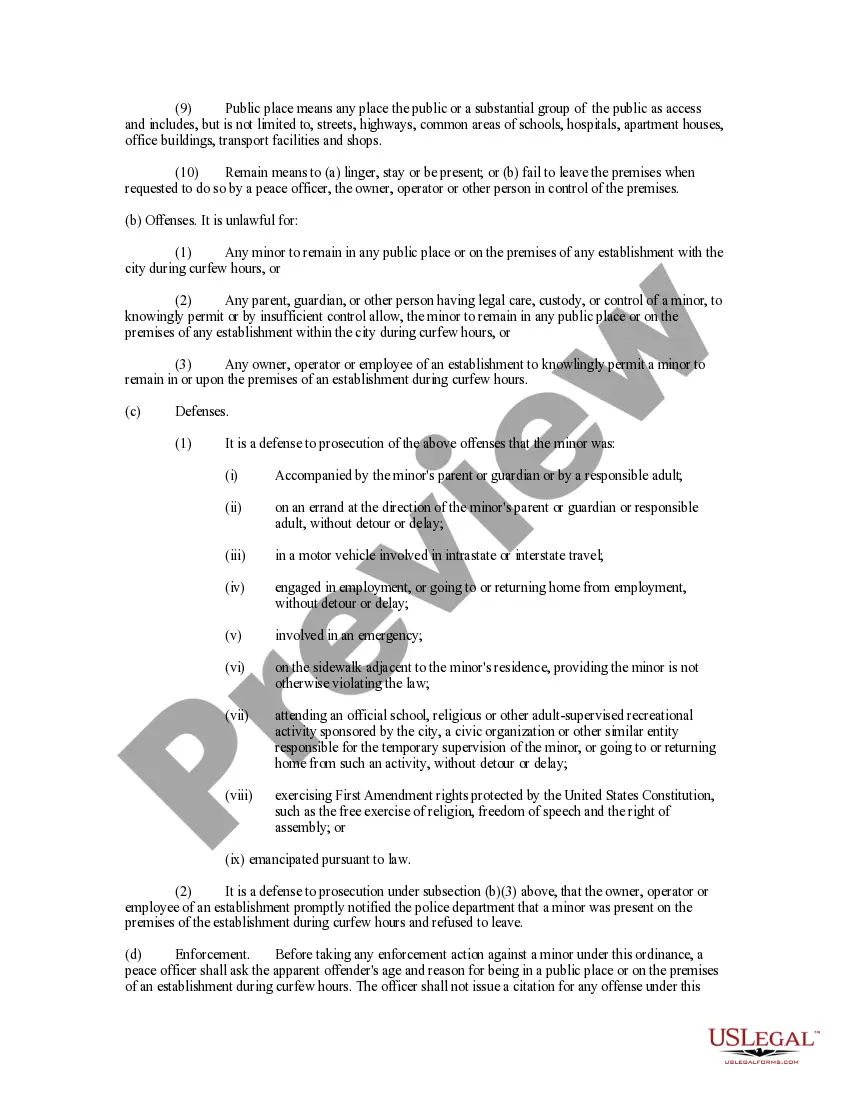
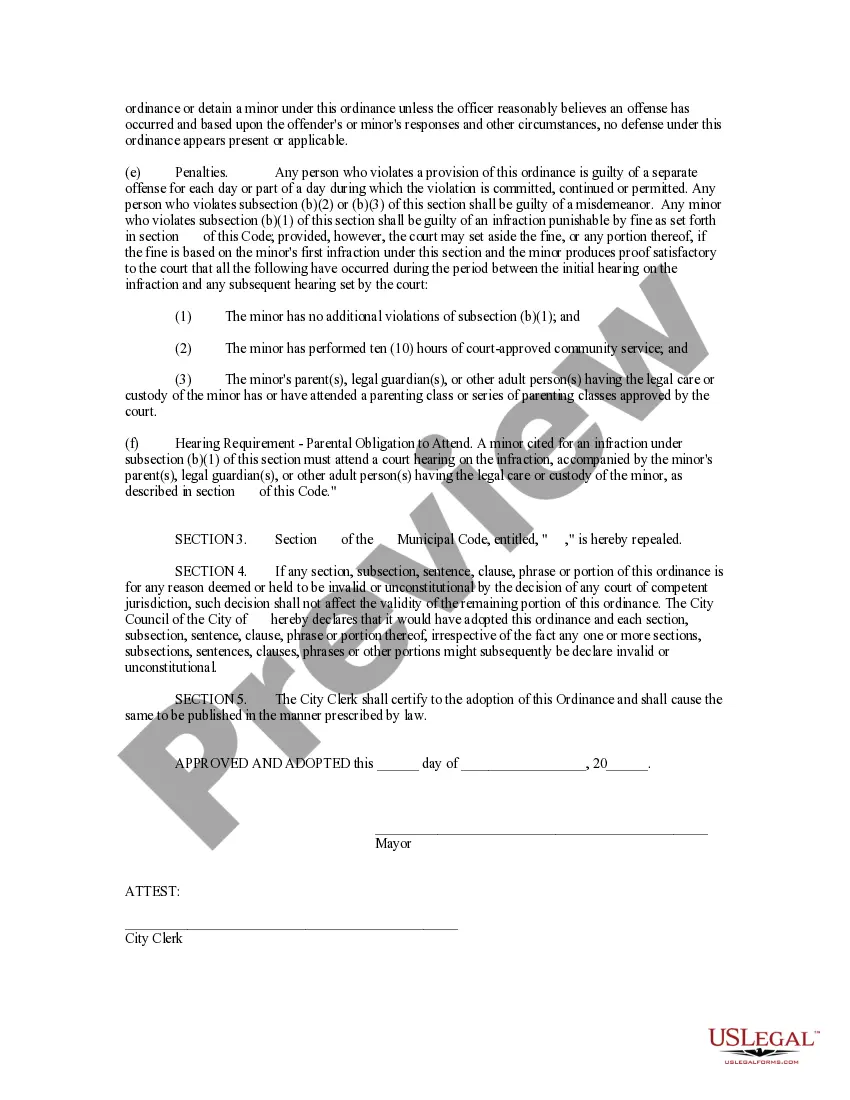
Typically, in California, the age at which you do not have a curfew is 18 years. By reaching this milestone, you have the legal freedom to be out at any hour without restrictions, provided there are no local laws stating otherwise. However, each city may have additional regulations, so reviewing local ordinances is always a wise decision. Understanding the curfew law for California can help you navigate these rules effectively.
Yes, California does have curfew laws, but they vary by city. Generally, curfews apply to minors under the age of 18, restricting their nighttime activities. Local ordinances may designate certain hours as curfew for younger individuals to enhance community safety. Familiarizing yourself with these laws can avoid unnecessary legal trouble.
In California, if you are a minor and are out past curfew, being accompanied by someone who is 18 or older may not exempt you from local curfew laws. Local jurisdictions may still enforce curfew regulations regardless of your companion's age. It’s important to know the curfew law for California and consult with local law enforcement agencies if you have questions about specific situations. Always prioritize safety and compliance with the law.
Curfew laws in Illinois require minors under 17 to be home by 10 PM on weekdays and 11 PM on weekends, unless accompanied by an adult. These laws aim to promote safety among young people in their communities. While this information pertains to Illinois, understanding curfew laws for California can help you navigate similar situations effectively. Be sure to check local regulations for specifics.
In California, individuals who are 18 years old are considered legal adults. Therefore, there is no legally mandated curfew law for California residents at this age. However, local cities may have specific ordinances that set curfews for minors. It's essential to consult these local laws to understand any age-specific regulations.
The curfew law for California generally sets a curfew time of 10 PM for minors on school nights and extends to 12 AM on weekends. However, local laws can vary and some municipalities may have different curfew hours. It's crucial for parents and teens to familiarize themselves with local ordinances to avoid violations. For comprehensive legal documents and advice, UsLegalForms offers reliable assistance to help navigate these nuances.
Yes, curfew laws in California can be legally enforced by law enforcement agencies. Failing to comply with these laws may result in warnings, citations, or even legal consequences for parents and minors. It is important to recognize that these laws aim to protect youth by limiting late-night activities. If you need assistance understanding legal obligations related to curfew, platforms like UsLegalForms can provide valuable resources.
In California, curfew law for teenagers, including 17-year-olds, typically mandates that they must be home by 10 PM on school nights and by 12 AM on weekends. However, local jurisdictions may adjust these times, so it's essential to check specific city regulations. Adhering to these curfew laws helps ensure the safety and well-being of minors. Understanding these rules can help you navigate adolescent freedoms responsibly.
If you stay up past your curfew, you may face consequences set by your parents, which could include loss of privileges or extra chores. Additionally, it’s essential to discuss why curfews exist and the importance of adhering to them. Familiarizing yourself with the curfew law for California can help reinforce the necessity of these guidelines.