False Imprisonment Arrest Without Warrant
Description
Get your form ready online
Our built-in tools help you complete, sign, share, and store your documents in one place.
Make edits, fill in missing information, and update formatting in US Legal Forms—just like you would in MS Word.
Download a copy, print it, send it by email, or mail it via USPS—whatever works best for your next step.
Sign and collect signatures with our SignNow integration. Send to multiple recipients, set reminders, and more. Go Premium to unlock E-Sign.
If this form requires notarization, complete it online through a secure video call—no need to meet a notary in person or wait for an appointment.
We protect your documents and personal data by following strict security and privacy standards.

Make edits, fill in missing information, and update formatting in US Legal Forms—just like you would in MS Word.

Download a copy, print it, send it by email, or mail it via USPS—whatever works best for your next step.

Sign and collect signatures with our SignNow integration. Send to multiple recipients, set reminders, and more. Go Premium to unlock E-Sign.

If this form requires notarization, complete it online through a secure video call—no need to meet a notary in person or wait for an appointment.

We protect your documents and personal data by following strict security and privacy standards.
Looking for another form?








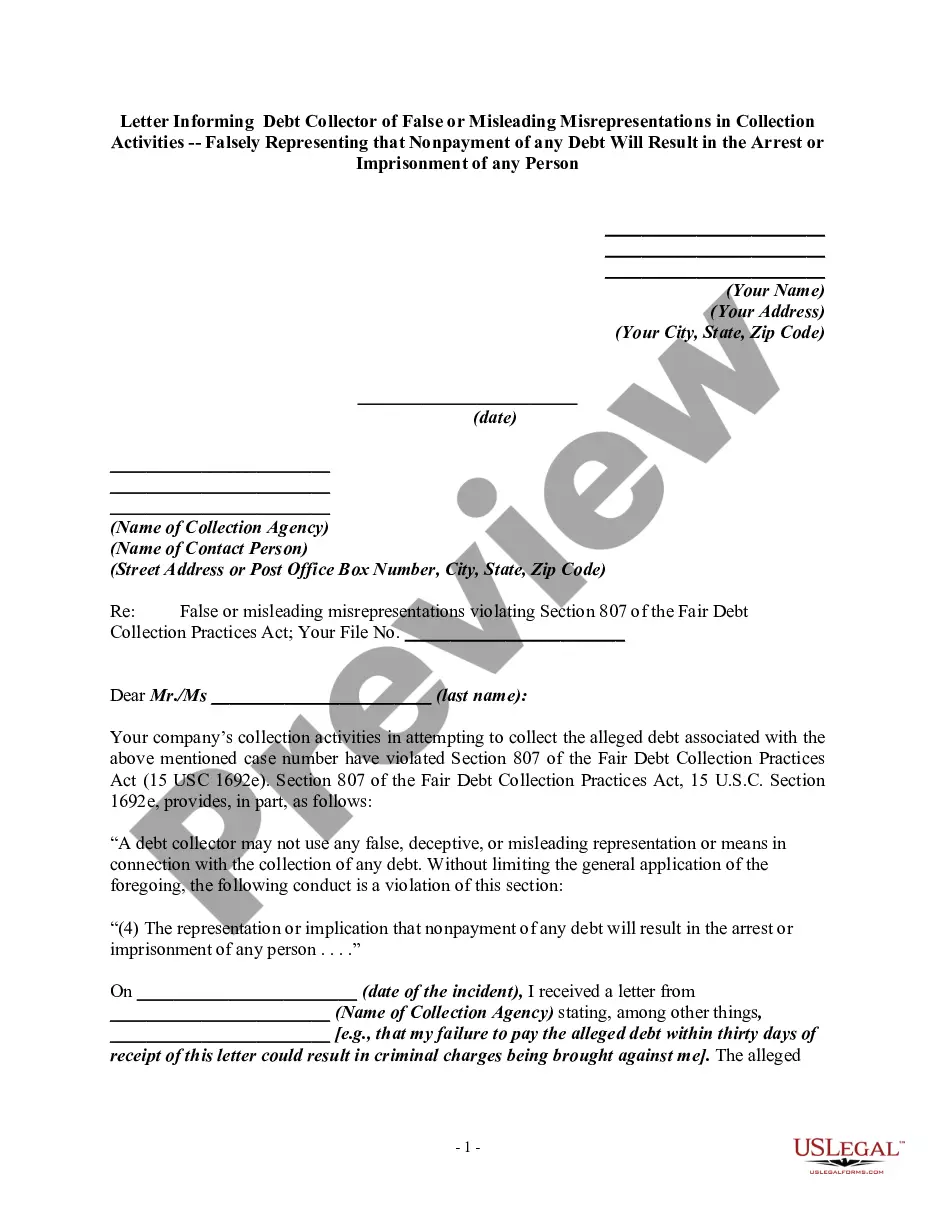
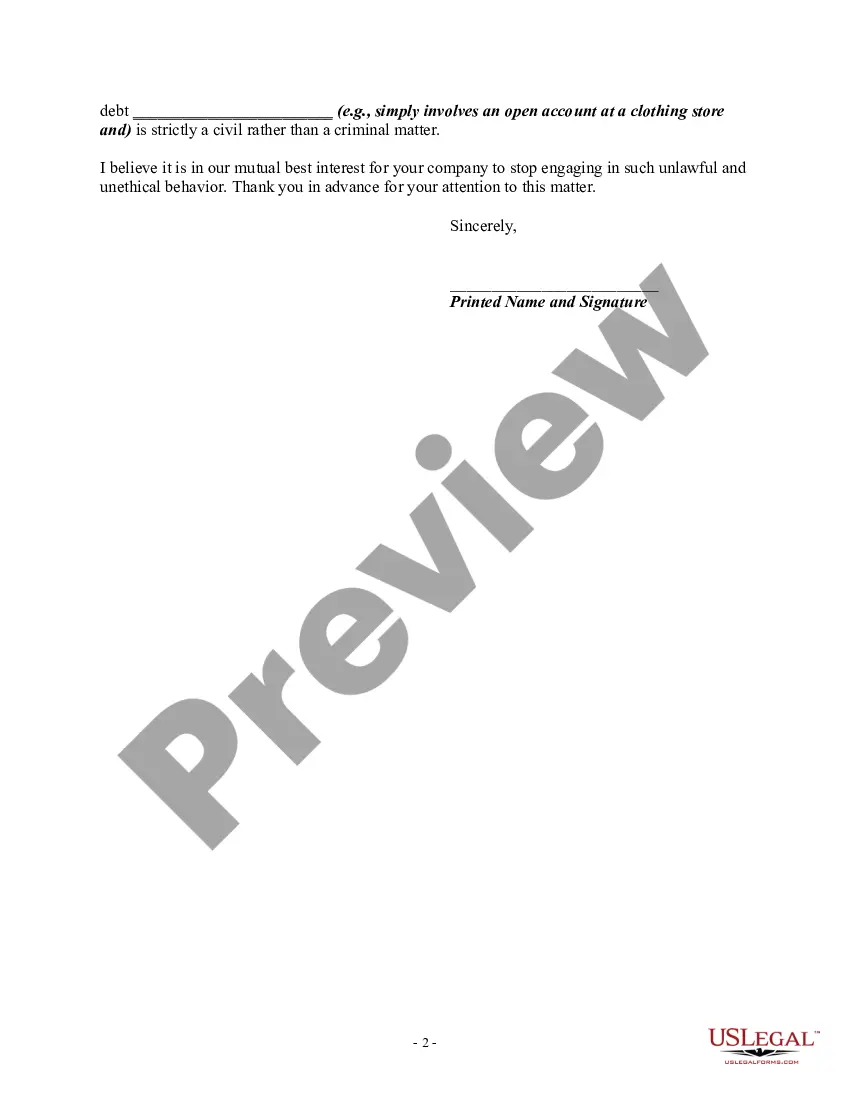
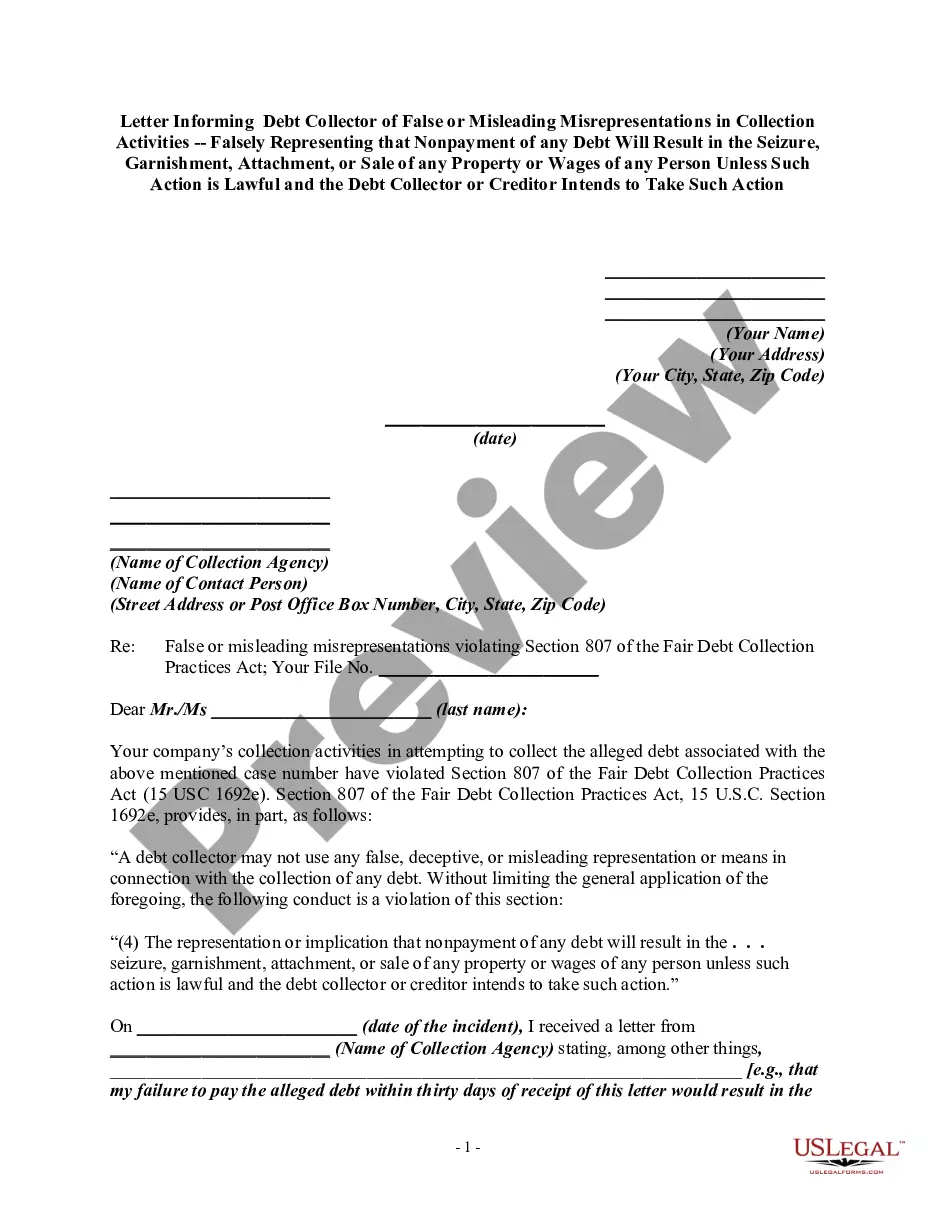
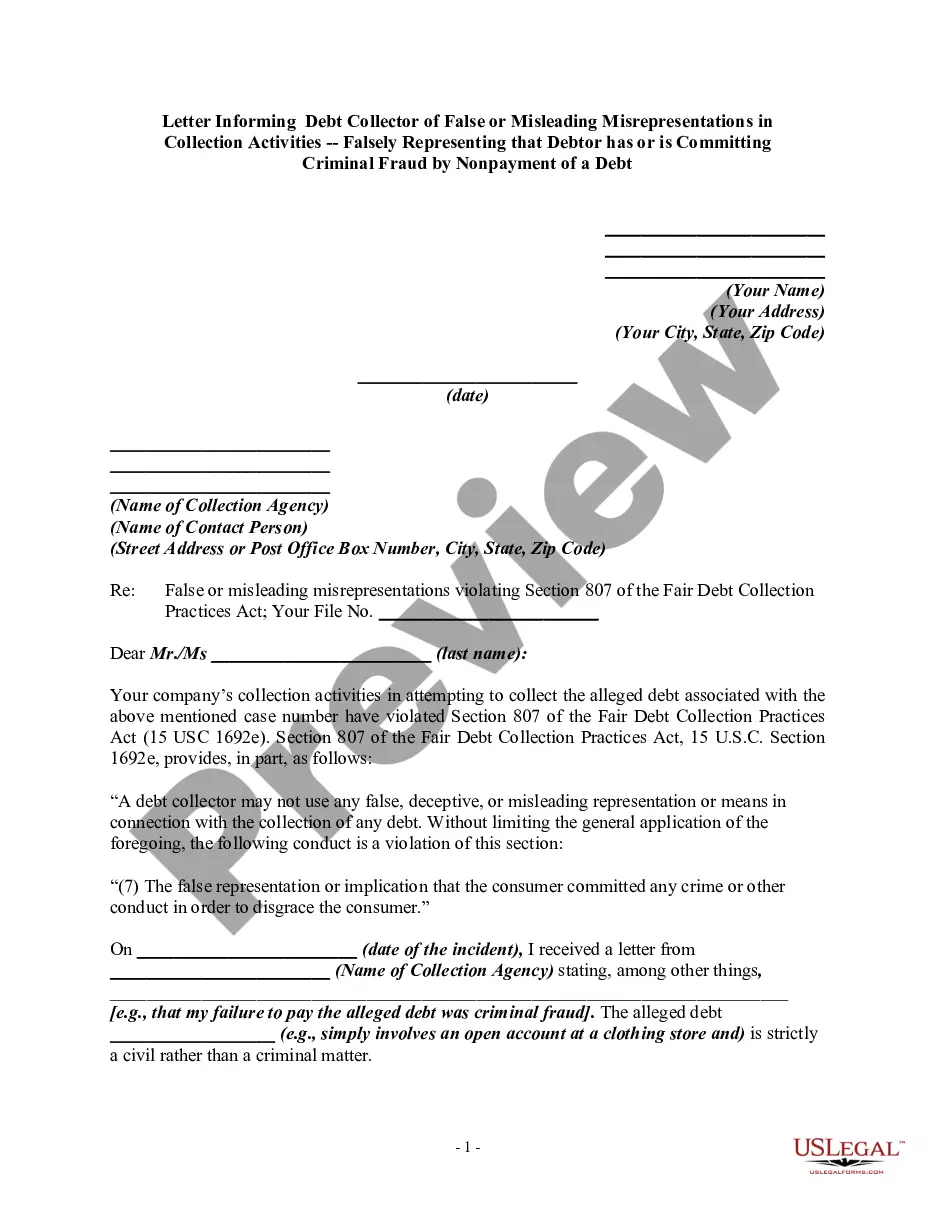
How to fill out Letter Informing Debt Collector Of False Or Misleading Misrepresentations In Collection Activities - Falsely Representing That Nonpayment Of Any Debt Will Result In The Arrest Or Imprisonment Of Any Person?
Legal oversight can be daunting, even for the most skilled experts.
When you are looking for a False Imprisonment Arrest Without Warrant and do not have the time to devote to finding the appropriate and current version, the procedures can be overwhelming.
US Legal Forms addresses any requirements you may have, from personal to business paperwork, all in one location.
Utilize advanced tools to complete and handle your False Imprisonment Arrest Without Warrant.
Below are the steps to follow after downloading the form you require: Validate it is the correct form by previewing it and reviewing its details. Ensure that the template is accepted in your state or county. Click Buy Now when you are ready. Choose a monthly subscription plan. Locate the format you need, and Download, complete, eSign, print, and send your documents. Enjoy the US Legal Forms online library, backed by 25 years of expertise and trustworthiness. Transform your daily document management into a straightforward and user-friendly process today.
- Access a resource hub of articles, guidelines, and materials pertinent to your situation and requirements.
- Save time and effort searching for the documents you need, and utilize US Legal Forms’ advanced search and Review tool to find False Imprisonment Arrest Without Warrant and download it.
- If you have a monthly subscription, Log In to the US Legal Forms account, search for the form, and download it.
- Check the My documents tab to see the documents you previously saved and to manage your folders as you prefer.
- If it is your first time with US Legal Forms, create an account and gain unlimited access to all benefits of the library.
- A robust online form library could be a pivotal solution for anyone who wants to manage these circumstances effectively.
- US Legal Forms is a frontrunner in online legal documents, with over 85,000 state-specific legal forms available to you at any time.
- With US Legal Forms, you can access state- or county-specific legal and organizational documents.
Form popularity
FAQ
When an arrest is made without a warrant, it is often referred to as a warrantless arrest. This legal provision allows law enforcement to act swiftly in specific situations where immediate action is necessary. Awareness of warrantless arrest procedures is crucial when discussing issues related to false imprisonment arrest without warrant.
Yes, an arrest can be made without a warrant under specific conditions. Law enforcement officers may take this action if they believe a suspect is committing a crime or poses a threat to public safety. This is a key aspect of the legal framework surrounding false imprisonment arrest without warrant.
An arrest can be made without a warrant in several situations, such as when an officer witnesses a crime or has probable cause to believe a crime has occurred. Officers may also arrest individuals for specific offenses occurring in their presence. Understanding these circumstances can help you navigate the complexities of false imprisonment arrest without warrant.
Most arrests occur without a warrant because law enforcement officers often need to act quickly. Situations may arise where immediate action is necessary to prevent harm or secure evidence. In these cases, officers can legally perform a false imprisonment arrest without warrant, based on probable cause.
Consent to restraint is a defense to a charge of false imprisonment. If a person gives express or implied consent to the violation of their liberty, no false imprisonment occurs. To consent, a person must assent freely and voluntarily and know the nature of the act they are or will be experiencing.
To prove a false imprisonment claim as a tort in a civil lawsuit, the following elements must be present: There was a willful detention; The detention was without consent; and. The detention was unlawful.
A person commits false imprisonment when they engage in the act of restraint on another person which confines that person in a restricted area. False imprisonment is an act punishable under criminal law as well as under tort law.
Penal Code § 236 PC defines the California crime of ?false imprisonment? as unlawfully restraining, detaining, or confining a person against his or her will. The offense can be charged as either a misdemeanor or felony and is punishable by up to three years in jail.
Elements of the crime intentionally detained, restrained, or confined another person; the restraint made the victim stay or go somewhere for a period of time; victim did not give their consent and was harmed; the conduct was a significant factor in causing victim's harm.