Llc Form Companies File For Tax Purposes
Description
Get your form ready online
Our built-in tools help you complete, sign, share, and store your documents in one place.
Make edits, fill in missing information, and update formatting in US Legal Forms—just like you would in MS Word.
Download a copy, print it, send it by email, or mail it via USPS—whatever works best for your next step.
Sign and collect signatures with our SignNow integration. Send to multiple recipients, set reminders, and more. Go Premium to unlock E-Sign.
If this form requires notarization, complete it online through a secure video call—no need to meet a notary in person or wait for an appointment.
We protect your documents and personal data by following strict security and privacy standards.

Make edits, fill in missing information, and update formatting in US Legal Forms—just like you would in MS Word.

Download a copy, print it, send it by email, or mail it via USPS—whatever works best for your next step.

Sign and collect signatures with our SignNow integration. Send to multiple recipients, set reminders, and more. Go Premium to unlock E-Sign.

If this form requires notarization, complete it online through a secure video call—no need to meet a notary in person or wait for an appointment.

We protect your documents and personal data by following strict security and privacy standards.
Looking for another form?





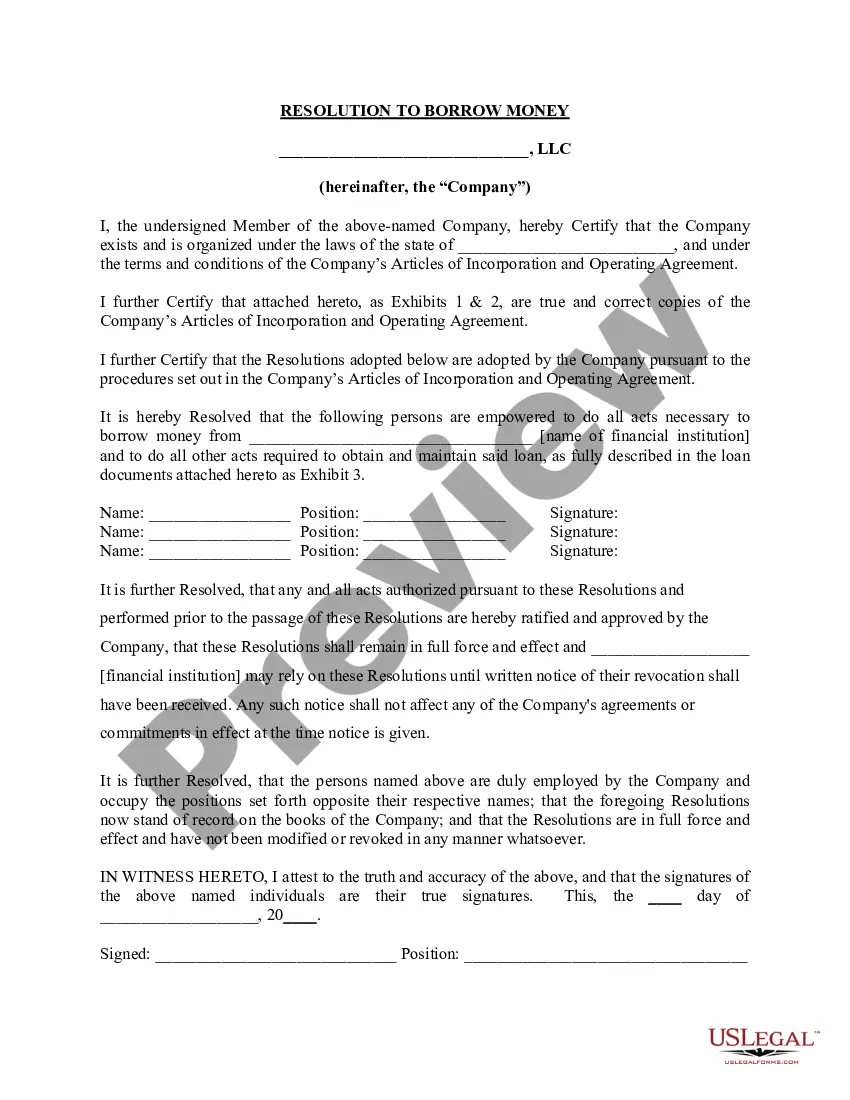
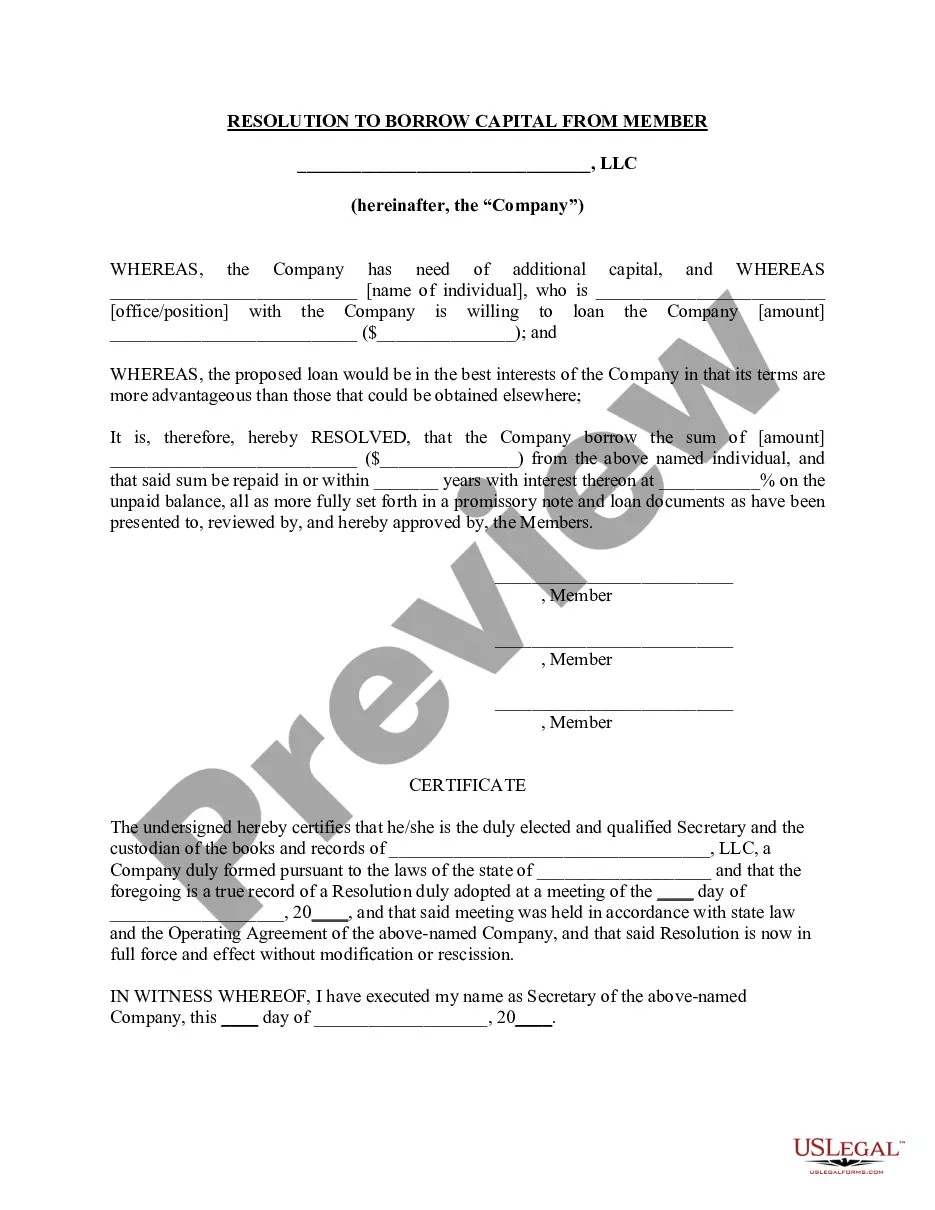
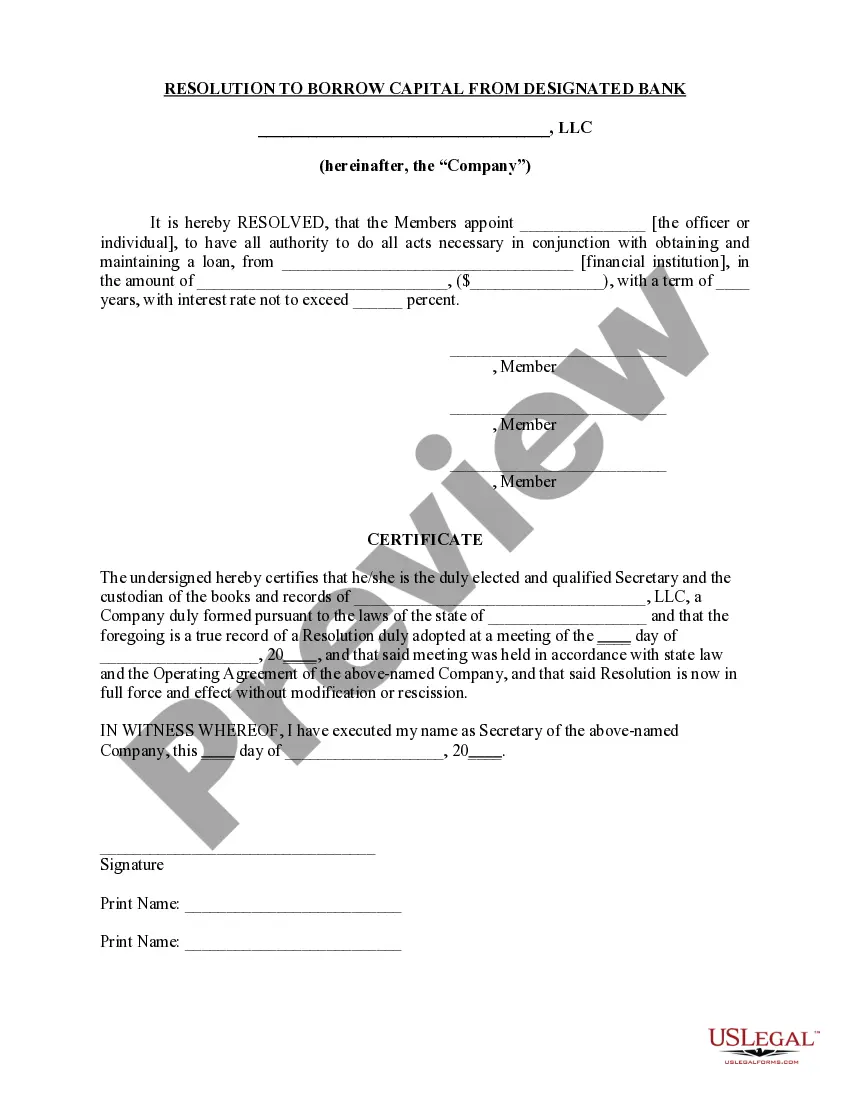
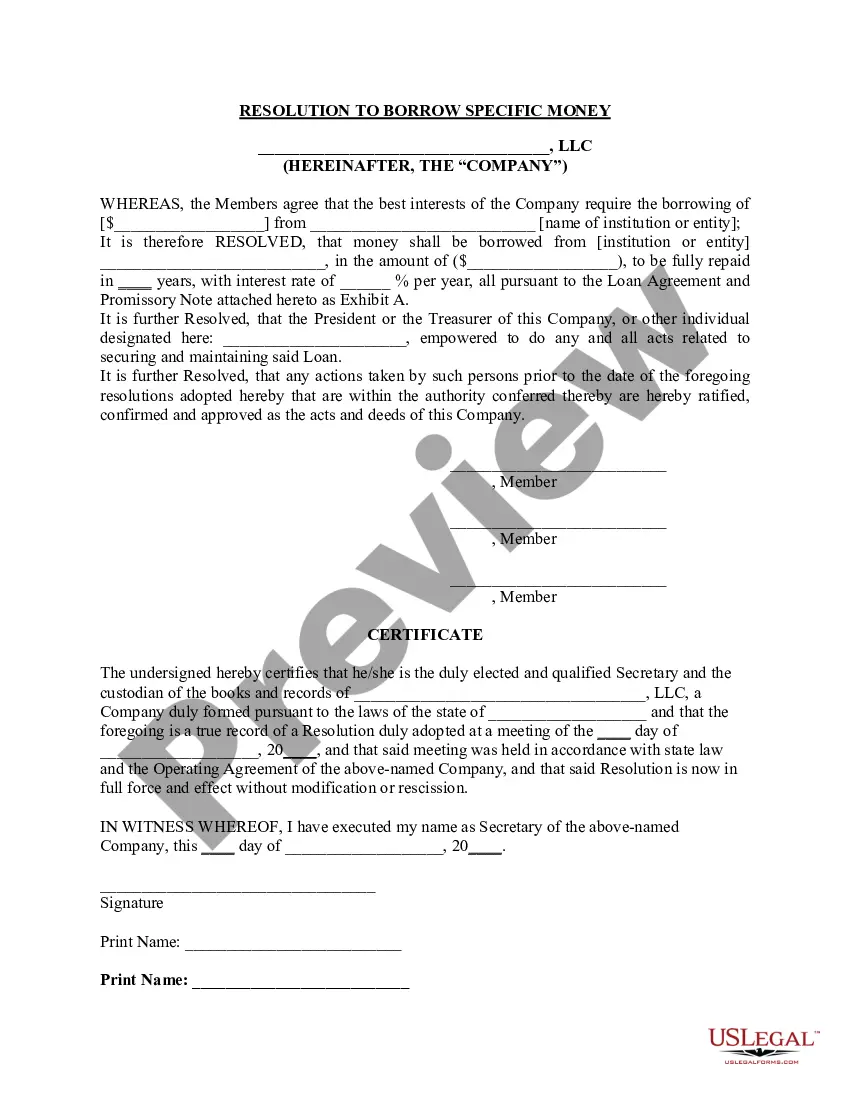
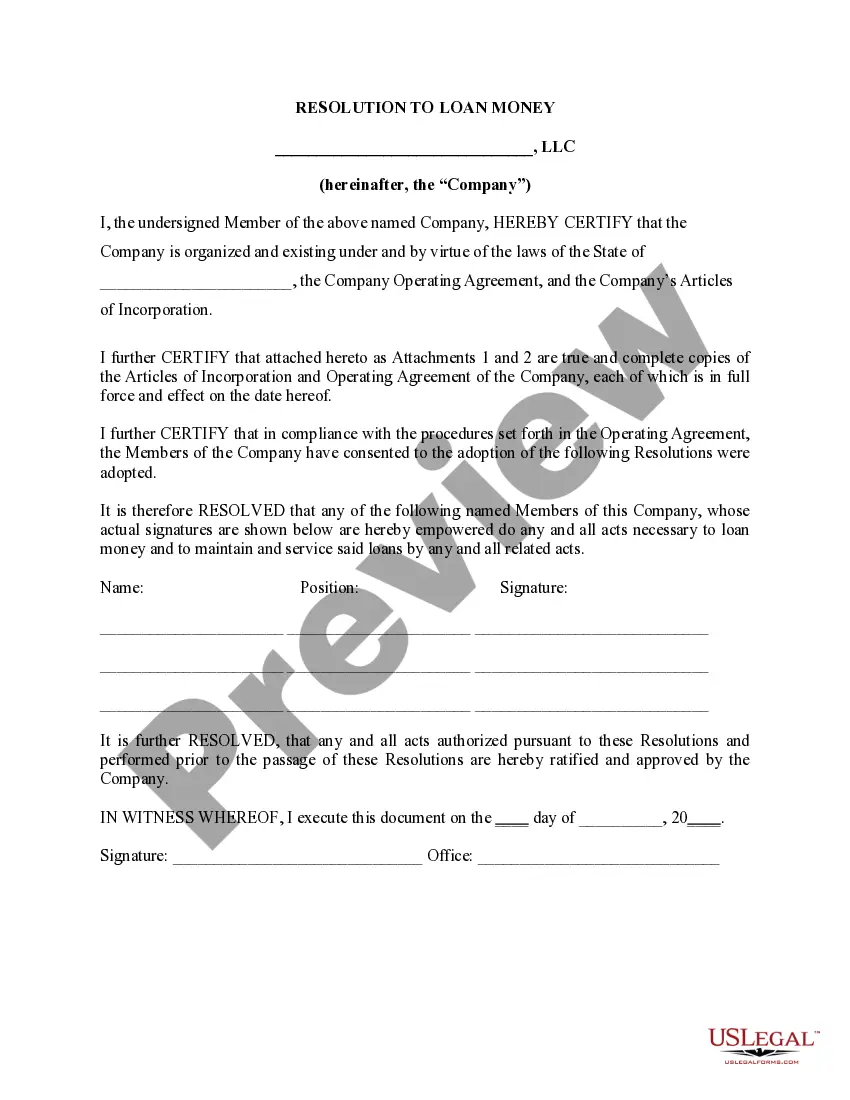
How to fill out Resolution Of Meeting Of LLC Members To Borrow Money?
- Log in to your US Legal Forms account if you're a returning user. Make sure your subscription is active; renew if necessary.
- For new users, browse the extensive library and check the form previews to find the correct LLC tax form that suits your jurisdiction.
- Utilize the search feature if you can't find what you need, ensuring you have the right documents.
- Once you've identified the necessary form, click the 'Buy Now' button to select your preferred subscription plan.
- Complete your purchase by entering your payment information through credit card or PayPal.
- Download the form to your device and access it anytime from the 'My Forms' section of your profile.
In conclusion, US Legal Forms simplifies the process of obtaining and filing LLC forms for tax purposes. By leveraging their robust library, you can ensure that your documents are not only available but also correctly filled out to convey your compliance.
Get started today—visit US Legal Forms and streamline your legal document needs!
Form popularity
FAQ
To find out if your LLC is classified as an S Corp, C Corp, or partnership, review your formation documents and IRS election forms. You can identify S Corporations by their election of S status via Form 2553, while those that have not elected this status are typically considered C Corporations. If you have not filed any forms, and your LLC has multiple members, it is most likely a partnership. Being clear about these classifications helps you navigate how LLC form companies file for tax purposes.
The main distinction lies in tax treatment and structure. An S corporation allows profits and losses to be passed to shareholders, avoiding double taxation. In contrast, a C corporation is taxed on its earnings before distributions. Meanwhile, a partnership LLC shares profits and losses among its members accordingly. Knowing these differences helps when determining how LLC form companies file for tax purposes.
The primary difference between LLC 1065 and LLC 1120 lies in their tax classifications. Form 1065 is used by partnership LLCs to report income, deductions, and credits, while Form 1120 is for C corporations. Understanding which form to file is crucial for meeting your tax obligations and optimizing your financial strategy. This distinction illustrates the various ways LLC form companies file for tax purposes.
To identify whether your LLC is classified as an S corporation, C corporation, or a partnership, examine your IRS election forms. An LLC becomes an S corporation by choosing that status with Form 2553, while a C corporation designation occurs by default if no action is taken. If your LLC operates as a partnership, it means you'll file Form 1065 for tax purposes. This classification is vital for how LLC form companies file for tax purposes.
An LLC can be either a partnership or an S corporation, depending on how it is structured and the tax classification it chooses. If your LLC has multiple members without elected S corporation status, it functions as a partnership. Conversely, if you've elected S corporation status, your LLC will be treated differently for tax purposes. Thus, understanding your LLC's classification helps determine how LLC form companies file for tax purposes.
To determine if your LLC is a partnership, look at your company's structure and member agreements. An LLC is classified as a partnership if it has multiple members and has not opted for special tax classifications. Remember, LLCs that choose the partnership classification must file Form 1065 for tax purposes. This option allows LLC form companies to file for tax purposes more easily.
Not filing taxes for your LLC can result in financial penalties, interest on owed taxes, and potential legal actions from the IRS or state authorities. The LLC may also lose its limited liability protection, which can expose its owners to personal liability. Understanding the consequences is vital, as knowing how LLC form companies file for tax purposes can prevent these issues and promote compliance.
Even if an LLC has no income, it may still need to file a tax return, depending on its structure and state requirements. This filing helps maintain good standing and avoids potential penalties. It's wise for LLC owners to be aware of their filing requirements to properly navigate how LLC form companies file for tax purposes, regardless of income.
To receive a 1099 for your LLC, you need to ensure that clients or customers know your business’s tax status. Typically, if your LLC earns more than $600 from a single client, they are required to issue a 1099 form to you. It is essential to provide accurate information to clients to avoid delays in receiving your 1099. This process ties back into how LLC form companies file for tax purposes and maintain proper documentation.
An LLC files Form 1065 when it is classified as a partnership for tax purposes. This form reports the income, deductions, gains, and losses of the business. Each member receives a Schedule K-1 to report their share of the partnership's income on their personal tax returns. Understanding how LLC form companies file for tax purposes helps ensure compliance with these requirements.