Should You Fire Employee For Poor Performance
Description
Get your form ready online
Our built-in tools help you complete, sign, share, and store your documents in one place.
Make edits, fill in missing information, and update formatting in US Legal Forms—just like you would in MS Word.
Download a copy, print it, send it by email, or mail it via USPS—whatever works best for your next step.
Sign and collect signatures with our SignNow integration. Send to multiple recipients, set reminders, and more. Go Premium to unlock E-Sign.
If this form requires notarization, complete it online through a secure video call—no need to meet a notary in person or wait for an appointment.
We protect your documents and personal data by following strict security and privacy standards.

Make edits, fill in missing information, and update formatting in US Legal Forms—just like you would in MS Word.

Download a copy, print it, send it by email, or mail it via USPS—whatever works best for your next step.

Sign and collect signatures with our SignNow integration. Send to multiple recipients, set reminders, and more. Go Premium to unlock E-Sign.

If this form requires notarization, complete it online through a secure video call—no need to meet a notary in person or wait for an appointment.

We protect your documents and personal data by following strict security and privacy standards.
Looking for another form?








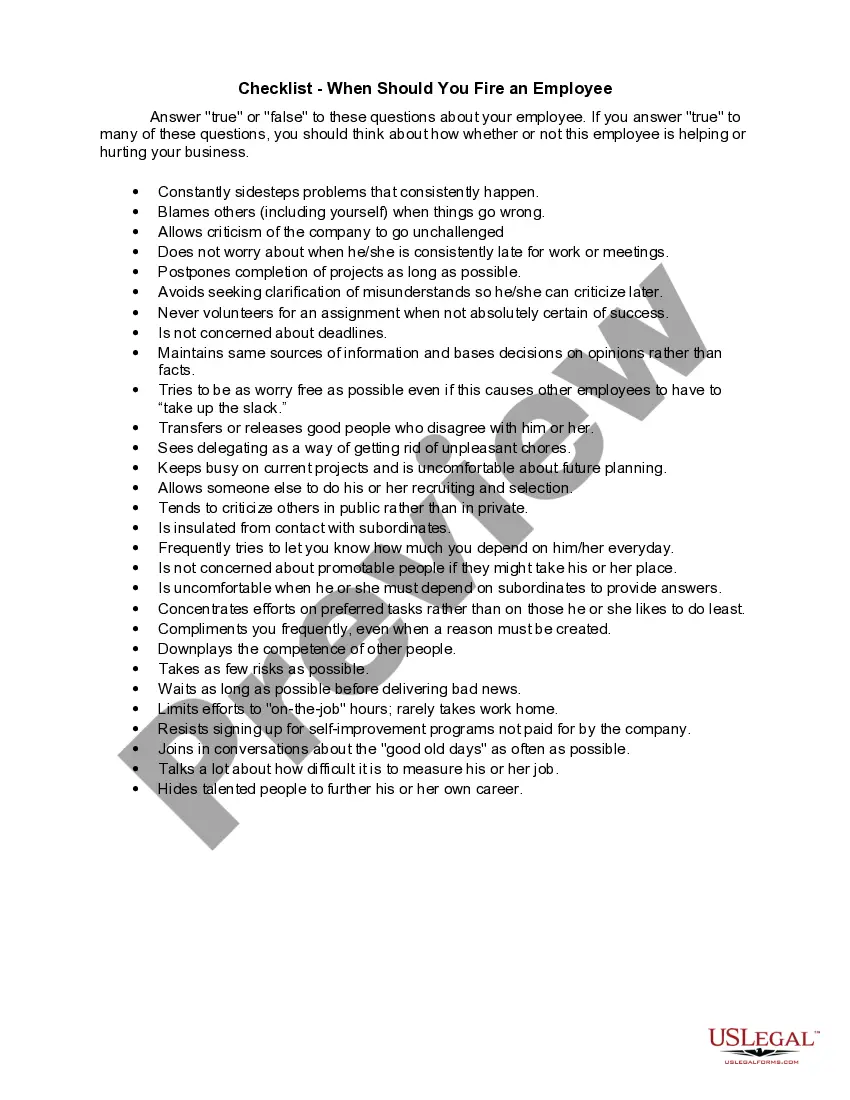
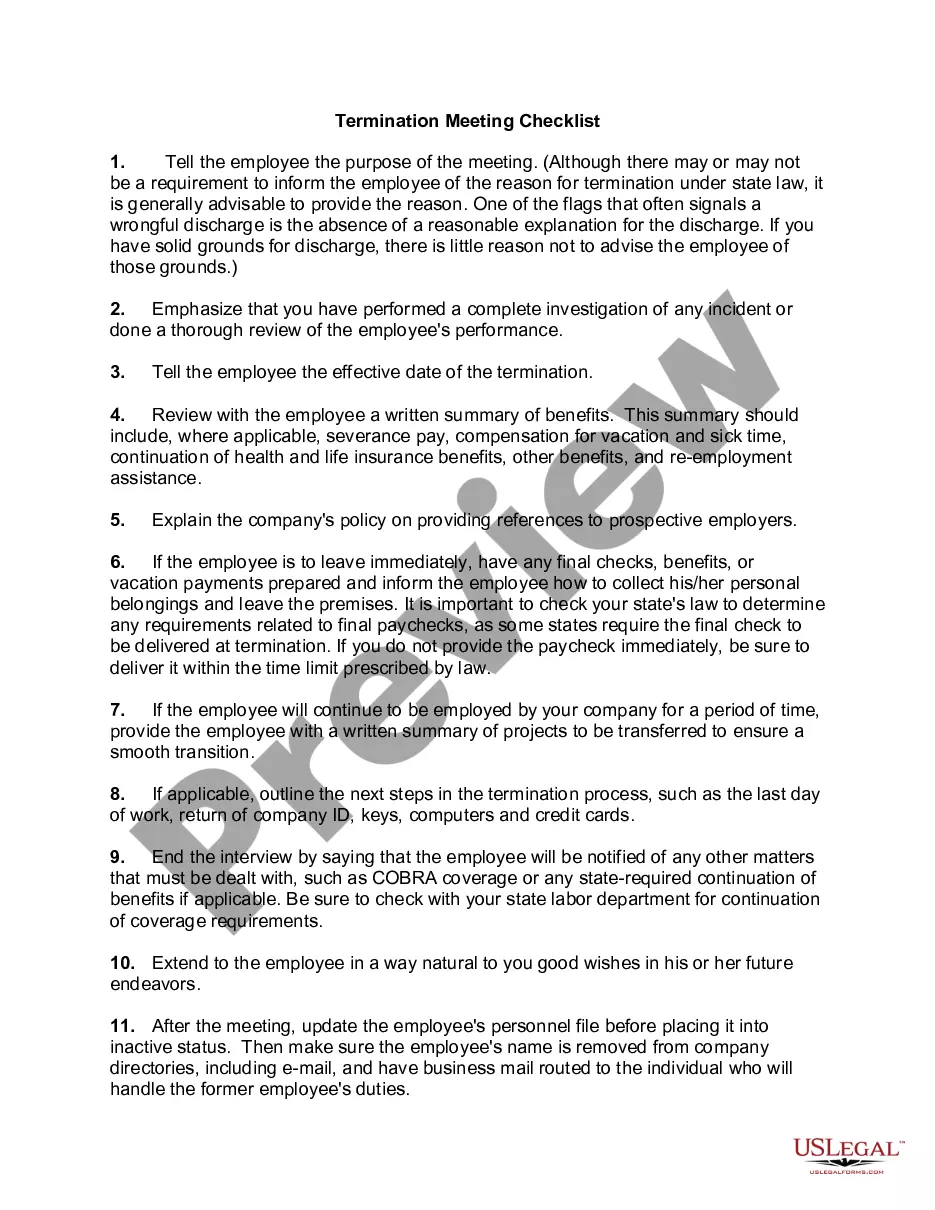
How to fill out Checklist - When Should You Fire An Employee?
Finding a reliable source for the latest and pertinent legal templates is half the battle when managing bureaucracy.
Selecting the appropriate legal documents requires carefulness and meticulous attention, which is why it is crucial to obtain samples of Should You Fire Employee For Poor Performance solely from trusted providers, such as US Legal Forms.
Eliminate the stress that comes with your legal documentation. Browse through the comprehensive US Legal Forms catalog where you can discover legal templates, verify their relevance to your situation, and download them instantly.
- Utilize the catalog browsing or search tool to find your template.
- Check the document's details to confirm it meets the needs of your state and county.
- View the form preview, if provided, to ensure it is the document you require.
- Return to the search and seek the correct form if the Should You Fire Employee For Poor Performance does not fulfill your needs.
- If you are confident about the document's relevance, download it.
- If you are a registered user, click Log in to verify and access your selected forms in My documents.
- If you have not created an account yet, click Buy now to acquire the template.
- Select the pricing option that fits your requirements.
- Proceed to registration to complete your purchase.
- Conclude your purchase by choosing a payment method (credit card or PayPal).
- Select the document format for downloading Should You Fire Employee For Poor Performance.
- Once you have the form saved on your device, you can modify it using the editor or print it out and fill it in manually.
Form popularity
FAQ
Yes, you can fire someone based on poor performance, but it's essential to have documented evidence of their shortcomings. Employers should communicate performance expectations clearly and provide feedback during performance reviews. If an employee fails to meet those expectations consistently, termination may be warranted. Utilizing resources like the uslegalforms platform can guide you through the necessary steps to ensure compliance and clarity when deciding if you should fire an employee for poor performance.
To terminate someone due to poor performance, first document specific instances of inadequate work. It's crucial to communicate these issues directly with the employee, providing them an opportunity to improve. If performance does not improve after clear feedback and support, you can proceed with termination. Ensuring you have followed a fair process can help you determine if you should fire an employee for poor performance.
The 33% rule under the Worker Adjustment and Retraining Notification (WARN) Act pertains to mass layoffs and plant closings. Essentially, if an employer lays off one-third of the workforce at a single site, the WARN Act requires them to provide a 60-day notice. This rule aims to protect employees from sudden job loss by ensuring they receive adequate warning. Understanding this rule can help you assess your obligations when considering whether you should fire an employee for poor performance.
Five fair reasons for dismissal include repeated poor performance, misconduct, redundancy, inability to perform job duties due to illness, and a breach of contract. Each reason must be well documented and communicated to the employee. If you are contemplating whether you should fire an employee for poor performance, ensuring that your reasons align with legal standards and company policy is essential. Utilizing resources like US Legal Forms can provide you with the necessary documentation to support your decisions.
Rule 44 in employment law pertains to the guidelines surrounding arbitration and mediation in disputes. It emphasizes the importance of resolving conflicts outside of the courtroom, which can benefit both employers and employees. Understanding this rule can help you navigate situations where you might need to consider whether you should fire an employee for poor performance while maintaining a focus on resolution. Familiarizing yourself with such regulations can also enhance your decision-making process.
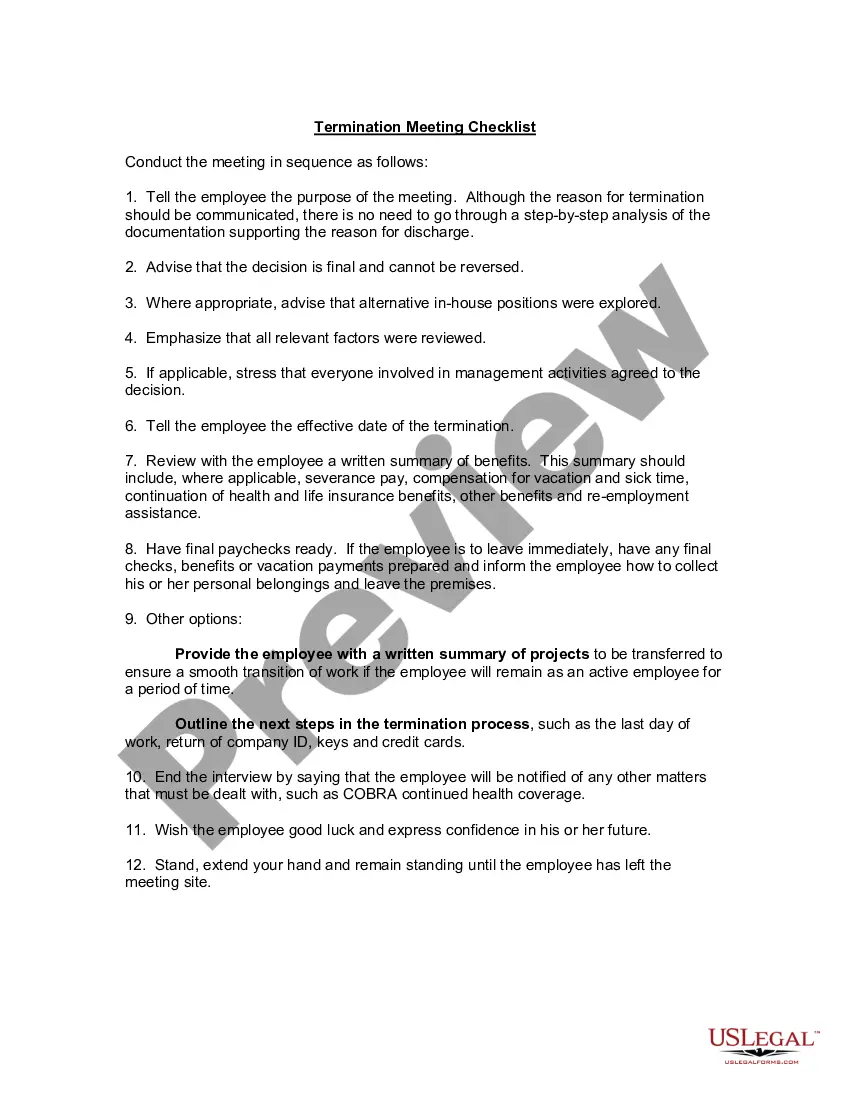
When you decide to terminate an employee due to poor performance, you should first review their performance history. Conduct performance evaluations, and offer opportunities for improvement. If there is no progress, prepare a termination letter outlining the reasons for dismissal. This approach not only clarifies your decision but also supports your stance if you need to justify why you should fire an employee for poor performance.
To effectively terminate an employee for poor performance, first document their performance issues clearly. Schedule a meeting to discuss these issues directly with the employee, allowing them to share their perspective. If the performance does not improve after providing feedback and support, you can proceed with the termination while ensuring compliance with legal requirements. Remember, when considering whether you should fire an employee for poor performance, having a clear process in place protects both you and the employee.
Dismissing an employee for poor performance requires a structured approach. First, provide the employee with feedback and opportunities for improvement, keeping records of these discussions. If performance does not improve, schedule a final meeting to discuss the decision, ensuring you communicate clearly and compassionately. Utilizing platforms like US Legal Forms can guide you through the documentation process, making it easier to handle the legal aspects of termination.
When you need to address termination due to poor performance, clarity is key. Start by documenting specific examples of the employee's performance issues, ensuring they understand the reasons behind your decision. Use factual information to support your explanation, and emphasize that this action is a necessary step for the overall health of the team and organization. Remember, being transparent helps maintain professionalism and respect.