Deceased Decedent Estate Without Will
Description
Get your form ready online
Our built-in tools help you complete, sign, share, and store your documents in one place.
Make edits, fill in missing information, and update formatting in US Legal Forms—just like you would in MS Word.
Download a copy, print it, send it by email, or mail it via USPS—whatever works best for your next step.
Sign and collect signatures with our SignNow integration. Send to multiple recipients, set reminders, and more. Go Premium to unlock E-Sign.
If this form requires notarization, complete it online through a secure video call—no need to meet a notary in person or wait for an appointment.
We protect your documents and personal data by following strict security and privacy standards.

Make edits, fill in missing information, and update formatting in US Legal Forms—just like you would in MS Word.

Download a copy, print it, send it by email, or mail it via USPS—whatever works best for your next step.

Sign and collect signatures with our SignNow integration. Send to multiple recipients, set reminders, and more. Go Premium to unlock E-Sign.

If this form requires notarization, complete it online through a secure video call—no need to meet a notary in person or wait for an appointment.

We protect your documents and personal data by following strict security and privacy standards.
Looking for another form?


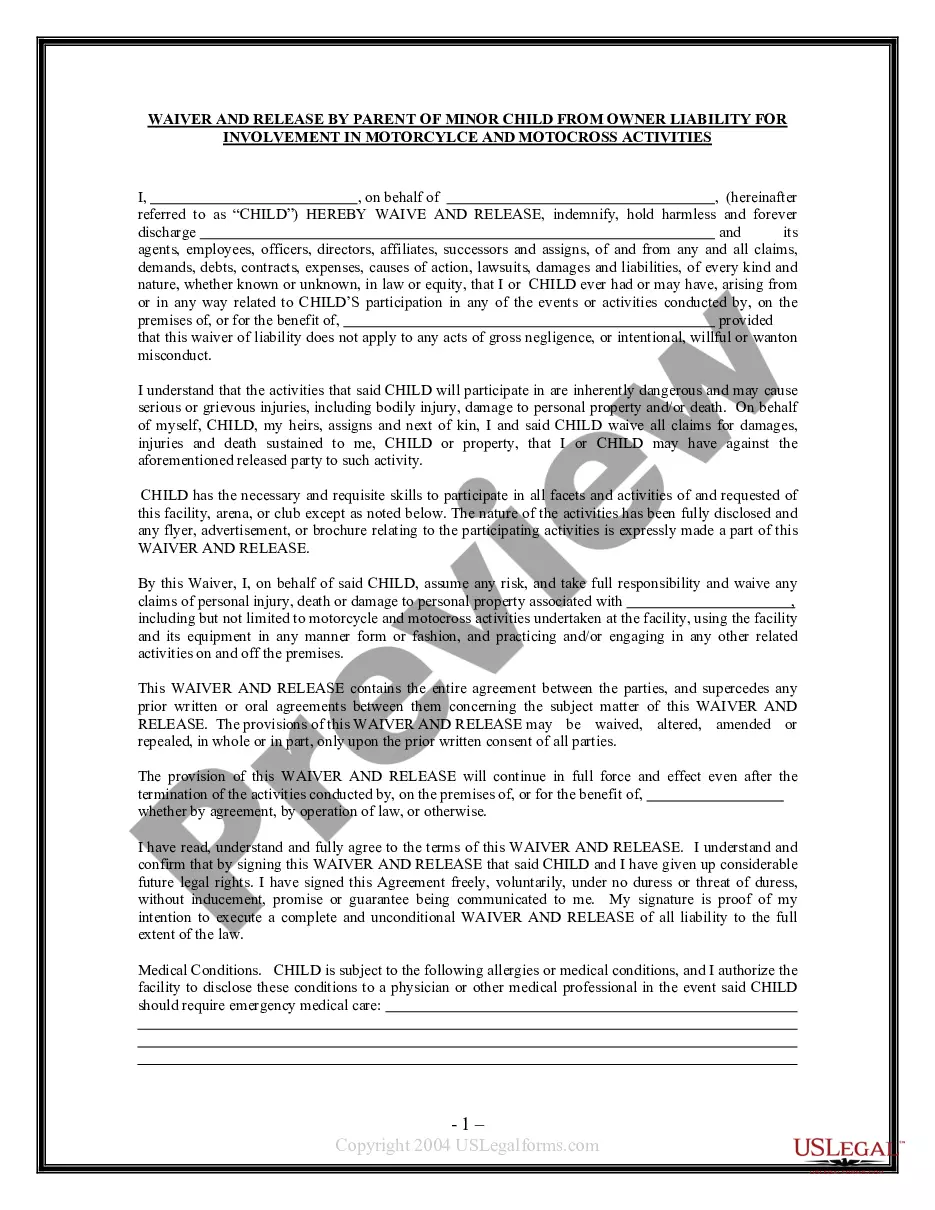

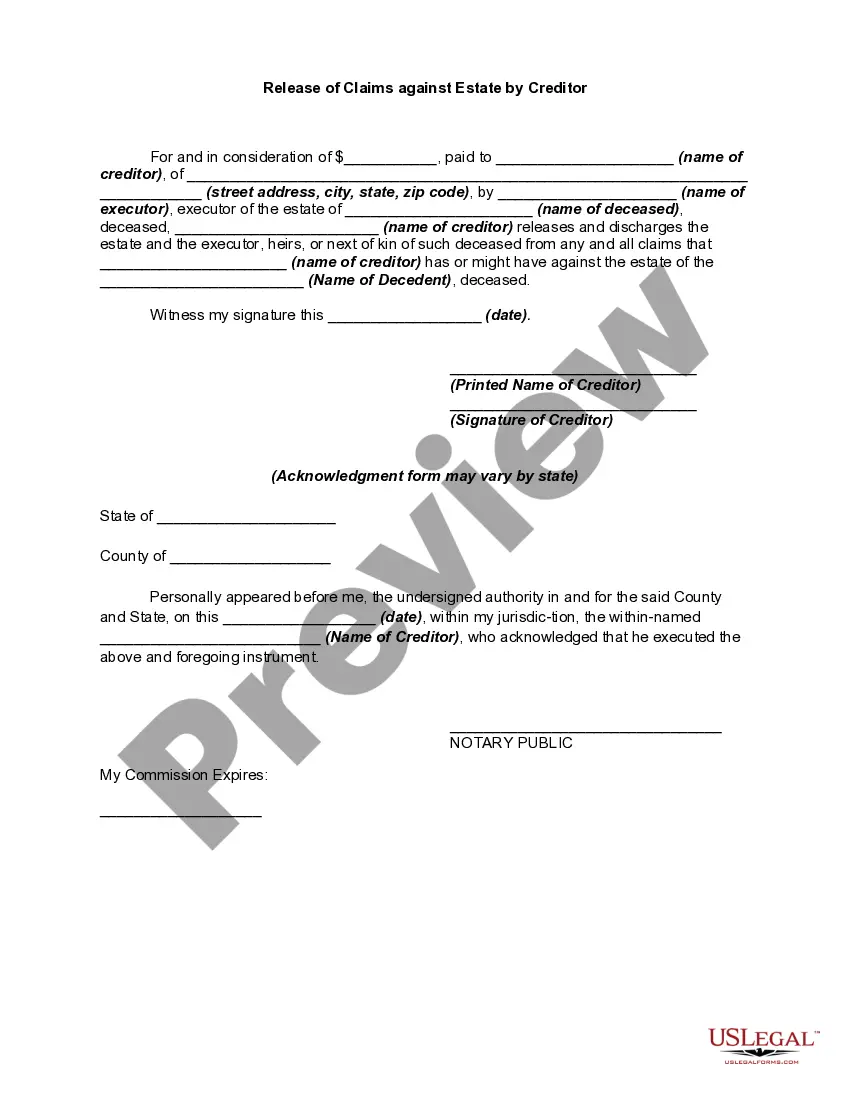
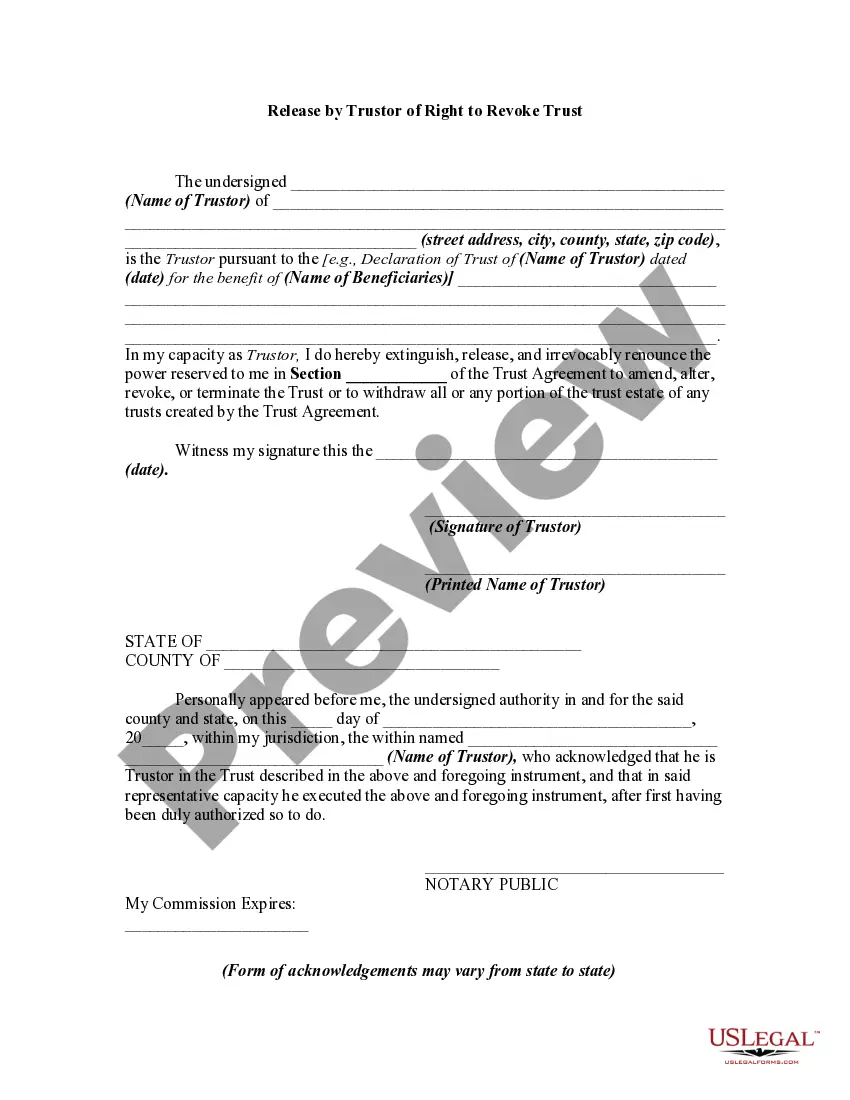
How to fill out Release Of Claims Against Estate By Creditor?
Identifying a reliable source for obtaining the latest and most applicable legal templates is a significant part of dealing with bureaucratic processes. Finding the appropriate legal documents requires care and meticulousness, which is why it is crucial to obtain samples of Deceased Decedent Estate Without Will exclusively from trustworthy providers, such as US Legal Forms. An incorrect template can squander your time and prolong your current situation. With US Legal Forms, you have minimal worries. You can access and review all the specifics regarding the document’s applicability and significance for your circumstances and in your jurisdiction.
Follow these steps to finalize your Deceased Decedent Estate Without Will.
Eliminate the inconvenience associated with your legal documentation. Explore the extensive US Legal Forms catalog to discover legal templates, assess their relevance to your situation, and download them instantly.
- Utilize the catalog navigation or search bar to find your template.
- Examine the form’s details to verify if it complies with the regulations of your state and locality.
- Preview the form, if an option is available, to confirm that it is the one you need.
- Return to the search and locate a suitable template if the Deceased Decedent Estate Without Will does not meet your requirements.
- Once you are certain about the form’s applicability, download it.
- If you are a registered user, click Log in to verify your identity and access your selected templates in My documents.
- If you have not created an account yet, click Buy now to acquire the template.
- Choose the payment plan that suits your needs.
- Proceed to the registration to finalize your order.
- Complete your purchase by selecting a payment method (credit card or PayPal).
- Choose the document format for downloading Deceased Decedent Estate Without Will.
- After you have the form on your device, you can edit it using the editor or print it out and fill it in by hand.
Form popularity
FAQ
When a deceased does not have a will, the estate will go through intestacy laws applicable in the state. This means that the distribution of assets will follow a predetermined order based on familial relationships. The process can be complex and may require legal assistance to ensure compliance with state regulations. Platforms like US Legal Forms can provide helpful resources for managing these situations.
If an estate is left without a will, the inheritance follows state intestacy laws, which outline who inherits a deceased decedent estate without will. Typically, the spouse and children are the first in line, followed by parents, siblings, and other relatives if no immediate family is present. Understanding these laws can help heirs navigate their rights effectively.
The distribution of a deceased decedent estate without will is managed by intestacy laws, which vary by state. Generally, the estate is divided among the closest relatives, starting with the spouse and children. If no immediate family exists, the estate may go to grandparents, siblings, or further relatives. Seeking legal advice can clarify your specific situation.
When there is no will, the default beneficiary for a deceased decedent estate without will is determined by state intestacy laws. Usually, the surviving spouse and children are first in line to inherit. If no spouse or children exist, more distant relatives may be considered. It is essential to understand your state's laws for accurate distribution.
In Alabama, it is possible to settle a deceased decedent estate without will through a simplified process under certain conditions. If the estate's value is below a specific threshold, heirs may use a small estate affidavit to claim assets. This method can save time and reduce the costs associated with probate. Consider using resources like US Legal Forms to ensure proper documentation.
In Massachusetts, when someone passes away without a will, the deceased decedent estate without will goes through intestacy laws. These laws determine how the estate is distributed among surviving relatives. Typically, the spouse and children have priority, but distant relatives may inherit if no immediate family exists. It is wise to consult an expert to navigate this process.
It is best to think of the decedent's belongings, paperwork, and assets as ?frozen in time? on the date of death. No assets or belongings should be removed from their residence. Their vehicle(s) should not be driven. Nothing should be moved great distances, modified, or taken away.
Here are the first things you should do when someone dies. Get a legal death pronouncement. ... Find out if the deceased made after-death plans. ... Make arrangements for the body. ... Arrange care for children and pets. ... Tell loved ones. ... Tell employer. ... Find end-of-life paperwork. ... Make memorial or funeral arrangements.
If a person dies without a will they are considered intestate "without a will". Therefore that person's property and estate is distributed ing to the state that is their home state. Real property is handled ing to state law. The distribution of all property is by relationship to the deceased.
Intestacy: Dying without a will In New Hampshire in the absence of a will, a surviving spouse inherits the entire estate unless the decedent and the spouse share descendants, in which case the spouse inherits the first $250,000 of the estate plus half the balance.